Peter Murrell: The Backroom Architect Who Built Scotland’s Dominant Party — and Stole From It
For over two decades, Peter Murrell ran the SNP's engine room while his wife led the party in public. In May 2026, he pleaded guilty to embezzling more than £400,000 — ending a political story that had defined modern Scotland.

*Disclaimer: We may earn a commission if you make a purchase through our affiliate links, at no extra cost to you.
⚡ Quick Facts — Peter Murrell
Full Name
Peter Tierney Murrell
Date of Birth
8 December 1964
Age (2026)
61 years old
Birthplace
Edinburgh, Scotland
Education
University of Glasgow
Former Role
SNP Chief Executive (1999–2023)
Former Spouse
Nicola Sturgeon (m. 2010, sep. 2025)
Legal Status (2026)
Remanded; sentencing 23 June 2026
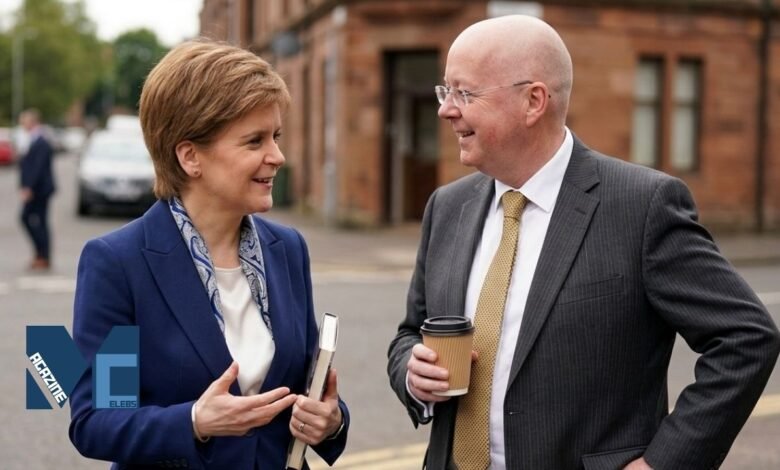
For most of his career, Peter Murrell preferred the shadows. While Nicola Sturgeon commanded parliamentary chambers and television studios, Murrell operated in the background — overseeing staff rosters, managing election logistics, and keeping the Scottish National Party’s vast organisational machinery running. To many Scots, he was simply the First Minister’s husband. To those who worked inside the SNP, he was something considerably more formidable: the man who, for more than two decades, had more practical control over the party’s day-to-day existence than almost anyone else.
That anonymity ended definitively on 25 May 2026, when Murrell stood in the dock at the High Court in Edinburgh and pleaded guilty to embezzling £400,310.65 from the party he had served — and secretly plundered — over a twelve-year period. The purchases detailed in the prosecution’s 119-page indictment were striking in their variety and banality: a £124,550 motorhome, a Jaguar I-Pace, items from Harrods and Estée Lauder, Kindles, gardening equipment, even telescopes. Presiding judge Lord Young described it as a “gross breach of trust.” Murrell was remanded in custody that same afternoon.
The story of Peter Murrell is, in many respects, the story of modern Scottish nationalism itself — its meteoric rise, its organisational sophistication, and the structural weaknesses that lay concealed beneath decades of electoral dominance. Understanding who he is, and how he arrived at this moment, requires going back to Edinburgh in 1964.
Early Life & Upbringing
Peter Tierney Murrell was born on 8 December 1964 in Edinburgh, Scotland. He grew up in the city’s western suburbs, attending Craigmount High School — a large comprehensive in the Corstorphine area of the capital. Public records and verified biographical sources confirm these basic facts, though Murrell has always been exceptionally guarded about his private life, and detailed accounts of his childhood and family environment are not in the public domain.
After Craigmount, he went on to study at the University of Glasgow, placing him in the same broad milieu as many of the generation of Scottish political figures who would come to define devolution-era politics. His specific degree and academic record have not been publicly disclosed. What is known is that, unlike Nicola Sturgeon — who read law at Strathclyde University and pursued a solicitor’s training — Murrell moved toward political and administrative work relatively early, without the legal or parliamentary route that many of his contemporaries took.
Before entering SNP politics full-time, Murrell spent approximately four years working as a public relations officer for the Church of Scotland. It is a detail that has often been overlooked in coverage of his later career, but it speaks to an early aptitude for communications, institutional management, and the particular art of projecting an organisation’s public image while keeping its internal workings largely invisible. Those skills would later define his entire tenure at the top of the SNP.
Parents, Siblings & Family Background
Murrell has maintained a notably high degree of privacy regarding his family of origin. No verified public source has named his parents or disclosed details about their professions, backgrounds, or circumstances. Similarly, whether he has any siblings has not been publicly confirmed. During the Operation Branchform investigation, officers did attend the Fife home of Murrell’s elderly mother — a detail reported by multiple news outlets at the time of his first arrest in April 2023, confirming only that his mother was alive and living in Fife at that point. Beyond this, his family background remains a matter he has not chosen to share publicly, and this article does not speculate further.
What the public record does confirm is that Murrell’s formative political experiences were shaped by Edinburgh and then Glasgow, and that his immersion in SNP structures began in earnest in the late 1980s. He joined the party in 1989 and was elected as Membership Convener for the Peterhead branch — an early indication of his preference for organisational roles over public-facing ones.
Full Biography & Career Timeline
Murrell’s rise within the SNP was steady rather than spectacular. He was not an elected politician, nor did he ever seek to be. His gift was organisational — the kind of unglamorous competence that keeps phone banks staffed, membership databases current, and election machines running when they need to run. He joined the staff of Alex Salmond’s Banff and Buchan constituency office, where he crossed paths with a young Nicola Sturgeon who arrived to volunteer in the summer of 1988. By 1992 he was serving as election agent for candidates in two local wards. In 1993 he was appointed secretary for the Banff and Buchan branches of Citizens Advice, and by 1994 he was working as a research assistant for Salmond in the general election campaign.
1988
Murrell meets Nicola Sturgeon at an SNP youth event he was organising, while she volunteers at Alex Salmond’s Banff and Buchan office. Their relationship would remain private for another fifteen years.
1999
Murrell is appointed SNP Chief Executive, succeeding Michael Russell. The year coincides with the establishment of the Scottish Parliament following devolution — a new chapter for Scottish politics and for Murrell’s role within it.
2003
Murrell and Sturgeon’s relationship becomes public knowledge for the first time, despite the couple having known each other for over a decade. Their professional overlap — she as a rising MSP, he as party chief executive — attracts comment but not yet controversy.
2007
The SNP wins the Scottish Parliament election for the first time, forming a minority government. The party’s organisational proficiency — widely attributed to Murrell’s stewardship — is credited as a decisive factor in the historic result.
2010
Murrell and Sturgeon marry in a civil ceremony at Òran Mór in Glasgow’s West End. Alex Salmond, then First Minister, attends. According to public reports, the couple do not have children.
2014
Scotland’s independence referendum ends in a No vote, but SNP membership surges dramatically — eventually reaching a peak of around 125,000 by 2018. Murrell oversees the party’s administrative expansion during this period. Sturgeon succeeds Salmond as First Minister.
2020
Murrell appears before the Holyrood Inquiry into the Scottish Government’s handling of harassment complaints against former First Minister Alex Salmond. He denies plotting against Salmond, but opposition MSPs contend he contradicted himself and Sturgeon on key points of evidence.
July 2021
Police Scotland formally launches Operation Branchform, an inquiry into the SNP’s finances and the alleged misappropriation of over £600,000 in donations raised for a second independence referendum campaign.
March 2023
Nicola Sturgeon resigns as First Minister on 15 February. Murrell resigns as SNP Chief Executive on 18 March, accepting responsibility for misleading the media over party membership figures. He had been facing a vote of no confidence from his own National Executive Committee.
April 2023
Murrell is arrested at his Glasgow home as part of Operation Branchform. Officers erect a large evidence tent in the garden and search the property for two days. A luxury motorhome is removed from outside the Fife home of his elderly mother. He is released without charge pending further investigation.
April 2024
Murrell is formally charged with embezzlement following a second arrest. He resigns his SNP membership. Former First Minister Humza Yousaf describes the development as “very serious and very shocking.” A report is submitted to the Crown Office.
25 May 2026
Murrell pleads guilty at the High Court in Edinburgh to embezzling £400,310.65 from the SNP between August 2010 and October 2022. He is remanded in custody. Sentencing is scheduled for 23 June 2026. Lord Young describes the conduct as a “gross breach of trust.”
💜 A Human Perspective
Whatever judgements history eventually settles on, it is worth acknowledging that Peter Murrell spent decades in a role that was, by its nature, relentlessly pressured and almost entirely thankless. Running a major political party from the inside — managing staff, finances, election logistics, internal disputes, and the accumulated expectations of hundreds of thousands of members — is a particular kind of grinding labour, conducted largely without public recognition. That this pressure does not excuse what he admitted in court on 25 May 2026 goes without saying. But the human dimension of his fall — a man who built something real, over decades, and then secretly drained it — remains complex in ways that straightforward condemnation does not fully account for.
Marriage to Nicola Sturgeon
The relationship between Peter Murrell and Nicola Sturgeon is one of the stranger and more consequential partnerships in modern British political life. They met in 1988 — he was organising an SNP youth camp, she arrived to volunteer — and they worked alongside each other for fifteen years before their relationship was publicly acknowledged in 2003. By then, Sturgeon had already been elected to the Scottish Parliament (1999) and was establishing herself as one of the SNP’s most forceful voices. Murrell, meanwhile, was running the party’s central operations.
They married in July 2010 at Òran Mór, a converted church and arts venue in Glasgow’s West End. It was, by most accounts, an intimate occasion. Salmond — then serving as First Minister — was among the guests. The couple do not have children; both have spoken publicly about their personal decision not to have a family, though neither has gone into detail about the circumstances around that choice. Sturgeon has, in separate contexts, spoken about having suffered a miscarriage, though she has not connected this publicly to any broader narrative about their marriage.
For years, the overlap between their professional roles attracted sporadic criticism. When Sturgeon became First Minister in 2014, the arrangement — in which Scotland’s head of government was married to the chief executive of the governing party — struck some observers as structurally problematic, regardless of the individuals involved. Several SNP leadership candidates in 2023, including Ash Regan, cited the arrangement as a “clear conflict of interest.” In January 2025, Nicola Sturgeon announced that she and Murrell had “decided to end” their marriage. She was subsequently cleared of any wrongdoing by prosecutors in relation to Operation Branchform.
Sturgeon’s statement following Murrell’s guilty plea was carefully worded. She said she had “no knowledge or suspicion” of his misuse of SNP funds. Prosecutors have confirmed she faces no charges.
British politics has seen its share of complicated spousal dynamics at the top of party structures — and if you’re interested in how public figures navigate the pressures of political life, the profile of Jonathan Powell, one of the most influential political figures operating behind the scenes during the Blair years, offers an instructive parallel.
Public Image & Political Standing
Throughout the peak years of his influence, Murrell cultivated near-total invisibility. He gave almost no interviews, made no public speeches, and appeared at public events only in the capacity of Sturgeon’s spouse rather than in his own professional right. Within the SNP, however, his influence was described by insiders as pervasive. He controlled staffing, managed organisational resources, and was seen as a decisive voice in campaign strategy.
The 2007 Holyrood election, which delivered the SNP’s first-ever government, is frequently cited as the moment that cemented his reputation. The party had lost the 2003 election badly, shedding seats and struggling for direction. Murrell’s reorganisation of the SNP’s campaign infrastructure in the years that followed — professionalising data management, tightening message discipline, modernising membership administration — was credited by many party figures as essential to the 2007 breakthrough.
The scrutiny that arrived after 2014 was of a different order. As the SNP became not just the governing party of Scotland but arguably the dominant political force in the country, questions about accountability and governance intensified. The Salmond affair, which consumed Scottish politics between 2018 and 2021, cast Murrell in a particularly uncomfortable light. His appearance before the Holyrood Inquiry in 2020 — during which he denied plotting against his party’s former leader — was widely assessed as evasive and, in certain details, inconsistent with other testimony. His personal texts to a senior SNP official, which later emerged in the inquiry process, appeared to show him encouraging pressure on the police investigation into Salmond. Murrell denied the interpretation placed on those messages.
By the time he resigned in March 2023, the combination of the Salmond affair fallout, the membership numbers controversy, and the mounting Operation Branchform investigation had fundamentally altered his position within the party he had built.
Financial Overview & The Embezzlement Case
Murrell’s personal salary as SNP Chief Executive was never publicly disclosed in full. The SNP, as a registered political party, is not required to publish individual pay details. Verified financial data regarding his personal net worth, property holdings, or savings has not been publicly disclosed, and this article does not speculate on figures that have not been confirmed through official proceedings or verifiable public records.
What the court record does confirm, with considerable specificity, is the scale of what he took. Between August 2010 and October 2022 — a period that spans from the year he married Nicola Sturgeon to less than a year before her resignation — Murrell admitted to embezzling £400,310.65 from the SNP. The prosecution’s indictment ran to 119 pages. Items purchased using party funds included a £124,550 motorhome, a Jaguar I-Pace valued at approximately £81,000 (with £57,500 drawn from SNP accounts), a Volkswagen Golf, items from luxury retailers including Harrods and Estée Lauder, jewellery, cosmetics, Kindles, gardening equipment, and telescopes. In some instances, he is alleged to have submitted false invoices, used party credit cards taken out in the names of staff who worked under him, and falsified the party’s accounts.
Police Scotland’s Assistant Chief Constable Stuart Houston described the operation as “a lengthy and extremely complex case due to the scale of criminality over a 12-year period and the lengths Peter Murrell went to try and cover his tracks.” The investigation, Operation Branchform, reportedly cost almost £2.7 million in public funds and involved inquiries across Europe. In his guilty plea, Murrell agreed to a reduced charge: approximately £60,000 was removed from the original indictment of over £459,000 as part of the plea arrangement with prosecutors.
📊 Confirmed Embezzlement Items — Guilty Plea (May 2026)
Note: Figures are drawn from the guilty plea and prosecution indictment as reported by BBC News, ITV, Al Jazeera, and The Irish Times. Net worth data has not been publicly disclosed.
Former SNP leader John Swinney, now serving as First Minister, called the admission “a terrible breach of trust and an overwhelming betrayal.” He was not alone. The Operation Branchform investigation had begun as an inquiry into whether independence referendum donations had been improperly diverted. What the guilty plea revealed was something considerably more personal: a man systematically funding his own lifestyle with money donated by party members who believed they were contributing to a political cause. For the SNP’s standing across Scotland, the reputational consequences are likely to be enduring.
“The Peter Murrell case is not simply a story about financial crime. It is a case study in what happens when institutional trust, personal access, and unchecked authority converge in a single individual, inside a closed organisational culture.”
— AB Rehman, Biography Research Writer
🔎 Operation Branchform — Key Facts
Investigation Launched
July 2021
Admitted Sum
£400,310.65
Offending Period
August 2010 – October 2022
Sentencing Date
23 June 2026
Where Is Peter Murrell Now? (2026 Status)
As of the date of publication — 31 May 2026 — Peter Murrell is remanded in custody in Scotland, following his guilty plea at the High Court in Edinburgh on 25 May 2026. His sentencing hearing is scheduled for 23 June 2026 before Lord Young. His defence team sought bail at the preliminary hearing, arguing he posed no flight risk and had cooperated with the investigation over multiple years. The application was rejected.
Legal analysts commenting on the case have suggested that a custodial sentence of between three and six years would not be out of keeping with the severity and duration of the offending, though sentencing in Scots law is a matter of judicial discretion. Any sentence imposed will be reduced to reflect time already spent on remand. The maximum penalty for embezzlement under Scots law is life imprisonment, though sentences at that level are vanishingly rare for offences of this category.
Former SNP treasurer Colin Beattie, who had also been arrested as part of Operation Branchform, had his case dropped as part of the proceedings. Nicola Sturgeon — who was herself arrested and questioned in June 2023 — was confirmed by prosecutors as facing no charges. She issued a statement following the guilty plea saying she had “no knowledge or suspicion” of Murrell’s conduct.
The SNP, under current First Minister John Swinney, is attempting to move forward from what has been described as the most damaging episode in the party’s modern history. Membership, already in decline from its 2018 peak, faces further questions. The costs of Operation Branchform — approaching £2.7 million in public expenditure — and the reputational toll on the independence movement are likely to take years to fully assess.
For anyone following the broader landscape of Scottish public life and the figures who shape it, the profile of Anne Hogarth — another figure who has worked at the intersection of public institutions and behind-the-scenes influence in the UK — provides a different but useful frame of reference.
❓ Frequently Asked Questions — Peter Murrell
How old is Peter Murrell?
Peter Murrell was born on 8 December 1964 and is 61 years old as of 2026.
Is Peter Murrell still married to Nicola Sturgeon?
No. In January 2025, Nicola Sturgeon publicly announced that she and Peter Murrell had decided to end their marriage. They had been married in July 2010. Their separation preceded Murrell’s guilty plea by approximately sixteen months.
What did Peter Murrell plead guilty to?
On 25 May 2026, Peter Murrell pleaded guilty at the High Court in Edinburgh to embezzling £400,310.65 from the Scottish National Party between August 2010 and October 2022. He used the funds to purchase personal items including a motorhome, luxury goods, two vehicles, and various consumer goods.
Where did Peter Murrell go to school and university?
Murrell attended Craigmount High School in Edinburgh before going on to study at the University of Glasgow. His specific degree has not been publicly disclosed.
Do Peter Murrell and Nicola Sturgeon have children?
Peter Murrell and Nicola Sturgeon do not have children. Both have made references publicly to this aspect of their personal lives, though neither has discussed it in extensive detail.
When is Peter Murrell being sentenced?
Sentencing is scheduled for 23 June 2026 at the High Court in Edinburgh. Murrell has been remanded in custody following his guilty plea on 25 May 2026.
What is Peter Murrell’s net worth?
Verified financial data regarding Peter Murrell’s personal net worth has not been publicly disclosed. His SNP salary was never officially published. Estimates circulating on certain websites are not based on verified sources and should be treated with scepticism.
Final Assessment
Peter Murrell spent over two decades building one of the most electorally successful political parties in British history. He did it largely without credit, without public profile, and — it now emerges — without financial restraint over the funds entrusted to him. The 2007 Holyrood breakthrough, the membership surge of 2014, the organisational machine that made the SNP the dominant force in Scottish politics: all of this has a complicated relationship with the man who helped construct it and then, repeatedly, stole from it.
The case raises questions that go beyond Peter Murrell personally. How does an organisation of the SNP’s scale fail to detect systematic embezzlement over twelve years? What does that say about the party’s governance, its financial oversight, and the concentration of authority in a small number of individuals? These are questions that Scotland’s political class is still working through. The answers, whatever form they take, will shape the SNP’s credibility on devolution, independence, and public accountability for years to come.
What is beyond dispute is that the Peter Murrell who left the High Court in Edinburgh in handcuffs on 25 May 2026 bore little resemblance to the invisible operator who had, for so long, preferred to keep his name out of the papers. He is now, unavoidably, a central figure in one of Scotland’s most consequential political scandals — not as a bystander or an organisation man, but as the person who caused it. Sentencing is due on 23 June 2026.
For wider context on the political figures who shaped Scotland and the UK in this era, the Jonathan Powell biography traces how backroom operators navigate the boundary between institutional loyalty and personal ambition. And for readers interested in how public prominence affects those adjacent to political figures, the profile of Coleen Rooney — a very different public figure — examines that intersection of private life and public scrutiny in a comparable, if distinct, context.
📎 Sources & References
- Wikipedia — Peter Murrell (verified personal details, career timeline)
- BBC News Scotland — Who is Peter Murrell?
- ITV News — Peter Murrell admits embezzlement (May 2026)
- The Irish Times — Murrell pleads guilty, May 2026
- Al Jazeera — Ex-SNP chief pleads guilty (May 2026)
- STV News — Peter Murrell remanded in custody
- Politics.co.uk — Peter Murrell profile
- BBC News Scotland — Murrell resigns over membership row (March 2023)
AB Rehman
Biography Research Writer & Public Figure Analyst
AB Rehman specialises in long-form biographical research on public and political figures, with a focus on British and Scottish public life. This article draws solely on verified public records, court documents, and reporting from established news organisations.
📋 Editorial Disclaimer
This article is prepared for informational and biographical purposes only. All factual claims are drawn from verifiable public sources, including court records, BBC News, ITV, Al Jazeera, The Irish Times, STV, and Wikipedia. Where information could not be independently verified, this is explicitly noted in the text. This article does not constitute legal commentary or financial advice. The embezzlement case against Peter Murrell is a matter of public record following his guilty plea on 25 May 2026. Sentencing is pending as of the publication date of this article. No speculation has been introduced regarding outcomes, motives, or personal circumstances beyond what is publicly documented.