
Fed Rate Hike 2026: What It Means for Your Savings, Debt, and Investments


*Disclaimer: We may earn a commission if you make a purchase through our affiliate links, at no extra cost to you.
Introduction
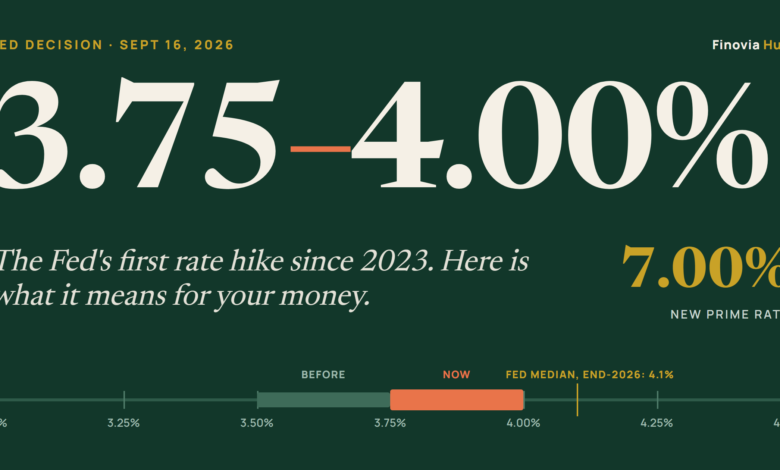
On September 16, 2026, the Federal Reserve raised interest rates for the first time since 2023. The move was small, a quarter of a percentage point, but it changes the direction of travel. For the past few years most people expected rates to drift lower. Now the Fed is pushing them the other way, and it has signalled that it may not be finished.
If you have a credit card balance, a savings account, a mortgage, a car loan, or money in the stock market, this decision touches you. Some of those effects show up on your next statement. Others take months. A few barely move at all.
This guide explains what the Fed actually did, why it did it, and what it means for your savings, your debt, and your investments. It also covers the simple moves worth making now, and the common mistakes people make when rates start rising. If you are new to money basics, start with our personal finance for beginners guide and come back here.
What Did the Fed Actually Do?
The Federal Reserve’s policy committee, the FOMC, voted 12 to 0 to raise the target range for the federal funds rate to 3.75% to 4.00%, up from 3.50% to 3.75%. You can read the full wording in the Fed’s official statement.
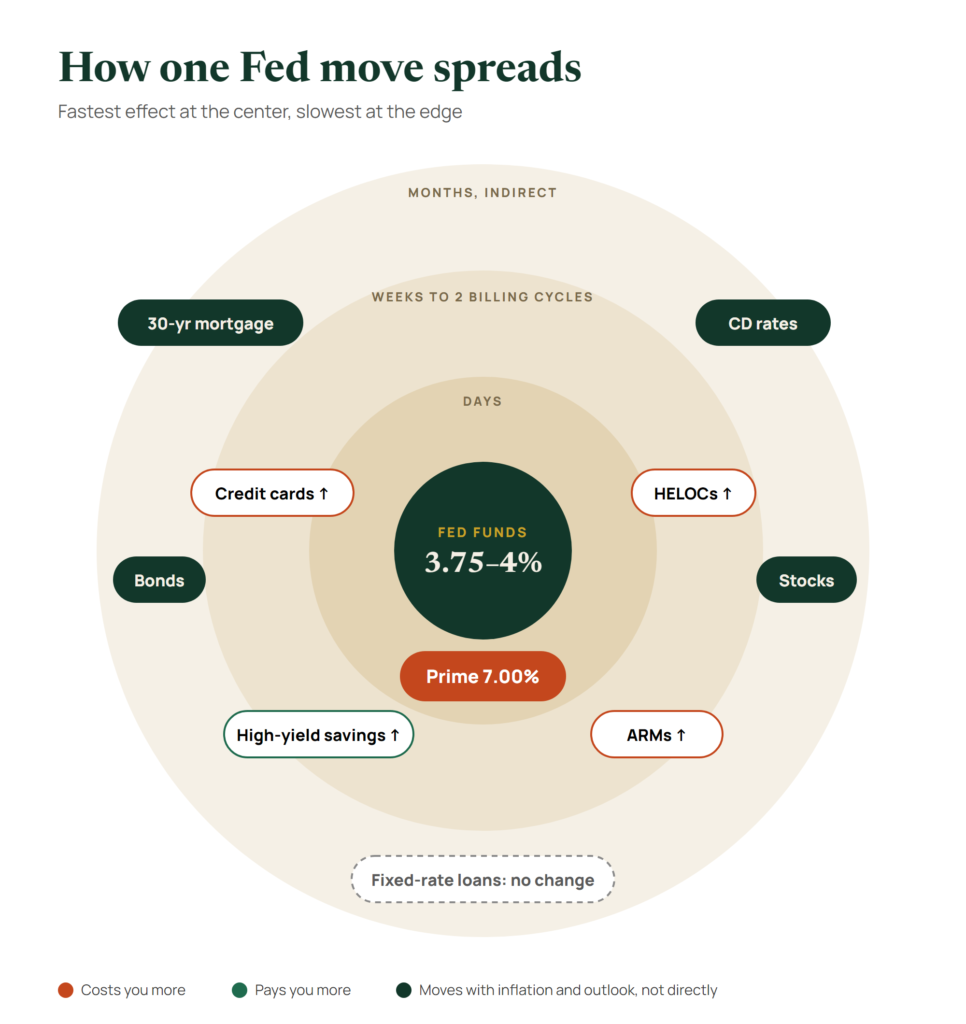
The federal funds rate is the rate banks charge each other for overnight loans. You never pay it directly. But almost every other rate in the economy is priced off it in some way, which is why a change at the Fed eventually reaches your wallet.
Three things make this decision worth paying attention to:
- It reverses the trend. This is the first hike since 2023, after a stretch where rates were held or cut.
- The vote was unanimous. No committee member disagreed, which suggests the concern about inflation is widely shared.
- More may follow. The Fed’s own September projections put the median federal funds rate at 4.1% by the end of 2026. That is above the current range, which implies at least one more quarter-point hike this year.
Why Did the Fed Raise Rates?
The short answer is inflation. The Fed’s goal is 2% inflation, and prices have been running above that for years. According to the Bureau of Labor Statistics, consumer prices rose 3.4% in the 12 months to August 2026. Energy was a big driver: gasoline prices were up 27.4% over the year.
At the same time, the economy is not weak. The Fed described activity as expanding at a solid pace, with steady job gains and stable unemployment. When growth is healthy and inflation is stuck above target, the Fed’s standard tool is to make borrowing more expensive. Higher rates cool spending on homes, cars, and other big purchases, which takes pressure off prices over time.
That is the theory. In practice, it means borrowers pay more and savers earn more, at least for a while.
What the Fed Rate Hike Means for Your Savings
Savers are the clearest winners from a rate hike. Banks pay more to attract deposits when their own borrowing costs rise. But the gains are not automatic, and they are not equal across every account.
Traditional Savings Accounts
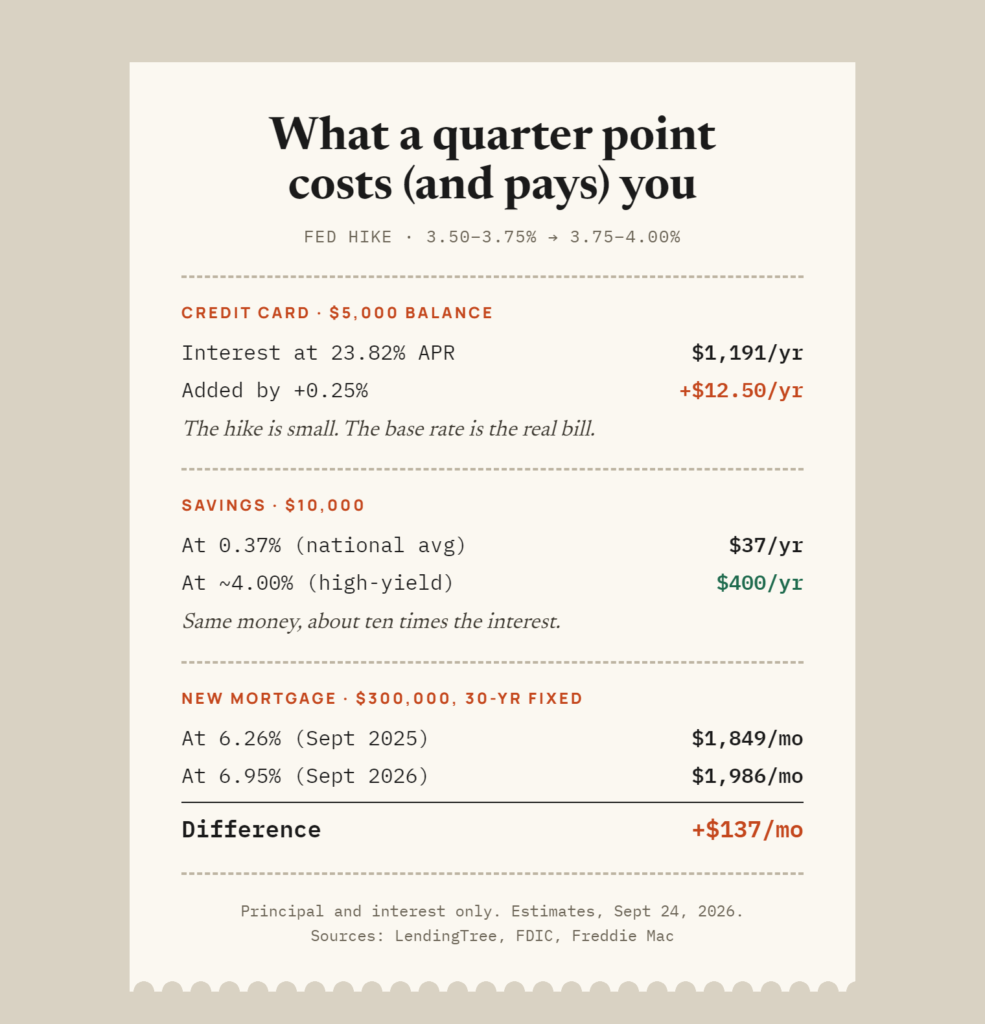
If your money sits in a savings account at a big high-street bank, you may see almost no change. The FDIC’s national average savings rate was just 0.37% as of September 21, 2026. Large banks are slow to pass rate hikes on to savers because many customers never move their money.
High-Yield Savings Accounts
Online banks compete harder. Some advertised yields above 4% in September 2026, roughly ten times the national average. On a $10,000 emergency fund, that is the difference between earning about $37 a year and about $400 a year. If you have not compared accounts recently, our guide to the best high-yield savings accounts walks through what to look for.
Certificates of Deposit (CDs)
CD rates tend to rise when the Fed signals more hikes ahead. The national average for a 12-month CD was 1.73% in the FDIC’s latest data, but competitive online CDs pay far more. If you expect rates to keep rising, shorter terms (6 to 12 months) let you roll into a better rate later instead of locking in today’s number for five years.
What the Fed Rate Hike Means for Your Debt
For borrowers, the effect depends on one question: is your rate fixed or variable?
Credit Cards
Most credit cards carry a variable rate tied to the prime rate. Banks moved quickly this time. Within a day of the Fed decision, lenders including BNY, M&T, U.S. Bank, and Huntington raised their prime rate from 6.75% to 7.00%. Your card’s APR will usually follow within one or two billing cycles.
Credit card rates were already high. LendingTree put the average new card offer at 23.82% in September 2026, and other trackers report anywhere from about 19% to 25% depending on how they measure. On a $5,000 balance, a quarter-point hike adds only about $12.50 a year. The real problem is the base rate: at 23.82%, that same balance costs roughly $1,191 a year in interest.
So the hike is a reminder, not a crisis. If you carry a balance, paying it down is still the highest guaranteed return available to you. Our step-by-step guide on how to pay off debt faster covers the avalanche and snowball methods in detail.
Mortgages
Fixed-rate mortgages do not follow the Fed directly. They track longer-term bond yields, which react to inflation expectations and the Fed’s outlook. Even so, mortgage rates have been climbing. Freddie Mac reported the 30-year fixed rate at 6.95% on September 17, 2026, up from 6.76% a week earlier and 6.26% a year before.
On a $300,000 loan, that one-year jump raises the monthly principal and interest payment from about $1,849 to about $1,986, an extra $137 a month.
- If you already have a fixed-rate mortgage: nothing changes. Your rate is locked.
- If you have an adjustable-rate mortgage (ARM): check when your rate next resets. It may move up.
- If you are buying soon: get pre-approved and ask lenders about rate locks, since rates have been moving week to week.
Home Equity Lines of Credit (HELOCs)
HELOCs are usually priced at prime plus a margin, so they move almost immediately. If you have a balance on one, expect your rate to rise by about a quarter point on your next statement.
Auto Loans and Personal Loans
Existing fixed-rate car loans and personal loans do not change. New loans will likely cost a little more. If you are shopping for a car, a larger down payment and a shorter loan term both reduce how much the higher rate costs you in total.
Federal Student Loans
Existing federal student loans have fixed rates, so this hike does not affect them. Private student loans with variable rates may rise.
What the Fed Rate Hike Means for Your Investments
Rate hikes often cause short-term swings in the stock market. Higher rates make borrowing more expensive for companies and make safer assets, like savings accounts and bonds, more attractive by comparison. That can pull money out of stocks for a while.
For long-term investors, a single rate hike is not a reason to change course. Markets have lived through many hiking cycles. What matters more is staying invested, keeping costs low, and staying diversified.
Stocks and Index Funds
If you invest regularly through a broad index fund, a rate-driven dip means your next contribution buys more shares at a lower price. That is how dollar-cost averaging is supposed to work. Our comparison of ETFs vs mutual funds explains the two most common ways beginners get that broad exposure.
Bonds
When rates rise, the price of existing bonds falls, because new bonds pay more. If you hold a bond fund, you may see a small loss on paper. The upside is that new money going into bonds now earns higher yields than it did a year ago.
Just Getting Started?
A rate hike does not change the basics of how to begin. You do not need a large sum, and you do not need to time the market. Our guide on how to start investing with just $100 covers the first steps.
Current Rate Snapshot
Here is where the key rates stood as of September 24, 2026. These change often, so treat them as a starting point and check current offers before making a decision.
| Rate | Latest Figure | Source |
|---|---|---|
| Federal funds target range | 3.75% to 4.00% | Federal Reserve, Sept 16, 2026 |
| Prime rate | 7.00% | Major U.S. banks, Sept 17, 2026 |
| Average new credit card APR | 23.82% | LendingTree, Sept 2026 |
| 30-year fixed mortgage | 6.95% | Freddie Mac, Sept 17, 2026 |
| 15-year fixed mortgage | 6.26% | Freddie Mac, Sept 17, 2026 |
| National average savings rate | 0.37% | FDIC, Sept 21, 2026 |
| National average 12-month CD | 1.73% | FDIC, Sept 21, 2026 |
| Inflation (CPI, 12 months to August) | 3.4% | Bureau of Labor Statistics |
Rates, yields, and offers change frequently and vary by lender and by your credit profile. The figures above are for general information only and are not financial advice.
Smart Moves to Make Now
You cannot control what the Fed does. You can control how exposed you are to it. These steps work whether rates rise again in October or hold steady.
- Move idle cash to a high-yield account. If your savings earn close to the 0.37% national average, you are leaving real money on the table.
- Attack variable-rate debt first. Credit cards and HELOCs react fastest to hikes. Focus extra payments there.
- Call your card issuer. If you have a good payment history, ask for a lower APR. It does not always work, but it costs nothing to ask.
- Consider a balance transfer. A 0% introductory offer can pause interest while you pay down the principal. Watch the transfer fee and the date the promotion ends.
- Keep CD terms short for now. If more hikes are coming, shorter terms let you reinvest at higher rates later.
- Keep investing on schedule. Automatic contributions remove the temptation to react to headlines.
- Build or top up your emergency fund. Higher borrowing costs make it more expensive to cover surprises with a credit card.
Who Is Most Affected by Rising Rates?
Not everyone feels a rate hike the same way. It helps to know which group you fall into.
- People carrying credit card balances feel it fastest, because card rates are variable and already high.
- Homebuyers face higher monthly payments on new mortgages, which can reduce how much house they can afford.
- ARM and HELOC borrowers see their rates reset upward.
- Savers with cash in high-yield accounts or CDs benefit the most.
- Retirees living on interest income generally come out ahead, as long as their cash is in accounts that actually pass through higher rates.
- Homeowners with fixed-rate mortgages are largely unaffected.
Common Mistakes to Avoid
Panic-Selling Investments
Selling stocks because of one rate decision usually locks in losses and means missing the recovery. If your goals and time horizon have not changed, your plan should not either.
Leaving Savings in a Near-Zero Account
A rate hike only helps you if your bank passes it on. Many large banks do not. Check what your savings account actually pays.
Locking Into Long CDs Too Early
A five-year CD can look attractive, but if the Fed hikes again, you could be stuck below market rates. Match the term to when you will need the money, and consider building a CD ladder.
Ignoring Variable-Rate Debt
A quarter point sounds small. But hikes tend to come in a series, and each one stacks on top of the last. Paying down variable-rate balances now protects you if rates keep climbing.
Stretching to Buy a Home Before Rates Rise Further
Rushing into a purchase you cannot comfortably afford to beat the next hike is riskier than waiting. Budget for the payment at today’s rate, not the rate you hope to refinance into later.
What Happens Next?
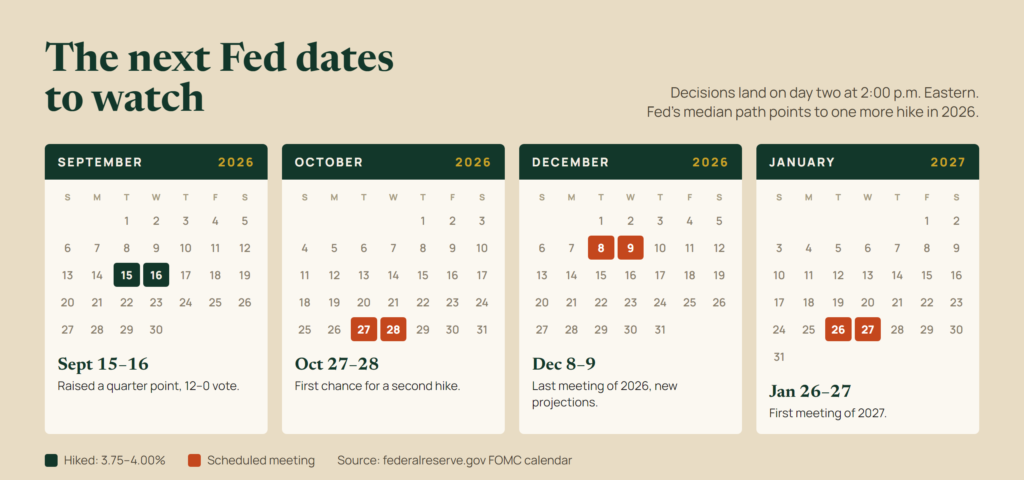
The Fed has two more scheduled meetings this year, on October 27 to 28 and December 8 to 9, 2026, according to the official FOMC calendar. The first meeting of 2027 is on January 26 to 27.
The Fed’s September projections show a median federal funds rate of 4.1% at the end of both 2026 and 2027, then gradual cuts to 3.9% in 2028 and 3.6% in 2029. Those are forecasts, not promises. If inflation cools faster than expected, the Fed may stop hiking. If it stays stubborn, the path could go higher.
The practical takeaway: plan as if borrowing will stay expensive for at least the next year, and make sure your savings are earning a rate that reflects that.
Frequently Asked Questions
Did the Fed raise interest rates in September 2026?
Yes. On September 16, 2026, the Federal Reserve raised the federal funds target range by a quarter point to 3.75% to 4.00%. It was the first increase since 2023.
Why did the Fed raise rates in 2026?
Inflation remained above the Fed’s 2% goal. Consumer prices rose 3.4% in the 12 months to August 2026, and the Fed raised rates to help bring inflation back to target sooner.
Will the Fed raise rates again in 2026?
It is possible. The Fed’s September projections show a median federal funds rate of 4.1% by the end of 2026, which is above the current range. The next meetings are October 27 to 28 and December 8 to 9, 2026.
How does a Fed rate hike affect my credit card?
Most credit cards have variable rates tied to the prime rate, which rose from 6.75% to 7.00% after the hike. Your APR will usually rise by about a quarter point within one or two billing cycles.
Does a Fed rate hike raise my existing mortgage payment?
Not if you have a fixed-rate mortgage. Your rate is locked for the life of the loan. Adjustable-rate mortgages and home equity lines of credit can rise when rates go up.
Is a Fed rate hike good for savers?
Generally, yes. Banks tend to raise yields on savings accounts and CDs after a hike. The biggest gains usually go to people with money in high-yield savings accounts, since many large banks keep their savings rates low.
What is the prime rate now?
The U.S. prime rate is 7.00%. Major banks raised it from 6.75% on September 16 and 17, 2026, following the Fed’s decision.
Should I sell my stocks when the Fed raises rates?
For most long-term investors, no. Rate hikes can cause short-term market swings, but selling in reaction often locks in losses. Staying invested and keeping regular contributions is usually the better approach.
Should I lock in a CD rate now?
If you expect more rate hikes, shorter CD terms of 6 to 12 months give you the flexibility to reinvest at a higher rate later. Longer terms make more sense if you think rates are near their peak.
Final Thoughts
The September 2026 rate hike is small on its own, but it marks a turn. After years of expecting rates to fall, borrowers and savers now need to plan for rates that stay higher, and possibly climb a little further.
The good news is that the right moves are simple. Put your cash somewhere it actually earns a competitive rate. Pay down variable-rate debt, starting with credit cards. Keep investing on schedule and ignore the headlines. Do those three things and a rate hike becomes something that works in your favor rather than against you.
If you want to put your extra savings to work beyond a bank account, our list of passive income ideas is a good next read.