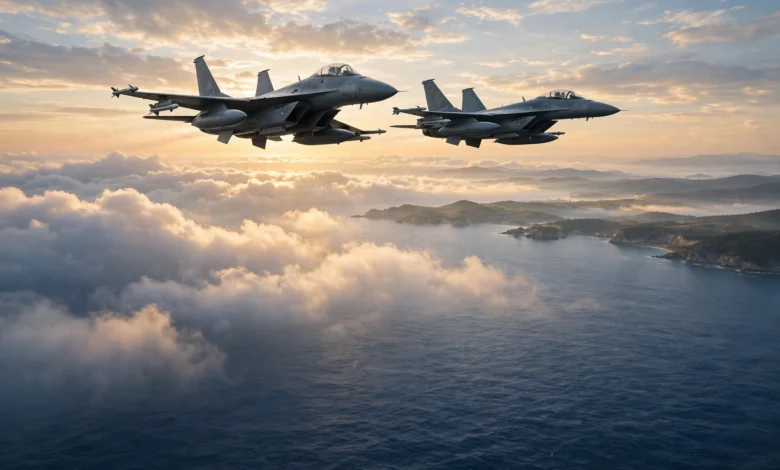

Japan scrambled fighter jets early on Tuesday 17 November 2026 after two suspected Russian aircraft entered its airspace near Okinoshima island, off Fukuoka in south-western Japan, in a rare breach that drew a stern protest from Tokyo to Moscow.
The two aircraft entered Japanese airspace shortly after 4am local time, each for around three minutes, according to Japan’s top government spokesman, Chief Cabinet Secretary Minoru Kihara. The Japan Air Self-Defense Force sent up fighters to warn the planes, which then flew on through the Tsushima Strait, between Yonaguni Island and Taiwan, and out into the Pacific.
Japan Scrambles Jets — Quick Reference Summary
| Event | Japan scrambles jets after suspected Russian planes enter its airspace |
| Date | Tuesday 17 November 2026 |
| Time of breach | Shortly after 4am local time (1900 GMT Monday 16 November) |
| Location | Near Okinoshima island, off Fukuoka, south-western Japan |
| Aircraft involved | Two suspected Russian aircraft; types not disclosed |
| Duration of each breach | Around three minutes |
| First aircraft | Entered 4:07–4:10am local time |
| Second aircraft | Entered 4:09–4:12am local time |
| Japanese response | Fighter jets scrambled; warnings issued |
| Government spokesman | Chief Cabinet Secretary Minoru Kihara |
| Protest lodged | “Very stern protest” to Moscow through diplomatic channels |
| Previous incursion | 2024, Russian patrol plane off Rebun Island, Hokkaido |
Two Aircraft, Three Minutes Each Over Okinoshima
Japan’s defence ministry said the first suspected Russian aircraft entered Japanese airspace between approximately 4:07am and 4:10am local time, while the second entered between 4:09am and 4:12am. Both incursions happened over Japanese territorial waters north-west of Okinoshima.
The Japan Air Self-Defense Force scrambled fighter aircraft from its Western Air Defense Force and issued notifications and warnings to the planes. The ministry did not disclose the aircraft types or give further details about how they were identified.
Kihara said the aircraft travelled through the Tsushima Strait before passing between Yonaguni Island and Taiwan and heading towards the Pacific Ocean. The flight path took the planes through one of the region’s busiest maritime corridors, close to territory claimed and watched by several governments.
Tokyo’s Protest and the Words It Chose
Kihara described the incident in unusually blunt language for a Japanese government spokesman. He called the flight paths a serious infringement of Japan’s sovereignty and completely unacceptable, and said Tokyo had lodged a very stern protest with Russia through diplomatic channels.
“The violation of our national airspace by Russian aircraft is not only a grave infringement of our country’s sovereignty, but also a threat to our security and is completely unacceptable,” Kihara said. He added that Japan had strongly demanded measures to prevent any recurrence.
Defence Minister Shinjiro Koizumi addressed the incident at a press conference on 17 November, describing the violations in the same terms, as a serious infringement of sovereignty and a threat to Japan’s security. Moscow had not commented on the incident at the time the reports were published.
Seoul and Taipei Respond on the Same Morning
Japan was not the only government to react on Tuesday morning. South Korea said it had deployed fighter jets and carried out tactical manoeuvres after several Russian military aircraft entered its air defence identification zone over the East Sea, also known as the Sea of Japan.
South Korea’s Joint Chiefs of Staff said an unspecified number of Russian aircraft entered and later exited the Korea Air Defence Identification Zone, known as KADIZ, in the early hours of Tuesday. Taiwan also said its military responded after two Russian military aircraft were detected in its air defence identification zone.
These zones are unofficial buffer areas beyond territorial airspace, where governments identify approaching aircraft for security purposes. Entering one is not the same as entering sovereign airspace, which is what Japan says happened over Okinoshima. The distinction matters, because only Japan reported a breach of its territorial airspace itself.
Why the Timing Matters Before the APEC Summit
The alleged incursions come days before the APEC economic summit in China this week, which Russian President Vladimir Putin is due to attend alongside United States President Donald Trump. The timing has been read as a reminder of Russia’s military reach in the region, even as its attention remains fixed on the war in Ukraine.
Relations between Tokyo and Moscow have deteriorated sharply in recent years, and the two countries still have a decades-old dispute over a chain of islands in the Pacific Ocean. Japan’s announcement framed the incident in that wider context, presenting the breach as part of a pattern rather than an isolated navigational error.
The story also lands in a week of heightened regional military activity, with South Korea and Taiwan both reporting Russian aircraft movements on the same morning. That coordination, whether deliberate or coincidental, is what turned a brief airspace breach into one of the day’s most searched news stories in the United Kingdom. The week has already brought major financial-market news, including the Deutsche Bank leak.
A Rare Breach — and the 2024 Precedent
Airspace violations of this kind are rare for Japan. The last such incursion was in 2024, when a Russian military patrol plane entered Japanese airspace off Rebun Island in Hokkaido. Japan lodged a very serious protest with Moscow after that plane entered its airspace three times, and officials described it as the first confirmed incursion since 2019.
The 2024 episode set the template for Tuesday’s response: jets scrambled, warnings issued, and a formal protest delivered through diplomatic channels. The difference this time is the scale, with two aircraft involved, and the regional picture, with South Korea and Taiwan reporting activity on the same day.
For now, the facts that are certain are narrow. Two suspected Russian aircraft entered Japanese airspace for about three minutes each, Japan sent up jets, and Tokyo protested. The aircraft types, the intent behind the flight, and Moscow’s account of events remain undisclosed, and any explanation beyond the official statements would be speculation.
What Happens Next
Tokyo has demanded measures to prevent a recurrence, but it has not said what steps it will take if another breach follows. The APEC summit later this week will put Putin and Trump in the same room, and the incident gives both leaders a fresh talking point on Russia’s posture in East Asia.
Japan’s defence ministry is expected to release further details of the flight paths if it chooses to do so, and Moscow’s response, when it comes, will show whether Russia treats the episode as a routine patrol or a deliberate signal. Until then, the incident stands as the first confirmed Russian airspace violation over Japan since 2024, and a reminder that the region’s overlapping air defence zones remain a live source of tension. The incident follows a run of disruptive news in the United States, including the US bank outage that hit online banking on Monday.
Frequently Asked Questions
Q1: What happened between Japan and Russia on 17 November 2026? A: Two suspected Russian aircraft entered Japanese airspace near Okinoshima island, off Fukuoka, shortly after 4am local time on Tuesday 17 November 2026. Japan scrambled fighter jets, issued warnings, and lodged a very stern protest with Moscow.
Q2: How long were the Russian planes in Japanese airspace? A: Each aircraft breached Japanese airspace for around three minutes, according to Japan’s defence ministry. The first entered between 4:07am and 4:10am, and the second between 4:09am and 4:12am local time.
Q3: What did Japan’s government say about the incident? A: Chief Cabinet Secretary Minoru Kihara called the flight paths a serious infringement of Japan’s sovereignty and completely unacceptable. Defence Minister Shinjiro Koizumi used the same characterisation at a press conference on 17 November.
Q4: Did South Korea and Taiwan report anything similar? A: Yes. South Korea scrambled jets after several Russian aircraft entered its air defence identification zone over the East Sea, and Taiwan said its military responded after two Russian aircraft entered its air defence identification zone, both on the same morning.
Q5: When was the last Russian airspace incursion over Japan? A: The last such incursion was in 2024, when a Russian military patrol plane entered Japanese airspace off Rebun Island in Hokkaido three times. Officials described it as the first confirmed incursion since 2019.
Checked Claims
- Claim: Two suspected Russian aircraft entered Japanese airspace on 17 November 2026. Verified — reported by Channel News Asia, TRT World and the BBC, all citing Japan’s Chief Cabinet Secretary Minoru Kihara.
- Claim: Each breach lasted around three minutes. Verified — Japan’s defence ministry gave entry times of 4:07–4:10am and 4:09–4:12am local time for the two aircraft.
- Claim: South Korea and Taiwan also responded to Russian aircraft the same morning. Verified — South Korea’s Joint Chiefs of Staff confirmed KADIZ entries, and Taiwan’s military said it responded accordingly.