
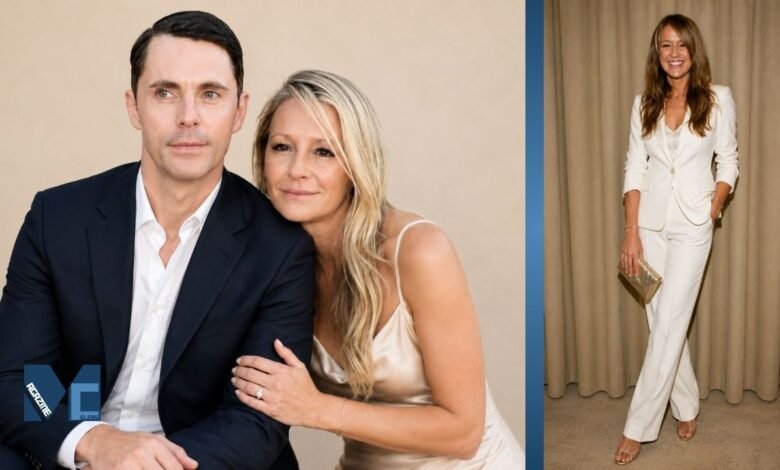
Sophie Dymoke & Matthew Goode: Inside Britain’s Most Private Celebrity Marriage
A fashion executive who shuns the spotlight, a versatile actor who puts family first — the full story of how Sophie Dymoke and Matthew Goode built a life together far from Hollywood's glare.


*Disclaimer: We may earn a commission if you make a purchase through our affiliate links, at no extra cost to you.
⚡ Quick Facts at a Glance
Sophie Dymoke — Born
Birthdate not publicly disclosed
Matthew Goode — Born
3 April 1978, Exeter, Devon
Matthew Goode — Height
6 ft 2 in (188 cm)
Married
2014 (Surrey, England)
Sophie’s Profession
Fashion Sales & Marketing Executive
Matthew’s Net Worth (Est.)
~$6 million (Celebrity Net Worth, 2024)
Known For
The Crown, Downton Abbey, The Imitation Game
Sophie Dymoke is a British fashion executive best known publicly as the wife of English actor Matthew Goode. A graduate of the University of Wales with a background in economics, she has carved out a career of her own within the high-end fashion industry, most notably in sales and marketing roles for premium denim brand MiH Jeans. She is the mother of the couple’s three children and, by all credible accounts, a genuinely private individual who has chosen to stand well clear of the celebrity circuit that surrounds her husband’s work.
Matthew Goode, born on 3 April 1978 in Exeter, Devon, is one of Britain’s most consistently respected working actors — a performer who has navigated romantic comedies, literary adaptations, superhero films, and prestige television without quite becoming a household name in the way some of his peers have. That deliberate restraint, both professionally and personally, seems fitting for a man whose relationship with Dymoke predates almost all of his most prominent screen credits. The two met in 2005, years before his roles in The Crown, Downton Abbey, and The Imitation Game would bring him sustained international visibility.
Together, they represent something relatively unusual in contemporary celebrity culture: a long partnership built before fame arrived at scale, sustained through two decades, and conducted almost entirely out of the public eye. Neither maintains a notable social media presence. Their wedding was held privately in Surrey. Their children’s lives have been kept off the internet. What follows is a careful account of what is publicly known — and what remains, by design, their own.
Early Life & Background
Sophie Dymoke was born and raised in Royal Tunbridge Wells, a prosperous market town in Kent, southeast England. It is a setting that carries a particular social character — Georgian architecture, good schools, and a quietly aspirational middle-class culture that likely shaped her sensibility. Her exact date of birth has not been publicly disclosed, and she has not provided biographical details about her upbringing in any verified public forum. What is confirmed is that she later attended the University of Wales, where she studied economics, before entering the fashion industry — a trajectory that speaks to a combination of analytical rigour and an eye for the commercial side of creative businesses.
Matthew William Goode grew up rather differently. Born in Exeter, Devon, he spent his early years in the small village of Clyst St. Mary, outside the city. His own description of the family home — a two-bedroom house with doorways so low he had to duck to pass through them — is a useful corrective to the impression his later on-screen roles might create. Goode has a natural facility for projecting upper-class ease, but his origins were grounded and ordinary. His mother Jennifer was a nurse and an amateur theatre director who ran a local dramatic society called the Campion Players. His father Anthony was a geologist. When his parents later separated, Jennifer remarried; from that earlier marriage she brought three children, making Matthew the youngest of five overall, with a brother, two half-brothers and a half-sister — the latter being former television weather presenter Sally Meen.
Parents, Siblings & Family Background
The Goode household was not a wealthy one, but it was culturally engaged. Jennifer’s involvement in amateur theatre planted early seeds, even if Goode did not immediately follow the path. His father Anthony’s geological career kept the family professionally grounded in the sciences. As Matthew has noted in interviews, the combination was an unusual one — an environment where intellectual curiosity was valued but theatrical ambition was not exactly the expected outcome.
Among his siblings, half-sister Sally Meen achieved her own public profile as a television weather forecaster in the 1990s, giving the family one prior brush with British broadcast recognition before Matthew’s own career took hold. His brother James attended the same school though as a boarder, while Matthew was a day pupil. The sibling dynamic — being the youngest in a blended family — is something Goode has gestured toward when explaining his drive; the competition for attention in a household of five children, he has suggested, possibly had something to do with the performance instinct.
Sophie Dymoke’s family background, by contrast, remains almost entirely private. No verified public source has disclosed details about her parents or siblings, and she has not discussed her upbringing in any available interview. This detail has not been publicly disclosed.
Education
Matthew Goode’s educational path is comparatively well-documented. He attended Exeter School, an independent co-educational day school in the city where he grew up, studying geography, English, and drama at A-level. His early ambition, interestingly, was archaeology rather than acting. It took encouragement from a drama teacher — who helped him overcome a significant stage fright — to redirect his energies. From Exeter School, he went on to the University of Birmingham, where he studied drama. It was not until near the end of his degree, by his own telling, that he seriously committed to an acting career, spurred partly by the observation that a friend had secured a drama school place. He applied for a loan to fund further training and was accepted onto the postgraduate course at the Webber Douglas Academy of Dramatic Art in London, then one of Britain’s most respected conservatoires. His first major break came during that training period, when he was cast as Guy Bennett in a production of Another Country.
Sophie Dymoke attended the University of Wales, where she studied economics. Beyond that, no further details about her schooling have been confirmed through verified public sources.
Matthew Goode — Career Timeline
2002
Screen debut in ABC’s television film Confessions of an Ugly Stepsister, alongside Stockard Channing and Jonathan Pryce. Small but well-noticed role that opened doors in British and American television.
2004
Breakthrough in romantic comedy Chasing Liberty opposite Mandy Moore. Earned a Teen Choice Award nomination for Choice Breakout Movie Star — Male, placing him firmly on the map as a leading man in waiting.
2005
Appeared as Tom Hewett in Woody Allen’s Match Point, alongside Scarlett Johansson and Jonathan Rhys Meyers. Received a British Independent Film Award nomination for Best Supporting Actor — a significant critical endorsement.
2008–2009
Starred as Charles Ryder in the literary adaptation Brideshead Revisited (2008), then as the morally ambiguous Ozymandias/Adrian Veidt in Zack Snyder’s Watchmen (2009). Both roles demonstrated his range across period drama and genre filmmaking.
2013–2014
Appeared in Park Chan-wook’s psychological thriller Stoker (2013), winning the Chainsaw Award for Best Supporting Actor. In 2014, played Hugh Alexander in Oscar-winning The Imitation Game, part of an ensemble that won the Screen Actors Guild Award for Outstanding Performance by a Cast.
2014–2015
Joined the final season of Downton Abbey as Henry Talbot, the charming racing driver love interest for Lady Mary. The role made him a fixture in one of British television’s most-watched period dramas and widened his fanbase considerably.
2019
Portrayed Anthony Armstrong-Jones, 1st Earl of Snowdon, in Season 3 of Netflix’s The Crown opposite Helena Bonham Carter as Princess Margaret. The performance earned him Gold Derby Award and Primetime Emmy nominations for Best Guest Actor in a Drama Series.
2022
Starred as legendary Hollywood producer Robert Evans in the Paramount+ miniseries The Offer, a dramatisation of the making of The Godfather. The performance was well received and underlined his continued appeal to prestige television productions.
💜 A Human Perspective
Matthew Goode has spoken, in various interviews, about consciously weighing the demands of his career against his family’s needs — deliberately limiting the volume of work he takes on so that his children grow up with a present father. In a profession that rewards relentless availability and self-promotion, that is a harder choice than it looks from the outside. Sophie Dymoke, for her part, has navigated the particular psychological complexity of having a public profile entirely derived from her marriage — a position that would unsettle anyone with a serious professional identity of their own — while apparently maintaining that identity intact, on her own terms and largely on her own schedule.
Sophie Dymoke’s Career in Fashion
Away from the red carpets she occasionally attends alongside her husband, Sophie Dymoke has built a professional career in the fashion industry. She has worked in senior sales and marketing roles for several British fashion brands, with her most widely cited position being at MiH Jeans — a London-based premium denim label known for its heritage-influenced aesthetic and its following among fashion insiders. Her role has been described variously as sales director and marketing strategist, responsibilities that sit at the commercial edge of the creative industry.
It is worth contextualising what that means professionally. A senior sales director at a British luxury fashion brand is not a nominal title. The role typically encompasses managing wholesale accounts, developing brand strategy, overseeing retail partnerships, and driving revenue targets — work that requires both creative instinct and hard business acumen. Sophie’s economics background from the University of Wales provided a foundation that the fashion world — particularly at the premium end — genuinely rewards. According to public reporting, a sales director in the UK fashion sector can earn upwards of £86,000 annually, with commission and bonuses adding considerably to that figure. Specific earnings for Sophie Dymoke have not been publicly disclosed.
She has also been noted as a supporter of charitable organisations including the Red Cross, particularly work focused on children and the elderly. Beyond that, her civic and philanthropic activities have not been publicly detailed. Like many people who happen to be married to famous individuals, the texture of her day-to-day professional life remains hers alone.
Relationship, Marriage & Children
The story of how Sophie Dymoke and Matthew Goode met has been recounted in a handful of interviews, each with slight variations in telling — which is itself rather telling. The core facts are these: the two met in Clapham, south London, around 2005, through a mutual friend named Emily, who was Goode’s neighbour at the time. Sophie was Emily’s close friend and was visiting when Goode returned, exhausted, from a film shoot overseas to find her sitting on the doorstep, having been locked out. He let her in and carried her bag upstairs. Or — depending on whose version you prefer — he shrugged and held the door open. The divergence in recollection is the kind of small, affectionate domestic detail that accumulates in long partnerships.
The two reconnected at Emily’s subsequent wedding, where something shifted between them. They began dating, quietly, and kept the relationship almost entirely out of the press throughout the years that followed — which coincided with some of Goode’s most prominent film work. Other high-profile British celebrity couples have attracted considerable tabloid attention during similar periods; Sophie and Matthew largely avoided it.
Their first child, a daughter named Matilda Eve, was born in March 2009. A second daughter, Teddie Eleanor Rose, arrived in September 2013. Their son, Ralph Goode, was born in August 2015. The couple married in 2014, between the births of their second and third children, at a garden ceremony held at the Surrey property of Matthew’s sister and her husband. The wedding was small, private, attended by family and close friends, and produced no official photographs in the public domain. The Goode family is currently based in the London area, with Surrey frequently cited as their home base.
Goode has noted in interviews that when considering acting roles, his family is an explicit part of the calculation — not just logistics but values. The characters he takes on, the filming schedules he accepts, the projects he declines: all of these decisions involve an awareness of his responsibilities at home. That is not unusual for a parent, but it is somewhat unusual to say openly in a profession where visibility and availability are typically treated as paramount.
“What Matthew Goode and Sophie Dymoke have built together is not a public relationship polished for consumption — it is a private one, constructed with evident care, and all the more coherent for it.”
— AB Rehman, Celebrity Features & Biography Research Writer
Public Image & Personality
Matthew Goode is broadly perceived as an actor who has made deliberate choices — not to court celebrity, not to pursue roles purely for their commercial scale, and not to build a media persona that outlasts his actual work. He maintains no verified active social media presence of note. He gives relatively few interviews compared to actors at his level of recognition, and when he does, the conversation tends toward the craft rather than the personal. He has a dry wit in the few public appearances he makes and projects the kind of self-possession that comes from knowing what he values and declining to apologise for it.
Sophie Dymoke’s public image is, by any measure, almost entirely constructed by proximity. She appears at select premieres and industry events alongside Matthew — notably at screenings for The Imitation Game in Toronto and New York, and at BAFTA ceremonies in London. In photographs from these events, she looks composed and engaged. She does not give interviews. She has no public social media presence. What can be observed is limited to what is captured by Getty photographers at events she attends as a guest.
Among the British acting community, younger actors emerging through similar routes increasingly speak about the difficulty of maintaining privacy in an era of digital omnipresence. That the Goodes have managed it across two decades is, at minimum, a logistical achievement.
Financial Overview
Matthew Goode’s estimated net worth, as reported by Celebrity Net Worth, stands at approximately $6 million as of 2024. This figure is an industry estimate based on his career output — more than two decades of film and television work, including prominent roles in major productions — and should be treated as an approximation rather than a verified financial disclosure. Goode has never publicly confirmed his earnings or wealth.
His income streams are consistent with an actor of his standing: per-episode and per-film fees from television and cinema, residuals from productions that continue to stream and broadcast internationally (most notably The Crown and Downton Abbey, both of which remain in active global distribution), and occasional commercial or voice work. He is not a celebrity with a product line, a perfume, or a lifestyle brand. His financial profile is straightforwardly that of a working actor who has worked steadily and well for over twenty years.
Sophie Dymoke’s personal net worth has not been publicly disclosed. No verified source has provided confirmed financial data about her individual earnings or assets.
📊 Matthew Goode — Estimated Net Worth Sources (2024)
Note: All figures are industry estimates only. Verified financial data has not been publicly disclosed by either Matthew Goode or Sophie Dymoke.
Where Are They Now? Current Lifestyle & Status
As of 2026, the Goode family continues to be based in England, with the London and Surrey area consistently cited as their home. Matthew Goode remains an active working actor, though he has not accumulated the kind of franchise commitments or blockbuster attachments that would require relentless international travel. His most recent prominent project, the Paramount+ series The Offer (2022), demonstrated his continued appeal in prestige television, and he is understood to be selective rather than prolific in his project choices.
Sophie Dymoke, similarly, continues her work in the fashion industry. She has been associated with MiH Jeans in a senior capacity for a sustained period, and public reporting suggests she remains professionally active. The couple’s three children — Matilda, now in her mid-teens, Teddie in early adolescence, and Ralph approaching ten — are at ages where family life demands a presence that both parents have visibly prioritised.
Neither Matthew nor Sophie maintains active social media profiles in any verified capacity. Their public appearances together remain infrequent and purposeful — the kind of attendance that says “we support each other’s work” rather than “we are building a brand.” For observers accustomed to the full machinery of modern celebrity, there is something almost arresting about that consistency. Other figures adjacent to the British fashion world have navigated the public/private divide with varying degrees of success; Sophie’s approach — complete absence from the discourse — remains one of the more coherent solutions.
✨ Matthew Goode — Career Snapshot
Years Active
2002 – Present (24+ years)
Training
Webber Douglas Academy, London
Notable Awards
SAG Award (The Crown ensemble, 2019); Chainsaw Award (Stoker, 2014)
Est. Net Worth
~$6 Million (2024 industry estimate)
Matthew Goode — Physical Profile
Matthew Goode stands 6 feet 2 inches tall (approximately 188 centimetres), with a lean, athletic build. His publicly recorded measurements cite a chest of approximately 40 inches, a waist of 33 inches, and biceps of around 16 inches. He has dark hair and green eyes, features that have made him a recurring choice for roles requiring a particular kind of patrician English allure — the sort of looks that read as both approachable and slightly unattainable on screen.
He is known to be an enthusiastic golfer — a passion that developed by his mid-teens — as well as someone who grew up playing hockey and cricket. More recently, a fondness for vintage cars and cooking has been noted in profiles. These are the kinds of details that sketch a personality: someone with patience for craft, a tolerance for slow improvement, and a preference for activities that reward attention over spectacle. It fits with what can be observed of him on screen — an actor who tends to underplay rather than dominate, who trusts the frame rather than fighting it.
For readers searching for Matthew Goode images and pictures, his appearances at major film premieres and awards ceremonies — particularly the BAFTA ceremonies and Toronto International Film Festival events — are among the most widely available and photographed moments of his public life. Like other figures from prominent British acting families, visual records of Goode tend to cluster around major industry events rather than the paparazzi street photography that follows more media-hungry celebrities.
❓ Frequently Asked Questions
Who is Sophie Dymoke?
Sophie Dymoke is a British fashion executive who has worked in senior sales and marketing roles for several high-end fashion brands, most notably MiH Jeans. She is best known publicly as the wife of English actor Matthew Goode. She was raised in Royal Tunbridge Wells, Kent, and studied economics at the University of Wales.
Who is Matthew Goode’s wife?
Matthew Goode’s wife is Sophie Dymoke. The couple met in Clapham, London, in 2005, dated for several years, and married in 2014 at a private garden ceremony in Surrey. They have three children together.
How tall is Matthew Goode?
Matthew Goode is 6 feet 2 inches tall, which is approximately 188 centimetres.
How many children do Sophie Dymoke and Matthew Goode have?
They have three children: daughters Matilda Eve Goode (born March 2009) and Teddie Eleanor Rose Goode (born September 2013), and son Ralph Goode (born August 2015).
What is Matthew Goode’s net worth?
According to Celebrity Net Worth, Matthew Goode’s estimated net worth is approximately $6 million as of 2024. This is an industry estimate based on his career earnings; neither Goode nor his representatives have confirmed this figure publicly.
When did Sophie Dymoke and Matthew Goode get married?
Sophie Dymoke and Matthew Goode married in 2014. The wedding was held privately in the garden of his sister’s property in Surrey and was attended only by family and close friends. No official wedding photographs have been released publicly.
What TV shows and films is Matthew Goode best known for?
Matthew Goode is best known for his roles as Henry Talbot in Downton Abbey, Anthony Armstrong-Jones in The Crown, Hugh Alexander in The Imitation Game, Ozymandias in Watchmen, and Robert Evans in The Offer. His breakthrough film was the 2004 romantic comedy Chasing Liberty.
Where does the Goode family currently live?
The family is reported to be based in the London and Surrey area of England. Specific address details have not been publicly disclosed, and the family has consistently maintained privacy regarding their home life.
Final Thoughts
What is most striking about the story of Sophie Dymoke and Matthew Goode — when you step back from the filmography and the biographical dates — is the sheer consistency of the choices both of them have made. Goode has been famous enough, for long enough, that a different set of decisions could have yielded a very different kind of public life. The tabloid circuit, the reality of celebrity, the social media presence, the lifestyle branding: none of it happened. Sophie Dymoke never became a brand in her own right, never leveraged her position for column inches, never became the subject of a profile about “the woman behind the man.” She worked, raised children, and — as far as the available public record shows — got on with it.
That restraint is, in its own way, a form of eloquence. British public life has a particular tradition of discretion among certain families, a sense that privacy is not merely a preference but a considered position. The Goodes appear to inhabit that tradition genuinely, not performatively.
Matthew Goode at 48 is an actor who has worked with Woody Allen, Park Chan-wook, and the teams behind two of the most-watched prestige television series of the past decade. His half-sister was a TV presenter. His mother ran an amateur theatre group in Devon. His wife studied economics in Wales and became a fashion executive. His three children are growing up in Surrey, largely unknown to the internet. The elements of the story are, individually, unremarkable. Together, they make a life that is coherent and, on its own terms, complete. That is, arguably, the more interesting achievement.
Sources & References
- Celebrity Net Worth — Matthew Goode Net Worth
- Wikipedia — Matthew Goode
- IMDb — Matthew Goode Official Page
- AceShowbiz — Matthew Goode Biography
- The Famous People — Matthew Goode Biography & Facts
- AmoMama — Sophie Dymoke Profile
- Chasing Matthew Goode — Detailed Fan Biography (sourced from verified interviews)
AB Rehman
Celebrity Features & Biography Research Writer
AB Rehman is an entertainment and public figure biography writer with a focus on British and international celebrity profiles. His work draws on verified public sources, official records, and reputable journalism to produce factually grounded, editorially independent features.
Editorial Disclaimer: This article is produced for informational and entertainment purposes. All factual claims are based on publicly available, verified sources cited above. Financial figures attributed to Matthew Goode represent third-party industry estimates only and have not been confirmed by the subject or their representatives. Information about Sophie Dymoke reflects only what has been confirmed through credible public sources; where details are unavailable, this article acknowledges that clearly rather than speculating. No endorsement, affiliation, or business relationship exists between the author, this publication, or the individuals profiled.