
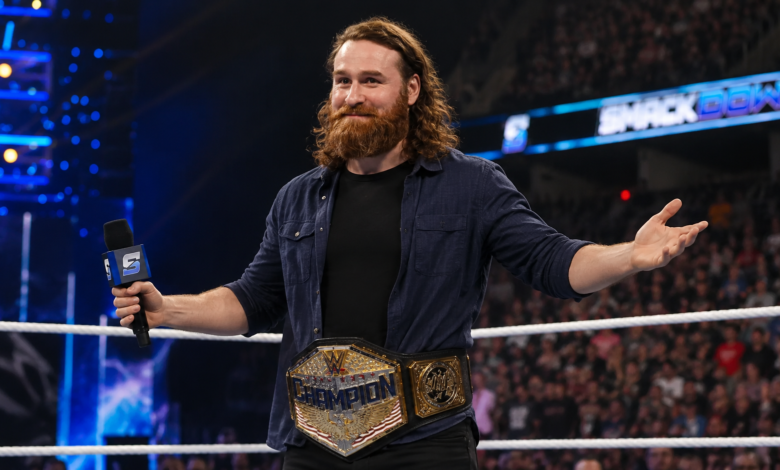
Sami Zayn Net Worth: How a $39K Rookie Contract Became a $2 Million Wrestling Fortune
From masked indie icon El Generico to WWE main-event storyteller — the financial rise of Rami Sebei, the Syrian-Canadian kid from Laval who bet on himself.


*Disclaimer: We may earn a commission if you make a purchase through our affiliate links, at no extra cost to you.
st. Read Time: 11 min
Quick Answer
Sami Zayn (real name Rami Sebei, born July 12, 1984, Laval, Quebec) is a Canadian professional wrestler signed to WWE. As of 2026, his estimated net worth stands at $2 million, built on an annual WWE salary of approximately $500,000, merchandise royalties, pay-per-view bonuses, and brand partnerships.
At a Glance
Estimated Net Worth
$2 Million
Annual WWE Salary
~$500K
Real Name
Rami Sebei
Born
July 12, 1984
Hometown
Laval, Quebec, Canada
Heritage
Syrian-Canadian
WWE Debut
February 2013 (NXT)
Signature
Helluva Kick · “Olé!”
The Laval Kid: Syrian Roots, Canadian Grit
Before there was a Helluva Kick. Before the “Olé!” echoed through arenas from Montreal to Riyadh. Before Roman Reigns ever called him “Honorary Uce” — there was just a boy named Rami Sebei, growing up in the working-class Montreal suburb of Laval, Quebec, the child of Syrian immigrants who had left their hometown of Homs in the 1970s seeking a better life in Canada.
That bicultural upbringing — Arabic spoken at home, French at school, English absorbed through pop culture and television — gave Sebei something rare: fluency in three languages and an instinctive feel for different audiences. It’s no accident that, decades later, Sami Zayn would become one of wrestling’s most globally resonant performers, equally beloved in London, Jeddah, and his hometown of Montreal.
As a teenager at Collège Montmorency in Laval, Sebei was an accomplished soccer player. He later enrolled at Concordia University in Montreal, studying international relations — a field that speaks to his lifelong engagement with global politics, humanitarian work, and the Palestinian rights advocacy he’s spoken about openly. He left university, however, to pursue the one passion that wouldn’t leave him alone: professional wrestling, inspired by watching Shawn Michaels and Bret Hart as a child.
“I wanted to do what Bret Hart did. I wanted to make people care — not just cheer. There’s a difference.”
— Sami Zayn, reflecting on his childhood influences (paraphrased from public interviews)
El Generico: The Masked Years That Built a Legend
Sebei made his professional wrestling debut on March 1, 2002, initially working as “Stevie McFly” for a small Quebec promotion. But within months, he adopted a persona that would define eleven years of his career: El Generico, a fictional masked luchador from Mexico whose only vocabulary was “Olé!” and whose in-ring work was anything but generic.
His first major outing as El Generico came on July 14, 2002, at the Scarred For Life event in Laval for the International Wrestling Syndicate (IWS). What followed was an extraordinary decade on the independent wrestling circuit — touring 29 countries, building a reputation that crossed language barriers precisely because the character’s emotional storytelling needed no translation.
By 2004, El Generico had joined Pro Wrestling Guerrilla (PWG) in Los Angeles, a promotion that became his second home. There, he won the PWG World Championship twice and the PWG World Tag Team Championship five times with partners including Human Tornado, Quicksilver, Kevin Steen, and Paul London. He was the only competitor to participate in all eight consecutive Battle of Los Angeles tournaments from 2005, winning the prestigious tournament in 2011.
His partnership — and feud — with Kevin Steen (later Kevin Owens in WWE) in Ring of Honor (ROH) produced what many critics consider some of the finest independent wrestling ever recorded. The Wrestling Observer Newsletter named their feud the Feud of the Year for 2010. Sebei also earned ROH World Tag Team Championship gold alongside Steen before the rivalry turned personal and bitter in ways that would prefigure their WWE storylines years later.
The Earnings Timeline: From $39K to $500K
2002–2012 · Independent Circuit
El Generico earned his keep on the indie scene, eventually reaching an estimated $100,000 per year by 2012 — a strong income for the independent wrestling world, spread across ROH, PWG, Dragon Gate, CHIKARA, and dozens of international bookings.
January 2013 · WWE Signs Rami Sebei
The initial WWE developmental contract offered just $39,000 — less than half what he’d been earning independently. Sebei accepted, betting on long-term opportunity over short-term cash. The gamble, as the numbers now confirm, paid off significantly.
2014–2015 · NXT Champion
Zayn’s NXT earnings reportedly surpassed $252,000, reflecting his growing prominence as the face of WWE’s developmental brand and his NXT Championship reign, captured at NXT TakeOver: R Evolution in December 2014.
2022 · Multi-Year Re-Sign
Following reports that his previous deal was expiring, Zayn re-signed with WWE in early 2022 for a multi-year contract, with his reported base salary settling at approximately $500,000 annually — before bonuses, merchandise royalties, or pay-per-view uplifts.
2023–2026 · Post-Bloodline Superstar
The Bloodline storyline’s cultural moment — culminating at Elimination Chamber Montreal 2023 — transformed Zayn from a dependable mid-card performer into a main-event draw. One financial analysis site noted his upside potential now exceeds $3.5 million annually when all revenue streams are factored in, though his verified base remains the $500K figure. His total estimated net worth sits at $2 million.
Where the Money Comes From
Sami Zayn’s financial picture has never been as simple as a single salary line. Like most WWE talent, his income is layered:
~$500K/yr
Significant / Undisclosed
Undisclosed
Undisclosed
Bar widths are illustrative of relative contribution, not exact percentages. Specific contract terms have not been publicly disclosed.
On the merchandise side, Zayn has long been one of WWE’s stronger sellers — particularly during The Bloodline era, when his “Honorary Uce” T-shirts and related apparel moved in significant quantities. WWE merchandise royalties are paid as a percentage of net sales, and for consistently popular characters, this income stream can rival a substantial portion of base salary.
His reported brand partnerships with Nike, Mountain Dew, and Montreal-based vegan bar company Mid-Day Square represent his growing commercial identity outside the ring. The Mid-Day Square partnership in particular aligns with his values — the Montreal company is vegan and organic, matching Zayn’s plant-based nutrition approach.
It’s worth noting: exact per-appearance pay-per-view fees and royalty structures have not been publicly disclosed by WWE or TKO Group Holdings. The $2 million net worth estimate, while cited widely, remains an industry approximation rather than a verified figure from audited accounts.
The WWE Career That Built the Brand
Zayn signed with WWE in January 2013 and debuted unmasked on NXT — a brave creative decision, shedding the eleven-year El Generico persona to start fresh. Within months, he was the brand’s most beloved performer. His feud with Cesaro produced one of NXT’s all-time great matches (the 2-out-of-3 Falls classic in August 2013), and his NXT Championship win over Adrian Neville (now known as PAC) at NXT TakeOver: R Evolution in December 2014 is still cited as one of the most emotionally satisfying moments in the brand’s history.
The main roster debut in May 2015 — answering John Cena‘s United States Championship Open Challenge — was characteristically Zayn: a moment that introduced him to millions of new viewers not with a victory but with a performance that made people feel something. He lost the match. The crowd, including Cena’s, gave him a standing ovation.
The years that followed brought multiple WWE Intercontinental Championship reigns (he is a four-time holder of the title), a tag team championship alongside Kevin Owens, and a character journey that moved from underdog babyface to conspiracy-theorist heel to Honorary Uce to — perhaps most improbably — the emotional soul of the most celebrated storyline WWE has produced in the streaming era.
The Moment That Changed Everything
From April 2022 to January 2023, Zayn’s storyline integration into The Bloodline — Roman Reigns’ dominant Samoan family faction — became something rare in professional wrestling: a story that general entertainment media covered not because it was controversy, but because it was genuinely good television.
At Elimination Chamber: Montreal 2023, in front of his hometown crowd, Zayn received what observers called one of the loudest arena reactions in years. The match against Roman Reigns for the Undisputed WWE Universal Championship wasn’t just a sporting event — it was a homecoming. His subsequent WrestleMania 39 tag team title win alongside Kevin Owens formalized the emotional arc that had captivated millions.
Championship Record & Industry Recognition
WWE
Intercontinental Champion (×4)
WWE
United States Champion (×2)
WWE
Undisputed Tag Team Champion (w/ Owens)
NXT / PWG / IWS
NXT Champion · 2× PWG World · 2× IWS World
Beyond championships, Zayn’s industry peer recognition includes the Wrestling Observer Newsletter’s Feud of the Year (2010) for his work with Kevin Steen, the Shad Gaspard/Jon Huber Memorial Award (2020), and Best Gimmick (2022) — the latter a nod to his Honorary Uce character work that preceded his babyface explosion. He was also named NXT Superstar of the Year at the 2013 Slammy Awards.
The Man Behind the Character: Family, Faith, and Sami for Syria
Rami Sebei is, by all accounts, notably private about his personal life — unusual for a WWE performer whose profession depends on public connection. He married Khadijah Farhat Sebei (known as “Deeja”) in August 2018. Khadijah, of Irish and Lebanese descent, was introduced — briefly and memorably — during The Bloodline storyline in 2022. The couple have a son, Rami Sebei Jr., born in 2021.
His property footprint is similarly understated: homes in Canada and Florida, with no details publicly available on valuations. In interviews, he has spoken warmly about his famously modest tastes — at one point mentioning ownership of a 2004 Nissan Altima — a detail that tells you something about where his values actually sit.
The most significant use of his public platform may be Sami for Syria — a humanitarian campaign Zayn created to provide medical services for children caught in Syria’s ongoing conflict. Running campaigns via social media, selling limited-edition merchandise, and working with international aid organizations, Zayn has used his WWE spotlight to raise both funds and awareness for a crisis that is personal to him. He is also affiliated with Connor’s Cure and the Make-A-Wish Foundation through WWE’s charitable infrastructure.
His multilingual ability — Arabic, French, English — has made him a particular touchstone for Arab wrestling fans, and he has spoken openly about the responsibility he feels as a visible Syrian-Canadian Muslim in a mainstream American entertainment product. WWE’s expansion into the Middle East, including the significant Saudi Arabia events, has brought Zayn into rooms where that representation carries weight.
Putting the $2 Million in Context
To understand Sami Zayn’s net worth accurately, it helps to understand how WWE compensation structures actually work. Unlike salaried employees, WWE performers are technically independent contractors, responsible for their own travel and expenses. The $500,000 base figure, while significant, does not arrive as pure take-home pay.
By comparison, Roman Reigns and Brock Lesnar — the company’s apex earners — reportedly command between $5 million and $12 million annually including all revenue. Cody Rhodes, as WWE Champion, sits in a similar tier. Zayn, for most of his main roster career, occupied a dependable upper-midcard position where $500K was a fair market rate.
The post-Bloodline period has changed the calculus. TKO Group Holdings, WWE’s parent company following its 2023 merger with the UFC under Endeavor, reported revenues exceeding $1.7 billion in 2024 — buoyed by a landmark media rights deal that brought Raw to Netflix in January 2025. In that environment, performers who demonstrably move the needle — as Zayn did during the Bloodline arc — have leverage that reflects in contract renegotiations.
Whether Zayn has formally renegotiated since the Bloodline arc’s conclusion has not been publicly confirmed. What is confirmed is that his current net worth trajectory points steadily upward, with merchandise, expanded pay-per-view exposure (including Saudi Arabia events), and an increasingly global fanbase all contributing.
Why Zayn’s Story Matters Beyond the Numbers
Professional wrestling has produced bigger earners than Sami Zayn. What it hasn’t reliably produced is someone who built wealth, reputation, and cultural impact simultaneously — without a gimmick built on dominance. Zayn’s financial story is inseparable from his storytelling: the value he generates for WWE is rooted in emotional credibility, not spectacle. In a media landscape where authenticity is the scarcest commodity, that’s an unusual kind of equity.
You May Also Be Interested In
Kevin Owens Net Worth
Zayn’s lifelong rival and tag partner — a financial parallel story.
Roman Reigns Net Worth
The Tribal Chief whose Bloodline arc turned Zayn into a superstar.
Cody Rhodes Net Worth
The American Nightmare who finished his story — and earned accordingly.
WWE Highest Paid Wrestlers
Where does Zayn rank among WWE’s most compensated talent?
The Verdict: What Sami Zayn’s Net Worth Really Reflects
As of June 2026, Sami Zayn’s estimated net worth of $2 million reflects the financial reality of a career built on consistency, craft, and the slow accumulation of cultural capital. He is not the wealthiest wrestler in WWE’s locker room. He is, however, among the most interesting financial stories in sports entertainment — a performer whose value to the product has historically exceeded what the numbers on his contract might suggest.
The trajectory matters more than the current figure. A man who accepted a $39,000 WWE contract in 2013 — a pay cut from his independent earnings, taken as a long-term bet — now earns more than twelve times that annually on base salary alone. He has main-evented pay-per-views on multiple continents, sold merchandise that fans wear as genuine cultural identity rather than promotional merchandise, and built a humanitarian platform that transcends sport.
Rami Sebei took the mask off in 2013 and never needed to put it back on. What he replaced it with — authenticity, heritage, emotional intelligence, and a storytelling capacity that very few performers in any medium can match — has proven to be worth considerably more.
Sources & Transparency Note
Net worth figures cited in this article are industry estimates drawn from multiple entertainment and sports finance sources including Forbes coverage of WWE compensation structures and IMDb biographical records. WWE contract terms are not publicly disclosed; salary and net worth figures represent best available estimates, not audited financial data. Where specific details could not be verified, this article has noted “This detail has not been publicly disclosed.”
This article was researched and written by AB Rehman, Celebrity Features Writer & Biography Research Analyst. It does not constitute financial, legal, or investment advice.