
How to Fix Loose Glasses: Every Method That Actually Works, From Home Fixes to Professional Adjustments
Glasses that slip, wobble, or sit crooked are more than an annoyance — they can distort your vision and damage the frames over time. Here is a complete, practical guide to tightening, adjusting, and restoring your eyewear at home and at the optician — covering every frame type and every common cause.


*Disclaimer: We may earn a commission if you make a purchase through our affiliate links, at no extra cost to you.
📋 Quick Facts
Primary Cause
Loose or worn hinge screws
Essential Home Tool
Precision eyeglass screwdriver
Time to Fix at Home
Under 5 minutes (most cases)
Cost at an Optician
Often free; minor charge if needed
Frame Types Covered
Metal, plastic, titanium, rimless
Key Risk of Ignoring
Prescription misalignment & eye strain
Repair Kit Cost
£3–£10 / $4–$12 (approx.)
When to See a Professional
Broken hinge, bent frame, rimless damage
To fix loose glasses at home, start by identifying the cause: in most cases, the hinge screws have worked themselves loose through daily use. Using a small precision screwdriver — available in any eyeglass repair kit — turn each hinge screw clockwise until it is snug but not overtightened. If the arm is loose but the screw is already tight, the problem is likely a worn hinge or bent temple arm, which requires a different approach. Most fixes take under five minutes and cost nothing if you already own the right tools.
Glasses that slip down the nose, sit unevenly, or wobble at the temples are among the most common complaints among eyewear users. According to optometry industry estimates, the vast majority of eyeglass wearers will experience some form of frame loosening within the first year of regular use — a natural consequence of the repeated opening, closing, and general handling that frames endure daily. Yet many people either tolerate it or assume they need to pay for a professional repair when a straightforward home adjustment would do the job entirely.
This guide covers every workable method for tightening and adjusting loose glasses, from the simplest screw-tightening technique to adjusting nose pads, reshaping bent temple arms, and knowing when the frame is genuinely beyond a DIY fix. It applies to metal, plastic, titanium, and most rimless frames, with specific notes on the differences between each. Whether your glasses are new and slipping or older and increasingly wobbly, the information here should let you handle the problem yourself — or walk into an optician knowing exactly what needs doing.
Why Glasses Become Loose: Understanding What’s Actually Happening
Glasses are precision instruments held together by very small screws — typically measuring between 1.0mm and 1.4mm in diameter — and the hinges they secure are engineered for thousands of open-and-close cycles. But no mechanical fastener is indefinitely stable under repetitive stress, and hinge screws are particularly susceptible to vibration-induced loosening. Every time you put your glasses on, take them off, or leave them on a surface where they encounter minor impacts, those screws shift fractionally. Over weeks and months, that fraction adds up.
There are, broadly speaking, four reasons glasses become loose. The first and most common is a loose hinge screw — the tiny Phillips or flat-head screw that holds the temple arm to the front frame. The second is a worn or fatigued hinge barrel: the interlocking metal components that the screw passes through can deform slightly over time, creating play even when the screw itself is tight. The third is a bent or spread temple arm — particularly common with metal frames that have been sat on or stored carelessly. The fourth is deteriorated or incorrectly positioned nose pads, which affects how the frame sits on the face even when the hinges themselves are perfectly functional.
Plastic frames present their own specific challenges. Because they rely on the elasticity of the material itself rather than exposed screws and barrels (in many designs), they loosen through a different mechanism: the plastic widens slightly at the temple-to-front joint, reducing the tension that holds the arm in place. Heat can temporarily restore that tension, but the process requires care. Titanium frames, meanwhile, are highly resistant to bending and corrosion, but their hinges are no less susceptible to screw loosening than aluminium or acetate frames.
Tools You Need Before You Start
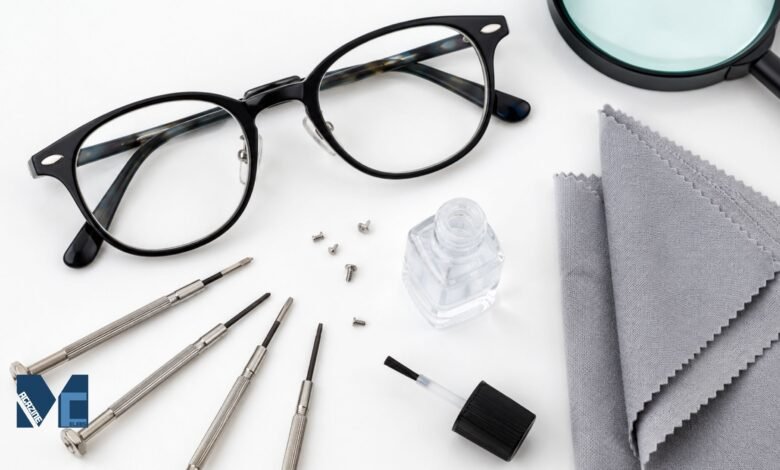
The single most important piece of equipment for fixing loose glasses at home is a precision screwdriver set — specifically one that includes both flat-head and Phillips-head drivers in sizes 0.0 to 1.5mm. These are widely available as eyeglass repair kits at pharmacies, hardware stores, and online retailers for between £3 and £10. They typically include a small collection of spare screws in common sizes, a pair of micro-tweezers for handling dropped hardware, and occasionally a magnifying glass. If you wear glasses regularly, keeping one of these kits at home is straightforwardly sensible.
For adjusting nose pads on metal frames, a pair of small needle-nose pliers with rubber or plastic tips (to avoid scratching the frame) is useful. For gently reshaping temple arms, your hands and moderate controlled pressure are usually sufficient; for more significant bends, a frame-adjustment tool or a professional’s specialised pliers are preferable. Clear nail varnish or a thread-locking compound like Loctite Blue (removable grade) can be used to prevent screws from loosening again after tightening — a step that many opticians themselves use.
One thing to avoid: standard household screwdrivers. Their blades are typically far too wide for eyeglass screws, and forcing an oversized driver into a tiny screw head strips the slot almost instantly. A stripped screw is significantly more difficult to remove than a loose one, and may require a professional to extract. The few pounds spent on a proper kit repay themselves on the first use.
Timeline: How Glasses Loosen and How Repairs Evolved
1700s–1800s
Early spectacle frames were handcrafted from silver, brass, and tortoiseshell. Hinge mechanisms were riveted rather than screwed, meaning adjustments required a blacksmith or skilled craftsman. The concept of a user-serviceable eyeglass frame was largely absent.
Early 1900s
Standardised screw-hinge systems became common as industrial manufacturing made small screws widely available. Opticians began offering basic adjustment and repair services. The first eyeglass repair kits for home use appeared as a consumer product category.
1970s–1980s
Plastic acetate frames became dominant in consumer eyewear. Their spring-hinge mechanisms and screw-free designs introduced new loosening patterns — and required different repair techniques than metal frames. Optical chains began offering free minor adjustments as a standard customer service.
2000s
Titanium and memory-metal (Flexon) frames entered mainstream production, promising greater resilience. These materials reduced some loosening issues but created new repair challenges — titanium cannot be easily reshaped by hand, and memory-metal hinges require specific tools.
2010s
Online tutorials, YouTube repair videos, and affordable precision tool kits democratised home eyeglass repair significantly. Consumer confidence in DIY eyeglass maintenance grew, with screw-tightening and nose pad adjustment becoming widely understood as safe home procedures.
2020s–Present
3D-printed frame components and screwless magnetic-hinge designs are entering the market, raising new questions about home repairability. Many mainstream frames, however, still use the same screw-hinge system in use for decades — making the core repair skills as relevant as ever.
💜 Why This Matters
For the estimated 2.2 billion people globally who live with a vision impairment, according to the World Health Organization, eyeglasses are not an accessory — they are a functional necessity. Frames that sit incorrectly do not just cause discomfort; they can shift the optical centres of prescription lenses away from the pupils, inducing headaches, nausea, and eye strain that many people mistakenly attribute to the prescription itself. Knowing how to correct this problem is, for hundreds of millions of people, a genuinely practical skill with a real impact on daily quality of life — not a trivial household hack.
Step-by-Step: How to Fix Loose Glasses at Home
Step 1 — Diagnose the problem. Before reaching for a screwdriver, identify where the looseness is coming from. Hold the frames at the bridge (the part that sits on your nose) and gently open and close each temple arm. If you feel or see play at the hinge, the screw is likely loose. If the arm feels stiff but the frame still slips on your face, the issue is fit rather than hardware — and you need to adjust the nose pads or temple tips instead. If both arms move firmly but the frame still sits asymmetrically, one arm has been bent.
Step 2 — Tighten hinge screws. Place the glasses on a clean, well-lit surface — a white cloth or microfibre cleaning cloth works well for contrast. Select the correct screwdriver head: most modern frames use a flat-head slot, though some use Phillips. Turn each screw clockwise in small increments. The correct tension is snug but not forceful — the arm should move with a little resistance when opened, not swing freely or require significant pressure to move. Overtightening can crack plastic frames at the hinge or strip the screw head.
Step 3 — Replace a missing or stripped screw. If the screw is missing entirely, the spare screws in most repair kits include common sizes. Hold the hinge barrels aligned with tweezers (the small holes must be directly lined up) and thread the new screw in with your fingertip before engaging the screwdriver. If the original screw slot is stripped — meaning the driver keeps slipping without catching — the screw needs to be replaced, not further tightened. A rubber band held over the stripped head can sometimes provide enough friction to get it out; if not, an optician can remove it with specialised tools.
Step 4 — Use clear nail varnish or thread-locker to prevent future loosening. After tightening, apply a tiny drop of clear nail varnish to the screw head with a toothpick, then allow it to dry before wearing the glasses. This acts as a mild adhesive that keeps the screw in place through daily use but remains removable if the screw ever needs adjusting again. Opticians commonly use a removable thread-locking compound for the same purpose. Avoid permanent thread-lockers (red Loctite), which make the screw essentially irremovable.
Step 5 — Adjust temple arms for fit. If the glasses still slip after screw tightening, the temple arms may need to be curved slightly downward at the ear. On metal frames, hold the arm firmly close to the ear tip and apply gentle, controlled downward pressure to increase the curve. Work in small increments and test the fit after each adjustment. On plastic frames, warming the temple tip in hot (not boiling) water for 30 seconds makes the material pliable enough to reshape by hand; it will harden again as it cools. Never apply heat to the front of plastic frames, particularly near the lenses.
Step 6 — Adjust nose pads. On metal frames with adjustable nose pads, use rubber-tipped pliers or your fingertips to gently squeeze or splay the pad arms until the bridge sits level and centred on your nose. The pads should make even contact on both sides without pinching. On plastic frames, nose pads are moulded into the bridge and cannot be adjusted — if fit is the issue here, an optician may need to heat and reshape the bridge, or the frame may simply not be the right fit for your face shape.
Frame-Specific Advice: Metal, Plastic, Titanium, and Rimless
Metal frames are the most forgiving for home repair. Their exposed screws are easy to access, their temples can be bent with care, and replacement screws in standard sizes fit most models. The main risk is over-bending: metal frames, particularly thin aluminium alloy designs, can crack or snap at the hinge if bent too far. Always work in small increments and test frequently. Stainless steel frames are more resilient and tolerate more reshaping; they are also more resistant to corrosion from sweat, which can cause screw seizure over time. If a screw is seized rather than just tight, do not force it — an optician can apply a penetrating lubricant to free it without damage.
Plastic (acetate) frames cannot be adjusted by bending without heat. The material is rigid at room temperature and will snap rather than flex. The safe method is to warm the problem area — a bowl of hot (not boiling) water, or a low-heat hair dryer kept at least 15 centimetres from the frame — for 20 to 30 seconds, then shape while the material is warm and hold it in position until it cools. This works for temple arms, the bridge, and to some extent nose saddles. Do not apply heat near the lenses, as even moderate temperatures can warp certain lens coatings and materials. Many opticians have dedicated tools for assessing material stress before attempting adjustments on older or brittle acetate.
Titanium frames are substantially harder to reshape than steel or acetate, and attempting to bend them significantly at home risks snapping the frame at the hinge. For titanium, screw maintenance is the most the average person should attempt at home. Any reshaping or hinge repair should go to a professional. The upside is that titanium hinges are usually of high quality and tend to loosen more slowly than cheaper metal equivalents; they also resist the screw seizure that affects steel frames in humid conditions.
Rimless frames — where the lenses are held by screws or compression fittings directly to the bridge and temple arms, with no surrounding frame — are the most fragile category for home repair. The mounting screws pass through small holes drilled into the lens itself, and overtightening can crack the lens. If a rimless frame is loose, the correct approach is almost always to take it to an optician. The screws are small, the tolerances are tight, and the consequence of getting it wrong (a cracked lens) is expensive. For those who do attempt it: the screws are typically size 1.0mm or smaller, require a correspondingly tiny driver, and should be tightened only until the lens is stable — not until you feel resistance.
📊 Cost Comparison: DIY vs Professional Repair (2026 Estimates)
Note: Costs are approximate and vary by location, optician, and frame complexity. Many high-street opticians offer basic screw tightening and minor adjustments at no charge as a courtesy service. Verified pricing varies widely; always obtain a quote before authorising repair work.
“The most common reason people get headaches from their glasses is not a wrong prescription — it is a frame that has shifted out of position. Two millimetres of misalignment at the hinge can move the optical centre of a lens enough to cause significant strain.”
— General observation consistent with guidance from the College of Optometrists (UK) on frame fit and visual comfort
Where Things Stand Now: Modern Frames and Repair Options in 2026
The eyewear market has seen significant design change in recent years, with more brands experimenting with screwless spring hinges, magnetic closure systems, and even memory-polymer temples that resist deformation. For people who frequently experience loose glasses, these newer designs offer a practical advantage: fewer points of mechanical failure. Brands including Lindberg, Silhouette, and several specialist sports eyewear manufacturers have developed minimalist, screw-free designs that effectively eliminate the most common loosening mechanism.
That said, the overwhelming majority of glasses sold globally still use conventional screw-hinge construction, and the home repair skills described in this guide remain fully applicable. What has changed most significantly in the past decade is access to information and tools. A basic eyeglass repair kit is now available at nearly every pharmacy and supermarket, and video tutorials covering everything from hinge screw replacement to nose pad adjustment number in the millions online. The barrier to competent home repair has never been lower.
One development worth noting for regular glasses wearers: several UK and US optician chains, including Specsavers and Boots Opticians, have formal policies of offering free basic adjustments — tightening screws, bending temple tips, repositioning nose pads — to any customer who walks in, regardless of whether they bought their glasses there. Many independent opticians offer the same service. If you are uncertain about attempting a repair yourself, this is always a sensible first option: it costs nothing, takes minutes, and is performed by someone with the right tools and experience. The caveat is that some opticians will decline to adjust frames purchased elsewhere, particularly if they are from a budget online retailer with non-standard screw sizes, so it is worth calling ahead.
For those interested in the broader context of personal care and maintenance habits — from understanding how everyday objects are engineered to planning ahead for specialist equipment needs — eyeglass repair sits in an interesting space: it is a technical skill that most people never learn, yet it is genuinely accessible once you understand the underlying mechanics. The tools are cheap, the technique is learnable in one session, and the payoff — glasses that sit correctly and stay there — is immediate and tangible.
✨ Loose Glasses Fix — At a Glance
Most Common Fix
Tighten hinge screw clockwise
Time Required
2–5 minutes (basic repair)
Key Prevention Tip
Clear varnish on screw head
When to Stop DIY
Cracked frame, rimless, broken hinge
Common Mistakes That Make Loose Glasses Worse
The most frequently encountered mistake is using the wrong screwdriver. As noted earlier, a standard flat-head driver from a household toolkit is almost always too wide for eyeglass screws, and the result is a stripped screw head that is far more difficult to deal with than the original looseness. A second common error is overtightening: the screw should be snug, not immovable. Glasses hinges are designed with a specific operating tension, and forcing a screw past the point of resistance can crack plastic frames at the barrel, or cause the screw to seize in metal ones.
A subtler mistake is attempting to fix fit issues by bending the frame at the wrong point. If glasses slip down the nose, the instinct is often to bend the temple arms inward at the front — which does nothing for the grip that keeps glasses up, and can misalign the frame. The correct adjustment is at the ear bend, curving the temple tips slightly downward so they hook more securely behind the ear. Similarly, pushing the nose pads too close together to compensate for slipping creates a pinching sensation and does not address the underlying fit issue, which is usually the temple angle rather than the nose pad width.
People also sometimes use superglue on hinge screws that keep loosening. This is understandable as an impulse but creates significant problems: standard cyanoacrylate adhesives (superglue) are not designed for metal-on-metal applications under repeated stress, and they have a tendency to migrate into the barrel joint, effectively fusing the hinge and making the arm immovable. The frame then needs to go to a professional for removal, which costs considerably more than the original repair would have. Clear nail varnish applied carefully to the screw head achieves the same locking effect without the risk.
Finally, there is a tendency to postpone adjustment until the glasses are significantly misaligned. A screw that is slightly loose is much easier to tighten than one that has worked itself almost entirely free — the latter can drop and be lost during the adjustment process, leaving you without a functional frame until you find a replacement screw of the correct size. Checking and tightening hinge screws as part of a regular lens-cleaning routine takes seconds and prevents most of the more serious loosening problems from developing.
For anyone managing their home environment and day-to-day maintenance more broadly, the principle is the same one that applies to many household objects — from understanding what household materials can be repaired versus replaced to keeping garden tools in working order. Small preventative checks consistently outperform reactive repairs, both in cost and in effort.
❓ Frequently Asked Questions
How do you fix glasses that keep sliding down your nose?
The most effective fix for glasses that slide down is to adjust the temple arm curve behind the ear. For metal frames, gently bend the ear tip section downward for a firmer hook. For plastic frames, warm the area in hot water for 30 seconds before reshaping. Adjusting nose pads closer together can also help, but temple angle is usually the primary factor.
Can I tighten my glasses at home without a special screwdriver?
Technically possible with a very thin flat-head driver, but not recommended. Eyeglass screws are typically 1.0mm–1.4mm in diameter, and standard household screwdrivers are too wide. A poorly fitting driver strips the screw head easily. A proper eyeglass repair screwdriver costs £3–£5 and eliminates this risk entirely — it is the correct tool for the job.
Is it safe to bend glasses frames to fix the fit?
Safe for metal frames when done gradually and in small increments — particularly at the temple ear tips. Plastic frames require heat before reshaping; bending cold acetate causes it to snap. Titanium frames are generally too hard to reshape safely at home and should go to a professional. Never attempt to bend the bridge of any frame — this affects lens alignment and can crack the frame.
How do I stop my glasses screws from coming loose again?
After tightening, apply a tiny drop of clear nail varnish to the screw head using a toothpick. Allow it to dry fully before wearing the glasses. This acts as a mild thread-locker that keeps the screw in place through daily use but remains removable when needed. Opticians use similar proprietary compounds for the same purpose. Avoid standard superglue, which can migrate into the hinge joint.
Will an optician fix loose glasses for free?
Many high-street opticians — including major UK chains like Specsavers and Boots Opticians — offer basic frame adjustments at no charge as a courtesy service, regardless of where the glasses were purchased. This typically includes screw tightening, nose pad adjustment, and minor temple bending. More complex repairs (broken hinges, cracked frames) usually incur a charge. Calling ahead to confirm is advisable.
How often should I check and tighten my glasses screws?
Checking hinge screws every 4–6 weeks is a sensible habit for regular glasses wearers. Incorporating it into your lens-cleaning routine takes under a minute and catches loosening before it progresses to the point where screws drop out entirely. Frames that see heavy daily use — sport, outdoor work — may need more frequent checks. Frames used occasionally tend to retain their tension longer.
Final Thoughts
Fixing loose glasses is, in the majority of cases, a five-minute job that costs almost nothing and requires one small tool. The challenge is not technical complexity — it is the pervasive assumption that eyewear is too delicate or specialised for non-professionals to touch. That assumption is largely unfounded for the common repairs described here. Screw tightening, temple adjustment, and nose pad repositioning are well within the capacity of anyone who has ever assembled flat-pack furniture or changed a plug fuse. The stakes are low, the tools are cheap, and the techniques are well established.
Where the picture becomes more nuanced is with premium or unusual frames — rimless designs, titanium, high-flex memory metal, or antique spectacles — where the tolerances are tighter and the margin for error smaller. In those cases, the calculus shifts: the cost of getting it wrong (a cracked lens, a seized hinge, a snapped temple arm) can exceed the cost of the original glasses. Knowing where your frame sits on that spectrum is part of making an informed decision about whether to fix it yourself or take it to someone with the right equipment.
The broader lesson, perhaps, is about paying attention. Glasses that are slightly loose today are glasses with a stripped screw tomorrow. Catching the problem early — a ten-second check while cleaning the lenses — is genuinely the most effective repair strategy available. It costs nothing, prevents the more complicated problems from developing, and means your glasses keep doing what they are supposed to do: sitting exactly where they need to be, without you having to think about them at all.
📚 Sources & References
- World Health Organization — Blindness and Visual Impairment Fact Sheet
- College of Optometrists (UK) — Clinical Management Guidelines
- Specsavers — Glasses Adjustments & Repairs Help Page
- American Academy of Ophthalmology — How Eyeglasses Should Fit
- The Vision Council (US) — Eyewear Industry Market Research
All sources verified at time of publication. Links subject to change.
Hassan Ali
Senior Features & Research Writer
Hassan Ali is a features and research writer covering consumer products, health and lifestyle, and everyday how-to topics. His work focuses on practical, verified guidance drawn from reputable primary sources — aimed at readers who want accurate information without having to sift through conflicting online advice. He writes for both general and specialist audiences across print and digital publications.
⚠️ Editorial Disclaimer
This article is intended for informational purposes only. All repair methods described are based on publicly available guidance from eyewear professionals and industry sources at the time of publication. Individual results may vary depending on frame material, construction, and condition. For prescription eyewear, particularly rimless, titanium, or high-value frames, professional assessment is always recommended before attempting home repairs. The author and publisher accept no liability for damage arising from home repair attempts. This article does not constitute professional optical or medical advice.