
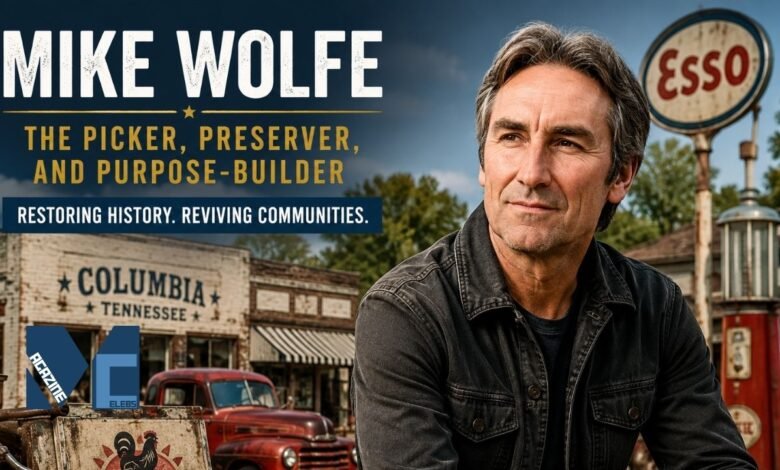
Mike Wolfe’s Passion Project: How the American Pickers Star Is Saving Small-Town America One Building at a Time
Beyond the cameras and the barn finds, Mike Wolfe has quietly built a preservation movement in the American heartland — restoring forgotten storefronts, reviving communities, and betting his own money on the past.


*Disclaimer: We may earn a commission if you make a purchase through our affiliate links, at no extra cost to you.
⚡ Quick Facts — Mike Wolfe
Full Name
Michael Wayne Wolfe
Date of Birth
November 6, 1964
Birthplace
Joliet, Illinois, USA
Age (2026)
61 Years Old
Known For
American Pickers, Antique Archaeology, Historic Preservation
Estimated Net Worth
~$7 Million (unverified)
Passion Project Hub
Columbia, Tennessee
Current Status
Active — American Pickers Season 27 (2025)
Mike Wolfe has spent more than four decades treating rust as currency. Born in Joliet, Illinois, and raised in Bettendorf, Iowa, he is best known as the creator and star of the History Channel’s American Pickers — a show that turned the solitary, unglamorous act of digging through barns into a prime-time event. But the television career, which launched in January 2010 and has now surpassed twenty-seven seasons, is only part of the story. Behind it sits something far more personal and considerably more expensive: a multi-year preservation effort centered on Columbia, Tennessee, where Wolfe has quietly invested over $1.5 million of his own money restoring shuttered gas stations, a derelict automotive dealership, a nineteenth-century Italianate mansion, and a former Esso station now reborn as a wine and gathering space called Revival.
What people call his “passion project” defies easy categorisation. It is part real estate, part cultural activism, part community revitalisation. The thread connecting all of it is the same instinct Wolfe showed at age four when he dragged a broken bicycle out of a neighbour’s trash in Iowa — the conviction that discarded things have worth, that forgotten places hold stories worth keeping, and that the act of saving them is not nostalgia but a practical argument about identity. Columbia is now home to Columbia Motor Alley, Two Lanes Guesthouse, Revival, and a growing constellation of restored properties that have turned a small Middle Tennessee town into a destination for Americana enthusiasts and heritage tourists alike.
In April 2025, Wolfe closed his Nashville Antique Archaeology location after fifteen years, choosing to consolidate his energy around Columbia and his original LeClaire, Iowa flagship. The decision said something about where his priorities genuinely lie. Season 27 of American Pickers returned in July 2025, and new History Channel projects have been announced. But ask anyone close to the work what drives him, and the Columbia buildings come up before the television credits.
Early Life & Biography — Joliet, Illinois to Bettendorf, Iowa
Mike Wolfe was born on November 6, 1964, in Joliet, Illinois. His parents separated when he was young, and his mother, Rita, raised him and his two siblings, Beth and Robbie, largely on her own after the family relocated to Bettendorf, Iowa. Money was scarce. The modest circumstances of that upbringing, rather than hampering his curiosity, appear to have sharpened it.
Bettendorf sits on the Iowa side of the Quad Cities area, a mid-sized industrial stretch along the Mississippi River. It is the kind of place where alleyways behind older homes yielded discarded appliances, bicycle frames, old signage, and the kind of material debris that a curious child could spend hours cataloguing. Wolfe did exactly that. By his own accounts, given in interviews and in his 2013 book American Pickers Guide to Picking, he was pulling bicycles from neighbours’ garbage before he started primary school. His first significant sale came early: a restored bicycle, sold for five dollars, which introduced him to the logic of the transaction — find it, clean it, understand what it is, find someone who wants it more than you do.
That loop became his education. Long before any camera crew, long before Antique Archaeology had a front door, Wolfe was developing a methodology — not just an eye for objects but an ear for the stories attached to them. He attended Bettendorf High School, and while no verified records confirm post-secondary education, his professional formation happened not in classrooms but in barns, estate sales, and roadside stops across the Midwest.
Parents, Siblings & Family Background
Wolfe’s father is not publicly identified, and no verified public source has confirmed details about his background or profession. His mother, Rita Wolfe, is the formative figure — a single parent who raised three children through tight years without, by any account Wolfe has offered, any reduction in warmth or expectation. He has spoken in interviews about the influence of her resilience on the work ethic he brought to every venture that followed.
His brother Robbie later appeared on American Pickers, which suggested the family’s shared interest in the trade was genuine rather than constructed for television. His sister Beth has kept a lower public profile. Mike is described in multiple sources, including his IMDb biography, as the second of the three children. The Wolfe family story — a single mother, limited resources, and children who learned to find value where others saw nothing — maps closely onto the philosophy that would later drive everything from the original Antique Archaeology store to the Columbia restoration projects.
Wolfe met Jodi Faeth in 1994, and the couple spent nearly two decades together before marrying in September 2012 in Tennessee. Their daughter, Charlie Faeth Wolfe, was born in January 2012 and was notably born with a cleft lip and palate — a challenge Wolfe and Jodi navigated publicly and with candour. The marriage ended in divorce, finalised in 2021. Wolfe has since been in a public relationship with Leticia Cline, a journalist and motorcycle enthusiast. Much like Wolfe’s approach to preservation, his personal life has been less about performance and more about commitment to particular people and particular places over a very long time.
Full Bio & Career Timeline
Early 1970s
Begins “picking” in Bettendorf, Iowa, salvaging discarded bicycles from neighbours’ rubbish and selling them — his first encounter with the economics of finding value in overlooked objects.
Late 1980s–1990s
Works as a professional picker across the Midwest, building relationships with collectors, estate sale networks, and barn owners. Develops the curatorial philosophy — centred on object narratives rather than pure commodity value — that will define his public career.
2000
Opens Antique Archaeology in LeClaire, Iowa — a curated retail space and living museum of Americana that transforms his professional practice into a brick-and-mortar destination. The store becomes a pilgrimage site for vintage collectors long before the television show exists.
January 18, 2010
American Pickers premieres on the History Channel after Wolfe spends nearly five years pitching the concept to various networks. The debut draws 3.1 million viewers — the network’s highest-rated premiere since Ice Road Truckers in 2007. Wolfe is credited as creator, executive producer, and co-host.
2011–2012
Opens a second Antique Archaeology location in Nashville, Tennessee. Launches the Rustorations lighting line. Signs an endorsement deal with Indian Motorcycles. Marries Jodi Faeth in September and welcomes daughter Charlie in January 2012.
2013
Publishes two books: American Pickers Guide to Picking and the children’s title Kid Pickers: How to Turn Junk Into Treasure. Launches Two Lanes, a line of American-made apparel and accessories tied to the heritage-travel aesthetic he has built across his career.
November 2017
Purchases Columbia Motor Alley — a 13,440-square-foot 1947 Chevrolet dealership in Columbia, Tennessee — for approximately $400,000. The acquisition marks the formal beginning of his large-scale historic preservation work in the town, transforming an automotive relic into a functioning community hub.
September 2022
Purchases a second major Columbia property — a former Esso station — for $600,000, with renovation investment of $38,630 documented through permit records. Also acquires a 151-year-old Italianate house in Columbia for $700,000, undertaking structural restoration to recover the building’s original tower and cupola from historic photographs.
April–July 2025
Closes the Nashville Antique Archaeology location on April 27, 2025, after fifteen years of operation. Revival wine bar — the restored Esso station — opens in Columbia with outdoor seating, a fire pit, a pergola, and event space. Season 27 of American Pickers premieres on the History Channel in July 2025.
2025–2026
Announces a new History Channel series alongside continued Columbia investment. Two Lanes Guesthouse operates as a booked-out short-term rental. The LeClaire Antique Archaeology store — Wolfe’s original — remains open and active. First film appearance confirmed in the neo-Western production Day of Reckoning.
💜 A Human Perspective
The death of Frank Fritz — Wolfe’s longtime co-host on American Pickers, who passed away in October 2024 following a series of health struggles — cast a long shadow over a year that was otherwise defined by new beginnings. Wolfe and Fritz had a publicly strained falling-out in 2021, and Fritz’s removal from the show was a story that played out in tabloids with a rawness neither man appeared to have fully chosen. Whatever the private weight of that complicated friendship, the loss arrived during a period of intense creative and financial investment. Wolfe’s daughter Charlie, born with a cleft lip and palate, also serves as a quiet reminder that behind the road trips and the barn finds is a father who has had to weigh the demands of a peripatetic career against the slower responsibilities of family — a tension he has acknowledged in interviews without ever fully resolving it on camera.
Mike Wolfe Passion Project Explained: Columbia, Tennessee as Living Laboratory
Columbia, Tennessee sits in Maury County, about an hour south of Nashville, and has long carried the informal title of “Antique Capital of Tennessee.” For Wolfe, it is also something more personal: the town where much of his off-screen life and investment is concentrated, and the place where his preservation philosophy has moved from television concept to physical reality.
The Columbia Motor Alley acquisition in 2017 was the anchor. The 13,440-square-foot former Chevrolet dealership — built in 1947 — now operates as a working repair shop, a display space for Wolfe’s personal collection of cars and motorcycles, and a merchandise hub. It houses local businesses including Muletown Coffee and Trek Bicycle Store, tenants whose presence transforms what could have been a vanity project into a functioning commercial address. The Antique Archaeology website describes it as a place where Wolfe’s “love of transportation history and historic preservation comes together” — language that is both promotional and, by all observable evidence, accurate.
The Revival project tells a more complicated story. The former Esso station sat empty, then failed fire and gas inspections in 2023 after Wolfe purchased and began renovating it. Progress was slow. By mid-2025, however, the building passed inspection and opened as a wine bar and community gathering space, with outdoor seating arranged around a central fire pit, a wooden pergola, a stage for live performances, and a custom interior finished with vintage materials sourced through Wolfe’s network. It is designed to function as what urban planners sometimes call a “third place” — not home, not work, but somewhere people gather voluntarily — and the surrounding community in Columbia appears to have received it as exactly that.
The 151-year-old Italianate house, acquired for $700,000 with more than $200,000 in documented renovation work, represents Wolfe’s most architecturally ambitious undertaking. Using historic photographs, his team has worked to restore the building’s original decorative tower and cupola — features that were removed or lost at some point in the building’s twentieth-century history. Whether that work is complete as of this writing has not been publicly confirmed.
Those interested in how public figures channel their platforms toward tangible cultural impact might also consider the work of adventurer and television presenter Shara Grylls, whose family’s philanthropic and community-focused activities offer an interesting counterpoint to Wolfe’s preservation-driven model. Both figures demonstrate how celebrity can be redirected from self-promotion toward something more durable.
Financial Overview — What the Numbers Suggest
Verified, independently audited financial data on Mike Wolfe’s earnings and net worth has not been publicly disclosed. Various entertainment and celebrity publications estimate his net worth at approximately $7 million as of 2025, though these figures are derived from secondary calculations and should be treated as approximations rather than confirmed sums.
The observable income streams are diverse. American Pickers has been running for more than fifteen years, and Wolfe holds creator and executive producer credits alongside his co-hosting role — an arrangement that typically generates more substantial earnings than on-screen talent fees alone. Multiple sources estimate per-season salary in the range of $500,000, though no official confirmation from Wolfe or his representatives has been made available publicly. The Antique Archaeology brand contributes through retail sales, licensed merchandise, and the cultural currency of the store’s identity. Two Lanes — the apparel and accessories line — adds another income strand tied to the same Americana aesthetic that runs through everything Wolfe does. Real estate in Columbia, with tenanted commercial units and the Two Lanes Guesthouse short-term rental, provides ongoing revenue. Book deals, speaking engagements, and the Indian Motorcycles endorsement arrangement have diversified the picture further.
What makes the financial story genuinely interesting, however, is not the size of the numbers but where the money goes. The documented Columbia investments — over $1.5 million in property and restoration costs by available estimates — represent a meaningful portion of any reasonable net worth figure. These are not tax-efficient write-offs in the conventional sense; they are, as far as public evidence suggests, genuine bets on the long-term viability of historic preservation as a community and economic development model. That is unusual for someone operating primarily in the television entertainment space.
📊 Estimated Income Sources — Mike Wolfe (2026)
Note: All figures are estimates based on public reporting. No verified financial data has been officially disclosed by Wolfe or his representatives.
Public Image, Philosophy & What Separates Wolfe from the Crowd
Reality television has produced countless figures who parlayed screen time into merchandise lines and personal brand platforms. Wolfe has done that too, but his public image has remained unusually coherent because the television work and the off-screen activity express the same underlying idea. American Pickers built an audience on the premise that overlooked objects still carry worth. The Columbia preservation project applies that same logic to buildings. The continuity is legible even to casual viewers, which is partly why the passion project attracts genuine public interest rather than simply celebrity curiosity.
His philosophy, articulated across interviews and in his books, rests on the distinction between collecting and preserving. Collectors accumulate. Preservationists contextualise. Wolfe has always been interested in the story behind the object — the welder who made a particular sign, the mechanic who owned a specific garage, the community that gathered around a particular corner store. This curatorial sensibility extends to his approach to the built environment. A restored Esso station is not just a picturesque backdrop; it is an argument that the history of working-class American commerce belongs in daily life rather than in a museum display case.
That approach has earned him credibility in communities that might otherwise be sceptical of celebrity investment. Local reporting from Columbia has noted his hands-on engagement with renovation work, his willingness to involve neighbourhood artisans and tradespeople, and his use of Two Lanes to provide micro-grant support and exposure to rural craftspeople. Whether all of this translates into sustained economic impact for Columbia beyond the initial tourism stimulus is a question that time will answer more reliably than any press release.
The work Wolfe does in preserving heritage culture resonates with how certain public figures in the UK have approached local identity and cultural continuity. For those exploring how celebrity translates into genuine community engagement, the story of John Cena — an American entertainment figure who has consistently used his platform for causes beyond his own commercial interests — offers an interesting parallel, even if the specifics of their fields differ considerably.
“Mike Wolfe’s work in Columbia is less about what a television personality can do for a town, and more about what happens when someone treats a place the same way they treat a vintage motorcycle — with patience, craft, and the belief that getting it right is worth the time.”
— AB Rehman, Celebrity Features & Biography Research Writer
Where Is Mike Wolfe Now? Current Lifestyle & Status (2026)
As of 2026, Mike Wolfe divides his professional life between the American Pickers production schedule — Season 27 began airing in July 2025 — and the ongoing Columbia, Tennessee restoration portfolio. The Nashville Antique Archaeology store closed in April 2025, a decision Wolfe attributed to a desire to refocus on family and on Columbia specifically. His original LeClaire, Iowa store continues operating and remains a destination for visiting collectors and fans of the show.
The Revival wine bar, once the longest-delayed component of his Columbia plan due to failed inspections, is now open to visitors. Two Lanes Guesthouse operates as a short-term vacation rental bookable through standard platforms, offering guests accommodation within a space decorated with picks from the show. Columbia Motor Alley hosts periodic public events and houses a selection of working tenants. The 1873 Italianate house restoration is understood to be ongoing, though confirmed completion details are not currently available through public reporting.
Wolfe has also confirmed a new History Channel project beyond American Pickers, and his first film appearance in the neo-Western production Day of Reckoning represents a tentative extension into scripted entertainment. His relationship with Leticia Cline appears intact, though neither has made extensive public statements about it beyond confirming the connection. At 61, he presents publicly as someone who has made deliberate choices about where his energy goes — away from celebrity amplification and toward the physical, incremental work of keeping old things standing.
✨ Mike Wolfe’s Columbia Preservation Portfolio — Snapshot
Total Invested (Est.)
$1.5 Million+
Key Properties
Columbia Motor Alley, Revival, Italianate House, Two Lanes Guesthouse
Retail Presence
LeClaire, Iowa (Antique Archaeology open); Nashville location closed April 2025
TV Status (2025–26)
American Pickers Season 27 + New History Channel Project
Relationships & Family Life
Wolfe’s personal life has been characterised by long commitments rather than frequent change. He met Jodi Faeth in 1994, and the couple were together for approximately eighteen years before marrying in September 2012. Their daughter, Charlie Faeth Wolfe, was born in January of that year. Charlie’s diagnosis of a cleft lip and palate was something both parents acknowledged publicly, and by available accounts they navigated it together without turning it into a media narrative. The marriage ended in divorce finalised in 2021, and Wolfe has since been publicly linked to Leticia Cline — a model, journalist, and motorcycle enthusiast whose interests align naturally with his own.
Brother Robbie Wolfe has appeared on American Pickers in a supporting capacity, and the working relationship between the siblings suggests a family bond that extended into the professional sphere. The late Frank Fritz, while not a family member, occupied a role in Wolfe’s public life that functioned somewhat like one over the decade-plus of the show. His death in October 2024 — following a falling-out that had been made public in 2021 — added a layer of private grief to a period that was otherwise professionally active. Wolfe addressed Fritz’s passing publicly and with apparent sincerity, though the circumstances of their estrangement were never fully aired in a way that allowed for neat closure.
For readers interested in how family dynamics play out across long careers in public life, the story of figures like Dominic West’s family illustrates the complexity of balancing personal commitments and career visibility — a tension Wolfe has navigated in his own distinctly private way.
❓ Frequently Asked Questions — Mike Wolfe
What exactly is Mike Wolfe’s passion project?
Mike Wolfe’s passion project is a broad historic preservation initiative centred primarily in Columbia, Tennessee. It encompasses the restoration of multiple commercial and residential properties — including Columbia Motor Alley, the Revival wine bar (a former Esso station), Two Lanes Guesthouse, and a 151-year-old Italianate mansion — alongside his Two Lanes brand, which supports rural American artisans through exposure and micro-grants. The project extends his on-screen picking philosophy into the built environment.
Is Antique Archaeology still open?
The original Antique Archaeology store in LeClaire, Iowa is open and operating as of 2025–2026. The Nashville, Tennessee location — opened in 2011 — closed permanently on April 27, 2025, after fifteen years. Wolfe cited a desire to focus on Columbia projects and family as reasons for the closure.
How much has Mike Wolfe invested in Columbia, Tennessee?
Based on publicly documented property purchase records and renovation permit filings, Wolfe has invested in excess of $1.5 million in Columbia across multiple properties. This includes approximately $400,000 for Columbia Motor Alley, $600,000 for the Esso station (now Revival), $700,000 for the 1873 Italianate house, plus documented renovation costs on each property. Additional undisclosed expenditure is likely.
What happened between Mike Wolfe and Frank Fritz?
Frank Fritz and Mike Wolfe had a well-publicised falling-out in 2021, after which Fritz was removed from American Pickers. Fritz subsequently suffered a stroke and a period of serious health decline. He passed away in October 2024. Wolfe acknowledged his death publicly. The specific nature of the estrangement between them was never fully disclosed by either party, and no detailed verified public account of the dispute’s origins has been published.
What is Revival, and can visitors go?
Revival is a restored Esso gas station in downtown Columbia, Tennessee, that Wolfe transformed into a wine bar and community gathering space. It features outdoor seating, a fire pit, a pergola, and a stage. The space opened to the public in mid-2025 following several years of renovation and permit approvals. It operates as a bookable event venue and welcomes walk-in visitors during regular hours.
What is Mike Wolfe’s net worth?
No verified financial disclosure has been made by Mike Wolfe or his representatives. Multiple entertainment publications estimate his net worth at approximately $7 million as of 2025, derived from a combination of television earnings, retail operations, real estate, and brand activities. These figures should be treated as estimates rather than confirmed amounts.
Final Thoughts — The Long Game
The story of Mike Wolfe’s passion project is, at its core, a story about what happens when someone refuses to let the logic of the television career define the logic of their actual life. For more than two decades, Wolfe has been the man on screen pulling objects from barns and telling the stories attached to them. That work has been consistent and, by the numbers, genuinely successful. But alongside it, and in many respects more revealing of his values, is the quieter project of restoring buildings that most developers would have demolished, investing in towns that most entertainment careers would have long since left behind, and betting on the idea that the past is an asset rather than a liability.
Columbia, Tennessee is still a small town. The Italianate mansion may or may not have its cupola back by the time this is read. Revival will have its good nights and its quiet ones. But Wolfe’s investment there — financial and personal — represents something that is genuinely unusual in the world of reality television celebrities: a coherent argument, made in concrete and timber and old signage, about what matters enough to spend your money and your time on.
That argument will outlast the broadcast schedules. Whether it changes the economic trajectory of Maury County in any lasting way is a larger question. But as a demonstration of what a passion project can look like when it is not primarily a marketing exercise, it holds up rather well.
Those who follow heritage conservation and how it intersects with public figures might also find the profiles of Bear Grylls’ family members — including Jesse Grylls and Huckleberry Grylls — interesting reads, as the Grylls household represents another mode of public life built around authenticity, outdoor values, and commitment to something beyond entertainment output.
📚 Sources & References
- IMDb — Mike Wolfe Official Biography
- National Today — Mike Wolfe Birthday & Biography
- The US Sun — Mike Wolfe to Open Tennessee Wine Bar (May 2025)
- Six Magazine — Mike Wolfe Passion Project: Main Street Mission
- Magazine Meme — Mike Wolfe Passion Project Analysis
- First Internet Marketing — Columbia Investment Overview
- Mabumbe — Mike Wolfe Biography, Career & Family
AB Rehman
Celebrity Features & Biography Research Writer
AB Rehman writes long-form profiles and biography features on public figures across entertainment, culture, and television. His work focuses on separating verified public record from speculation and on finding the human context behind careers that attract sustained public interest.
📋 Editorial Disclaimer
This article is a research-based biographical feature compiled from publicly available sources including IMDb, national publications, and verified news reports. Net worth figures, financial estimates, and income source breakdowns are approximations sourced from public entertainment reporting and have not been independently verified or confirmed by Mike Wolfe or his representatives. Where specific data could not be verified, this article states so explicitly. No private information has been disclosed or inferred. This article is intended for informational and editorial purposes only.