
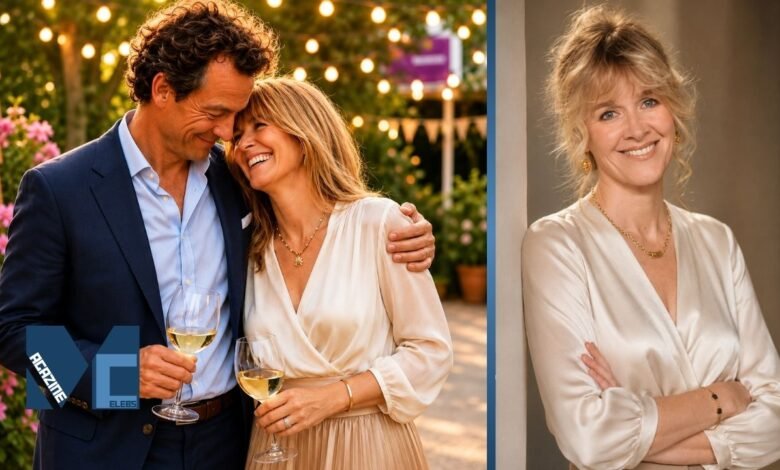
Catherine FitzGerald: The Irish Aristocrat and Landscape Designer Who Stood Her Ground
Born into one of Ireland's oldest noble dynasties, Catherine FitzGerald has built a distinguished career in landscape design entirely on her own terms — long before the tabloids ever came knocking.


*Disclaimer: We may earn a commission if you make a purchase through our affiliate links, at no extra cost to you.
⚡ Quick Facts: Catherine FitzGerald
Full Name
Catherine Celinda Leopoldine FitzGerald
Date of Birth
18 May 1971
Birthplace
Glin, County Limerick, Ireland
Age (2026)
54 Years Old
Profession
Landscape Designer & Gardener
Spouse
Dominic West (m. 2010)
Children
4 (Dora, Senan, Francis, Christabel)
Family Title
Daughter of the 29th Knight of Glin
Catherine FitzGerald is an Irish landscape designer, gardener, and aristocrat born on 18 May 1971 in Glin, County Limerick. The daughter of Desmond FitzGerald, the 29th and final Knight of Glin, she grew up steeped in one of Ireland’s most enduring noble dynasties — a lineage tracing its origins to Norman settlers of the medieval era. Today she is perhaps best known internationally as the wife of British actor Dominic West, though her professional reputation as a thoughtful and accomplished garden designer stands independently of that association.
Her career spans more than two decades of work across private estates, historic royal residences, and urban community spaces, with commissions ranging from Hillsborough Castle in Northern Ireland to a physic garden at Holyrood Palace in Edinburgh. She trained formally at the Royal Horticultural Society’s garden at Wisley after graduating from Trinity College Dublin, and went on to work under celebrated landscape architect Arabella Lennox-Boyd before establishing her own practice. Along the way, she built a quiet and steady body of work that has earned genuine respect within horticultural circles in both Ireland and Britain.
Public attention has come her way intermittently and not always on her own terms — most notably following tabloid coverage of her husband in October 2020. How she navigated that period, and what she has said about it in the years since, says rather a lot about her character. But to understand Catherine FitzGerald fully, you have to start, as she often does herself, at Glin.
Early Life & Biography — Growing Up at Glin Castle
She was raised, from around the age of three, at Glin Castle — the ancestral seat of the FitzGerald family on the south bank of the Shannon estuary. The castle itself is an 18th-century Gothic Revival structure set within a 400-acre wooded estate, and for Catherine it was simply home. The grounds, with their kitchen gardens, pleasure walks, and the particular quality of light that comes off the Shannon in winter, were her first classroom in horticulture.
The FitzGerald dynasty, to which she belongs through her father’s line, has deep roots in medieval Ireland. The family’s Hiberno-Norman origins and their centuries-long hereditary role as Knights of Glin gave the FitzGeralds an unusual place in Anglo-Irish cultural history — neither straightforwardly English nor simply Irish, but occupying a complicated middle ground that Desmond FitzGerald, her father, explored with considerable intellectual vigour throughout his life. Growing up in that household meant growing up around scholars, architects, conservators, and people who thought seriously about the relationship between the built environment and the landscape it inhabits. Those conversations left their mark.
Catherine attended St Mary’s Calne, a boarding school in Wiltshire, England, before returning to Ireland for university. The transition between two countries — something that would define her adult life as well — began early.
Parents, Siblings & Family Background
Her father, Desmond FitzGerald (1937–2011), was the 29th Knight of Glin and one of Ireland’s foremost authorities on Irish decorative arts and architecture. He spent many years as the Irish adviser to Christie’s auction house and was a prolific author and champion of Irish heritage preservation. He and his wife, Olda Ann Willes — Catherine’s mother — were central figures in the effort to restore and maintain Glin Castle after it had fallen into partial disrepair, work that consumed much of their adult lives and installed in their children a deep sense of responsibility toward the estate. Because the title Knight of Glin could only pass through the male line, and Desmond had no sons, the title became extinct upon his death in 2011.
Catherine has two younger sisters, Honor and Nesta. The three grew up in a household that was simultaneously a lived-in family home and a place of considerable cultural significance — a combination that brings its own peculiarities. Their godfather was the noted British antiques dealer and style arbiter Christopher Gibbs, a detail that speaks to the world their parents moved in. Of her siblings’ current lives, no verified public information has been widely reported.
Dominic West has spoken openly about his admiration for the FitzGerald family, describing them in a Sunday Times interview as “an amazing family” with a history he finds “very romantic and appealing.” He has said he feels a sense of personal obligation to help sustain Glin Castle’s legacy — a commitment that has, in practical terms, shaped where the couple have chosen to base their family.
Education — From Trinity to Wisley
After St Mary’s Calne, Catherine went on to Trinity College Dublin, where she read English and Art History. It was at Trinity that she first met Dominic West — both were students there in the early 1990s, and the two had what she later described to the Irish Independent as a “wonderful love affair,” reading poetry together with views over Dublin and the Wicklow Mountains. They were together for roughly six months before going their separate ways.
Following her Trinity degree, she undertook formal horticultural training at the Royal Horticultural Society’s garden at Wisley in Surrey — a two-year programme that gave her the technical grounding to move from instinct and observation into structured professional practice. She then worked as a planting designer under prominent figures in the British landscape design world, most notably Arabella Lennox-Boyd, who had won the prestigious Chelsea Flower Show’s Best in Show award multiple times. That apprenticeship gave her access to some of the most ambitious private garden projects in Britain and Ireland and shaped the restrained, place-responsive philosophy she would later articulate under her own name.
Career Timeline
Early 1990s
Studies English and Art History at Trinity College Dublin; begins informal horticultural work at Glin Castle during university years.
Mid-1990s
Completes two-year horticultural training at RHS Wisley, Surrey; subsequently joins Arabella Lennox-Boyd’s practice as a planting designer on major UK and Ireland projects.
2000s
Establishes independent practice; begins collaborating with London-based landscape architect Mark Lutyens. Undertakes private commissions across Ireland and the UK, from country estates to urban London courtyard gardens.
2011
Father Desmond FitzGerald, the 29th Knight of Glin, passes away. Catherine and Dominic West take on responsibility for Glin Castle and its grounds, eventually developing it into an exclusive hire venue for weddings and private events.
c. 2018–2020
Completes the redesign of gardens at Hillsborough Castle, Northern Ireland — the Royal Family’s official residence in the north, now managed by Historic Royal Palaces. The gardens open to the public to considerable acclaim.
2020–2021
Finds herself inadvertently at the centre of tabloid coverage following photographs of her husband Dominic West with actress Lily James in Rome. The couple issue a joint statement reaffirming their marriage. Catherine speaks publicly in an Irish Independent interview about the strength of their relationship.
Recent Years
Continues active design practice, contributing a planting scheme for St Olav’s Church in Rotherhithe, east London, and a newly imagined Physic Garden at Holyrood Palace in Edinburgh. Splits time between Glin, north Wiltshire, and London.
The Designer’s Philosophy — Gardens That Belong
What distinguishes Catherine FitzGerald’s approach to landscape design, and what has drawn serious clients to her work over more than two decades, is a discipline she describes as listening before planting. Her professional philosophy draws directly from Alexander Pope’s instruction to “consult the Genius of the place” — the idea, familiar to 18th-century garden theory, that any intervention in a landscape should enhance rather than override its inherent character. As she has written on her own website: “I seek to create gardens which feel completely of their place rather than imposed, acting with nature and local idiom rather than against it.”
In practice, that means reading soil, light, prevailing wind, and the existing ecology of a site before introducing a single plant. Her aesthetic leans toward what she calls “evergreen bones” — structural planting that provides form and permanence across every season — softened by looser, more romantic layers that shift with the year. It is a measured approach, but not a cold one. Descriptions of her completed gardens tend to emphasise atmosphere and a sense of having always been there.
The project at Hillsborough Castle represents her most visible public commission. Working alongside Mark Lutyens — with whom she has shared a studio for many years — she took on the redesign of gardens that serve not only as a royal residence but as a public heritage site now run by Historic Royal Palaces. Gardens of that kind carry obligations that purely private commissions do not: they must be botanically sound, visually compelling across the seasons, accessible to the general public, and respectful of their historical context all at once. The fact that the gardens have been well received by both horticultural critics and the visiting public is a meaningful measure of the work.
Beyond the major commissions, she has maintained a steady stream of private work on smaller-scale gardens — London courtyard spaces, country gardens in Wiltshire and Ireland — and has contributed written pieces on horticulture to publications including House & Garden, The Telegraph, and The Garden (the journal of the Royal Horticultural Society). Writing, for her, seems to be an extension of the same thinking she brings to design: careful, observational, and grounded in the specifics of place.
💜 A Human Perspective
In October 2020, Catherine FitzGerald faced a situation that most people would find deeply disorienting — being thrust into global tabloid scrutiny through no action of her own, as photographs of her husband with another woman circulated online and in print. She and Dominic appeared publicly together within days, issuing a handwritten note that confirmed their marriage was “strong.” In a subsequent interview with the Irish Independent, she spoke with striking candour about their early romance and what had brought them back together, describing it not in defensive terms but with something closer to perspective — the composure of someone who had lived through enough to know the difference between a crisis and a catastrophe. Her own husband has since described that period as “obviously horrible, particularly for her,” while noting they have been able to find some humour in how the press interpreted their every public moment afterward. It speaks, perhaps, to a relationship that had substance enough to absorb what was thrown at it.
Relationships, Marriage & Children
Catherine’s romantic history before Dominic West is a matter of public record. In 1995, she married Edward Lambton, Viscount Lambton — the future 7th Earl of Durham — in what would become a seven-year marriage. The couple divorced in 2002. Edward Lambton, known informally as Ned, is a British musician. No children were born from that marriage, according to available public records.
She and Dominic West had originally dated briefly as Trinity College students in the early 1990s, a romance she later recalled with considerable warmth. After their paths diverged — he went on to a relationship with Polly Astor, with whom he has a daughter named Martha — Catherine lived a separate adult life, married, and eventually divorced. It was only when she was in her early thirties that the two reconnected, becoming engaged in 2007 and marrying on 26 June 2010 in a Catholic ceremony at the Church of the Immaculate Conception in Limerick.
They have four children together: Dora, Senan, Francis, and Christabel. The family has been primarily based at Glin Castle in County Limerick, a choice that Dominic West has spoken about in several interviews with evident affection. “My children are surrounded by Irish wit and humanity,” he told one publication. “They have a far broader existence than they would anywhere else in the world.” The Wests also maintain a home in north Wiltshire, where Catherine has been developing a garden of rambling roses and fruit trees around a restored brewery house, as well as a base in London. The family, in other words, operates across three countries — which has its own particular character for children of that age.
Regarding the 2020 Lily James photographs and their aftermath: both Catherine and Dominic have addressed it publicly, in measured terms and without the kind of prolonged media management that such situations often generate. Dominic West spoke to The Sunday Times in April 2024, acknowledging how difficult the period was for his wife while noting that, with the distance of time, they have been able to laugh at how their every public appearance was framed as a “show of unity” — even when they had simply been arguing about parking. Catherine, for her part, had already offered her own account in the Irish Independent interview, framing her relationship with Dominic as one built over the full arc of adult life rather than a single dramatic decision. Whether that framing satisfies everyone is another matter; it is, however, consistent with everything else known about her approach to things.
“There’s something about having lived a full life before settling down — I felt I could throw myself into family life and having babies with gusto.”
— Catherine FitzGerald, speaking to Fox News / Irish Independent, 2021
Public Image & Personality
Catherine FitzGerald has never courted public attention. She maintains no verified social media presence of note, gives few interviews, and when she does speak to journalists it tends to be about her work or her family in terms that are warm but not confessional. The contrast with the celebrity ecosystem her husband moves in is pronounced, and appears to be entirely deliberate.
What emerges from the interviews she has given is a portrait of someone with a clear sense of her own priorities. She is evidently serious about her practice, speaking about it with precision and enthusiasm. She is loyal to the landscape of County Limerick, describing it as a wellspring of creative reference. And she is candid about the choices that have shaped her life — the first marriage that didn’t work, the reconnection with Dominic, the decision to raise a family far from the centre of British celebrity culture — without appearing to feel the need to justify any of them. That particular combination of groundedness and aristocratic self-assurance is, perhaps, what Dominic West has described as the quality of the family he married into.
Among professionals in the horticultural world, she is regarded as a practitioner who takes the work seriously and produces results of genuine quality. The Hillsborough Castle redesign in particular has attracted attention from garden historians and Royal Horticultural Society members as a model of how to approach a heritage landscape without anachronism or false nostalgia. For those who follow landscape design, her name carries weight quite apart from any association with The Wire or The Crown.
Financial Overview
Verified financial data regarding Catherine FitzGerald’s personal net worth has not been publicly disclosed. No credible source has produced confirmed earnings figures, fee structures, or asset valuations. Any specific net worth estimate circulating online should be treated with scepticism.
What can be stated with reasonable confidence, based on her verified public profile, is that her income streams derive from several identifiable sources: private landscape design commissions in Ireland and the UK; freelance writing for publications including House & Garden, The Garden, and The Telegraph; income generated by Glin Castle as an exclusive hire and event venue; and, presumably, income associated with the broader West household through Dominic’s acting career. The Glin Castle operation in particular appears to have been structured — along the lines of many comparable historic Irish estates — as a small luxury hospitality business rather than a purely private residence.
📊 Estimated Income Streams (Illustrative Overview — Not Verified Figures)
Note: These bars represent a qualitative illustration of income diversification, not quantified financial data. No verified net worth figure exists in public record for Catherine FitzGerald.
Where Is She Now? Current Lifestyle & Projects
As of 2026, Catherine FitzGerald divides her time between Ireland and England. The family’s primary home is Glin Castle in County Limerick, where she has spent over two decades adding to and adapting the grounds with extended plantings — a collection of magnolias, flowering trees, acid-loving shrubs, and an ongoing wildflower meadow project beneath a canopy of Killarney oaks. She has described the Gulf Stream microclimate of the west Irish coast as a perpetual source of horticultural possibility, allowing a range of tender and exotic plants that would not survive further east.
She also maintains a residence in north Wiltshire, England — a restored brewery house where she is, by her own account, building a more personal garden of rambling roses and fruit trees. It is, from the description she has offered publicly, very much a working domestic garden rather than a showpiece commission: the kind of place you make for yourself over years, without clients or deadlines. The London studio she shares with Mark Lutyens provides the professional base for her broader design practice.
Glin Castle, meanwhile, continues to operate as a small luxury venue and events space. Following the approach she and Dominic adopted after inheriting responsibility for the property from her parents, the castle accommodates up to 20 overnight guests on an exclusive hire basis, and hosts weddings, cultural events, and private gatherings. The Rococo interiors — painstakingly restored by her parents from the mid-20th century onward — are maintained in partnership with conservation specialists, while practical modernisations have been introduced to support guest stays.
Among recent professional work, the Holyrood Palace physic garden commission — a newly conceptualised medicinal and culinary garden space for the royal Edinburgh residence — represents a continuation of her engagement with historic and public-facing landscapes. She continues to write occasionally for horticultural publications, though her primary focus remains design practice itself. For partners of high-profile British actors who have built independent careers of genuine substance, Catherine FitzGerald’s trajectory offers an instructive model: stay grounded, stay serious about the work, and let the rest follow its own course.
✨ Glin Castle & Practice Snapshot
Estate History
800+ years FitzGerald ownership
Estate Scale
400-acre wooded demesne
Notable Commission
Hillsborough Castle (Historic Royal Palaces)
Practice Based
Ireland, UK (London & Wiltshire)
❓ Frequently Asked Questions
How old is Catherine FitzGerald?
Catherine FitzGerald was born on 18 May 1971, making her 54 years old as of May 2026.
Who is Catherine FitzGerald’s father?
Her father was Desmond FitzGerald (1937–2011), the 29th Knight of Glin and a prominent authority on Irish decorative arts and architecture. He was the last to hold the hereditary title, which became extinct upon his death as it could only pass through the male line.
When did Catherine FitzGerald marry Dominic West?
They married on 26 June 2010 in a Catholic ceremony at the Church of the Immaculate Conception in Limerick, Ireland. They had originally met as students at Trinity College Dublin in the early 1990s and rekindled their relationship in their early thirties.
How many children does Catherine FitzGerald have?
She and Dominic West have four children together: Dora, Senan, Francis, and Christabel. The family is primarily based at Glin Castle in County Limerick, Ireland.
Was Catherine FitzGerald married before Dominic West?
Yes. She married Edward Lambton, Viscount Lambton (the future 7th Earl of Durham), on 19 October 1995. They divorced in 2002. No children were born from that marriage.
What is Catherine FitzGerald’s most famous landscape design project?
Her most high-profile commission to date is the redesign of the gardens at Hillsborough Castle in Northern Ireland, the Royal Family’s official residence there, now managed by Historic Royal Palaces. The redesigned gardens opened to the public to positive critical reception.
What is Catherine FitzGerald’s net worth?
Verified financial data has not been publicly disclosed. No credible source has confirmed a specific net worth figure. She derives income from landscape design commissions, the Glin Castle venue operation, freelance horticultural writing, and other sources, but no independent financial estimate has been verified.
Final Thoughts
The story of Catherine FitzGerald is, in its essentials, one of continuity — between past and present, between landscape and the people who inhabit it, between inherited responsibility and personal ambition. She is the last direct inheritor of a dynasty that held a title stretching back to the 14th century, and she carries that legacy not as a burden but as a kind of professional raw material: the knowledge accumulated over generations about how a place works, what it needs, what it can bear.
Her design practice grew from that ground, literally and figuratively. The gardens at Glin Castle were her first sustained project, and the philosophy she developed there — attentiveness to the genius loci, respect for the rhythms of a specific place — has informed commissions as varied as a community meeting square outside a church in Rotherhithe and the grounds of a royal residence in Northern Ireland. That range is not accidental. It reflects someone who is genuinely curious about what landscape can do in very different contexts, and who has the technical training to act on that curiosity.
The tabloid chapter of 2020 gave many people their first introduction to her, which is an unfortunate way for anyone to be introduced. But those who looked beyond the headlines found something more interesting: a woman with deep roots, a serious profession, a close reading of the landscape she inhabits, and the confidence, apparently, to weather considerable turbulence without losing either. In the horticultural world, where she is primarily known, her reputation rests on the work. That is, by any measure, where she would prefer it to rest.
For readers interested in the broader world of British actors and the families behind their public lives, Catherine FitzGerald’s biography offers a compelling counterpoint — someone whose own story, professional achievements, and family heritage are entirely sufficient to stand on their own terms.
📚 Sources & References
- Catherine FitzGerald — Official Website (About Page)
- Catherine FitzGerald — Wikipedia
- Who Is Catherine FitzGerald? — Hello! Magazine (2020)
- Dominic West Discusses How Catherine Was Affected by Lily James Drama — E! Online (2024)
- Catherine FitzGerald Speaks on Her Marriage — Fox News / Irish Independent interview (2021)
- Catherine FitzGerald — Great Gardens of the World Profile
AB Rehman
Celebrity Features Writer
AB Rehman is a features writer specialising in public figures, aristocratic biography, and the British and Irish entertainment world. His work draws on verified public records, primary interviews, and established editorial sources to produce long-form profiles of cultural and public interest.
Editorial Disclaimer
This article has been researched using publicly available sources including official interviews, verified newspaper and magazine reports, and the subject’s own professional website. Financial data is not provided where not independently verified. All statements attributed to named individuals are drawn from published interviews in reputable media outlets. Where information could not be verified, this has been clearly noted. This article is intended for general informational and editorial purposes only.