
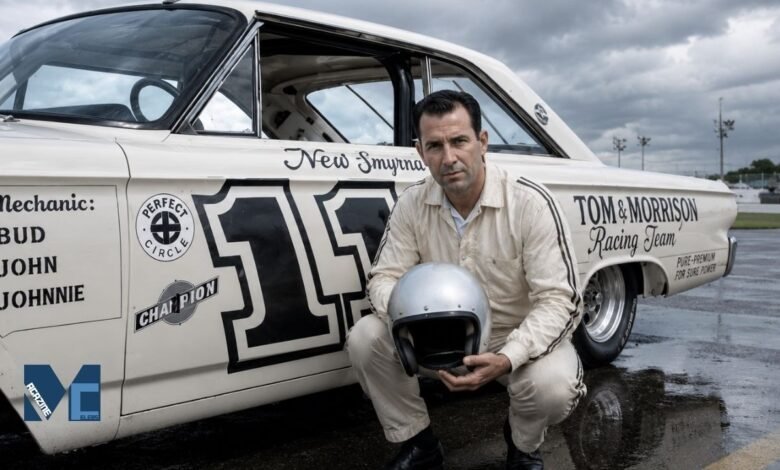
Ned Jarrett: The Gentleman Champion Who Raced Hard, Spoke Harder, and Lived Fully
A two-time NASCAR Cup champion, beloved broadcaster, and the patriarch of American stock car racing's most decorated family — the life of Ned Jarrett was one of quiet ferocity and lasting grace.


*Disclaimer: We may earn a commission if you make a purchase through our affiliate links, at no extra cost to you.
⚡ Quick Facts: Ned Jarrett
Full Name
Ned Miller Jarrett
Born
October 12, 1932 — Conover, NC
Died
June 4, 2026 — Newton, NC (Age 93)
Nickname
“Gentleman Ned”
NASCAR Championships
1961 & 1965 (Grand National)
Career Wins
50 (in 352 starts)
Hall of Fame
NASCAR Hall of Fame (2011)
Children
Glenn Jarrett, Dale Jarrett, Patricia Jarrett
Ned Jarrett — born October 12, 1932, in Conover, North Carolina, and passed away peacefully on June 4, 2026, at age 93 — was one of the most complete figures American motorsport has ever produced. A two-time NASCAR Grand National champion, a broadcaster whose voice became part of the sport’s mythology, and a father whose son would one day lift the same trophy he once held, Jarrett’s life traced an arc that few athletes ever manage: sustained excellence followed by genuine reinvention.
He is remembered as “Gentleman Ned” — a nickname that stuck not as flattery, but as something closer to a measured verdict. In a sport built on aggression, Jarrett was calm under pressure without ever sacrificing the competitive ruthlessness required to win. He claimed 50 Cup Series victories across just 352 starts, including a 1965 season so dominant it remains unmatched in certain statistical categories to this day. When he retired that year at 34 — still champion, voluntarily — he became the only driver in NASCAR history to walk away from the sport as a sitting series champion.
What came after was, if anything, equally impressive. His broadcasting career spanned decades with CBS and ESPN, culminating in a 1993 Daytona 500 call that has been replayed more times than perhaps any other moment in NASCAR media history. And through all of it — the sawmill childhood, the bad check written to buy a race car, the broken back he raced through, the son he openly cheered to victory on national television — Jarrett remained, by every verified account, exactly who he presented himself to be.
Early Life & Biography — Born in the Foothills of North Carolina
The piedmont foothills of Catawba County, North Carolina, in the 1930s were not a place that promised much by way of spectacle. Farming and timber work defined the local economy, and Homer Keith Jarrett ran a sawmill that kept the family solvent through discipline and labor. His son Ned grew up in that world — working the mill by age twelve, learning the weight of honest effort before he ever had a chance to court any other kind.
But cars were in the air. According to established accounts, his father allowed young Ned to drive the family vehicle to church on Sunday mornings when he was just nine years old — a detail that, whether folklore or fact, captures something essential about how the boy related to machines. Later, sitting in a local general store, he would overhear farmers talking excitedly about a new racetrack being carved into a hillside nearby at Hickory. By the time his father took him to that brand-new Hickory Motor Speedway, something had been permanently settled inside him.
That Homer Jarrett disapproved of racing as a profession made little practical difference. Ned was drawn to it with a certainty that teenage prohibition could only delay. He entered his first race in 1952 — co-owning a Sportsman Series Ford with his brother-in-law, John Lence — and finished tenth. His father found out. The terms were straightforward: he could work on cars, but not drive them. Ned obeyed, until he didn’t.
Parents, Siblings & Family Background
Ned Jarrett was the son of Homer Keith Jarrett and Eoline Marie, a North Carolina family rooted in farming and sawmill work. His parents were devout, practical people — the kind who saw racing not as ambition but as recklessness. Homer’s eventual acceptance of his son’s chosen path came only after the wins became impossible to ignore. Once Ned began collecting victories under his own name, the objections softened into something like pride.
No detailed public records exist confirming the names or careers of Ned’s siblings beyond what appears in general biographical sources. What is consistently documented is the collaborative bond between Ned and his brother-in-law John Lence, who co-owned his early Sportsman car and whose occasional absences from the driver’s seat gave Ned his first covert opportunities behind the wheel.
Jarrett’s personal life unfolded in two chapters. He married his first wife, Olene Rebecca Proctor, on January 14, 1950. They had one son, Glenn Ned Jarrett, born in 1950. The marriage ended in divorce. On February 18, 1956, Ned married Martha Ruth Bowman, a native of Catawba County whom he had met at a small-town dance years earlier. Their partnership lasted 67 years and produced two more children — Dale Arnold Jarrett, born November 26, 1956, and Patricia Dawn Jarrett, born August 31, 1959. Martha passed away peacefully on February 5, 2023, surrounded by family.
Education & Formative Years
Specific details about Ned Jarrett’s formal schooling have not been publicly disclosed in verified sources. What is well-established is that his practical education came through the family sawmill, the surrounding agricultural community of Catawba County, and — most consequentially — the short tracks and dirt ovals of the Carolina piedmont. The sport itself was his curriculum.
By his own account, the values instilled by his upbringing — hard work, honesty, faith, and a certain steadiness under pressure — were the qualities he carried into competition and, later, into the broadcast booth. His family noted after his passing that he was “a devout Christian and a devoted, loving family man,” traits that clearly predated any championship win. The faith and community orientation of his early years in Catawba County seemed to inform everything that came after, including his reputation for sportsmanship in a sport not always associated with that quality.
Full Bio & Career Timeline
1952–1953
Jarrett enters his first Sportsman race at Hickory Motor Speedway, co-owning a Ford with brother-in-law John Lence. His father disapproves. He later competes under assumed names to circumvent the ban — including using Lence’s name to race when his brother-in-law falls ill. He finishes second, and the ruse is eventually discovered. His father relents.
1957–1958
Jarrett claims back-to-back NASCAR National Sportsman Division championships — the predecessor to what is now the Xfinity Series. Over two seasons, he enters roughly 150 races and wins approximately 80 of them. His chief rival is Ralph Earnhardt, father of the future NASCAR legend Dale Earnhardt Sr.
1959
To fund his move to NASCAR’s elite Grand National division, Jarrett agrees to pay $2,000 for a 1957 Ford owned by Junior Johnson’s operation — writing a check he knows will bounce. With banks closed for the weekend, he has two races to win enough prize money to cover it. He wins both. The car is his. The story becomes legend.
1961
Jarrett wins his first NASCAR Grand National championship driving a Chevrolet for owner B.G. Holloway. The title is built not on dominant victories — he wins just once — but on extraordinary consistency: 34 top-ten finishes in 46 starts. He beats Rex White for the title.
1965
The most dominant season in Jarrett’s career — and arguably one of the most dominant in early NASCAR history. Driving for DuPont heir Bondy Long, he wins 13 races and finishes in the top five in 42 of 54 starts. He claims the Southern 500 at Darlington Raceway by 14 laps — still the largest margin of victory by distance in NASCAR Cup Series history. He wins the title despite breaking his back in a June crash at Greenville-Pickens Speedway and recovering to complete the season.
1966
When Ford Motor Company announces its withdrawal from NASCAR, Jarrett — having lost factory support — chooses retirement over an uncertain future in underfunded machinery. He is 34 years old and the reigning champion. He remains the only driver in NASCAR Cup history to retire while holding that title.
1978–2000
Jarrett launches his second career behind the microphone. Beginning as a pit-road reporter for Motor Racing Network (MRN) in 1978, he transitions to television and spends 17 years as an analyst for CBS Sports. He also works with ESPN. In 1984, he interviews President Ronald Reagan live at the Firecracker 400, the race in which Richard Petty claimed his 200th career victory.
2011
Jarrett is formally inducted into the NASCAR Hall of Fame as part of the Hall’s second class of inductees, alongside David Pearson, Bobby Allison, Lee Petty, and Bud Moore. He had already been inducted into the Motorsports Hall of Fame of America in 1997 — one of more than twelve motorsports and sports halls of fame that honored him by 2004.
The 1993 Daytona 500: A Moment That Defined a Career
There are broadcast moments, and then there is what happened inside the CBS booth at Daytona International Speedway on February 14, 1993. Ned Jarrett was calling the final laps of the Daytona 500 when his youngest son, Dale, wheeled his Joe Gibbs Racing entry toward the lead. Below in the field, five-time series champion Dale Earnhardt stalked the rear bumper. What followed was less a sporting call and more an act of pure, unguarded fatherhood heard by millions.
“C’mon, Dale, go baby, go,” Jarrett told the television audience, having apparently decided that professional neutrality could wait. “Don’t let him get to the inside of you coming around this turn… It’s the Dale and Dale show as they come off Turn 4. You know who I’m pulling for — it’s Dale Jarrett. Bring her to the inside, Dale, don’t let him get down there. He’s gonna make it! Dale Jarrett’s gonna win the Daytona 500!”
The call has been replayed countless times since. What made it endure wasn’t just the result — Dale Jarrett did win — but the emotional nakedness of a father watching his son conquer a race the father himself never won. Ned Jarrett later recalled that people regularly asked him whether Dale could actually hear him, imagining him somehow wired into the car’s communication system. He wasn’t. He was simply a parent who forgot, momentarily and magnificently, that he was also a television broadcaster.
Ned was present for Dale’s other two Daytona 500 victories as well, in 1996 and 2000. When Dale Jarrett captured the 1999 NASCAR Winston Cup Series title, the family joined Lee and Richard Petty as just the second father-son combination in history to each win Cup championships. That lineage — not unlike the families of other great sporting dynasties — is now regarded as one of the defining narratives in American motorsport.
💜 A Human Perspective
In 1965, Ned Jarrett broke his back in a crash at Greenville-Pickens Speedway — and then returned to the car anyway, completing arguably the greatest championship season in early NASCAR history. That willingness to absorb physical damage and keep competing speaks to something beyond mere toughness; it speaks to a man who had decided, somewhere along the way, that fear was a condition to be managed rather than obeyed. Losing Martha, his wife of 67 years, in February 2023 — the woman he had met at a small-town dance in the Carolina foothills decades before — was the kind of loss that cannot be raced through or broadcast past. It simply had to be carried. He did, for three more years, until his own passing on June 4, 2026, at home in Newton, North Carolina, with family beside him.
Family, Marriage & Children
Ned Jarrett married twice. His first marriage was to Olene Rebecca Proctor on January 14, 1950, with whom he had a son, Glenn Ned Jarrett. The marriage ended before 1956. Glenn went on to become a NASCAR driver himself and later a pit reporter for MRN Radio — the same network his father had helped put on the map.
The defining partnership of Ned’s life was with Martha Ruth Bowman, whom he married on February 18, 1956. By all accounts, she was central to his decision-making — including, reportedly, his choice to retire from driving in 1966. Racing’s physical risks were real and the family was growing; Martha’s presence in the conversation mattered. Their 67 years together produced two more children. Dale Arnold Jarrett, born in 1956, became one of the sport’s genuine stars: three Daytona 500 wins, the 1999 Winston Cup championship, and — following his father’s induction — his own place in the NASCAR Hall of Fame. Patricia Dawn Jarrett, born in 1959, married Jimmy Makar, who served as Dale’s crew chief during his Joe Gibbs Racing years and was instrumental in several of Dale’s major victories.
Martha Bowman Jarrett passed away on February 5, 2023. According to a family statement released at the time, the couple had spent those years “in complete love and devotion.” Ned and Dale Jarrett form part of a select group of families — alongside the Pettys and, more recently, the Elliotts — whose father-son NASCAR championship pairings give the sport a generational texture it rarely achieves in other forms of American motorsport.
Public Image & the “Gentleman Ned” Reputation
The nickname “Gentleman Ned” was not constructed by a publicist. It emerged organically from the paddock, from competitors and officials who noticed that Jarrett seemed to operate according to a code that had nothing to do with racing strategy. He did not manufacture feuds. He did not play politics with the press. When he lost, he absorbed it. When he won — emphatically, repeatedly — he did so without performing contempt for the defeated.
NASCAR CEO Steve O’Donnell captured the essential tension in his statement following Jarrett’s death: “Despite his calm demeanor, ‘Gentleman’ Ned Jarrett was as fierce a competitor as NASCAR has ever seen.” That word “despite” is doing significant work. The two qualities — gentleness and ferocity — are typically positioned as opposites. Jarrett’s career suggests they needn’t be. His 1965 win total of 13 races, in a field of accomplished competitors, was not achieved through manners. It was achieved through an almost mechanical consistency and an ability to manage machinery across long races that his peers often found supernatural.
In 1998, NASCAR named him one of its 50 Greatest Drivers of all time. His 43 victories in Ford-equipped machinery remain the manufacturer record for that marque. After his death, tributes arrived from across the sport — from Hall of Famers and team owners, from broadcasters who had learned from him, and from fans who remembered the sound of his voice on a February afternoon in 1993. The way passion projects of certain public figures take on lives of their own applies particularly well to Jarrett’s broadcasting legacy, which outlasted his racing career in terms of cultural reach.
Financial Overview
Verified financial data regarding Ned Jarrett’s personal net worth has not been publicly disclosed by his estate or any official source. Estimates appearing on various celebrity biography websites vary considerably and should not be treated as authoritative. What can be reasonably stated is that Jarrett’s income across his lifetime came from multiple streams: prize money from his racing career in the 1950s and 1960s (an era when NASCAR purses were substantially smaller than today’s), a long-running radio and television broadcasting career spanning from the 1960s through the early 2000s, personal appearances, endorsements, and his long association with MRN, CBS, and ESPN.
His 1965 season — 13 wins and a championship — would have commanded significant prize earnings for its era, but direct comparisons to modern NASCAR economics are misleading. The sport has transformed financially in ways that make historical salary estimations unreliable without access to contemporaneous records, which have not been made public.
📊 Estimated Income Sources — Ned Jarrett (Illustrative, Not Verified)
Note: Income source proportions are illustrative based on career timelines only. No verified financial figures are publicly available. Percentages do not reflect actual earnings data.
“Ned Jarrett’s life was proof that you can be hard-edged and deeply principled at the same time — that the person who breaks their back in June and wins the championship in October isn’t a machine, but someone who has simply decided, over and over again, to keep going.”
— AB Rehman, Celebrity Features Writer
Where He Was, and Where He Left From
In his final years, Ned Jarrett remained in Newton, North Carolina — the same part of the world where he was born, where he first pressed a pedal to the floor on a Sunday morning, where he learned the texture of a sawmill and the weight of ambition deferred. He had never been one for relocation as a statement of success. Newton was home. It stayed home.
After Martha’s death in February 2023, Jarrett entered the final chapter with his family close. He had outlived his wife, outlasted most of his contemporaries, and watched the sport he shaped evolve into something almost unrecognizable from the dirt-track world of his youth. Yet his contributions were still being cited at NASCAR events, his 1993 Daytona call still clipped and reshared, his 1965 margin of victory still standing — unchallenged — in the record books.
He died on June 4, 2026, at his home in Newton, North Carolina, with his family present. He was 93 years old. His family described him simply as “a true NASCAR legend” and “truly the best father anyone could have wished for.” Both things, based on the public record, appear to be accurate. The stories of spouses who stand beside legendary athletes — as Martha Bowman Jarrett did for 67 years — rarely receive their proper accounting. Hers was one such story.
✨ Ned Jarrett — Career & Legacy Snapshot
Total Cup Wins
50 (in 352 starts)
Championships
2 (1961 & 1965)
Record Still Standing
Largest margin of victory (14 laps, 1965 Southern 500)
Hall of Fame
NASCAR (2011) + 12+ others
❓ Frequently Asked Questions — Ned Jarrett
When did Ned Jarrett die?
Ned Jarrett passed away on June 4, 2026, at his home in Newton, North Carolina. He was 93 years old and died peacefully of natural causes, with his family by his side.
How many NASCAR championships did Ned Jarrett win?
Ned Jarrett won two NASCAR Grand National (Cup Series) championships — in 1961 and 1965. He also won two NASCAR Sportsman Division championships in 1957 and 1958.
Why is Ned Jarrett called “Gentleman Ned”?
The nickname arose from his reputation for calm sportsmanship and dignified conduct both on and off the track — qualities that stood out in the competitive, often rough environment of early NASCAR racing.
Is Dale Jarrett the son of Ned Jarrett?
Yes. Dale Arnold Jarrett, born November 26, 1956, is Ned’s son with his second wife Martha Bowman. Dale went on to win three Daytona 500s (1993, 1996, 2000) and the 1999 NASCAR Winston Cup championship, making the Jarretts only the second father-son pair to each win Cup titles, after Lee and Richard Petty.
What was Ned Jarrett’s most famous broadcasting moment?
His call of the final laps of the 1993 Daytona 500 on CBS, in which he openly cheered his son Dale to victory over Dale Earnhardt. The call — including the line “Dale Jarrett’s gonna win the Daytona 500!” — remains one of the most replayed moments in NASCAR broadcast history.
Why did Ned Jarrett retire from racing at age 34?
When Ford Motor Company withdrew from NASCAR competition in 1966, Jarrett lost his factory support. Faced with the prospect of racing in less competitive machinery, he chose to retire while he was still the reigning champion. He remains the only driver in Cup Series history to do so. Family considerations, particularly his commitment to Martha and their children, also played a documented role in the decision.
How many children did Ned Jarrett have?
Ned Jarrett had three children. Glenn Ned Jarrett (born 1950) from his first marriage to Olene Rebecca Proctor; and Dale Jarrett (born 1956) and Patricia Dawn Jarrett (born 1959) from his marriage to Martha Ruth Bowman.
What NASCAR record does Ned Jarrett still hold?
Jarrett holds the record for the largest margin of victory in NASCAR Cup Series history — winning the 1965 Southern 500 at Darlington Raceway by 14 laps (approximately 17.5 miles over the second-place finisher). That record has never been broken.
Final Thoughts
Ned Jarrett’s story doesn’t follow a conventional hero arc, which is perhaps why it holds up so well decades on. There’s no single moment of revelation, no dramatic comeback from total obscurity. What there is instead is a man who chose a disreputable profession against his father’s wishes, won it twice at the highest level, walked away voluntarily at his peak, rebuilt himself in a completely different medium, and then — in a broadcast booth on Valentine’s Day 1993 — let the whole world hear him be a father for three unforgettable minutes.
The records he left are genuine: 50 Cup Series victories, two championships, the largest margin of victory in the sport’s history, a 17-year run as one of television’s most credible motorsport voices. But the more lasting thing may be the culture he represented. Racing, at its competitive heights, tends to reward selfishness. Jarrett seemed to understand that there was a different way to compete — one that took nothing away from the ferocity but added something the fiercest competitors in the sport rarely manage: the quality of being genuinely liked.
He was named one of NASCAR’s 50 Greatest Drivers in 1998. He was inducted into the Hall of Fame in 2011. He outlived his wife, his rivals, and most of his era. And when he died on June 4, 2026, in the same North Carolina county where he had grown up, he left behind a family that has never stopped competing — and a sport that, in certain fundamental ways, still measures itself against the standard he set.
📚 Sources & References
- NASCAR.com — Official Statement: Ned Jarrett, Two-Time Cup Series Champion, Dies at 93 (June 5, 2026)
- ESPN — NASCAR Hall of Fame Driver, Announcer Ned Jarrett Dies at 93
- Encyclopaedia Britannica — Ned Jarrett Biography
- Wikipedia — Ned Jarrett
- NASCAR Hall of Fame — Ned Jarrett Inductee Profile (Class of 2011)
- Speed Sport — The Amazing Life of Ned Jarrett
- Interstate Batteries — Dale vs. Dale: The 1993 Daytona 500 and the Jarrett Family
- RACER Magazine — Ned Jarrett 1932–2026
About the Author
AB Rehman
AB Rehman is a celebrity features writer and biography research analyst specialising in public figures across sport, entertainment, and American culture. His work focuses on factual, long-form profiles built on verified public sources.
⚠️ Editorial Disclaimer
This article has been compiled from publicly available sources including official NASCAR statements, reputable news organisations, encyclopaedia entries, and established motorsport publications. All financial references are acknowledged as unverified estimates where no authoritative data exists. This article does not constitute legal, financial, or medical advice. Where information could not be confirmed through verified public sources, this has been noted explicitly. Readers are encouraged to cross-reference information with primary sources listed above.