
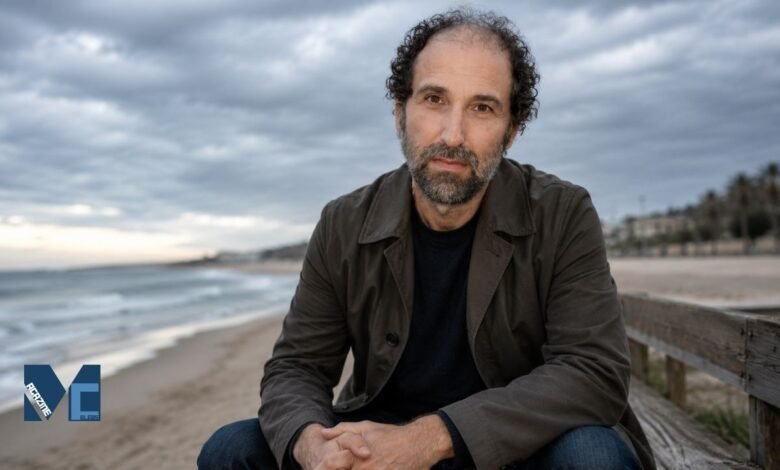
Thomas Bangalter: The Man Behind the Helmet — Biography, Net Worth & Life After Daft Punk
From a Paris apartment studio to five Grammy Awards — the full, verified biography of the French electronic music producer who changed modern sound and then quietly walked away from it all.


*Disclaimer: We may earn a commission if you make a purchase through our affiliate links, at no extra cost to you.
⚡ Quick Facts
Full Name
Thomas Bangalter
Date of Birth
January 3, 1975
Age (2026)
51 years old
Birthplace
Paris, France
Known For
Co-founder, Daft Punk
Spouse
Élodie Bouchez (m. 1996)
Children
2 sons (Tara-Jay, Roxan)
Est. Net Worth
~$90M (unverified)
Thomas Bangalter was born on January 3, 1975, in Paris, France. He is best known as one half of the pioneering electronic duo Daft Punk, alongside Guy-Manuel de Homem-Christo — a partnership that ran from 1993 until the group’s dissolution in February 2021. Over nearly three decades, Bangalter helped produce some of the most commercially and critically successful electronic music ever recorded, culminating in five Grammy Awards for 2013’s Random Access Memories, including Album of the Year. He is also a record label founder, film score composer, and, since 2023, a solo classical orchestral composer.
What makes Bangalter genuinely unusual in the contemporary music landscape is the sustained, almost philosophical commitment to privacy he maintained for most of his career. For the better part of two decades, he and de Homem-Christo appeared publicly only in elaborate robotic helmets — a choice that was equal parts performance art and personal preference. The decision was deliberate, and in interviews following Daft Punk’s breakup, Bangalter has been candid about what it meant to him. “We were always on the side of humanity and not on the side of technology,” he told the BBC in 2023, describing the robot personas as something closer to a long-running conceptual art installation than a simple stage gimmick.
Since stepping out from behind the helmet, Bangalter has spoken more openly — to the New York Times, NPR, and others — about his creative thinking, his Parisian upbringing, and the unusual trajectory that took him from house music into the concert halls of Bordeaux. This biography draws on those verified public statements and established reporting to piece together as complete and accurate a picture as the public record permits.
Early Life & Biography
Bangalter grew up in Paris at a time when the city was undergoing a quiet cultural ferment — the French electronic scene that would later give the world house, French touch, and electroclash was still many years away from forming. His household, however, was already saturated with music. He began piano lessons at the age of six, studying under a member of the Paris Opera’s teaching staff. By his own account, his parents held him strictly to his practice schedule — something he later expressed gratitude for, even if it felt like discipline at the time.
In 1987, Bangalter enrolled at Lycée Carnot, a public secondary school in Paris, where he encountered the person who would define much of his adult life. In eighth grade, he met Guillaume Emmanuel de Homem-Christo — known publicly as Guy-Manuel de Homem-Christo — and the two bonded over a shared enthusiasm for 1960s and 1970s film and music. That early rapport, rooted in taste rather than ambition, would eventually become the bedrock of Daft Punk.
Together with a third classmate, Laurent Brancowitz, Bangalter and de Homem-Christo formed an indie punk band called Darlin’ in the early 1990s. Brancowitz later departed to join the band Phoenix — a group that would go on to considerable international success of its own. When Brancowitz left, Bangalter and de Homem-Christo shifted their attention to electronic music, beginning to experiment with synthesizers and drum machines. That pivot, from guitars to machines, was the decisive turn.
Parents, Siblings & Family Background
Bangalter’s father is Daniel Bangalter — known professionally as Daniel Vangarde — a French songwriter and record producer who built a significant career in European pop and disco. Vangarde’s credits include work with the Gibson Brothers and the group Ottawan, whose 1980 hit “D.I.S.C.O.” became a European chart staple. His influence on his son was tangible: while Bangalter was not raised to simply follow in his father’s footsteps, Vangarde played an active advisory role in guiding the young duo through the practicalities of the recording industry in their early years.
His mother, Thérèse Thoreux, was a classical dancer and choreographer. The family connection to dance and choreography would resurface decades later in one of the most significant projects of Bangalter’s solo career. No verified public information is available regarding siblings.
Bangalter has described growing up in a home where the arts were simply the fabric of ordinary life — not rarefied or distant, but present and practical. His father’s professional world was the music business as a trade; his mother’s was movement and performance as discipline. The combination, he has suggested in various interviews, gave him a particular understanding of craft as work rather than inspiration alone. Like the formative influence of a parent’s artistic career on a child’s later creative identity, Bangalter’s upbringing was perhaps the most consequential shaping force in his professional life.
Full Bio & Career Timeline
1987–1992
Meets Guy-Manuel de Homem-Christo at Lycée Carnot in Paris. The pair form indie punk band Darlin’ with classmate Laurent Brancowitz, who later joins Phoenix.
1993
Daft Punk is formally founded after Darlin’ dissolves. The duo receive a dismissive review in Melody Maker calling their sound “a daft punky thrash” — inadvertently providing the name they would carry for 28 years.
1997
Debut album Homework is released, largely recorded in Bangalter’s home. The record redefines electronic music in Europe and breaks the duo into the mainstream. Bangalter also launches his solo record label, Roulé.
1998
As part of the trio Stardust, Bangalter co-produces “Music Sounds Better with You,” a single that becomes one of the defining tracks of the French house era and reaches No. 2 in the UK charts.
2001
Discovery is released — Daft Punk’s second studio album and a commercial breakthrough. The duo adopt their signature robotic helmets and begin to construct the visual mythology that will define their public identity for two decades.
2002
Bangalter composes the score for Gaspar Noé’s controversial film Irréversible, demonstrating an early and serious interest in cinema beyond club music.
2010
Daft Punk provides the full soundtrack for Disney’s Tron: Legacy, blending orchestral and electronic elements and introducing the duo to an entirely new generation of listeners. Bangalter is awarded the Chevalier des Arts et des Lettres by the French government.
2013–2014
Random Access Memories is released on May 17, 2013. It debuts at number one in twenty countries and wins five Grammy Awards the following year, including Album of the Year and Record of the Year for lead single “Get Lucky” (featuring Pharrell Williams and Nile Rodgers).
February 2021
Daft Punk announces its dissolution via an eight-minute video titled “Epilogue,” excerpted from their 2006 film Electroma. No official statement explains the decision in detail. The announcement generates an immediate surge in album sales worldwide.
2022–2023
Bangalter’s orchestral score for the ballet Mythologies, choreographed by Angelin Preljocaj, premieres in Bordeaux and is subsequently released as a solo album on April 7, 2023, via Erato/Warner Classics — his first major solo release and his most substantial public reemergence since Daft Punk’s breakup.
The arc of Bangalter’s career resists easy categorisation. He came of age in the Paris club scene of the early 1990s — a world of warehouse parties, imported Chicago house records, and bedroom production setups. Homework, released in 1997, was practically a document of that moment: raw, functional, and recorded without formal studio infrastructure. The tracks “Around the World” and “Da Funk” established a sound that was immediately identifiable yet difficult to imitate — music that seemed to operate outside genre boundaries even as it was saturated with genre influence.
The subsequent years brought increasing scale. Discovery (2001) was a more polished, pop-inflected record, accompanied by a feature-length animated film produced with Japanese director Leiji Matsumoto. The helmets arrived around this time — a choice that has been interpreted variously as anti-celebrity posturing, conceptual art, and straightforward introversion. Bangalter’s own explanations have tended toward the philosophical: the robots, he has said, were a way of centring the music rather than the personalities behind it. As questions of public identity and persona have become central to celebrity culture, Daft Punk’s decision to physically mask themselves looks increasingly prescient.
The Tron: Legacy soundtrack in 2010 marked a genuine expansion of Bangalter’s compositional register. Working within the constraints of film — synchronising emotional cues to visual narrative, writing for orchestra alongside synthesiser — gave the duo experience that would visibly inform everything that followed. The Grammy sweep for Random Access Memories in 2014 represented the commercial and critical apex of the Daft Punk project. The album was made with live session musicians in professional studios, a deliberate departure from the electronic production methods that had defined the duo’s earlier work. Collaborators included Nile Rodgers, Pharrell Williams, Giorgio Moroder, and Julian Casablancas — a roster that underscored Bangalter and de Homem-Christo’s ambition to situate their music within a broader history of recorded pop rather than simply the electronic dance canon.
💜 A Human Perspective
Wearing a robot helmet for two decades is not simply a stylistic choice — it is a way of managing the psychological weight of extreme public visibility. Bangalter has spoken candidly about the toll that sustained fame and constant scrutiny exact on creative people. His comment to the BBC that “the last thing I would want to be, in 2023, is a robot” carries more than irony: it suggests a genuine reckoning with what the persona cost as well as what it protected. The years of anonymity also meant that when Bangalter finally began speaking under his own name — to the New York Times, to NPR, to concert programme notes — there was an unusual quality of freshness to those conversations, as though a long silence had been lifted. For someone who shaped the sound of a generation, the willingness to step back from the spotlight and reimagine himself as a classical composer reflects both courage and an unusually settled artistic identity.
Relationships & Personal Life
Bangalter has been married to French actress Élodie Bouchez since 1996, according to public records — though some sources cite their wedding year as 2001 or 2002, and the precise date has not been officially confirmed. Bouchez is a respected figure in French and international cinema, having won the César Award for Best Actress. The couple have two sons: Tara-Jay, born around 2002, and Roxan, born in 2008. Exact birth dates have not been publicly disclosed.
In the mid-2000s, the family relocated temporarily to Beverly Hills, California, partly to support Bouchez’s work in American productions and partly due to Bangalter’s own growing interest in film composition. They subsequently returned to France. Bangalter has been consistently reticent about his domestic life in interviews, and very little of it has entered the public domain. He does not maintain verified social media accounts in any public capacity, and the couple rarely appears together at industry events. This sustained discretion sets him apart sharply from most musicians of equivalent stature — a contrast worth noting, especially in an era when the personal lives of even tangentially famous figures are subject to intense public scrutiny.
Public Image & Artistic Identity
For most of the period during which Bangalter was one of the most commercially successful musicians on earth, nobody outside his immediate circle knew what he looked like. That is an extraordinary fact, and it deserves more attention than it typically receives. The robotic helmets were many things simultaneously — a rejection of the celebrity apparatus, a conceptual statement about the relationship between humans and machines, and a practical solution to the question of how two intensely private people could operate at stadium scale without sacrificing their sense of self.
Bangalter has been characteristically thoughtful in discussing this period since Daft Punk’s dissolution. In one of his most widely cited post-breakup statements, he described the robot characters as comparable to a Marina Abramović performance art piece — something sustained, deliberate, and ultimately finite. The helmets, in this reading, were never a disguise so much as a costume worn in full awareness of its own artifice. What distinguishes this from ordinary celebrity eccentricity is the philosophical coherence: Bangalter appears genuinely to have thought through the implications of the persona over many years, rather than simply falling into it.
His father’s background in the commercial music industry likely gave him a clear-eyed view of the machinery behind fame from an early age. The result is an artist who engaged with the pop world on his own terms — releasing records through major labels, winning mainstream awards, collaborating with household names — while maintaining a private life that the vast majority of similarly successful musicians have never managed to sustain. Much like the complex dynamics between artistic legacy and personal identity, Bangalter’s story invites serious reflection on what musicians sacrifice — and preserve — in the construction of a public persona.
Financial Overview: Net Worth & Earnings
Verified financial data for Thomas Bangalter has not been publicly disclosed. No official or audited figures exist in the public domain. Multiple entertainment finance websites have cited estimates in the range of $90 million USD as of 2024–2026, attributing this to Daft Punk’s catalogue royalties, touring revenue from their live performances (including the celebrated 2006–2007 Alive tour), licensing deals for films and advertising, and the Roulé record label, which Bangalter operated until its dissolution in 2018. These estimates should be treated as plausible approximations rather than verified facts.
What can be established is that Daft Punk’s commercial footprint was substantial. Random Access Memories debuted at number one in twenty countries; the Alive 2007 tour helped open the American market to electronic dance music on a scale that few European acts had previously achieved; and the duo’s music has been licensed extensively for advertising, film, and television over more than two decades. Bangalter’s composition for Tron: Legacy, his Stardust single “Music Sounds Better with You,” and his various soundtrack contributions would all represent ongoing royalty streams. The precise sum, however, remains unverified.
📊 Estimated Earnings Breakdown (Unverified — 2026)
Note: All figures and proportions are estimated from public reporting. No verified financial disclosures exist. Treat as indicative only.
“What Bangalter built over three decades — the music, the mystique, the deliberate retreat from celebrity — amounts to one of the most coherent artistic careers in modern popular music. The robot was always a frame. The work inside it was entirely human.”
— AB Rehman, Celebrity Features Writer
Where Is He Now? Current Lifestyle & Status
As of 2026, Thomas Bangalter is based in France, having long since returned from the family’s California period. He maintains a significantly lower public profile than most artists of equivalent historical stature, granting interviews selectively and appearing at events rarely. His most visible recent creative work has been the promotion and reception of Mythologies, the orchestral album released in April 2023, which represents a genuine creative departure — 23 tracks composed for a full symphony orchestra, drawing on Baroque music and American minimalism rather than anything in the electronic dance canon.
The project is meaningful beyond its musical content. For someone who spent two decades making dance music in robotic costume, composing a ballet score for the Opéra National de Bordeaux reads as a deliberate act of artistic reinvention. Bangalter has spoken about finding the assignment — first proposed by choreographer Angelin Preljocaj in 2019 — at precisely the moment he was looking for a reason to write for a full orchestra. The timing of the project’s commission, predating the Daft Punk dissolution, suggests the creative shift was underway long before the public announcement of the breakup.
His trajectory since 2021 has also included contributions to Gaspar Noé’s 2018 film Climax and the 2022 French film En Corps (about a ballet dancer, in a coincidence that seems almost too neat). He co-produced tracks on Arcade Fire’s 2017 album Everything Now and contributed work to Matthieu Chedid’s 2019 record. These projects suggest a musician who has not retired so much as recalibrated — moving away from the infrastructure of mass popular music toward more selective, personally meaningful collaborations. For fans who discovered Bangalter through the lens of public figures who have successfully navigated the transition from youthful fame to mature creative life, his post-Daft Punk chapter offers a genuinely interesting model.
✨ Thomas Bangalter: Career Snapshot
Active Years
1992 – Present
Grammy Awards
6 wins (incl. 5 for RAM)
Daft Punk Run
1993–2021 (28 years)
Latest Project
Mythologies (2023)
❓ Frequently Asked Questions
Who is Thomas Bangalter?
Thomas Bangalter is a French musician, composer, and producer born on January 3, 1975, in Paris. He is best known as one half of Daft Punk, the electronic music duo he co-founded with Guy-Manuel de Homem-Christo in 1993. Since the group’s 2021 dissolution, he has been active as a solo orchestral composer.
How old is Thomas Bangalter in 2026?
Thomas Bangalter turned 51 on January 3, 2026.
Who are Thomas Bangalter’s parents?
His father is Daniel Bangalter, known professionally as Daniel Vangarde — a French songwriter and producer associated with acts including the Gibson Brothers and Ottawan. His mother, Thérèse Thoreux, was a classical dancer and choreographer.
Why did Daft Punk break up?
The official reason for Daft Punk’s February 2021 dissolution was not publicly stated in detail. The announcement was made through an eight-minute video titled “Epilogue,” drawn from their 2006 film Electroma. Bangalter has since described the decision as a natural end to a long-running artistic project, without citing a specific precipitating event.
What is Thomas Bangalter doing now?
Since Daft Punk’s breakup, Bangalter released Mythologies, his debut solo album, in April 2023. The record is a 23-track orchestral score originally composed for a ballet choreographed by Angelin Preljocaj and premiered at the Opéra National de Bordeaux. He continues to compose for film and select collaborative projects.
Is Thomas Bangalter married?
Yes. He is married to French actress Élodie Bouchez, a César Award winner known for her work in French and international cinema. The couple have two sons. The exact date of their marriage is disputed across public sources; the most commonly cited years are 1996 and 2001–2002.
What is Thomas Bangalter’s net worth?
No verified financial data has been publicly disclosed. Various entertainment publications estimate his net worth at approximately $90 million USD as of 2024–2026, based on Daft Punk’s catalogue royalties, touring history, licensing deals, and film scoring work. These figures are estimates and should not be treated as confirmed.
Final Thoughts
Thomas Bangalter occupies a strange and singular position in the history of popular music. He was, for a sustained period, one of the most influential sound-makers on earth — and also one of its least visible public figures. The helmet was the point, not an obstacle to it. For more than twenty years, the question “who is behind the mask?” was at least as interesting as anything the music raised; and then, when the mask came off, the answer turned out to be a thoughtful, classically trained Parisian who wanted to write a ballet.
There is something almost old-fashioned about the seriousness with which Bangalter has approached his craft at every stage — from the meticulous, physically contained production of Homework to the live-musician ethos of Random Access Memories to the Baroque-inflected orchestration of Mythologies. Each pivot is coherent in retrospect. The son of a professional songwriter and a classical dancer was always going to care about structure, about history, about the relationship between tradition and disruption.
He remains, as of 2026, active and private in roughly equal measure — a distinction he has clearly earned and seems in no hurry to surrender. His story is a useful corrective to the assumption that commercial success and artistic integrity are necessarily in tension. Sometimes, it turns out, the robots were telling the truth all along. Much like artists who have channelled genuine passion into long-term creative endeavours, Bangalter’s career demonstrates that integrity and longevity are not accidents — they are choices, made consistently, over time.
📚 Sources & References
- Wikipedia — Thomas Bangalter
- Boosey & Hawkes — Official Composer Biography
- The Recording Academy / Grammy.com — Daft Punk Artist Profile
- Rolling Stone — Thomas Bangalter Announces Solo Album Mythologies
- NPR — From Daft Punk to Ballet (April 2023)
- Daft Wiki — Thomas Bangalter biography
- Grammy.com — Random Access Memories: For the Record
AB Rehman
Celebrity Features & Biography Research Writer
AB Rehman specialises in long-form public figure profiles, drawing on verified public records, official interviews, and established journalism to produce editorial-quality biography features. All claims in this article are sourced from reputable, named publications.
📋 Editorial Disclaimer
This article is produced for informational and editorial purposes only. All facts have been sourced from publicly available, reputable publications. Net worth figures are unverified estimates drawn from third-party reporting and do not represent confirmed or audited financial data. Where information could not be verified, this has been stated explicitly. This article does not claim legal, financial, or medical expertise. Any inaccuracies brought to the editorial team’s attention will be corrected promptly.