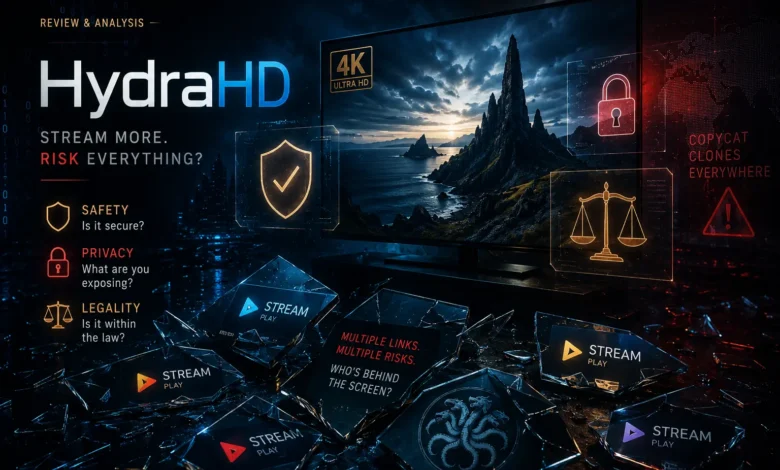
HydraHD Explained: What It Is, Is It Safe, and the Best Legal Alternatives in 2026
HydraHD is a free streaming platform that lets users watch movies and TV shows in HD without a subscription — but its legal status, safety record, and frequent domain changes raise serious questions every viewer needs to understand.


*Disclaimer: We may earn a commission if you make a purchase through our affiliate links, at no extra cost to you.
📋 Quick Facts
Platform Type
Free Streaming Aggregator
Subscription Required
No — Entirely Free
Video Quality
720p, 1080p, Some 4K
Legal Status
Unlicensed / Grey Area
Registration
Not Required
Known Domains
hydrahd.com/.org/.me (multiple mirrors)
Content Library
Thousands of Movies & TV Shows
Safe Legal Alternative
Tubi, Pluto TV, Crackle
HydraHD is a free online streaming platform that aggregates movies and TV shows — primarily in HD, 1080p, and sometimes 4K resolution — without requiring users to register an account or pay a subscription fee. It gained significant traction from around 2023 onward, driven largely by word-of-mouth across Reddit communities and Telegram groups. At its core, HydraHD does not host all content directly. Instead, it operates as a link aggregator, pulling streams from a network of third-party servers and presenting them through a clean, navigable interface. The practical result is a site that feels polished but rests on legally uncertain foundations.
The platform’s appeal is easy to understand. Streaming subscription costs have climbed steadily — the average U.S. household, according to data reported by multiple consumer research outlets, now spends upward of $50 per month across services. Against that backdrop, a site offering the same Hollywood titles with no fees, no login, and no regional restrictions is going to attract users. Whether it deserves that attention is a separate question.
This guide breaks down everything worth knowing about HydraHD in 2026: how it actually works, what security and legal risks it carries, why its domains keep changing, and which verified free and paid services offer a genuinely safe alternative. The goal is not to moralize but to inform — so you can make a considered decision with the facts in front of you.
Background: How HydraHD Became a Household Name Among Free Streamers
Free streaming has a long history on the internet, but the post-pandemic period saw a specific shift in user behaviour. As households accumulated multiple paid subscriptions during lockdown and then began cancelling them through 2022 and 2023, appetite for zero-cost alternatives surged. Sites like 123Movies, Putlocker, and FMovies had built large audiences before facing legal pressure and domain seizures. HydraHD emerged into this gap — cleaner in design, lighter on ads than many predecessors, and deliberately structured to avoid the chaotic pop-up experience that had made older piracy sites so irritating to use.
What made HydraHD distinct was its UI priority. Where comparable platforms looked dated or exploitative in their ad placement, HydraHD’s interface resembled a legitimate streaming service. Genre categories, search functionality, content ratings, and even subtitle options were integrated in a way that reduced friction. Security researchers and digital rights analysts, however, were quick to note the pattern: a polished front-end sitting atop an aggregation engine with no verified content licensing. As platforms like Movierulz had demonstrated before it, surface-level legitimacy does not equal legal compliance.
By 2024, HydraHD had become one of the more frequently searched streaming alternatives globally, appearing on “best free streaming” lists alongside legitimate services. That visibility brought both new users and increased scrutiny from rights holders. Domain takedowns followed, and the platform’s operators responded with a now-familiar playbook: mirror sites, new TLD registrations, and rebranded clones that kept traffic alive even as individual domains were blocked.
The Technical Architecture Behind HydraHD
Understanding what HydraHD actually is technically matters, because the platform’s defenders and critics often talk past each other. HydraHD operates primarily as a link aggregator — meaning it indexes streams hosted on third-party servers rather than exclusively hosting content itself. Some mirror versions do cache or directly serve certain files, but the dominant model is scraping: the platform’s engine locates videos hosted elsewhere, wraps them in its own player interface, and serves them to the browser.
This architecture has a specific consequence for users. Because streams are pulled from multiple sources — file-hosting CDNs, peer-to-peer indexes, cloud storage providers — the quality, safety, and legality of any given stream varies enormously. A movie streamed on one HydraHD mirror might load cleanly at 1080p; the same title on another mirror might redirect through a series of ad networks before reaching a low-quality source. Security firm analyses, including published reports from malware researchers at platforms like Malwarebytes and similar organisations, have consistently flagged this category of aggregator site as a common delivery mechanism for adware, browser fingerprinting scripts, and occasionally more serious malware payloads. The absence of HTTPS on some mirror domains further exposes users’ browsing activity and device information.
Timeline: Key Milestones in HydraHD’s Evolution
2022–2023
HydraHD launches and gains early traction on Reddit’s r/Piracy and r/FMHY communities, praised for its clean UI and HD quality relative to older piracy sites.
Early 2024
The platform’s primary domain (hydrahd.sh) faces DMCA enforcement pressure and copyright complaints from rights holders, triggering the first significant domain migration cycle.
Mid-2024
Multiple mirror sites appear under new TLDs (.com, .org, .me, .io), reflecting the standard domain-hopping strategy used by unlicensed streaming platforms to evade ISP-level blocks and registrar seizures.
Late 2024 – 2025
Security researchers and digital safety publications begin flagging HydraHD mirror sites for malvertising, phishing overlays, and credential-harvesting clones impersonating the original platform’s interface.
2025
Several original HydraHD domains (hydrahd.sh, hydrahd.io) go offline or become unreliable. Cloned and impersonator sites proliferate, making it increasingly difficult for users to distinguish the original platform from malicious copies.
2026
Search queries for “HydraHD working domain 2026” spike globally. Domain activity continues through new mirror registrations, but stability, safety, and legal exposure remain unresolved. Tech publications and consumer safety sites increasingly recommend legal alternatives.
💜 Why This Matters
The conversation around platforms like HydraHD is rarely just about copyright law — it’s about the real financial pressure on families navigating an era of subscription fatigue, where watching a film can require juggling four different paid services. That context deserves acknowledgment. But so does the less-discussed side of the equation: when a “free” site exposes your device to malware or quietly harvests your data, the cost of watching that film ends up being paid in a currency far more valuable than a monthly fee. Understanding both sides of this trade-off is how viewers protect themselves — and why the legal, genuinely free alternatives deserve more attention than they currently get.
Is HydraHD Safe? A Detailed Security Assessment
The honest answer is: it depends on which version of HydraHD you are visiting, and that uncertainty is itself the problem. The original platform, before widespread cloning began, attracted relatively few malware complaints by the standards of this category. Its reduced ad density compared to older piracy sites was genuinely noted by users as a differentiator. That picture has changed considerably since 2024.
As HydraHD’s primary domains were subjected to takedowns and blocking, a second generation of mirror sites and clones emerged to capture traffic from the brand name. Many of these copies are operated by entirely different parties and use the HydraHD branding opportunistically. Cybersecurity researchers have documented several specific risks associated with this ecosystem. Malvertising — the delivery of malicious code through advertising networks embedded in the page — is the most common vector. A misclick on what appears to be a play button can trigger a download of adware, spyware, or in more serious cases, ransomware or cryptocurrency mining scripts. Some clone sites have also deployed phishing overlays mimicking Netflix or Amazon Prime login pages, attempting to harvest credentials from users who instinctively enter their details.
Browser fingerprinting is a subtler but pervasive concern. Even without clicking anything, visiting many HydraHD mirrors exposes your IP address, browser configuration, and device identifiers to third-party tracking scripts. This data is routinely sold to ad networks, data brokers, or in worst-case scenarios, used to build profiles that are exploited in targeted fraud. Sites lacking HTTPS encryption — still present across some mirrors — leave this information fully exposed in transit. For users without a VPN and updated antivirus protection, visiting any unverified HydraHD domain carries a measurable security risk that is difficult to quantify in advance because of the sheer variability between mirrors.
Is HydraHD Legal? Jurisdiction-by-Jurisdiction Breakdown
HydraHD does not appear to hold streaming licences for the vast majority of content it aggregates. This places it firmly in the unlicensed category — a grey-to-dark zone that carries different legal weight depending on where you are. In the United States, streaming unlicensed content triggers the Digital Millennium Copyright Act (DMCA), and while enforcement historically targets distributors rather than individual viewers, civil liability exposure for users is not zero. Several ISPs in the U.S. have sent warning letters to subscribers identified via their IP addresses accessing piracy sites.
In the United Kingdom, the Copyright, Designs and Patents Act 1988 covers unauthorised streaming. Ofcom and rights-holder organisations including the Motion Picture Association have pursued aggressive ISP-level blocking orders in British courts, which is why a number of HydraHD domains are currently inaccessible via major UK broadband providers without a VPN. The European Union, following the 2017 CJEU ruling in Stichting Brein v Filmspeler, made clear that streaming from an illegal source can constitute copyright infringement even for end users — a shift that tightened the legal position across member states. In Pakistan, India, and much of Southeast Asia, copyright enforcement against individual streamers is relatively rare in practice, though the legal framework technically prohibits it. That practical leniency, however, does not insulate users from the device-level security risks described above, which apply regardless of jurisdiction.
As coverage of digital media regulation has noted repeatedly, the gap between what is technically illegal and what is actively prosecuted creates a false sense of security for casual users. Rights holders, particularly in the entertainment industry, have become more sophisticated in identifying and targeting habitual pirates, and the legal landscape in 2026 is meaningfully stricter than it was three years ago.
📊 HydraHD Risk & Feature Comparison vs Legal Alternatives
Note: Scores are editorial assessments based on publicly available reviews and security analyses. No verified independent audit of HydraHD has been publicly disclosed.
“Free platforms like HydraHD often lack secure encryption, exposing users to risk. The hidden costs of ‘free’ streaming — malware, data harvesting, and legal exposure — far outweigh the short-term convenience for most users.”
— Editorial assessment, MrDetechtive.com Digital Safety Guide, December 2025
Best Legal Alternatives to HydraHD in 2026
The most frequently cited legal alternatives to HydraHD — Tubi, Pluto TV, and Crackle — deserve more credit than they typically receive in these comparisons. Tubi, owned by Fox Corporation, has grown into one of the largest free legal streaming libraries available, with over 20,000 titles reported across its catalogue as of 2025. It is ad-supported, available without registration, and operates in the U.S., UK, Canada, Mexico, and Australia. The trade-off versus HydraHD is a slightly heavier ad load and a catalogue that skews toward library titles over brand-new releases — but the security, reliability, and legal clarity are categorically different.
Pluto TV, owned by Paramount, takes a hybrid approach: hundreds of curated live channels alongside an on-demand library. It is particularly strong for users who enjoy the passive, channel-surfing experience that streaming’s on-demand model largely abandoned. Crackle, operated under the Chicken Soup for the Soul Entertainment umbrella, offers a rotating selection of films, TV series, and original programming, also fully free and ad-supported. For anime specifically, Crunchyroll’s free tier remains one of the most substantial legal options available globally. Peacock‘s free tier, from NBCUniversal, offers access to news, sports highlights, and a portion of its entertainment library without payment. None of these platforms requires any of the workarounds — VPNs, ad blockers, device hardening — that responsible use of HydraHD demands.
It is also worth noting that digital habits around screen time and content consumption are evolving, and many viewers are discovering that the legal free tier ecosystem has quietly become far more comprehensive than it was even two years ago. The Tubi library alone would take years to watch in its entirety. The framing of “free illegal” versus “paid legal” is increasingly outdated — a genuinely adequate free-and-legal option has existed for some time.
Where Things Stand Now
As of mid-2026, the HydraHD ecosystem is fragmented. The original domains that built the platform’s reputation (hydrahd.sh, hydrahd.io) have gone offline or are unreliable, according to current domain tracking and user reports compiled by technology publications including NogenTech. Active mirrors exist — most commonly under .com, .org, and .me TLDs — but the operators behind each vary, and there is no publicly verifiable way to confirm which, if any, of the current mirrors represents the original platform rather than an impersonator. This is not a minor distinction: cybersecurity analyses have specifically identified fake HydraHD sites designed to mimic the original’s interface while deploying more aggressive malware payloads than the site’s genuine versions ever carried.
The broader category of link-aggregator free streaming sits in a precarious position legally. Rights holders, particularly in the UK and EU, have secured increasingly broad ISP-blocking orders that can take down entire IP ranges rather than just individual domains. In the U.S., the major studios have pursued litigation against both operators and, in some cases, upstream hosting providers. HydraHD’s domain-hopping strategy remains effective in the short term — search trends confirm that interest in “HydraHD new domain 2026” spikes every time a major mirror goes dark — but the operational overhead of maintaining a constantly migrating unlicensed platform is substantial, and the user experience degrades with every forced move. The question is less whether HydraHD will continue to exist in some form and more whether the version you find on any given day is safe, functional, or even genuinely related to the original.
For viewers frustrated by the subscription model, the more durable answer is likely found in the growing legal free tier — not because piracy enforcement has become impossibly strict, but because the legal alternatives have genuinely improved to the point where the trade-off no longer makes sense. Tubi TV reports over 80 million monthly active users. Pluto TV has expanded to over 35 countries. These are not consolation prizes; they are functioning platforms with real content libraries. The mainstream is moving toward ad-supported free streaming, and HydraHD’s model — unlicensed aggregation behind a rotating domain — is increasingly a legacy pattern rather than a forward-looking one.
✨ HydraHD — At a Glance
Subscription Cost
$0 / Free
Content Licensing
Unverified / Unlicensed
Domain Stability
Frequently Changes
Safety Verdict
Use With Caution
❓ Frequently Asked Questions
What is HydraHD and how does it work?
HydraHD is a free online streaming platform that aggregates links to movies and TV shows from third-party servers, presenting them through a clean browser-based interface. It does not require a subscription or registration. Rather than hosting all content directly, it operates primarily as a link aggregator — indexing streams from multiple external sources — which explains both its broad catalogue and its variable stream quality.
Is HydraHD safe to use?
Safety varies significantly depending on which domain or mirror you access. The original platform carried fewer ads and a lighter malware footprint than many comparable sites. However, since widespread cloning began in 2024, numerous fake and impersonator versions exist that deploy malvertising, phishing overlays, and browser fingerprinting scripts. Security researchers recommend using a reputable VPN and an ad blocker as minimum precautions, though these do not eliminate all risks.
Is HydraHD legal?
HydraHD does not appear to hold valid licences for the content it streams. This makes accessing it a potential copyright violation in most jurisdictions, including the U.S. (under DMCA), the UK (Copyright, Designs and Patents Act 1988), and the EU (following the 2017 CJEU ruling in Stichting Brein v Filmspeler). While individual viewer enforcement is relatively rare, it is not unknown, and legal exposure increases in stricter jurisdictions.
Why does HydraHD keep changing domains?
Domain changes are the standard response to copyright enforcement: DMCA takedown notices, court-ordered ISP blocks, and domain registrar seizures all push unlicensed platforms to migrate to new TLDs or mirror addresses. This pattern is common across all platforms in this category and reflects the ongoing legal pressure from rights holders rather than any technical instability in the platform itself.
What are the best free legal alternatives to HydraHD?
The strongest legal free alternatives are Tubi (owned by Fox Corporation, 20,000+ titles, available in multiple countries), Pluto TV (Paramount-owned, live channels plus on-demand), Crackle (rotating film and TV library), Peacock’s free tier (NBCUniversal), and Crunchyroll’s free tier for anime. All are ad-supported, require no subscription, and some require no registration. They are safe, legal, and substantially more stable than any HydraHD domain.
Is HydraHD still working in 2026?
Some HydraHD mirror domains remain active as of 2026, but the original primary domains (hydrahd.sh, hydrahd.io) have gone offline or are unreliable according to current reports from digital technology publications. Active mirrors exist but vary in safety, content quality, and operator identity. Users searching for “HydraHD new domain 2026” will find options, but verifying their legitimacy or safety is practically impossible without technical expertise.
Final Thoughts
HydraHD built its reputation on a genuine insight: that free streaming could look and perform better than the piracy sites that preceded it. The clean interface, reduced ad clutter, and broad catalogue were real differentiators, and it is not surprising that the platform attracted a loyal user base. But the story of HydraHD since 2024 is less about what the platform offered and more about what happened when enforcement pressure and opportunistic cloning eroded the things that made it worth using. The version of HydraHD that new users encounter in 2026 is a fragmented ecosystem of mirrors and copies, and the safety calculus has shifted considerably from its early days.
The deeper point is structural. Any platform built on unlicensed aggregation faces the same ceiling: it can never invest in infrastructure, content deals, or security the way a licensed service can, because its business model cannot sustain those investments. The domain-hopping cycle is not a temporary inconvenience — it is the permanent operational reality of running an unlicensed platform in an era of increasingly sophisticated rights enforcement. For users, that means instability and risk will remain features of HydraHD, not bugs to be fixed.
The legal free tier has matured enough that the argument for taking on those risks has narrowed considerably. Tubi, Pluto TV, and their peers are not exciting or underground, but they are reliable, safe, and comprehensive. The best outcome for viewers frustrated by subscription costs is probably not finding the latest working HydraHD mirror — it is discovering that the legal free option they dismissed as too limited three years ago has since quietly become large enough to keep them occupied for a very long time.
📚 Sources & References
- NogenTech — What is HydraHD? Working Domains in 2026 & Legal Alternatives (April 2026)
- LiveMag UK — Hydra HD Review 2025: Safe or Not? Complete Features, Safety, Legality & Alternatives Guide (December 2025)
- MrDetechtive — What Is HydraHD? A Complete Guide to Features, Safety, and Alternatives in 2025
- Pure Magazine UK — HydraHD in 2025: What Happened, Safety Tips & Best Free Alternatives (October 2025)
- Basically Brit — HydraHD Review 2025: Free HD Streaming, Features, Legality & Safer Alternatives (July 2025)
- TheTechWithAI — HydraHD Review: A Complete Guide to Features, Pros, and Streaming Experience (September 2025)
All sources verified at time of publication. Links subject to change.
AB Rehman
Technology & Consumer Products Writer
AB Rehman is a features and research writer covering consumer technology, digital media, and online platform analysis. His work focuses on separating verified fact from speculation, drawing on primary sources to produce accurate, readable long-form content for general and specialist audiences. He covers streaming platforms, cybersecurity risks, and digital rights issues with a focus on practical guidance for everyday internet users.
⚠️ Editorial Disclaimer
This article is intended for informational purposes only. All facts have been sourced from publicly available information at the time of publication. Where data could not be independently verified, this has been clearly noted. This article does not encourage, endorse, or facilitate access to unlicensed streaming content. Legal status of streaming platforms varies by jurisdiction; readers are advised to consult their local laws before accessing any platform. The author and publisher accept no liability for decisions made based on the information contained herein.