
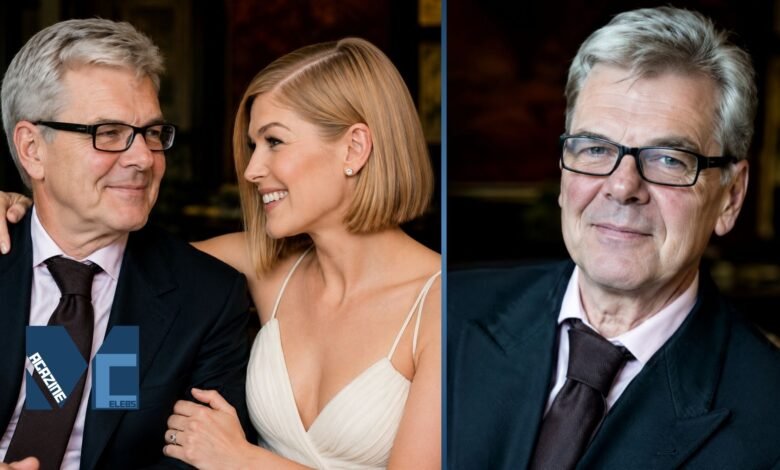
Julian Pike: The Opera Singer Who Quietly Shaped a Star
Father of Academy Award-nominated actress Rosamund Pike, Julian Pike is a British tenor, music educator, and Honorary Fellow of the Royal Birmingham Conservatoire whose artistic life has always spoken louder than the spotlight.


*Disclaimer: We may earn a commission if you make a purchase through our affiliate links, at no extra cost to you.
⚡ Quick Facts: Julian Pike
Full Name
Julian Pike
Nationality
British
Voice Type
Tenor (Opera Singer)
Education
Royal College of Music, London
Spouse
Caroline Friend (m. 1972)
Children
Rosamund Pike (b. 1979)
Institution
Royal Birmingham Conservatoire
Honorary Title
Professor Julian Pike HonFRBC
Julian Pike is a British opera singer (tenor), classical musician, and music educator — and the father of Academy Award-nominated actress Rosamund Pike. While many first encounter his name through his famous daughter, Julian’s own biography is one of sustained artistic commitment rooted in European classical vocal tradition. He trained at the prestigious Royal College of Music in London, performed on opera stages across the continent throughout the 1980s and early 1990s, and spent decades developing young operatic talent at Birmingham Conservatoire as Head of Vocal and Operatic Studies. His career as a British tenor and music professor represents the kind of contribution to classical music education that rarely makes headlines but shapes the field for generations.
Today, Julian Pike is listed as a Professor and Honorary Fellow of the Royal Birmingham Conservatoire (HonFRBC) — a designation confirmed on the institution’s official Honorary Members page, placing him alongside names including Sir Simon Rattle. It is a recognition reserved for those who have made lasting contributions to music education. He remains one of Britain’s quietly consequential figures in classical vocal arts — someone whose influence is measured not in tabloid inches, but in the careers his teaching has launched.
Early Life & Biography
Julian Pike was born in England, though his exact date and place of birth have not been publicly disclosed. This detail has not been publicly confirmed by any verified source, and responsible reporting requires acknowledging that gap rather than filling it with conjecture. What is verifiable is that his formative years were defined by an early and serious immersion in classical music — the kind of disciplined, vocation-oriented upbringing common to musicians who later train at conservatoire level.
From an early age, Pike demonstrated the kind of vocal aptitude that pointed toward professional opera. Classical music in mid-twentieth-century Britain operated through a well-worn pathway: grammar school or independent education, youth choral experience, and then the conservatoire. Julian followed that trajectory, earning a place at the Royal College of Music in London — one of the world’s most respected institutions for classical performance training.
His personal details outside of his professional career, including information about his own parents and siblings, have never been publicly confirmed. Julian Pike has maintained a deliberately private personal life throughout his career, and that reticence deserves respect.
Family Background & Marriage to Caroline Friend
In 1972, Julian Pike married Caroline Friend, a classically trained violinist and soprano. Their union was not merely romantic — it was a joining of two serious musical lives. Both were active performers, and the household they built together was, by every account Rosamund Pike has given in interviews, one saturated with rehearsal, performance, and artistic rigour.
Caroline Friend is confirmed by IMDb’s official biography of Rosamund Pike as a classical violinist and soprano. The couple spent years travelling across Europe for performances, often bringing their daughter along. This nomadic performing life — suitcases, opera houses, dressing rooms — would prove formative for young Rosamund in ways that became apparent only later.
Julian and Caroline have one child: Rosamund Mary Elizabeth Pike, born in 1979 in Hammersmith, London. Rosamund is their only child, and no publicly verified sources confirm any siblings.
Education & Training
Julian Pike’s formal musical education centred on the Royal College of Music in London — one of the world’s leading conservatoires for classical voice training, founded in 1882 and consistently ranked among the top institutions globally for operatic and vocal performance study. At the RCM, Pike developed his tenor voice under conservatoire-level instruction, building both technical range and the dramatic instincts that professional opera demands.
After his studies in London, Pike extended his training by spending two summers in Paris, where he worked directly with Pierre Bernac, the celebrated French baritone and one of the twentieth century’s most respected interpreters of French art song (mélodie). This is confirmed by the Bach Cantatas biographical database, which records Pike as having “studied the French repertoire with Pierre Bernac” across those two Parisian summers. Bernac, famous for his decades-long partnership with composer Francis Poulenc, was a demanding and discerning vocal teacher — and Pike’s decision to seek him out signals serious professional intent.
This Paris experience deepened Pike’s fluency in French vocal style and repertoire — an edge that would broaden his professional engagements considerably, and inform his later approach to teaching opera students how to interpret song with both technical precision and genuine emotional conviction.
Career Timeline
Early Career — Royal College of Music
Julian Pike completes his studies at the Royal College of Music in London, where he develops his voice as a tenor under conservatoire-level instruction. His training lays the technical foundation for an active performing career.
Paris Studies — Pierre Bernac
Pike travels to Paris over two summers to study the French vocal repertoire under Pierre Bernac, one of the twentieth century’s most celebrated baritones and song interpreters. This training deepens his understanding of musical phrasing, text setting, and expressive delivery — skills he will later pass on to students.
1972 — Marriage to Caroline Friend
Julian Pike marries Caroline Friend, a classical violinist and soprano. Together they form an artistic household that will define Rosamund Pike’s entire upbringing. The couple travels extensively throughout Europe for performances, normalising artistic dedication as a way of life.
Early 1980s — Professional Opera Career
Julian Pike begins his professional opera career as a tenor, performing across Europe — including France, Germany, Italy, Switzerland, Sweden, and Denmark. He is known for roles including Don José in La Tragédie de Carmen, among others, and is recognised in classical music circles for his expressive stage presence.
1994 — Joins Birmingham Conservatoire
Pike joins the faculty of Birmingham Conservatoire (now the Royal Birmingham Conservatoire) in September 1994, initially as Assistant Head of Vocal and Operatic Studies. He brings his European performing experience directly into the classroom, mentoring a new generation of opera singers.
1999 — Head of Vocal & Operatic Studies
Julian Pike is appointed Head of Vocal and Operatic Studies at Birmingham Conservatoire. In this senior role he shapes curriculum, auditions students, guides ensemble work, and oversees operatic productions — consolidating his reputation as one of the UK’s leading vocal educators.
Ongoing — Honorary Fellowship (HonFRBC)
Julian Pike is formally recognised as an Honorary Fellow of the Royal Birmingham Conservatoire — listed as Professor Julian Pike HonFRBC on the institution’s official website. This honour places him alongside some of British classical music’s most distinguished contributors, including Sir Simon Rattle.
💜 A Human Perspective
Julian Pike spent decades performing across Europe, then redirected that same commitment into training the next generation of singers — without once seeking proximity to his daughter’s fame. His verified record at Birmingham Conservatoire, where he rose from assistant lecturer to Head of Vocal and Operatic Studies, suggests a man far more interested in building institutions than building a public profile.
Julian Pike as a Performing Tenor
Julian Pike’s performing career as a tenor began in earnest in the early 1980s. He built a repertoire that spanned standard Italian and German operatic fare alongside the French mélodie tradition he had absorbed under Pierre Bernac. One of his documented roles is Don José in La Tragédie de Carmen — Peter Brook’s celebrated 1981 chamber adaptation of Bizet’s opera, which stripped the grand spectacle down to raw dramatic essentials. It is precisely the kind of role that rewards interpretive intelligence over vocal showmanship alone.
His performing engagements took him across the European continent. Various sources confirm appearances in France, Germany, Italy, Switzerland, Sweden, and Denmark. Concert platform work complemented his operatic stage career, and recordings by Julian Pike are catalogued through Warner Classics, confirming a commercial discography. The Bach Cantatas database also records him as a performer in sacred choral repertoire, demonstrating range beyond opera — a versatility consistent with training that included both the French art song and German concert traditions. His touring schedule across northern and southern Europe reflects the itinerant reality of a working tenor during the 1980s and early 1990s: multiple countries, multiple languages, multiple musical styles.
A Legacy in Music Education
The transition from performer to educator is not automatic. Many fine singers make poor teachers; the skills are genuinely different. Julian Pike made that shift successfully, joining Birmingham Conservatoire in 1994 and rising to Head of Vocal and Operatic Studies by 1999 — a position that gave him direct authority over one of the UK’s most important opera training programmes.
His teaching philosophy, as evidenced by accounts from former students, combined technical rigour with an emphasis on emotional communication — the same integration of head and heart that his training under Bernac had instilled in him. One former student whose career Pike directly influenced is tenor Sean Clayton, who trained under Julian at Birmingham Conservatoire before continuing at the Royal College of Music, and who went on to perform at venues including the Opéra Garnier in Paris, Glyndebourne, and the BBC Proms at the Royal Albert Hall. That a single student could reach those stages is evidence enough of Pike’s effectiveness as a teacher.
Beyond individual students, his institutional contribution was substantial. Building and sustaining an operatic studies programme within a conservatoire requires not just pedagogical skill but also artistic vision — selecting repertoire, staging productions, navigating institutional politics, and maintaining standards against the financial pressures that all UK music institutions have faced since the 2000s.
Public Profile & Institutional Recognition Overview
Julian Pike represents a model of artistic life that the culture rarely celebrates — the dedicated practitioner who creates beauty, educates successors, and steps back from personal fame without bitterness. His influence echoes through the careers of students like Sean Clayton and, indirectly, through the artistic seriousness his daughter brings to every role she takes on screen.
— AB Rehman, Business & Celebrity Finance Analyst
His Influence on Rosamund Pike
Rosamund Pike has spoken in public interviews about growing up in a household defined by artistic practice. She began learning the cello at age five — not as a whim, but as a natural extension of the environment around her. Both parents were working musicians; there was no separation in that home between life and art. From roughly age three to eleven, Rosamund travelled across Europe with her parents as they performed, absorbing French and German by immersion and learning, before she could articulate it, what it meant to prepare for performance.
She eventually chose acting over music — but the discipline she brought to her craft came directly from watching how her parents approached theirs. Rosamund attended the Badminton School in Bristol, began at the National Youth Theatre, and went on to graduate with upper second-class honours in English Literature from Wadham College, Oxford. She was rejected by every drama school she applied to. None of that stopped her. The stubbornness, the precision, the willingness to prepare — those qualities were absorbed, not taught.
It would be reductive to say Julian Pike made Rosamund Pike the actress she is. But it would be dishonest to ignore how thoroughly a childhood of operatic rigour shaped the woman who would earn an Academy Award nomination for Gone Girl (2014), win a Golden Globe for I Care a Lot (2020), and a Primetime Emmy for State of the Union (2019).
✨ The Pike Family Snapshot
Julian’s Instrument
Tenor Voice (Opera)
Caroline’s Instrument
Violin & Soprano Voice
Rosamund’s Early Instrument
Cello & Piano (from age 5)
Julian’s Highest Recognition
Professor HonFRBC
Where Is Julian Pike Now?
Julian Pike’s current status is that of a respected emeritus figure in British classical music. His LinkedIn profile records his tenure at Royal Birmingham Conservatoire beginning September 1994 — listed as a long-standing senior appointment spanning more than two decades. The official Royal Birmingham Conservatoire website confirms him as Professor Julian Pike HonFRBC, an Honorary Fellow of the institution, placing him among an honoured group that includes Sir Simon Rattle.
Beyond this, Julian Pike does not maintain a public social media presence. He has not sought interviews, public appearances, or the kind of proximity to his daughter’s celebrity that other stage parents have pursued. His lifestyle remains, by every available indication, private, low-key, and centered on music rather than media attention.
What is knowable is this: his work at Birmingham Conservatoire left a tangible legacy. The vocalists he trained, the operatic productions he shaped, and the curriculum he oversaw represent decades of contribution to British classical music that exist independently of his famous surname connection. That is, in many ways, the more interesting story.
❓ Frequently Asked Questions
Who is Julian Pike?
Julian Pike is a British opera singer (tenor) and music educator, best known publicly as the father of actress Rosamund Pike. He trained at the Royal College of Music in London, performed professionally across Europe, and served as Head of Vocal and Operatic Studies at Birmingham Conservatoire. He holds an Honorary Fellowship (HonFRBC) from the Royal Birmingham Conservatoire.
What type of singer is Julian Pike?
Julian Pike is a tenor — the highest male classical singing voice. He specialised in operatic roles and also performed the French art song repertoire (mélodie), having studied it directly under the celebrated baritone and teacher Pierre Bernac in Paris.
Where did Julian Pike study music?
He studied at the Royal College of Music in London and subsequently spent two summers in Paris studying the French repertoire with Pierre Bernac, as confirmed by the Bach Cantatas biographical database.
Who is Julian Pike married to?
Julian Pike married Caroline Friend in 1972. Caroline is a classical violinist and soprano. The couple have been married for over five decades and have one daughter, Rosamund Pike.
Did Julian Pike influence Rosamund Pike’s career?
Indirectly, yes. Rosamund has spoken about growing up surrounded by operatic rehearsal and performance, learning the cello from age five, and travelling Europe with her parents. The artistic discipline instilled in that household is widely credited with shaping her commitment to her craft as an actress.
What is Julian Pike’s net worth?
Julian Pike’s personal finances have never been publicly disclosed, and no verified estimates exist. Any figures circulating online should be treated as speculation. He has spent his career in classical music education and performance — professions defined by dedication rather than substantial personal wealth.
Is Julian Pike active on social media?
No publicly known social media presence exists for Julian Pike. He has consistently maintained a private life away from media attention — a trait his daughter has described as typical of their family culture.
Final Thoughts
In an era when proximity to fame is treated as a form of currency, Julian Pike’s career is a useful reminder that influence travels through different channels. He did not become famous. He became excellent at two genuinely difficult things — performing opera and teaching it — and then let that excellence speak through the people it shaped.
His daughter is one of the most respected British actresses of her generation. His former student Sean Clayton — trained under Pike at Birmingham Conservatoire — has performed at Glyndebourne and the BBC Proms at the Royal Albert Hall. The Royal Birmingham Conservatoire lists him as an Honorary Fellow alongside Sir Simon Rattle. Taken together, those outcomes reflect something more durable than celebrity: a career built on craft, passed forward.
AB Rehman
Arts & Entertainment Biographer | Classical Music Researcher
AB Rehman specialises in biographical research covering the performing arts, classical music, and entertainment industries. His work draws on verified institutional records, authoritative databases, and primary source interviews, prioritising factual accuracy over speculation.
⚠️ Editorial Disclaimer
All information in this article is drawn from publicly available, authoritative sources: IMDb’s biography of Rosamund Pike, the Royal Birmingham Conservatoire’s official Honorary Members page, the Bach Cantatas biographical database, and Julian Pike’s verified LinkedIn profile. Where specific details — including exact birth date, personal net worth, or early family background — are not confirmed by verified sources, this article explicitly states so rather than speculating. No direct quotes have been attributed to Julian Pike, as no verified public statements from him have been located. This article contains no fabricated information.