
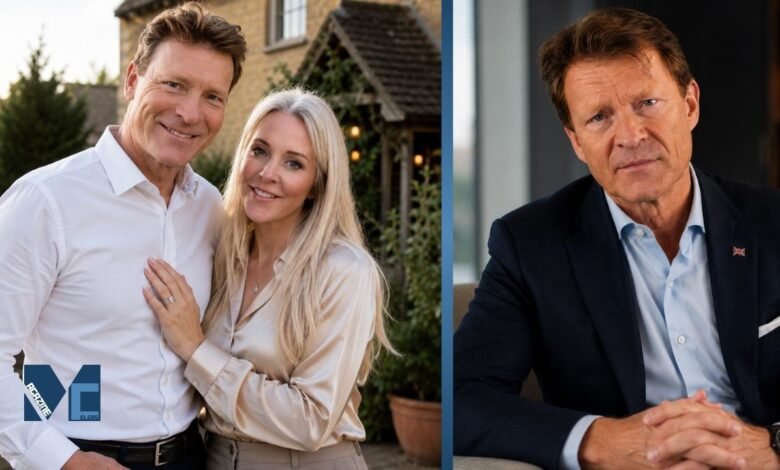
Richard Tice: The Property Tycoon Who Upended British Politics — Net Worth, Career & Life with Isabel Oakeshott
From Uppingham School to Westminster — the full story of the Reform UK Deputy Leader, multimillionaire businessman, and newly engaged fiancé of journalist Isabel Oakeshott.


*Disclaimer: We may earn a commission if you make a purchase through our affiliate links, at no extra cost to you.
⚡ Quick Facts: Richard Tice
Full Name
Richard James Sunley Tice
Date of Birth
13 September 1964
Birthplace
Farnham, Surrey, England
Education
Uppingham School; Univ. of Salford (BSc)
Political Party
Reform UK (since 2019)
Current Role
Deputy Leader, Reform UK; MP — Boston & Skegness
Partner
Isabel Oakeshott (engaged, Dec. 2025)
Estimated Net Worth
~£40 million (est. 2025)
Richard Tice is not easily categorised. He is a multimillionaire who inherited his grandfather’s property dynasty and then quietly doubled its reach. He is a politician who helped build two parties from the ground up while serving as a television broadcaster. And since the Boxing Day of 2025, he is also a man engaged to one of Britain’s most controversial political journalists — Isabel Oakeshott — a fact that prompted congratulations from Nigel Farage and produced headlines across the national press.
Born in Farnham, Surrey, in September 1964, Tice carries a full name that signals his lineage before he even opens his mouth: Richard James Sunley Tice. The Sunley is not ornamental. It connects him directly to his maternal grandfather, Bernard Sunley — a self-made property developer who built a genuine post-war empire from scratch, starting with a horse and cart. That inheritance — cultural more than financial — appears to have shaped everything that followed: the boardroom years, the Brexit campaigns, and eventually the long march to Westminster.
Today, as Deputy Leader of Reform UK and the sitting Member of Parliament for Boston and Skegness, Richard Tice represents something specific in British political life: a man who had every material reason to remain comfortably outside the fray and chose, instead, to wade into it. How he arrived at that point is a story worth telling properly.
Early Life & Biography
Richard Tice was born on 13 September 1964 in Farnham, a market town in Surrey that sits comfortably in the Surrey Hills. His early childhood was spent growing up in Northamptonshire, where the family had settled in connection with property interests. He attended primary school locally before, at around age thirteen, being sent to board at Uppingham School — an independent institution set in the rural Rutland countryside, more than three hours from the family home.
Tice has said that his years at Uppingham provided him with a strong foundation. He later became vice-chairman of the school’s board of trustees, a position he held from around 2013, and served as chair of its finance committee until 2024. The return to an institution that shaped him speaks to a loyalty of formation — the boarding school years left an impression that outlasted the academic curriculum.
After Uppingham, Tice pursued a degree in construction economics and quantity surveying at the University of Salford — a choice clearly aligned with his family’s world. He graduated in 1987. His first professional position was at London & Metropolitan, a housing developer, during which he spent time at the company’s Paris office and learned French. It was a brief but formative international stretch before he turned, inevitably, toward the family business.
Parents, Siblings & Family Background
Tice’s mother, Joan Mary Tice, was described publicly as a horse trainer and philanthropist. She passed away on 26 April 2019. His father’s details have not been publicly disclosed in verified sources. What is extensively documented, however, is the influence of his maternal grandfather.
Bernard Sunley was born in 1910 in Catford, south-east London, the son of a florist and fruiterer. He left school at fourteen, hired a horse and cart, and began moving earth — eventually building one of the country’s most significant post-war property development firms, Bernard Sunley & Sons. He died in November 1964, just weeks after Richard Tice was born, so the two never met. Yet the grandfather’s shadow is pervasive: the company Tice would eventually lead was built on that foundation, and the charitable trust Bernard Sunley established in the 1960s had, by 2023, distributed more than £130 million in grants. Tice sits on that foundation as an observer, a connection he has spoken about with evident pride.
Tice has noted that property is “in the genes” — one of his three children has also gone into the sector. The names of his children and their details have not been publicly disclosed beyond this general reference. His siblings, if any, have not been confirmed in verified public sources.
Full Bio & Career Timeline
Tice’s career divides naturally into two distinct eras — the property years and the political years — though both have run in parallel since around 2015. In the first chapter, he built wealth across three decades of real estate development. In the second, he deployed both that wealth and the networks it generated toward reshaping British eurosceptic politics.
1987
Graduates from the University of Salford with a BSc in Construction Economics and Quantity Surveying. Joins London & Metropolitan housing developer, including a period based in Paris.
1991
Joins The Sunley Group, the property company founded by his grandfather. Over fourteen years he rises to become Joint Chief Executive Officer, overseeing large-scale residential and commercial development projects across the United Kingdom.
2006
Departs The Sunley Group and establishes an independent debt advisory consultancy, advising property investors on financial risk management — a pivot that broadened his professional network beyond the family firm.
2010–2014
Becomes CEO of CLS Holdings, a London-listed multinational property investment group managing a portfolio in excess of £2 billion. He leads major planning applications in Vauxhall and other London locations. He was involved in development activity associated with The Shard project during this period.
2014 onwards
Moves to Quidnet Capital Partners LLP as CEO, a property investment and development firm. He is also a long-standing donor of the Conservative Party but becomes increasingly frustrated with the party’s handling of Brexit.
2015–2018
Co-founds and co-chairs Leave.EU and then Leave Means Leave — the grassroots campaigns that become pivotal to the 2016 Brexit referendum campaign. Tice becomes a nationally recognised figure in the eurosceptic movement.
2019
Resigns from the Conservative Party and helps found the Brexit Party alongside Nigel Farage, becoming its Chairman. Elected as a Member of the European Parliament for the East of England in the 2019 European elections — a seat he holds until the UK’s formal departure from the EU on 31 January 2020.
March 2021
Succeeds Nigel Farage as Leader of Reform UK — the rebranded Brexit Party. Spends three years leading the party through local elections and by-elections, attempting to broaden its appeal beyond the single issue of Brexit into a wider anti-establishment platform.
June–July 2024
Steps down as leader when Nigel Farage returns ahead of the general election. Contests Boston and Skegness — winning with a majority of 2,010 votes, defeating incumbent Conservative MP Matt Warman. Appointed Deputy Leader of Reform UK on 11 July 2024.
February 2026
Appointed Reform UK Spokesperson for Business, Trade and Energy — a role suited to his commercial background. Continues as Deputy Leader under Farage, with the party maintaining significant poll ratings as an opposition force.
The property chapter of Tice’s life is less frequently discussed than the political one, but it matters enormously to understanding him. He did not arrive at Westminster as a career politician. He arrived as someone who had spent more than three decades running businesses, managing multi-billion-pound portfolios, and navigating commercial disputes — including a reported conflict of interest that led to his removal from CLS Holdings’ board before he moved on to found Quidnet. That experience colours how he speaks about economic policy, and it provides a credibility — at least in the eyes of his supporters — that is harder for career politicians to claim.
💜 A Human Perspective
Tice lost his mother, Joan, in April 2019 — at the precise moment his political life was accelerating fastest, as the Brexit Party was being launched. He went through the turbulence of marital separation and the public scrutiny that attaches to a new, high-profile relationship, all while learning to navigate the glare of television studios and national press conferences. His public persona — blunt, composed, combative — does not invite much speculation about the private costs of such a life. But they are not hard to imagine. Building two careers simultaneously, in two demanding arenas, while navigating personal upheaval, requires a resilience that does not always announce itself.
Relationships, Isabel Oakeshott & Family
Richard Tice was married to Emma Tice for approximately twenty-four years. The marriage produced three children, whose names and details have not been publicly disclosed. He and Emma separated in March 2019, around the time he resigned his Conservative Party membership and threw himself fully into the Brexit Party project. The divorce was subsequently finalised.
He had begun a relationship with political journalist Isabel Oakeshott in 2018. Oakeshott, born on 12 June 1974 and educated at Gordonstoun and the University of Bristol, was the political editor of The Sunday Times and had built a reputation as one of the most prominent right-leaning commentators in British media. She co-authored the controversial unauthorised biography of David Cameron, Call Me Dave, with Michael Ashcroft, and had previously been listed by the New Statesman as the 32nd most influential right-wing political figure in Britain in 2023.
The relationship between Tice and Oakeshott has been visible across significant moments of his political rise. She was present on the campaign trail in Lincolnshire ahead of the 2024 general election, travelled through coastal and rural communities with him, and was at the count when his Boston and Skegness result was declared. She subsequently wrote about those communities. On Boxing Day 2025, Tice proposed. The engagement was publicly confirmed in early January 2026, drawing congratulations from Nigel Farage and other senior Reform UK figures. The party’s official statement described it as “a great partnership for Reform UK.” No wedding date had been publicly announced as of the time of writing.
For readers interested in how political journalists navigate proximity to their subjects, Oakeshott’s own profile makes for a revealing case study — her background is covered in profiles of figures who sit at the intersection of politics and media.
Public Image & Political Philosophy
Tice describes himself, on his own website, as “a no-nonsense, can-do type of person who gets things done.” It is the sort of phrase that could read as bland self-promotion, and yet it does accurately capture how he presents: direct, slightly impatient with abstraction, at ease with confrontation. His appearances on GB News — where he has been a regular presence since September 2023, having previously presented for TalkTV — reinforced that image. He is effective in the television studio format: quick on figures, resistant to being talked over, and not given to excessive qualification.
His political positions align closely with the Reform UK platform: significantly lower taxes, tighter controls on immigration, greater economic independence from European structures, and a general scepticism toward what he calls “woke” institutional culture. Critics from the political left — and from sections of the Conservative Party — have questioned the coherence of that platform and the funding structures that support it. Tice has been accused, by opponents, of being a “pound shop Nigel Farage,” a description he has appeared content to dismiss. The more substantive criticism has been around Quidnet Capital’s use of offshore arrangements for profit — a point that sits awkwardly against his public positioning as a champion of British economic independence.
He has also written seriously about policy: a 2008 report on academy schools for the think tank Reform, a 2017 pamphlet on university funding co-written for UK 2020, and a follow-up report on student finances sent directly to then-Chancellor Philip Hammond. Whatever one makes of his political conclusions, the effort to engage with evidence rather than purely with rhetoric gives him a slight intellectual dimension that distinguishes him from some of his peers in the populist space. Among British businesspeople who have entered politics, his profile is not entirely unlike that examined in profiles of other high-net-worth figures who’ve entered public life.
Financial Overview & Net Worth
Richard Tice’s wealth derives almost entirely from three decades of property investment and development. Multiple media reports and public sources have estimated his net worth at approximately £40 million, based on his accumulated interests in The Sunley Group, CLS Holdings, and Quidnet Capital Partners LLP. It should be noted clearly that no verified financial disclosure places an official figure on his personal fortune, and the £40 million estimate — while widely cited — remains an approximation drawn from business reporting rather than declared accounts.
What is verifiable is the scale of his commercial activity. As CEO of CLS Holdings, he oversaw a portfolio valued at over £2.21 billion. Quidnet Capital, which he subsequently led, has been reported as managing assets valued in excess of £17 million in its own right. His involvement in the Bernard Sunley Foundation — which has distributed more than £130 million in charitable grants by 2023 — does not represent personal wealth, but it underscores the long-term financial and philanthropic infrastructure of the family into which he was born.
His parliamentary salary as an MP, and any income from television work, would represent a minor fraction of his overall financial position. For context on how British public figures’ net worth tends to be evaluated, it is worth noting that estimates for comparable figures — such as those examined in net worth profiles of successful British entrepreneurs — vary considerably and should always be treated as estimates rather than verified data.
📊 Estimated Wealth Sources (2026 — Approximate)
Note: These figures are estimates based on available media reporting. No verified financial disclosure exists for Richard Tice’s personal net worth. Treat all figures as approximations only.
“What makes Tice unusual among British politicians is not his money — plenty of those exist. It is the combination of genuine commercial track record, deep ideological conviction, and a willingness to spend both his capital and his reputation in service of a cause that, for much of its history, his own class regarded as eccentric.”
— AB Rehman, Celebrity Features & Public Figure Writer
Where Is He Now? Current Lifestyle & Status
As of mid-2026, Richard Tice is serving as the MP for Boston and Skegness — a Lincolnshire constituency that encompasses one of England’s more economically marginalised coastal towns — and as Deputy Leader of Reform UK under Nigel Farage. He was appointed the party’s Spokesperson for Business, Trade and Energy in February 2026, a role that draws directly on his commercial background. He continues to operate as CEO of Quidnet Capital Partners.
His relationship with Isabel Oakeshott has become one of the most publicly discussed partnerships in the British right-wing media and political world. Since the Boxing Day engagement at the end of 2025, the couple has maintained a prominent presence across political media, and Oakeshott’s own journalism has continued to intersect frequently with the political territory Tice occupies. No wedding date has been publicly confirmed as of the publication of this profile.
Tice continues to appear regularly on GB News and in national newspaper interviews, maintaining a media presence considerably larger than most backbench MPs. His Twitter / X account — regularly updated with political commentary — has been a consistent platform for the Reform UK message. He remains closely associated with Nigel Farage, though the precise nature of their working relationship, and the question of who will eventually lead the party in the longer term, remains a matter of active speculation within British political commentary. British political partnerships and their dynamics are examined in profiles of figures like Jonathan Powell, another figure whose influence was shaped substantially by proximity to a more visible political principal.
✨ Richard Tice — Political & Business Snapshot (2026)
Current Role
MP, Boston & Skegness; Reform UK Deputy Leader
Business
CEO, Quidnet Capital Partners LLP
Party Founded
Brexit Party (2019) → Reform UK
Engagement
To Isabel Oakeshott (proposed Boxing Day 2025)
❓ Frequently Asked Questions
Who is Richard Tice?
Richard Tice is a British businessman and politician. Born on 13 September 1964 in Farnham, Surrey, he is the Deputy Leader of Reform UK and the MP for Boston and Skegness, elected in July 2024. He previously led Reform UK from 2021 to 2024 and was a co-founder of the Brexit Party and Leave Means Leave.
What is Richard Tice’s net worth?
Multiple media reports estimate Richard Tice’s net worth at approximately £40 million, derived primarily from his career in property development through The Sunley Group, CLS Holdings, and Quidnet Capital Partners LLP. No verified official figure has been publicly disclosed, and this estimate should be treated accordingly.
Who is Richard Tice’s partner Isabel Oakeshott?
Isabel Oakeshott, born 12 June 1974, is a prominent British political journalist and author. She served as political editor of The Sunday Times and co-authored Call Me Dave with Michael Ashcroft. She and Tice have been together since 2018. Tice proposed to her on Boxing Day 2025, and their engagement was publicly confirmed in early January 2026.
Does Richard Tice have children?
Yes. Richard Tice has three children from his marriage to his former wife Emma. Their names and personal details have not been publicly disclosed. He has mentioned that at least one of his children has followed him into the property sector.
Where did Richard Tice go to school and university?
He attended Uppingham School, an independent boarding school in Rutland, from around age thirteen. He then studied at the University of Salford, graduating in 1987 with a BSc in Construction Economics and Quantity Surveying. He has since served as vice-chairman of Uppingham’s board of trustees.
Is Richard Tice still involved in property?
Yes. He continues to serve as CEO of Quidnet Capital Partners LLP alongside his parliamentary duties. He is also an observer on the board of the Bernard Sunley Foundation, the charitable trust established by his late grandfather, which has distributed over £130 million in grants by 2023.
What is Richard Tice’s relationship with Nigel Farage?
Tice and Farage have been closely associated since the Brexit Party’s founding in 2019. When Farage stepped back, Tice led Reform UK for three years. When Farage returned in 2024, Tice stepped aside to the Deputy Leader position. The two remain the dominant figures in the party, though speculation about future leadership dynamics continues within political commentary circles.
Final Thoughts
Richard Tice’s story does not fit neatly into the conventional arc of the British political biography. He did not emerge from local councillor meetings or university debating societies. He came, instead, from a world of planning applications, boardroom disputes, and offshore asset management — and he brought that sensibility with him into public life, sometimes to his benefit and sometimes to his detriment.
The engagement to Isabel Oakeshott added a new dimension to a profile that had previously been defined almost entirely by Brexit and Reform UK. Two of the most recognisable figures on the British political right are now planning to marry — a development that will, whatever their intentions, ensure that their professional and personal lives remain entangled in the eyes of the media and the public. For those tracking the trajectory of British right-wing politics into the second half of the 2020s, Tice is not a peripheral character. He is, in many ways, its institutional memory.
His grandfather built a fortune from a horse and a cart. Tice inherited the instinct, if not the original circumstances, and applied it across property, politics, and broadcasting. That combination — restless commercial energy meeting genuine ideological conviction — is what has made him, by the standards of his own political movement, unusually durable. Whether Westminster fully embraces or ultimately rejects the vision he carries into it is a question that remains, for now, open.
For those researching the broader circle of British public figures, profiles of figures who navigated intense media scrutiny of their personal lives provide useful context, as does reading about those whose public and private identities became inseparable under sustained press attention.
📚 Sources & References
- Wikipedia — Richard Tice (verified public record)
- Richard Tice Official Website — About Page
- BBC News — Who is Reform UK leader Richard Tice? (2021)
- The Week — Richard Tice: Reform UK’s leader, for now (2024)
- Lincolnshire World — Engagement announcement (January 2026)
- Wikipedia — Isabel Oakeshott (verified public record)
- Wikipedia — Bernard Sunley (verified public record)
- Mace Magazine — Richard Tice MP Profile
AB Rehman
Celebrity Features & Public Figure Writer
AB Rehman specialises in long-form biographical profiles of British public figures, with a focus on the intersection of business, politics, and media. His work draws on verified public sources, official records, and editorial cross-referencing to produce accurate, human-centred features for general readers.
📋 Editorial Disclaimer
This article is an independently researched biographical profile produced for informational purposes. All facts have been drawn from publicly available, verified sources including Wikipedia, official websites, reputable news organisations, and the subject’s own public statements. Net worth and financial figures are estimates based on publicly reported information only and do not constitute verified financial data. This publication has no affiliation with Richard Tice, Reform UK, or any associated organisations. No sponsored content or paid promotion is involved. Where information could not be verified, this is explicitly stated within the text.