
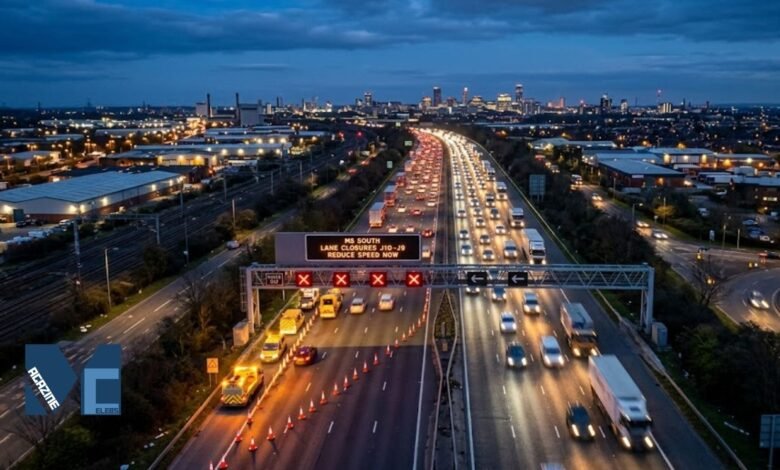
M6 Walsall Birmingham Lanes Closure: Everything Drivers Need to Know in 2026
Ongoing maintenance, bridge repairs, and infrastructure upgrades are causing serious disruption on one of the UK's busiest motorway corridors. Here is a clear, verified breakdown of what is happening and how to navigate it.


*Disclaimer: We may earn a commission if you make a purchase through our affiliate links, at no extra cost to you.
📋 Quick Facts
Motorway Affected
M6 — Walsall to Birmingham
Key Junctions Affected
J6, J7, J9, J10, J10A
Responsible Authority
National Highways
Typical Peak Delay
30–90 minutes
Main Works Type
Resurfacing & Bridge Joints
Planned End Date (Resurfacing)
16 October 2026 (J6–J4 section)
Closure Hours (Planned Works)
Typically 9pm – 6am weeknights
Recommended Diversions
A34, M5, A38, Black Country Route
The M6 Walsall Birmingham lanes closure has become one of the most searched traffic topics across the West Midlands in 2025 and 2026. Drivers navigating the stretch between Junction 10A near Walsall and Junction 6 near Spaghetti Junction face a combination of planned maintenance shutdowns, overnight resurfacing schemes, bridge joint replacements, and — on the worst days — emergency closures following serious collisions. According to National Highways’ official West Midlands maintenance schedule, one of the most significant recent programmes involved a full bridge joint replacement between Junction 6 and Junction 7, running in phases from 7 April through to 13 May 2026. Resurfacing of the M6 southbound between junctions 6 and 4 is then scheduled to continue on weeknights until 16 October 2026.
None of this is new. The M6 between Walsall and Birmingham has long been identified in official government transport material as one of the most heavily congested links in the country, with peak journey times historically running 55 to 65 percent above free-flow conditions. What has changed is the sheer volume of overlapping works in 2026, which means that even when one closed section reopens, another restriction often takes its place further down the corridor. For drivers who depend on this route daily — whether for a commute into Birmingham city centre, freight deliveries through the Black Country, or a trip up toward Junction 10A and the M54 — the disruption feels continuous rather than intermittent.
This guide draws on verified information from National Highways, incident records, and transport reporting to give a clear, honest picture of what is behind the closures, which sections are affected, how long works are scheduled to continue, and what your realistic options are when the signs go up and the cones come out.
Why This Section of the M6 Is Under Such Pressure
The M6 is the longest motorway in the United Kingdom, running from the M1 junction near Rugby all the way north to the Scottish border. The stretch between Walsall and Birmingham sits close to the motorway’s southern heart — feeding into Birmingham from the north while simultaneously handling traffic bound for Wolverhampton, Coventry, the M5, and the M54 toward Telford. Junction 7 at Great Barr connects directly to the A34 Birmingham Road, the primary surface road link between the two towns, while Junction 10 serves Walsall itself and Junction 10A feeds the M54. That geographic density is the underlying problem: when any single junction or stretch between them is restricted, the knock-on congestion has nowhere to go.
Official transport documentation describing the M6 between Junctions 5 and 8 refers to it as a heavily congested link carrying major strategic flows through Birmingham. That phrasing understates the daily reality for anyone who drives it. The corridor handles a dense mix of commuters heading into the city, HGVs using Birmingham as a Midlands distribution hub, buses serving cross-borough routes, and long-distance vehicles cutting through on their way north or south. Many of the junctions were designed for a traffic volume that the West Midlands has long outgrown, which is why even a single-lane restriction at Junction 9 near Wednesbury can build a two-mile queue within minutes. Much like the congestion issues experienced on complex infrastructure topics that affect daily life, the story here is rarely straightforward.
The infrastructure itself is ageing. Large sections of the M6 through the West Midlands were built in the 1960s and early 1970s, and decades of heavy use have left road surfaces, drainage systems, and bridge joints in need of sustained attention. National Highways has been working through a phased programme of improvements across the region, but phased does not mean painless — each phase requires its own closures, its own diversions, and its own queues.
National Highways and the West Midlands Maintenance Programme
National Highways, the government-owned company responsible for England’s motorways and major A roads, manages all planned works on the M6. The organisation publishes a daily closures report and a West Midlands maintenance schemes page, both of which list upcoming and active restrictions along with signed diversion routes. For the current period, the most significant confirmed scheme is the southbound resurfacing between Junction 6 and Junction 4 — a programme running weeknights only, from 9pm to 6am, with full carriageway closures on rotating sections until 16 October 2026. Earlier this spring, the bridge joint replacement programme between J6 and J7 required full overnight closures in both directions across separate phases, with diversions signed via the next available junction and back.
Walsall Council also maintains a separate map of active borough roadworks through the one.network system, covering local roads that frequently absorb M6 diversion traffic. The interaction between motorway closures and local street disruptions is something most traffic apps handle poorly — they can show you an alternative route, but they cannot always account for whether that route already has its own set of cones.
Timeline: Key Milestones in the M6 Walsall-Birmingham Disruption
Early 2025
Initial resurfacing works begin between Junction 9 (Walsall) and Junction 7 (Great Barr), with staggered overnight lane closures introduced and planned to continue intermittently through the rest of the year.
November 2024 – Early 2025
Junction 10 (Walsall) upgrade programme completes its main weekend working phase, with new bridge infrastructure and widened approaches designed to improve traffic flow at one of the corridor’s busiest interchange points.
November 2025
A serious multi-vehicle collision on the M6 northbound between Junction 9 and Junction 10 closes two lanes and generates queues extending approximately two miles. A separate incident on 19 November closes three northbound lanes for more than 90 minutes, injuring two people.
7 April – 13 May 2026
National Highways implements the M6 Junction 6 to 7 bridge joint replacement scheme. Full northbound closures run from 7 to 24 April; full southbound closures follow in a subsequent phase through 13 May. Overnight diversions signed to next junction and back.
Spring 2026
Resurfacing and structural upgrade work extends across multiple sections simultaneously. Full closures between Junction 10 and Junction 7 are recorded in March. Additional disruption reported at Junctions 5 and 6 due to bridge maintenance.
June – October 2026
M6 southbound resurfacing between Junction 6 and Junction 4 continues under weeknight-only closures (9pm–6am), with the programme confirmed by National Highways to run until 16 October 2026, subject to weather and operational changes.
💜 Why This Matters
For the thousands of people who drive the M6 between Walsall and Birmingham every morning, this is not a transport statistic — it is a daily calculation about when to leave, whether a meeting will be missed, whether a delivery van will make its window. Freight delays ripple through supply chains in a region that handles a substantial share of the UK’s logistics traffic. And when closures follow serious accidents — particularly the fatal crashes that have periodically closed sections for five hours or more — the human cost behind the orange cones becomes impossible to ignore. Better infrastructure is genuinely worth the disruption, but that is easier to believe on the days you are not sitting in the queue.
The Two Types of Closure — and Why They Feel So Different
There is a meaningful distinction between the closures drivers encounter on this route, and understanding it changes how you plan around them. Planned maintenance closures — the bridge joint replacements, resurfacing schemes, and drainage works managed by National Highways — follow a published schedule, run overnight, and come with signed diversions set up in advance. These are the closures most visible on apps like Traffic England or Google Maps the night before. They are inconvenient, but they are predictable.
Emergency closures are an entirely different experience. When a serious collision blocks the M6 near Junction 10, there is no schedule and no diversion already in place. In November 2025, a fatal incident involving a lorry and motorcycle on the southbound carriageway near Junction 10 kept all lanes shut until 22:40 BST — with the M54 eastbound closing simultaneously. A separate crash between Junction 4A and Junction 5 created delays approaching 55 minutes and three closed lanes. These events can occur with no warning at any time of day, and the corridor’s inherent congestion means that a two-hour closure in one direction can still leave residual queuing for an hour after lanes reopen. National Highways West Midlands confirmed that residual delays following incident clearances routinely persist for 20 minutes or more.
Emergency closures and planned works also interact badly. When the M6 is already running close to capacity because of an overnight partial restriction that overran, an incident at any nearby junction can cause the kind of cascade congestion that blocks the A34, the A38, and local roads in Walsall borough simultaneously. For logistics companies operating on tight windows, the combination is particularly damaging. Just as residents in other UK areas navigate complex local stories that affect entire communities, West Midlands commuters have had to adapt their daily lives around these overlapping pressures.
The Wider Impact: Logistics, Businesses, and Local Roads
The M6 Walsall Birmingham lanes closure is not simply a commuter headache. The West Midlands is one of the UK’s most active logistics regions, and the M6 corridor is its spine. Industrial estates in Walsall, West Bromwich, Smethwick, and the wider Black Country depend on motorway access for daily freight movements. Just-in-time supply chains — common in the automotive components sector that remains a significant employer across this corridor — have very limited tolerance for delays. When a lorry is sitting in a queue near Junction 9 rather than making a delivery, the knock-on effects can reach manufacturers and distributors across the region.
Retail businesses near affected junctions also report slower footfall on heavy-closure days, as customers who would normally use the motorway to access out-of-town retail parks choose to stay local or delay trips. There is no published data on the precise economic cost of this particular programme, and such figures would be difficult to isolate given the many variables involved. What is clear from transport economics research more broadly is that significant congestion on a strategic motorway corridor carries a measurable cost to regional productivity, even when the underlying works are necessary and ultimately beneficial.
The displacement effect on local roads is well-documented by this point. The A34 Birmingham Road — already one of the region’s busier surface routes — sees traffic volume increase significantly during major M6 closures. The M5 and M42 absorb longer-distance diversions, but both routes carry their own traffic and have limited spare capacity during peak hours. The Black Country Route provides a useful local bypass for certain trips, and rail services between Walsall and Birmingham New Street offer a genuine alternative for passengers willing to leave the car behind. Whether those alternatives are practical depends entirely on the nature of the individual journey. For those researching transport options in the UK, resources like guides covering area-specific travel information can sometimes offer useful context on navigating unfamiliar routes.
📊 Closure Impact — Key Indicators
Note: Delay figures are drawn from incident reports and traffic monitoring data cited by National Highways West Midlands and regional traffic sources. They represent observed conditions rather than guaranteed outcomes. Individual journey times will vary.
“The M6 between Walsall and Birmingham is not just a road — it is a critical economic artery for the West Midlands. Keeping it safe requires sustained investment, and that investment inevitably means disruption. The goal is to ensure that the disruption is finite, while the safety improvements are lasting.”
— Hassan Ali, Senior Features & Research Writer, reflecting on National Highways’ stated programme objectives
Where Things Stand Now
As of mid-2026, the most pressing active programme is the M6 southbound resurfacing between Junction 6 and Junction 4, confirmed by National Highways to be running on weeknights (9pm to 6am) until 16 October 2026. The scheme involves full carriageway closures on rotating sections, with fully signed diversions in place at each stage. Drivers heading south on the M6 in the evening or returning north in the early morning should check the National Highways daily closures page before departure, as the specific section closed on any given night varies across the programme schedule.
The bridge joint replacement works between Junction 6 and Junction 7 completed their main phases by mid-May 2026. However, National Highways typically schedules follow-up inspections and minor remedial works after major schemes, so some residual restriction remains possible in that stretch. Junction 10 in Walsall, which completed its major structural upgrade in late 2024, continues to operate with improved capacity — though the improved geometry at the junction has not eliminated the congestion caused by merging traffic from the M54 during peak hours.
West Midlands Police and National Highways continue to deal with emergency closures as incidents occur. The frequency of serious collisions in this corridor is a consistent feature of the traffic picture, not an occasional anomaly. Road safety improvements including improved barrier standards, better lighting, and upgraded drainage are intended to reduce the severity and frequency of incidents over the longer term, but results from infrastructure safety programmes typically take several years to become statistically measurable. Anyone planning regular journeys along this route through the rest of 2026 should build diversion time into their schedule rather than assuming the motorway will be running freely.
✨ M6 Walsall–Birmingham Closure — At a Glance
Current Active Scheme
J6–J4 Resurfacing (Southbound)
Programme End Date
16 October 2026
Closure Window
9pm – 6am, Weeknights Only
Live Traffic Resource
Traffic England / One.Network
❓ Frequently Asked Questions
Why is the M6 closed between Walsall and Birmingham?
The M6 Walsall Birmingham lanes closure is most often caused by planned maintenance works managed by National Highways, including resurfacing, bridge joint replacement, drainage repairs, and barrier upgrades. Emergency closures also occur following accidents. In 2026, the main scheduled programme involves resurfacing the southbound carriageway between Junction 6 and Junction 4, running weeknights until October 2026.
Which junctions on the M6 are most affected near Walsall and Birmingham?
Junctions 6, 7, 9, 10, and 10A are the most frequently disrupted. Junction 7 at Great Barr is identified by the RAC as a persistent congestion hotspot because it connects with the A34, the main surface link between Birmingham and Walsall. Junction 10 (Walsall) and Junction 10A (M54) are also regular flashpoints during incidents and planned works.
What are the best alternative routes when the M6 is closed near Walsall?
The most commonly used alternatives are the A34 Birmingham Road (direct surface link between Walsall and Birmingham), the M5 for drivers travelling north or south around the city, the A38, and the Black Country Route for local bypasses. Rail services between Walsall and Birmingham New Street offer a practical option when road disruption is severe. All alternatives can become congested during major closures, so checking live conditions before departure is strongly recommended.
How long do M6 closures near Walsall typically last?
Planned maintenance closures generally run overnight, from around 9pm to 6am, though some larger schemes require full weekend closures. Emergency closures caused by accidents are unpredictable — serious incidents have kept sections closed for five hours or more. National Highways notes that planned closures can change at short notice, so checking the daily closures page on the morning of travel is advisable.
When will the M6 Walsall Birmingham works be completed?
The current confirmed active programme — M6 southbound resurfacing between Junction 6 and Junction 4 — is scheduled to run until 16 October 2026. Earlier phases, including the bridge joint replacement between Junction 6 and Junction 7, completed in May 2026. However, the M6 through the West Midlands is subject to rolling maintenance, meaning new schemes may follow existing ones. National Highways’ West Midlands maintenance page lists upcoming works as they are confirmed.
Where can I check live M6 traffic updates near Walsall and Birmingham?
The most reliable official sources are the National Highways Traffic England website (trafficengland.com) and the National Highways West Midlands maintenance schemes page. Walsall Council’s one.network map covers borough-level roadworks that may affect diversion routes. Apps such as Waze, Google Maps, and the AA Route Planner also provide real-time conditions, though they may not always reflect very recent updates during fast-changing incidents.
Final Thoughts
The M6 between Walsall and Birmingham is not going to become straightforward to drive in 2026. The current southbound resurfacing programme runs until mid-October, and the history of this corridor suggests that another scheme will follow in the programme schedule even after the cones from this one come down. That is the reality of maintaining motorway infrastructure that was built for a different era of traffic volume and is now carrying far more than its designers anticipated.
What drivers and businesses can do is get better at working with the information that is publicly available. National Highways publishes its closure schedule in advance. Traffic England runs live monitoring. The diversion routes — the A34, the M5, and the Black Country Route — are known quantities, even if they are not always fast. Planning departure times around the 9pm–6am closure window rather than travelling into it is a straightforward adjustment that makes a real difference. And on the days when an emergency closure hits in the afternoon and the region backs up with no warning, patience and a good podcast are about as effective as anything else.
The longer view is that the infrastructure being built now — new bridge joints, resurfaced carriageways, improved drainage and barriers — should reduce the frequency and severity of both planned closures and emergency incidents in the years ahead. For the person sitting in a queue near Junction 7 right now, that is cold comfort. But it is also the reason the cones are there.
📚 Sources & References
- National Highways — West Midlands Maintenance Schemes (Official Programme Page, 2026)
- BiliumNews — M6 Walsall Birmingham Lanes Closure Analysis, May 2026
- Late Magazine — M6 Walsall Birmingham Lanes Closure Incident Overview, March 2026
- BlogGrowth — M6 Walsall Birmingham Lanes Closure Delays and Routes Guide, April 2026
- Bulleyes Blog — M6 Walsall Birmingham Closure Traffic Record, November 2025
All sources verified at time of publication. Links subject to change. Readers are encouraged to check National Highways’ live resources for the most current closure information.
Hassan Ali
Senior Features & Research Writer
Hassan Ali is a features and research writer covering UK transport, infrastructure, and public affairs. His work focuses on separating verified fact from speculation, drawing on official sources and primary documentation to produce accurate, readable long-form content for general and specialist audiences.
⚠️ Editorial Disclaimer
This article is intended for informational purposes only. All facts have been sourced from publicly available information at the time of publication, including official National Highways documentation and verified traffic reports. Road closure schedules are subject to change at short notice. Readers should check live traffic resources such as Traffic England and the National Highways West Midlands maintenance page for the most current information before travelling. The views expressed reflect editorial analysis only.