
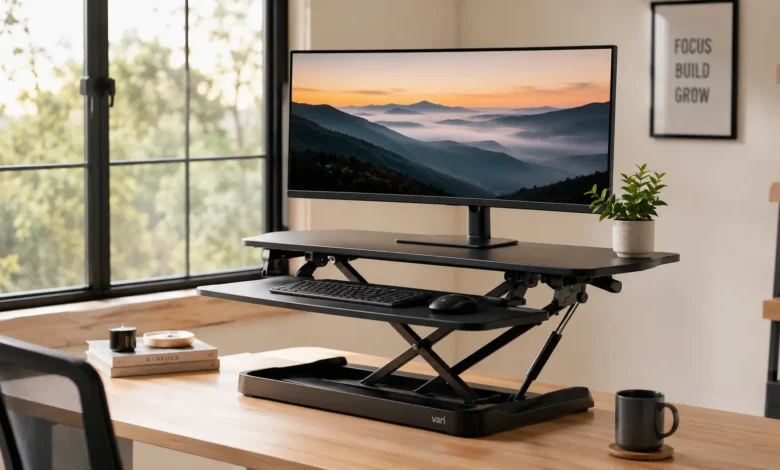
What Is a Riser Desk? Your Complete Guide to Standing Desk Converters
A riser desk lets you convert any existing desk into a sit-stand workstation — without buying new furniture. Here's everything you need to know before buying one.


*Disclaimer: We may earn a commission if you make a purchase through our affiliate links, at no extra cost to you.
📋 Quick Facts
Also Known As
Standing Desk Converter / Desk Riser
Primary Function
Raises monitor & keyboard to standing height
Typical Height Range
4–20 inches above desk surface
Average Price Range
£50–£400 / $60–$500 USD
Main Types
Z-lift, X-lift, Fixed-rise, Electric
Weight Capacity (Typical)
15–35 kg (33–77 lbs)
Recommended Standing Time
20–30 min per hour (NHS / ergonomics guidance)
Global Market Value (2023)
Approx. $3.2 billion (sit-stand segment)
A riser desk — sometimes called a standing desk converter or desk riser — is a platform that sits on top of your existing desk and raises your monitor, keyboard, and other work equipment to a height comfortable for standing. Unlike a full height-adjustable desk, a riser desk doesn’t replace your furniture: it builds on it, converting a conventional fixed-height workstation into a flexible sit-stand setup in minutes. Most models adjust manually through a gas-spring or scissor mechanism, though electric versions also exist.
The appeal is obvious. A full motorised standing desk can cost anywhere from £400 to well over £1,000. A quality desk riser achieves much the same ergonomic outcome for a fraction of the investment. That’s why they’ve become a fixture in home offices, open-plan workspaces, and especially corporate environments where estate managers want to introduce sit-stand working across hundreds of desks without wholesale replacement. According to a 2022 report by the British Standards Institution, prolonged seated work is associated with musculoskeletal complaints and reduced productivity — and the riser desk emerged as the practical, cost-effective answer to that problem.
What separates a mediocre riser desk from a genuinely useful one comes down to a handful of engineering details: the smoothness of the lift mechanism, the stability of the platform under load, the separation between monitor and keyboard (so both can be set at ergonomically correct heights independently), and the footprint relative to your existing desk surface. This guide works through all of it.
The Origins of the Riser Desk
Adjustable-height work surfaces aren’t new. Architects, draughtsmen, and artists have used tilted or elevated drawing boards for centuries — Leonardo da Vinci reportedly worked standing at a raised lectern, and the Victorians produced elaborate mechanical writing tables designed for upright posture. What changed in the late twentieth century was the desk job itself: the arrival of personal computing effectively chained knowledge workers to a fixed-height surface for eight or more hours a day, with consequences for posture and long-term health that researchers began documenting in earnest through the 1980s and 1990s.
The modern stand-alone height-adjustable desk arrived in the early 2000s, popularised in Scandinavian office markets where ergonomic regulation is more stringent than in the UK or US. But these were expensive, heavy, and required replacing existing furniture entirely. The desk riser concept — a discrete add-on platform — gained commercial traction around 2012–2015 as home working expanded and consumers sought affordable ways to introduce postural variety into their routines. Brands like Varidesk (now Vari), Ergotron, and FlexiSpot brought the category into mainstream awareness, and the post-2020 home-office boom drove demand to a level few manufacturers had anticipated.
Key Players and Category Founders
Vari (formerly Varidesk) is widely credited with popularising the consumer-grade desk riser when it launched its original V-shaped converter around 2013. The company’s approach — shipping a pre-assembled unit that required no tools and could be deployed immediately — removed the main barrier of perceived complexity. Ergotron, a Minnesota-based ergonomics manufacturer with roots in the professional AV market, brought more engineering rigour to the category through its WorkFit series, which introduced separate keyboard trays and weight-counterbalanced monitor arms as part of an integrated riser platform. Fellowes, Autonomous, and FlexiSpot have since joined the market with products ranging from budget-friendly manual risers to fully motorised electric converters. Each brand has taken a slightly different design philosophy, but the core proposition — raise existing work surfaces, reduce prolonged sitting — remains consistent across the category.
Timeline: Key Milestones in Sit-Stand Working
1985–1995
Early ergonomics research in Scandinavia links prolonged desk sitting to lower back pain and musculoskeletal disorders, prompting the first regulatory interest in adjustable workstations for office environments.
Early 2000s
Electric height-adjustable desks become mainstream in Northern European offices. Danish and Swedish manufacturers like Linak and Logicdata supply actuator systems to major furniture brands. Cost remains prohibitive for most consumers.
2013
Varidesk launches its first commercial sit-stand converter in the US, introducing the now-familiar V-lift platform that sits directly on an existing desk. The pre-assembled, no-tools format removes the main adoption barrier and sparks a new product category.
2015–2019
Standing desk converters enter mainstream UK office supply catalogues. Ergotron, Fellowes, and Kensington expand their ergonomics ranges. Research published in the British Journal of Sports Medicine recommends at least two hours of standing and light activity per working day, amplifying public interest.
2020–2021
The COVID-19 pandemic triggers an unprecedented surge in home office equipment purchases. Desk riser sales reportedly increase by over 150% across UK and US retailers in 2020, with many models selling out for months. Consumers setting up permanent home workstations invest in ergonomic products for the first time.
2023–Present
The sit-stand converter market continues to mature. Electric desk risers with programmable memory settings arrive at competitive price points. Hybrid working normalises the expectation of ergonomic equipment as a standard workplace consideration, driving both B2B and D2C growth across the category.
💜 Why This Matters
The riser desk isn’t really a furniture product — it’s a health intervention sold in flatpack form. For the millions of people who spend the better part of their waking hours at a desk, the gap between sitting all day and having the option to stand occasionally is not trivial: the research linking prolonged sedentary behaviour to cardiovascular risk, metabolic dysfunction, and chronic pain is substantial enough that the NHS and Public Health England both acknowledge it in workplace health guidance. A riser desk won’t transform your health on its own — no object can — but it removes the single biggest friction: cost. That matters most for people who want to do the right thing for their bodies but can’t justify replacing perfectly functional furniture.
Types of Riser Desk: What the Differences Actually Mean
The four main configurations on the market — Z-lift, X-lift, fixed-rise, and electric — each suit different working patterns and budgets. The Z-lift design uses a double-arm mechanism that moves both monitor platform and keyboard tray in one connected motion. It’s the most common type, tends to be the most compact, and works well for people who switch between sitting and standing several times a day. The limitation is that the keyboard tray and monitor surface move together, so you can’t set them at independent heights — which is fine for most users but becomes a problem if you need very precise ergonomic positioning.
The X-lift (or scissor-lift) format opens like a set of crossed arms when raised. These models typically offer a larger work surface and feel more stable under dual-monitor loads, though they tend to occupy more desk depth when folded down. For anyone running two 27-inch monitors alongside a docking station, an X-lift with a substantial platform area is often the practical choice. Fixed-rise products — essentially static platforms or monitor stands at a set height — are the simplest and cheapest option, but they commit you to one position, which defeats much of the ergonomic purpose. They’re best understood as monitor risers rather than true sit-stand solutions.
Electric desk risers, though still a relatively small part of the market, are gaining ground. They use a motor to raise and lower the platform at the press of a button and often include programmable height presets. The obvious convenience comes at a price premium — budget £200–£400 for a quality electric converter — but for users with mobility considerations, or those who stand and sit frequently throughout the day, removing the physical effort of the adjustment can make the difference between actually using the riser and leaving it in one position permanently.
Ergonomics: Getting the Setup Right
Buying a riser desk is only half the job. A poorly configured converter can introduce new postural problems — particularly neck strain from a monitor set too low, or wrist strain from a keyboard tray positioned at the wrong angle. The standard ergonomic guidance, consistent across the Health & Safety Executive (HSE) in the UK and OSHA in the US, is to position your monitor so the top of the screen is at or slightly below eye level when standing, with the screen roughly an arm’s length away. Your elbows should be at approximately 90 degrees when your hands rest on the keyboard — which means the keyboard tray needs to be at elbow height, not at the same level as the monitor surface.
This is why the distinction between single-surface risers (where everything sits at one level) and models with a separate, lower keyboard tray matters so much in practice. If you’re 5’10” and standing, your eyes and your elbows are at very different heights. A riser that places your keyboard at monitor height will have you either craning your neck down or raising your shoulders — and neither is the point. When evaluating any desk converter, the adjustability range and the presence of an independent keyboard tray should be near the top of your checklist.
Anti-fatigue mats are a commonly overlooked complement to a riser desk. Standing on a hard floor for extended periods introduces its own discomfort, and a well-designed anti-fatigue mat — ones with varying surface contours that encourage subtle movement — can significantly reduce leg and lower-back fatigue. Research from Cornell University’s Human Factors and Ergonomics Laboratory suggests that postural variation, rather than standing itself, is the active ingredient: the goal isn’t to replace sitting with standing, but to keep the body moving through a range of positions throughout the day.
📊 Riser Desk Market — Price & Adoption Breakdown
Note: Price ranges are approximate and based on publicly available retail data at time of publication. Individual products may fall outside these bands. Verified manufacturer pricing may differ.
“Prolonged sitting and prolonged standing are both problematic. The real benefit comes from postural variation — moving between positions, not simply substituting one static posture for another.”
— Public Health England / Active Working guidance, referenced in the British Journal of Sports Medicine sit-stand recommendations (2015)
Where Things Stand Now
The riser desk market has matured considerably since 2020. Early converters were often built to a single configuration and offered limited height adjustability; today’s mid-range products typically offer eight to twelve height settings, include independent keyboard trays, and are engineered to stability standards that make dual-monitor setups genuinely practical. Gas-spring mechanisms have largely replaced the crude locking-pin systems of earlier models, and the better manufacturers now test their products against commercial workplace certification requirements rather than consumer-grade standards alone.
The hybrid working model has fundamentally changed who buys these products. Where corporate procurement teams once drove the bulk of sit-stand converter sales, the individual home worker — fitting out a spare room or kitchen table — now accounts for a substantial share of the market. This shift has pushed manufacturers toward products that are aesthetically considered as well as functional, with wood-finish surfaces and cable management channels appearing even in the £100–£150 price bracket. Autonomous, FlexiSpot, and Ergotron have all updated their core product ranges significantly in the past two years to address this demand.
Looking ahead, the most interesting developments are happening at the intersection of the riser desk and smart home technology. Several brands are piloting Bluetooth-connected electric converters that track standing time and prompt users to change position, integrating with fitness apps and corporate wellness platforms. Whether these connected features justify the price premium remains to be seen, but the direction of travel is clear: the desk riser is moving from a passive ergonomic tool to an active health management device.
✨ Riser Desk — At a Glance
Market Size (Sit-Stand, 2023)
~$3.2 Billion (est.)
Recommended Daily Standing
2+ hours (BJSM guidance)
Typical Conversion Time
Under 5 seconds (gas-spring)
Cost vs. Full Standing Desk
60–85% cheaper
❓ Frequently Asked Questions
What is the difference between a riser desk and a standing desk?
A standing desk is a full piece of furniture with adjustable legs that replaces your existing desk entirely. A riser desk — also called a standing desk converter — sits on top of your current desk and raises the monitor, keyboard, and accessories to standing height. Riser desks are significantly less expensive and require no installation, but they occupy some of your existing desk surface.
Is a desk riser actually good for your health?
Evidence suggests that breaking up prolonged sitting with periods of standing reduces musculoskeletal discomfort and may support metabolic health. A 2018 study published in the BMJ Open found that sit-stand desks reduced sitting time in office workers by over an hour per day at three-month follow-up. However, a riser desk only helps if you actually use it — the health benefit comes from postural variation, not the device itself.
How do I choose the right riser desk for my setup?
Consider four factors: (1) the weight capacity relative to your equipment — a dual-monitor setup with a docking station may need a riser rated at 20 kg or more; (2) whether the model has a separate keyboard tray for proper ergonomic positioning; (3) the height range, which should comfortably reach your standing elbow height; and (4) the footprint, which should fit your desk without blocking necessary storage or surface space.
How long should I stand at a riser desk each day?
Current guidance from the British Journal of Sports Medicine recommends building up to at least two hours of standing and light activity during the working day, with the long-term goal of four hours. For beginners, starting with 20–30 minutes of standing per hour is sensible and avoids the leg and lower-back fatigue that comes from transitioning too quickly from a fully sedentary routine.
Are there any downsides to using a desk riser?
The main drawbacks are footprint (a riser takes up desk space and can feel cluttered), stability under heavy loads (budget models wobble with dual monitors), and the ergonomic compromise of a single-level platform that can’t set monitor and keyboard at independently correct heights. Excessive standing without an anti-fatigue mat can also cause foot and lower-leg discomfort. None of these are insurmountable — they’re largely solved by choosing the right model and using it correctly.
What is the best riser desk for home office use?
No single model is universally best — it depends on your desk depth, monitor setup, and budget. Among consistently well-reviewed options (based on independent reviews from Wirecutter, Which?, and TechRadar), the Ergotron WorkFit-TL and the Flexispot M2B are frequently cited in the mid-range, while Vari’s VariDesk Pro Plus is a solid premium pick. For budget-conscious buyers, the Duronic DM05D2 series offers good stability at a competitive UK price point. Verify current availability and pricing before purchasing.
Final Thoughts
The riser desk occupies a sensible middle ground in a category that can get expensive fast. It won’t give you the seamless, motorised glide of a premium height-adjustable desk, and it will occupy some of your existing work surface — both of which matter and are worth acknowledging honestly. But for most people working at a conventional desk, it offers a practical, immediate, and affordable route to the postural variation that the science consistently recommends. That’s not a small thing.
The temptation when buying ergonomic equipment is to over-research and under-act. A moderately good riser desk that you actually adjust several times a day will do more for your back and focus than a premium one left permanently at sitting height because the lift mechanism feels stiff. When evaluating models, prioritise smooth operation and stability over surface area and features you’ll rarely use. And consider the mat: standing on a good anti-fatigue surface makes the whole experience noticeably more comfortable, particularly in the first weeks before your legs adapt.
The broader context is worth keeping in mind too. The proliferation of riser desks reflects a genuine shift in how employers and individuals think about the workplace as a health environment — one accelerated dramatically by the mass experiment in home working that began in 2020. The riser desk is, in this sense, a small but concrete piece of that shift: proof that better working conditions don’t always require structural renovation. Sometimes they just need a gas-spring and a keyboard tray.
📚 Sources & References
- British Journal of Sports Medicine — Get Britain Standing: Sit-Stand Recommendations (2015)
- BMJ Open — Stand More AT Work (SMArT Work) study: sit-stand desks in offices (2018)
- Health & Safety Executive (HSE) — Display Screen Equipment Guidance
- Ergotron — Workspace Planner Tool (ergonomic height calculator)
- NHS — Why Sitting Too Much Is Bad for Our Health
All sources verified at time of publication. Links subject to change.
AB Rehman
Health & Lifestyle Writer
AB Rehman is a features and research writer covering health, lifestyle, and consumer products. His work focuses on separating verified fact from speculation, drawing on primary sources to produce accurate, readable long-form content for general and specialist audiences. He has covered ergonomics, workplace wellness, and home office equipment across multiple publications.
⚠️ Editorial Disclaimer
This article is intended for informational purposes only. All facts have been sourced from publicly available information at the time of publication. Where data could not be independently verified, this has been clearly noted. Price ranges are approximate and based on publicly available retail information; they should not be treated as purchasing advice. Health claims referenced in this article reflect cited published research and established guidance from public health institutions; they do not constitute medical advice. The views expressed reflect editorial analysis only.