
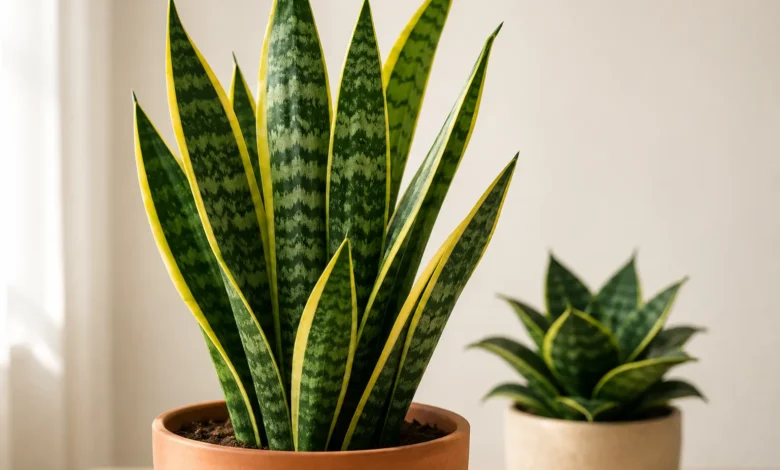
Trifasciata Sansevieria: The Complete Guide to the Snake Plant That Thrives on Neglect
From its West African origins to NASA's clean air research labs — how the mother-in-law's tongue became one of the world's most popular and resilient houseplants, and exactly how to keep it thriving.


*Disclaimer: We may earn a commission if you make a purchase through our affiliate links, at no extra cost to you.
📋 Quick Facts
Scientific Name
Dracaena trifasciata (syn. Sansevieria trifasciata)
Common Names
Snake Plant, Mother-in-Law’s Tongue, Serpent Plant
Native Region
West Africa (Nigeria, Congo, Togo, Cameroon)
Toxicity
Mildly toxic to cats, dogs, and humans if ingested
Watering Frequency
Every 2–6 weeks (season-dependent)
Light Requirements
Tolerates low light; prefers indirect bright light
Growth Rate
Slow to moderate; up to 1.2 m (4 ft) tall
USDA Hardiness Zone
Zones 9–11 outdoors; houseplant worldwide
Sansevieria trifasciata — commonly called the snake plant, mother-in-law’s tongue, or serpent plant — is one of the most forgiving and widely cultivated houseplants on earth. Native to the rocky, arid regions of West Africa, it has adapted over millennia to survive drought, poor soil, and dramatic temperature swings. That resilience is exactly why it now occupies windowsills, offices, and lobbies in virtually every country. Whether you’re a first-time plant owner or a seasoned collector, the snake plant’s needs are simple: well-draining soil, infrequent watering, and reasonable light. Get those three things right, and it will reward you for years — often decades.
The plant belongs to the Asparagaceae family and was reclassified by botanists in 2017 from the genus Sansevieria to Dracaena, making its full scientific name Dracaena trifasciata. However, the name Sansevieria trifasciata remains so embedded in horticultural literature, trade catalogues, and everyday use that both names are widely accepted and interchangeable. The word “trifasciata” refers to the three-banded pattern of lighter green markings that run horizontally across its dark, sword-like leaves — a detail that gives the plant a quietly distinctive look even before you know what it is.
Beyond aesthetics, the snake plant carries genuine practical appeal. A well-cited 1989 study conducted by NASA researchers — often referenced in discussions of indoor air quality — identified it as one of the plants capable of absorbing trace amounts of airborne toxins including benzene, formaldehyde, and trichloroethylene. The actual air-purifying effect in a typical home setting is modest rather than transformative (the study’s conditions were controlled and enclosed), but the research gave the plant a profile that decades of marketing have never quite let go. Combined with its near-indestructibility, it is little surprise that sansevieria trifasciata care has become one of the most searched plant topics globally.
Origins and Botanical Background
The snake plant’s wild habitat tells you almost everything you need to know about how to grow it. Across its native range — principally the coastal and inland areas of Nigeria, the Democratic Republic of Congo, Cameroon, and Togo — Dracaena trifasciata grows in rocky outcrops, dry forests, and open scrubland where rainfall is irregular and soil drainage is extreme. In those conditions, the plant evolved a CAM photosynthesis mechanism: it opens its stomata at night rather than during the day to minimise water loss. This biological adaptation is part of why it can cope with infrequent watering and why it is one of the few plants that releases oxygen during nighttime hours — a fact that contributes to its reputation as a bedroom-friendly plant.
The plant was formally described for Western botany in the early 19th century, though it had been collected and cultivated in Europe since at least the 1700s. It was named in honour of Raimondo di Sangro, the 18th-century Prince of Sansevero in Naples, an eccentric polymath and patron of the natural sciences. The attribution of the genus name Sansevieria to him is well-documented in botanical history, and it reflects the Enlightenment-era practice of naming newly classified specimens after aristocratic benefactors. The “trifasciata” species epithet, describing the three-banded leaf markings, was formalised by the botanist N.E. Brown of the Royal Botanic Gardens, Kew, in the late 19th century.
The Reclassification Debate and What It Means for Growers
The 2017 reclassification by Christenhusz and colleagues, published in the journal Phytotaxa, merged the entire Sansevieria genus into Dracaena based on molecular phylogenetic analysis. Not everyone in the horticultural world was pleased. Many nurseries, plant databases, and retailers continue to sell and catalogue the plant under the Sansevieria name, and some taxonomists still argue the split warrants separate genera. For practical purposes — growing, propagating, buying — the name you use makes no difference whatsoever. The plant behaves identically regardless of what the label says. Where it matters is in scientific literature searches and when cross-referencing care guides from different sources, which sometimes seem contradictory simply because they are using different names for the same species.
Timeline: Key Milestones in the Snake Plant’s History
c. 1700s
Sansevieria specimens first arrive in European botanical collections and private gardens via trade routes from West Africa. Exact records are fragmentary but cultivation is documented in England and the Netherlands.
1794
The genus Sansevieria is formally established and named in honour of Raimondo di Sangro, Prince of Sansevero, by botanist Vincenzo Petagna in his Institutiones Botanicae.
1903
Sansevieria trifasciata is formally described as a distinct species by botanist N.E. Brown of the Royal Botanic Gardens, Kew. The ‘Laurentii’ cultivar, featuring distinctive golden-yellow leaf margins, is also described around this period.
1989
NASA’s Clean Air Study, led by Dr. B.C. Wolverton, lists Sansevieria trifasciata among the houseplants capable of removing trace volatile organic compounds (VOCs) from enclosed environments. The study becomes one of the most cited horticultural references in popular media.
2017
Molecular phylogenetic analysis leads Christenhusz, Fay, and Chase to merge Sansevieria into Dracaena, renaming the species Dracaena trifasciata. The reclassification is published in Phytotaxa but remains contested in horticultural practice.
2020–Present
Global houseplant sales surge during the COVID-19 pandemic. Sansevieria trifasciata consistently ranks among the top five most purchased indoor plants in the UK, US, Germany, and Australia, per multiple nursery industry reports. Its low-maintenance profile suits the home-working generation precisely.
💜 Why This Matters
There is something quietly meaningful about a plant that survives indifference. The snake plant has been passed between flat-shares, carried from one rented room to another, and forgotten in dim hallways for months — yet it persists. For many people, it is the first plant they have ever kept alive, and that small act of keeping something green going carries a significance that goes beyond decoration. In an era when discussions around wellbeing, green spaces, and biophilic design have entered mainstream conversation, the sansevieria trifasciata offers an accessible, low-barrier entry point into the practice of caring for living things — something that plant psychologists increasingly suggest has measurable benefits for mood and attention.
Sansevieria Trifasciata Care: A Practical Deep Dive
The most common reason snake plants die is overwatering — not neglect. The plant stores water in its thick, leathery leaves and rhizomes, which means it can go weeks without a drink without any visible distress. In winter, particularly in cooler climates, watering once a month is often sufficient. In warmer months, every two to three weeks is a reasonable rhythm, but the golden rule is always to check the soil first: if the top two inches feel dry, water thoroughly and allow the pot to drain completely. Sitting in soggy soil for extended periods leads to root rot, which is almost always fatal if not caught early.
Light conditions are more flexible than most plant guides suggest. The plant sansevieria trifasciata genuinely tolerates low light — it will not immediately decline in a north-facing room or a corridor with minimal natural light. However, “tolerates” is not the same as “thrives.” In brighter, indirect light, growth accelerates, colours become more vivid, and the plant produces new leaves more readily. Direct, harsh afternoon sun can scorch the leaf edges, particularly in summer, so a spot that receives filtered morning light is close to ideal. The widely sold ‘Laurentii’ cultivar, with its cream-yellow leaf margins, tends to lose its distinctive variegation in very low light — reverting to a more uniform green over time.
Soil and pot choice are equally important. A well-draining cactus or succulent mix, or a standard potting compost amended with generous quantities of perlite or coarse sand, is appropriate. A terracotta pot is preferable to plastic or glazed ceramic because it allows excess moisture to evaporate through its walls — reinforcing the dry-and-drain care cycle the plant prefers. When repotting — which is needed infrequently, perhaps every two or three years — choose a new container only slightly larger than the previous one. The snake plant blooms most readily when its roots are slightly restricted, and oversized pots hold more moisture than the roots can process.
Popular Varieties: More Than One Snake in the Grass
Sansevieria trifasciata is the species, but the cultivar range is genuinely diverse. The most widely available variety is ‘Laurentii’, prized for its creamy-yellow edges and reaching heights of up to 90 cm. It was discovered growing in the Belgian Congo in the early 20th century and has since become the commercial standard. ‘Hahnii’ (also called the bird’s nest snake plant) grows in a low, compact rosette of short, wide leaves — a different visual profile entirely, and useful in smaller spaces. ‘Moonshine’ produces pale, silvery-green leaves with very faint banding — striking in contemporary interiors. ‘Twisted Sister’ has shorter, spiralling leaves with golden-yellow edges. The compact and architecturally interesting ‘Cylindrica’ — with round, tube-like leaves that can be braided as they grow — is a separate but closely related species (Dracaena angolensis) often sold alongside trifasciata cultivars.
For those looking at the plant through a design lens rather than a botanical one, the variety chosen matters considerably. Tall, upright cultivars like ‘Laurentii’ and ‘Black Gold’ suit floor positions, adding vertical interest to a corner. Low rosette forms are more suited to shelves and tabletops. The pale, almost grey tones of ‘Moonshine’ pair well with concrete and industrial interiors, while ‘Laurentii’s warmer yellow-green palette suits more traditional or earthy decor. The good news is that all of them have the same basic care requirements — so variety choice is purely aesthetic. Just as people make considered decisions about nutrition and supplementation to improve their environments (a practice explored in depth in content on the health benefits of natural foods), choosing the right plant variety for your space is its own considered act of environmental wellbeing.
Propagation, Toxicity, and Common Problems
Propagating sansevieria trifasciata is straightforward and satisfying. The two most reliable methods are division and leaf cuttings. Division involves removing the plant from its pot and carefully separating rhizome clumps at the roots — each section, as long as it has a portion of healthy rhizome, will grow independently. Leaf cuttings work by cutting a healthy leaf into sections of around 5–8 cm, allowing the cut ends to callous for 24 hours, then inserting them upright into moist, well-draining compost. Rooting takes several weeks. One important caveat: leaf-cutting propagation does not preserve variegation in cultivars like ‘Laurentii’. New plants grown from cuttings of that variety will revert to the plain green of the base species — only division maintains the golden margins. This is a frequently overlooked detail that disappoints many propagators who were expecting golden-edged offspring.
On toxicity: the plant contains saponins — compounds that are mildly toxic to cats, dogs, and humans if ingested. The American Society for the Prevention of Cruelty to Animals (ASPCA) lists it as toxic to domestic animals, with reported symptoms including drooling, nausea, and vomiting. It is not considered severely poisonous — contact or small accidental ingestion rarely causes serious harm — but households with curious pets or young children should place plants out of reach. The sap can also cause mild skin irritation in sensitive individuals, so wearing gloves when handling or repotting is reasonable precaution rather than strict necessity.
The most common problems beyond root rot include brown leaf tips (usually caused by inconsistent watering, fluoride in tap water, or very dry air), yellowing leaves (typically overwatering or poor drainage), and pests such as spider mites, mealybugs, or fungus gnats. Fungus gnats are especially prevalent in overly moist soil — allowing the compost to dry between waterings typically eliminates them without chemical intervention. Spider mites appear in hot, dry conditions; wiping leaves with a damp cloth and increasing humidity marginally usually resolves mild infestations. The bogenhanf (the German common name for sansevieria trifasciata, still widely used in German-speaking horticultural circles) is particularly valued in central Europe for its ability to cope with dry indoor heating in winter, which many other plants struggle to tolerate.
📊 Snake Plant: Key Care Priorities at a Glance
Note: Ratings are relative to common houseplants and reflect general expert consensus across reputable horticultural sources. Individual results vary with environmental conditions.
“The sansevieria is among the hardiest of all cultivated plants. It thrives under the most adverse conditions — irregular watering, poor soil, and dim light. In many ways it is the houseplant equivalent of a cactus, and it deserves a great deal more credit for it.”
— Dr. B.C. Wolverton, Environmental Scientist, NASA; paraphrased from How to Grow Fresh Air (1997), Penguin Books
Sansevieria Trifasciata in Feng Shui, Culture, and Commercial Use
In several West African traditions, sansevieria species have been used medicinally for centuries. In Nigeria, leaf fibres have historically been used for weaving and basket-making, and some traditional medicinal applications involved the plant’s sap — though it should be noted that ethnobotanical uses have not been validated through rigorous clinical trials and should not be relied upon for health treatment. In Chinese feng shui practice, the snake plant is considered a protective plant that absorbs negative energy, and its placement near the entrance of a home or business is sometimes recommended for this reason. Whether or not one subscribes to that philosophy, its placement near entrances does have a practical benefit: the plant is exceptionally tolerant of draughts and temperature fluctuations near doors.
Commercially, Sansevieria trifasciata is one of the most mass-produced foliage plants globally. It features prominently in IKEA, Homebase, and B&Q plant ranges in the UK, in Home Depot and Lowe’s in the US, and in equivalent garden retail chains across Europe and Asia. In Germany, where the plant is sold under the popular name Bogenhanf (literally “bow hemp,” a reference to its historically fibrous leaves), it remains one of the perennial bestsellers in garden centres. The global indoor plant market, valued at several billion dollars annually across major economies, relies substantially on species like this one precisely because high consumer success rates — plants that don’t die easily — drive repeat purchases and positive word of mouth.
Where Things Stand Now
As of 2025, demand for sansevieria trifasciata shows no signs of declining. The houseplant boom that began during the pandemic has settled into something more like a permanent cultural shift — younger urban demographics in particular have embraced indoor plants as part of broader wellness and home environment routines. The snake plant sits at the centre of that shift, equally useful in a minimalist London flat, a busy Karachi office, or a sun-drenched balcony in Cape Town. Social media platforms, particularly Instagram and TikTok, have generated enormous volumes of plant care content, and snake plant propagation videos consistently attract large audiences — demonstrating appetite for practical, hands-on plant knowledge rather than purely aesthetic imagery.
On the scientific side, researchers continue to examine the plant’s capacity for phytoremediation — the use of plants to absorb pollutants. While the 1989 NASA study remains the most cited reference, subsequent research published in journals including the Journal of Hazardous Materials and the International Journal of Environmental Research and Public Health has explored optimal conditions and realistic pollutant absorption rates in domestic settings. The emerging consensus is that while the plant does absorb VOCs, the practical air-quality improvement in a typical room requires more plants than most people keep — somewhere between 10 and 1,000 plants per 10 square metres to match mechanical air filtration, according to a 2019 analysis by Michael Waring of Drexel University. That nuance rarely makes headlines, but it matters for setting accurate expectations.
✨ Sansevieria Trifasciata — At a Glance
Optimal Temp Range
15°C – 29°C (60°F – 85°F)
Known Cultivars
70+ named varieties
Photosynthesis Type
CAM (night oxygen release)
Lifespan (indoors)
10–25+ years with correct care
❓ Frequently Asked Questions
How often should I water Sansevieria trifasciata?
Water your snake plant every 2–6 weeks, depending on the season. In summer, every two to three weeks is typically appropriate; in winter, monthly watering is often sufficient. Always check that the top two inches of soil are dry before watering again. Overwatering is the most common cause of decline — when in doubt, wait longer.
Is Sansevieria trifasciata toxic to cats and dogs?
Yes. The ASPCA lists Sansevieria trifasciata (snake plant) as toxic to both cats and dogs due to its saponin content. Ingestion typically causes gastrointestinal symptoms including nausea, vomiting, and drooling. It is not considered severely poisonous, but pets should be kept away from the plant as a precaution.
What is the difference between Sansevieria and Dracaena trifasciata?
They are the same plant. In 2017, the genus Sansevieria was reclassified into Dracaena based on molecular analysis, making the formal scientific name Dracaena trifasciata. However, the name Sansevieria trifasciata remains widely used in horticulture, retail, and plant care literature. Both names refer to the identical species with no difference in growth, care, or behaviour.
Can snake plants survive in low light?
Yes — Sansevieria trifasciata is one of the most light-tolerant houseplants available. It will survive in low-light positions including north-facing rooms and corridors, though growth will slow considerably. For best health and colour vibrancy, indirect bright light is preferable. Variegated cultivars like ‘Laurentii’ may lose their yellow margins in very low light.
Why are the leaves of my snake plant turning yellow?
Yellow leaves are almost always a sign of overwatering or poor drainage. Remove the plant from its pot and check the roots — if they are brown, mushy, and foul-smelling, root rot has set in. Trim any affected roots, allow the plant to dry out, and repot into fresh, well-draining compost. Reduce watering frequency going forward. Occasionally, yellowing may also indicate a nutrient deficiency or very low light conditions.
Does Sansevieria trifasciata really purify the air?
It does absorb some VOCs including benzene and formaldehyde, as documented in NASA’s 1989 Clean Air Study. However, researchers including Michael Waring (Drexel University, 2019) have noted that the concentration of plants required to meaningfully improve air quality in a typical room is far greater than most people keep. The air-purification benefit of a single snake plant in a domestic room is real but modest.
Final Thoughts
The snake plant earns its global reputation not through dramatic flower displays or rare beauty but through a more compelling quality: reliability. It asks for very little and, in return, offers architectural presence, longevity, and a certain undemanding companionship that few other houseplants can match. The sansevieria trifasciata has been in human cultivation for over three centuries. That is a long track record — longer than most beloved garden varieties and certainly longer than most contemporary houseplant trends. When something survives that long in people’s homes, crossing continents and cultural contexts, it is worth paying attention to why.
For anyone new to plant keeping, it is a natural starting point. For experienced collectors, it remains a useful foil to more temperamental specimens — a plant that quietly holds its corner while orchids sulk and fiddle-leaf figs drop leaves at the slightest draught. And for those who take their cues from botanical science or feng shui or simply from what looks good in a modern flat, it adapts without complaint to each framing. The care fundamentals are simple enough to summarise in a single sentence: well-draining soil, infrequent watering, indirect light. Everything else is refinement.
Perhaps what the mother-in-law’s tongue communicates most clearly — through decades of survival in offices, bathrooms, forgotten hallways, and bright living rooms — is that resilience and elegance are not mutually exclusive. You can keep a plant alive for twenty-five years with minimal intervention and have it look exactly as composed on the last day as the first. That is not something many living things can claim.
📚 Sources & References
- ASPCA — Toxic and Non-Toxic Plants: Snake Plant (Sansevieria trifasciata)
- NASA Technical Reports Server — Interior Landscape Plants for Indoor Air Pollution Abatement, Wolverton et al., 1989
- Royal Botanic Gardens, Kew — Plants of the World Online: Dracaena trifasciata
- Waring, M.S. et al. — “Potted plants do not improve indoor air quality”, Journal of Exposure Science & Environmental Epidemiology, 2019
- Royal Horticultural Society (RHS) — Dracaena trifasciata Plant Profile
All sources verified at time of publication. Links subject to change.
AB Rehman
Health & Lifestyle Writer
AB Rehman is a features and research writer covering health, lifestyle, and plant care. His work focuses on separating verified fact from speculation, drawing on primary sources including peer-reviewed studies and institutional databases to produce accurate, readable long-form content for general and specialist audiences.
⚠️ Editorial Disclaimer
This article is intended for informational and educational purposes only. All facts have been sourced from publicly available information at the time of publication, including peer-reviewed studies, institutional plant databases, and reputable horticultural organisations. Botanical care advice is general in nature and should be adapted to your specific growing environment. The air-purification properties of Sansevieria trifasciata described herein reflect findings from cited scientific literature; they are not medical claims. Toxicity information is based on ASPCA guidance — consult a veterinarian promptly if you suspect a pet has ingested any plant material. No financial advice is contained in this article. The views expressed reflect editorial analysis only.