Stand Pile: The Ancient Chinese Practice of Zhan Zhuang That Builds Strength Through Stillness
Stand pile — known in Chinese as Zhan Zhuang — is a millennia-old standing meditation and qigong method that develops internal strength, corrects posture, and cultivates qi through motionless practice. Here is everything you need to know.


*Disclaimer: We may earn a commission if you make a purchase through our affiliate links, at no extra cost to you.
📋 Quick Facts
Chinese Name
Zhan Zhuang (站桩)
Translation
Standing Post / Pile Standing
Estimated Origin
3rd Century BC (Taoist tradition)
Practice Category
Qigong / Internal Martial Arts
Modern Populariser
Wang Xiangzhai (1885–1963)
Associated Arts
Tai Chi, Yiquan, Xingyiquan, Bagua
Core Benefit
Qi cultivation, posture & internal strength
Session Duration
2 minutes to 2 hours per posture
Stand pile — rendered in Chinese as Zhan Zhuang (站桩) — is one of the most deceptively demanding practices in the entire spectrum of traditional Chinese health cultivation. The concept is disarmingly simple: you stand still. Yet within that stillness lies a complete training system that has shaped the bodies and minds of martial artists, Taoist monks, and medical qigong practitioners for well over two thousand years. Whether the goal is managing chronic pain, building structural strength for combat, or quieting an overstimulated nervous system, the standing pile delivers results that most conventional exercise methods cannot replicate.
The phrase “stand pile” is an English rendering of Zhuang, meaning post or pile — the kind of wooden stake driven into the ground to bear enormous loads without moving. To stand like a pile, in this tradition, means to root the body so deeply and align it so precisely that effort dissolves into effortlessness. This is not passive stillness. As one key text from the Dachengquan tradition describes the practice, it is “movement without moving any parts of the body, and yet involving all of them.” That paradox sits at the heart of why this practice has survived the centuries.
Interest in stand pile practice has grown considerably outside East Asia over the past two decades, drawn in by its accessibility — no equipment, no large space, no prior fitness baseline — and by a growing body of research into standing meditation’s effects on circulation, musculoskeletal alignment, and mental clarity. This article examines the origins of pile standing, its core postures and mechanics, its documented health benefits, and the practitioners who shaped the tradition as it exists today.
Origins and Historical Background of Stand Pile Practice
The earliest documented forms of standing cultivation appear in the medical and philosophical texts of ancient China, with some scholars tracing precursor practices to the 3rd century BC, during the flowering of Taoist philosophy under works such as Laozi’s Tao Te Ching. The Taoists, whom historian of Chinese medicine Paul Unschuld has described as practitioners of what they called “inner alchemy,” developed standing postures as a way to regulate qi — the circulating life-force energy believed to animate every biological process. These were not martial methods initially; they were health-preservation and longevity practices, rooted in the observation that trees, standing still and deeply rooted, outlast everything that moves frantically around them.
By the Tang Dynasty (618–907 AD), standing practices had begun to merge with the combat traditions of Chinese martial arts. Internal stylists recognised that a practitioner who could hold the body in deep structural alignment without trembling would naturally develop the rooted power — sometimes called “whole-body connected strength” or hun yuan jin — that differentiates internal martial arts from purely muscular approaches. The integration was gradual, and different lineages absorbed pile standing at different rates, but by the Ming and Qing dynasties it had become a cornerstone of nearly every internal style: Taiji Quan, Xingyiquan, and Baguazhang all developed their own variants.
The term Zhan Zhuang itself, as a unified concept, was coined in the 20th century. Wang Xiangzhai, born in 1885 in Hebei Province, China, was the pivotal figure: a student of the Xingyiquan master Guo Yunshen, Wang became dissatisfied with conventional martial training and distilled everything he had learned into a system centred entirely on standing practice. He named this new art Yiquan — “Intent Fist” — and placed Zhan Zhuang at its centre. His work made the conceptual and practical architecture of stand pile far more accessible to students outside the closed-door lineage system.
Key Figures: Wang Xiangzhai and the Medical Research of Dr Yu Yong Nian
Wang Xiangzhai (1885–1963) is the central figure in the modern transmission of stand pile as a codified discipline. His creation of Yiquan — and his insistence that motionless standing contained more developmental power than entire catalogues of complex martial forms — was considered radical in the martial arts world of early 20th-century China. He attracted students from across Asia, and his influence persists through dozens of lineages active today.
Equally significant for the health dimension of pile standing is Dr Yu Yong Nian, a Beijing-based practitioner who trained directly under Wang Xiangzhai and spent decades documenting the physiological effects of the practice on his patients and students. His research, published in works translated loosely as Zhan Zhuang: The Art of Nourishing Life, provided clinical documentation of improvements in cardiovascular regulation, red blood cell production, and haemoglobin levels in practitioners — giving the Taoist tradition a biomedical vocabulary that has helped it survive in the modern health landscape. His work remains a primary reference for practitioners and researchers who approach the subject empirically rather than philosophically.
In the West, health practitioners working with joint and musculoskeletal conditions have increasingly pointed to standing meditation practices as low-impact interventions that support structural health without the loading stress of conventional weight-bearing exercise. This convergence of ancient tradition and contemporary wellness research has brought stand pile to an audience far beyond those who train in formal martial arts schools.
Timeline: Key Milestones in the History of Stand Pile
3rd Century BC
Taoist practitioners in China develop early standing cultivation methods as part of inner alchemy and longevity practices, laying the conceptual foundation for what will become Zhan Zhuang.
Tang – Ming Dynasties (618–1644)
Internal martial arts lineages — including early Xingyiquan and Taiji — integrate pile standing as a structural training method, embedding it in the foundational curriculum of neijia (internal) schools.
Early 20th Century
Wang Xiangzhai, studying under Xingyiquan master Guo Yunshen, creates Yiquan — a martial system built entirely around Zhan Zhuang. He coins the modern term and publishes foundational texts articulating the method’s principles.
1950s – 1980s
Dr Yu Yong Nian conducts clinical research on stand pile at Beijing medical institutions, documenting measurable physiological improvements in patients. His work bridges traditional Chinese medicine and Western biomedical frameworks.
1990s – 2000s
Practitioners such as Master Lam Kam Chuen publish accessible guides (notably The Way of Energy), bringing stand pile to Western audiences through mainstream publishing. Interest grows rapidly in Europe and North America.
2010s – Present
Academic research into standing meditation practices — published in journals covering Traditional Chinese Medicine, sports science, and rehabilitation — validates many of the health claims historically associated with Zhan Zhuang, accelerating adoption in physiotherapy and wellness settings globally.
💜 Why This Matters
In an era defined by constant movement, productivity pressure, and exercise regimes designed for maximum visible output, stand pile asks something genuinely counter-cultural: simply be still and let the body heal itself. For the millions of people living with chronic postural pain, anxiety disorders, or the kind of low-grade fatigue that no amount of sleep seems to fix, the stand pile tradition offers a framework that is simultaneously ancient and surprisingly contemporary. What is perhaps most compelling is that it demands almost nothing externally — no gym, no equipment, no special clothing — yet asks everything of your attention and patience, making it one of the most honest practices available to anyone willing to try it.
How Stand Pile Works: Mechanics, Postures, and the Role of Qi
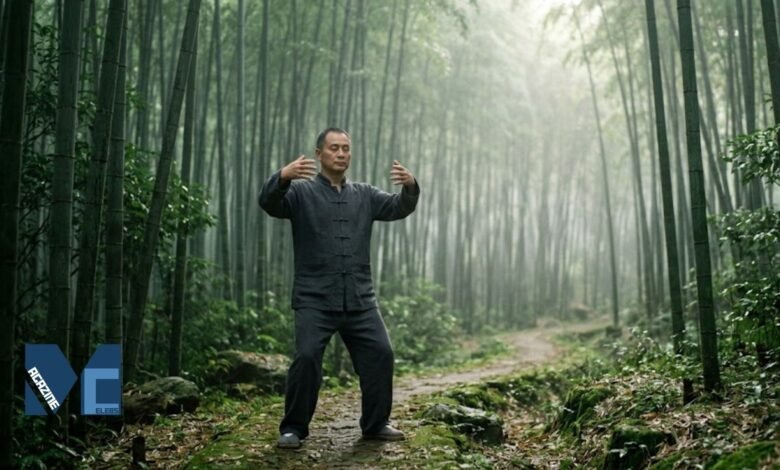
At its technical core, stand pile practice involves holding specific postures — the most common being the Hun Yuan stance, sometimes called “tree hugging” or Cheng Bao — for extended periods with minimal external movement. The practitioner stands with feet shoulder-width apart, knees gently bent, spine lengthened, and arms held out as though embracing a large sphere. Every joint is simultaneously opened and supported. The tongue rests lightly against the upper palate. Breathing is natural, slow, and diaphragmatic. The instruction from most teachers is to relax every muscle group progressively, allowing the skeleton, rather than muscular gripping, to bear the weight.
What makes this deceptively demanding is the interaction between deep muscular engagement and surface relaxation. Holding a low posture for ten minutes requires significant isometric effort from the quadriceps, hip stabilisers, and deep spinal muscles — yet the instruction is to remain soft, not braced. This creates a training effect closer to what modern sports scientists call “intramuscular coordination training” than to conventional strength work. Over time, the body learns to bear load efficiently, which is why practitioners report reductions in chronic back and shoulder pain alongside improvements in general posture that transfer into everyday movement. Studies cited in a 2019 paper published via ResearchGate, reviewing benefits of standing meditation techniques including Zhan Zhuang, noted improvements in circulation, musculoskeletal health, and regulation of the nervous system across multiple practitioner populations.
The qi dimension is harder to frame in biomedical terms, but is central to how the tradition understands what is happening during practice. In Traditional Chinese Medicine theory, qi flows through pathways called meridians, and stagnation of that flow is associated with pain, fatigue, and dysfunction. Stand pile is understood to create conditions — through deep relaxation, correct spinal alignment, and sustained focused attention — in which blocked qi flow normalises. Whether one accepts TCM theory or prefers a Western neurological model (in which the benefits are attributed to reduced sympathetic nervous system activation and improved blood flow through relaxed musculature), the physical outcomes described are broadly consistent across both frameworks.
Stand Pile in Martial Arts: From Baji Quan to Yiquan
Stand pile’s role within the Chinese martial arts is not merely foundational — for some styles, it is the curriculum. In Yiquan, the system Wang Xiangzhai developed, a student might spend months or even years on Zhan Zhuang before any striking, pushing, or partner work is introduced. The reasoning is structural: without a rooted, whole-body-connected frame, technique is just surface movement. A practitioner who has spent hundreds of hours in the standing pile builds what internal arts practitioners call “ground path” — the capacity to transmit force from the earth through the body to the point of contact without losing structural integrity. This is distinct from simple muscular strength, and it is extremely difficult to develop by other means.
Beyond Yiquan, practically every major internal style uses stand pile at its core. Taijiquan schools use the Wuji standing posture as the entry point to form practice. Xingyiquan employs San Ti Shi — the Three Body Posture — as its primary standing method, requiring the student to hold an asymmetric structure that develops the specific connectivity needed for Xingyi’s explosive striking techniques. Baguazhang, whose practitioners are known for their characteristic circle-walking, also uses pile standing to develop the root and central axis from which all the style’s turning and spiralling originates. The principle of building a solid base before advancing is a constant across all of these traditions.
Outside China, the stand pile has been adopted and adapted by practitioners of Brazilian Jiu-Jitsu, MMA coaching circuits, and strength-and-conditioning programmes specifically because it develops postural endurance and kinesthetic body awareness without the injury risk of loaded barbell work. The evidence base for its usefulness in athletic contexts remains less formally documented than its health applications, but the anecdotal adoption across high-performance sport is extensive and growing.
📊 Documented Health Benefits — Evidence Strength
Note: Evidence strength ratings are based on practitioner literature, clinical observations by Dr Yu Yong Nian, and academic review papers. Large-scale randomised controlled trials remain limited. Readers should consult a qualified practitioner before beginning stand pile practice for medical purposes.
“Zhan Zhuang readjusts the functions of the various organs while keeping the outward form of the body motionless — it is movement without moving any parts of the body, and yet involving all of them.”
— Wang Xuan Jie, Dachengquan (translation via Internal Arts International)
Stand Pile and the Modern Wellness Landscape
The contemporary wellness industry has absorbed stand pile under several overlapping labels — standing meditation, static qigong, postural endurance training — without always acknowledging the coherent tradition behind them. This dilution has brought the practice to a far wider audience, including people who would never set foot in a martial arts school, but it has also stripped away much of the structural precision that makes the practice effective. A practitioner standing in roughly the right shape for two minutes while listening to a podcast is not doing Zhan Zhuang. The internal attention — what the tradition calls “listening inward” or nei ting — is not incidental to the practice. It is the practice.
Proper instruction remains important. While the postures of stand pile are accessible to beginners with minimal physical preparation, the subtle alignment corrections that distinguish useful standing from time wasted require at least initial guidance from an experienced teacher. Common beginner errors include locking the knees rather than softening them, collapsing the lower back by tucking the pelvis too forcefully, and tensing the shoulders upward, all of which undermine the structural integrity the practice is designed to develop. Many practitioners report initial discomfort — muscle fatigue and trembling in the legs are entirely normal — but the capacity to stand longer and more comfortably builds within weeks of consistent daily practice.
People managing conditions such as arthritis have found low-posture stand pile particularly useful, since the gentle loading of the joint in a properly aligned position, without impact stress, can help maintain mobility while reducing inflammation associated with disuse. This remains an area where qualified healthcare advice is essential before beginning, and the claim here is not that stand pile replaces medical treatment, but that it has demonstrated value as a complementary practice for people managing joint conditions.
Where Things Stand Now
As of 2026, stand pile practice occupies an interesting position — simultaneously ancient and newly relevant. Academic interest has accelerated since the mid-2010s, with researchers in sports science, physiotherapy, and integrative medicine publishing studies examining the neurological, musculoskeletal, and cardiovascular effects of standing meditation. A 2019 review published via ResearchGate examining standing meditation techniques including Zhan Zhuang catalogued benefits spanning improved fluid dynamics in the body, increased red blood cell production, enhanced haemoglobin levels, and measurable improvements in postural control — findings consistent with Dr Yu Yong Nian’s clinical work conducted decades earlier.
Online communities devoted to Zhan Zhuang have expanded considerably, with practitioners sharing their daily standing logs and progress reports across platforms. Dedicated YouTube channels from lineage teachers in China, the UK, and the United States now provide accessible technical instruction for beginners who have no access to a local teacher. Lam Kam Chuen’s foundational book The Way of Energy, originally published in 1991 by Gaia Books, remains widely in print and is widely cited as the most accessible entry point to the practice for Western readers. It provides instruction on the standing postures and the principle of building duration from short daily sessions upward.
Within martial arts, the stand pile continues to gain recognition beyond its traditional home in Chinese internal styles. Brazilian Jiu-Jitsu coaches, strength trainers, and physical therapists working with practitioners managing body alignment issues have increasingly referenced standing pile training as a tool for developing proprioception and reducing habitual tension patterns. The practice has, in the truest sense, crossed over — without yet losing what makes it distinct.
✨ Stand Pile / Zhan Zhuang — At a Glance
Practice Age
~2,300+ years
Primary Posture
Hun Yuan / Cheng Bao
Equipment Needed
None
Beginner Daily Duration
5–10 minutes per session
❓ Frequently Asked Questions
What is a stand pile in Chinese martial arts?
A stand pile — Zhan Zhuang in Chinese — is a static standing practice used in qigong and internal martial arts such as Taiji, Yiquan, and Xingyiquan. The practitioner holds specific postures for extended periods, developing postural alignment, qi cultivation, and structural strength. The term “pile” refers to a post driven into the ground — the practitioner aims to stand with the same rooted, load-bearing quality.
What are the health benefits of stand pile practice?
Documented and widely reported benefits include improved posture and spinal alignment, reduction in chronic back and neck pain, enhanced blood circulation (including increased red blood cell and haemoglobin production as documented by Dr Yu Yong Nian), improved lymphatic flow, better mental clarity, reduced stress and nervous system overactivation, and greater joint mobility. Stand pile is low-impact and suitable for a wide range of fitness levels.
How long should a beginner practice Zhan Zhuang each day?
Most experienced teachers recommend beginners start with just two to five minutes in the basic standing posture, practised daily. The priority is correct alignment over duration. Over several weeks, practitioners typically build toward 10–20 minute sessions. Advanced students in traditional schools may stand for 30 minutes to over an hour per session, though this develops slowly and should not be rushed.
Is stand pile the same as standing meditation?
There is significant overlap, but stand pile and standing meditation are not identical. Zhan Zhuang contains a specific structural and energetic framework — particular alignments, internal attentions, and progressions — drawn from Chinese martial arts and Taoist health cultivation. Standing meditation is a broader category that includes practices from multiple traditions including Yoga’s Tadasana. Stand pile is a specific, codified form within that broader field.
Who created the modern form of Zhan Zhuang?
Wang Xiangzhai (1885–1963), a Chinese martial artist and student of Xingyiquan master Guo Yunshen, is credited with coining the modern term Zhan Zhuang and developing the Yiquan system built entirely around pile standing. His work synthesised centuries of internal martial arts tradition into an accessible, principle-based framework that became the most widely referenced modern source for stand pile practice.
Can stand pile help with arthritis or joint pain?
Many practitioners and some clinical practitioners report improvements in joint pain management through gentle, properly aligned stand pile practice, particularly because it loads joints without impact stress. However, it is not a medical treatment, and anyone with diagnosed arthritis or significant joint conditions should consult a qualified healthcare provider before beginning. The practice’s low-impact nature makes it a candidate complementary activity, but professional guidance is essential to avoid aggravating existing conditions.
Final Thoughts
What stand pile ultimately teaches, more than any specific health benefit, is the ability to be uncomfortable and remain. The legs burn after a few minutes in a low stance. The mind wanders. An itch demands scratching. The modern reflex to optimise, to accelerate, to move on to the next thing — all of it gets surfaced and examined when you are doing nothing but standing. It is in this sense a practice of character as much as a practice of the body, which is why it has endured across very different historical periods and cultural contexts.
The physiological evidence is compelling enough on its own: improved posture, better circulation, reduced chronic pain, enhanced kinesthetic awareness. But the tradition has always claimed more than biomechanics, and practitioners who have stayed with the stand pile for years consistently describe a qualitative shift in how they inhabit their bodies — a baseline quietness and structural ease that persists beyond the standing sessions themselves. That is a harder thing to measure, but it may be the most significant thing the practice offers.
For anyone curious, the entry cost is genuinely zero. Find a space where you will not be disturbed, stand with feet shoulder-width apart, soften the knees, lengthen through the crown of the head, and raise the arms to roughly chest height as though embracing a large sphere. Remain there for five minutes. What happens next is entirely individual — but something, almost certainly, will happen. The tradition’s persistence across two and a half millennia suggests it has been earning that trust for a very long time.
📚 Sources & References
- Zhan Zhuang — Wikipedia (Overview of history, styles, and key figures)
- Introduction to Zhan Zhuang Gong or Standing Pile Skill — Master Nick Scrima’s Chinese Martial Arts Center
- Benefits of Tadasana, Zhan Zhuang and Other Standing Meditation Techniques — ResearchGate, 2019
- Zhan Zhuang Standing & the Internal Organs — Internal Arts International (citing Wang Xuan Jie, Dachengquan)
- Zhan Zhuang: Ancient Standing Meditation for Energy & Focus — Scott Jeffrey (citing Dr Yu Yong Nian, The Search for Wu, 2006)
- Zhan Zhuang Standing Meditation — Balanced Life Tai Chi
All sources verified at time of publication. Links subject to change.
Hassan Ali
Health & Lifestyle Writer
Hassan Ali is a features and research writer covering health, traditional wellness practices, and lifestyle topics. His work focuses on separating verified fact from speculation, drawing on primary sources — including clinical literature and historical lineage documentation — to produce accurate, readable long-form content for general and specialist audiences.
⚠️ Editorial Disclaimer
This article is intended for informational purposes only. All facts have been sourced from publicly available information at the time of publication. Stand pile / Zhan Zhuang is a traditional practice with a significant history of use, but it is not a substitute for medical treatment. Individuals managing health conditions — particularly musculoskeletal, cardiovascular, or joint conditions — should consult a qualified healthcare professional before beginning any new physical or meditative practice. Where data could not be independently verified, this has been clearly noted. The views expressed reflect editorial analysis and general wellness information, not personal medical advice.