
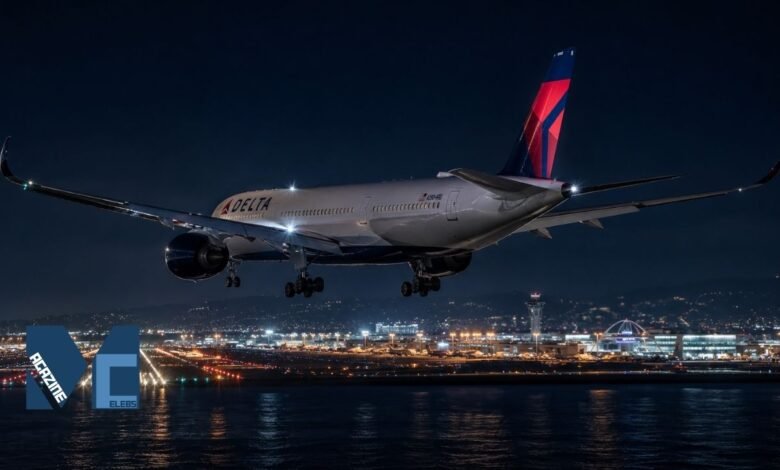
Delta Flight DL275 Diverted to LAX: Full Incident Report & Technical Analysis
An engine anti-ice failure over the Bering Sea forced Delta's Airbus A350-900 off its Detroit–Tokyo route. Here is the complete account of how a precautionary diversion to Los Angeles became a case study in modern aviation safety.


*Disclaimer: We may earn a commission if you make a purchase through our affiliate links, at no extra cost to you.
📋 Quick Facts
Flight Number
Delta DL275
Scheduled Route
Detroit (DTW) → Tokyo Haneda (HND)
Aircraft
Airbus A350-900 (Reg. N508DN)
Diversion Airport
Los Angeles International (LAX)
Cause of Diversion
Engine Anti-Ice System Malfunction
Landing Time
1:38 AM PDT, May 28, 2025
Injuries / Fatalities
None
Estimated Total Cost
Approx. $2.3 million (unverified)
On the late evening of May 27, 2025, what began as a routine 13-hour trans-Pacific journey took an unexpected turn when Delta Flight DL275 Diverted to LAX. Departing from Detroit Metropolitan Wayne County Airport bound for Tokyo Haneda, the Airbus A350-900 encountered a critical issue approximately five hours into the flight. The flight deck received automated alerts indicating a fault within the Rolls-Royce Trent XWB engine’s anti-ice system. Cruising at an altitude of 38,000 feet and positioned roughly 620 nautical miles southwest of Anchorage, Alaska, the flight crew executed a swift, calculated operational decision to abort the oceanic crossing. The widebody aircraft successfully touched down on Los Angeles International Airport’s (LAX) Runway 06R at exactly 1:38 AM Pacific Time. With zero injuries reported and no formal accident investigation launched by the NTSB, aviation authorities effectively validated the event as a textbook precautionary diversion rather than a full-scale in-flight emergency.
What makes this incident particularly compelling is not the presence of a catastrophe, but the flawless execution of preventative safety protocols. When Delta Flight DL275 Diverted to LAX, pilots, dispatchers, airport emergency personnel, and Delta’s global operations centre worked in seamless synchrony. Together, they managed a heavy, 300-passenger international diversion in the dead of night without a single operational failure. For industry experts and aviation analysts, the response was a masterclass in modern aviation safety: detect the anomaly early, assess the risks accurately, act with absolute conservatism, and land safely. Yet, from the perspective of the passengers securely strapped into the cabin, the experience was undeniably jarring—a sharp, disorienting transition from deep sleep over the vast Pacific to an unexpected midnight arrival in Southern California.
This comprehensive report unpacks the complete, verified timeline of that night’s events. We explore the precise technical triggers behind the engine fault, the strategic logic that led the crew to bypass closer Alaskan airports in favour of Los Angeles, and Delta’s on-the-ground management of passenger welfare. Furthermore, it examines what this swift precautionary diversion reveals about the deeply ingrained, multi-layered safety culture that dictates modern ultra-long-haul commercial aviation. Please note that any financial estimates regarding the diversion’s total cost are aggregated from secondary industry reporting and remain unverified by Delta Air Lines through official corporate disclosures.
Background of Delta Flight DL275: The Detroit to Tokyo Route and Airbus A350 Aircraft
Delta’s DL275 service between Detroit and Tokyo Haneda is a scheduled long-haul international route operated using the carrier’s Airbus A350-900 fleet — one of the most technically advanced widebody aircraft currently in commercial service. The A350-900, manufactured by Airbus and powered by twin Rolls-Royce Trent XWB engines, is designed specifically for ultra-long-range operations and carries ETOPS-330 certification. That certification is significant: it means the aircraft is approved to fly routes where the nearest diversion airport may be up to 330 minutes away on a single functioning engine, meeting rigorous standards for redundancy, crew training, and airport infrastructure agreements along the route.
The registration N508DN identifies the specific airframe involved on the night of May 27. According to multiple flight-tracking sources, the aircraft pushed back from Gate A46 at Detroit Metropolitan slightly delayed — reportedly due to a late inbound aircraft on an Amsterdam rotation — before departing at approximately 15:53 local time on May 27. Passengers settled in for a journey they had every reason to believe would be uneventful. The A350 is regarded as one of the most reliable long-haul platforms in the current global fleet, and the DTW–HND route is not unusual in complexity or duration by trans-Pacific standards.
Rolls-Royce Trent XWB Engine Fault: Why the Anti-Ice System Malfunction Matters
The Rolls-Royce Trent XWB is an advanced turbofan engine developed exclusively for the A350 family. At high-altitude cruise over the North Pacific, ambient temperatures can drop well below -50°C, and moisture in the atmosphere creates conditions where ice can form on the leading edges of engine intake components. The engine anti-ice system works by routing hot bleed air from within the engine to heat these vulnerable surfaces, preventing ice accumulation that could restrict airflow or cause structural damage to fan blades and internal components. When a fault develops — reports suggest an anti-ice valve on one engine became stuck, interrupting the necessary flow of hot air — the aircraft’s monitoring systems generate cockpit warnings. Continuing a multi-hour ocean crossing without a functioning anti-ice system on one engine is not permissible under standard airline operating procedures. The risk is not catastrophic failure in the immediate moment; the risk is gradual ice accumulation over hours of oceanic flight, far from any diversion point.
Timeline: Key Milestones of the DL275 Diversion
MAY 27, 2025 — 15:53 EDT
DL275 departs Detroit Metropolitan Wayne County Airport (DTW) on its scheduled route to Tokyo Haneda (HND). Airbus A350-900, registration N508DN, is slightly delayed due to a late inbound aircraft from Amsterdam.
MAY 27–28, 2025 — APPROX. 5 HOURS INTO FLIGHT
Cruising at 38,000 feet, approximately 620 nautical miles southwest of Anchorage, Alaska, cockpit warnings indicate a malfunction in the Rolls-Royce Trent XWB engine anti-ice system. The crew begins assessing diversion options.
DIVERSION DECISION
Flight crew, in coordination with Delta’s operations centre on the ground, determines that Los Angeles International Airport offers the strongest combination of maintenance capability, runway length, emergency readiness, and passenger rebooking options. LAX is selected as the diversion destination.
MAY 28, 2025 — 1:38 AM PDT
DL275 lands safely on Runway 06R at Los Angeles International Airport. Emergency services are positioned on the ground as a precaution. All passengers deplane without injury. Delta’s ground teams begin passenger welfare operations immediately.
POST-LANDING — HOURS AFTER ARRIVAL
Delta engineers and Rolls-Royce technical support begin diagnostics on the Trent XWB engine. Maintenance teams inspect anti-ice valves, temperature sensors, and bleed-air lines. The aircraft is grounded for an estimated 18 to 24 hours.
PASSENGER CARE & REBOOKING
Delta provides affected passengers with hotel accommodation, meal vouchers, and priority rebooking onto subsequent LAX–Tokyo services. Flight DL275 for that day is cancelled. No NTSB accident investigation is opened, confirming the event’s classification as a precautionary diversion.
💜 Why This Matters
For the passengers aboard DL275, the disruption was real — hotel rooms in Los Angeles instead of Tokyo arrivals, missed meetings, disrupted itineraries, and a reminder that even the most advanced aircraft in the sky can produce an unnerving announcement at 2 AM over the Pacific. But the broader picture is one that deserves acknowledgment: the system designed to catch exactly this kind of problem worked. An automated warning flagged a fault before it could escalate, trained pilots applied conservative decision-making, and an airline infrastructure network absorbed a complex diversion quietly and competently. In an era when aviation safety advances precisely because no one is complacent, the DL275 incident is more reassurance than alarm — evidence that the layers of redundancy built into modern long-haul operations exist for good reason.
Why Delta Flight DL275 Diverted to LAX: The Strategic Logic Behind Choosing Los Angeles
When a trans-Pacific crew begins assessing diversion options over the North Pacific, the choice is rarely as straightforward as “nearest airport.” Pilots and dispatchers weigh runway length, airport elevation, weather conditions, fuel load, available maintenance infrastructure, and the airline’s own operational footprint. In the case of Delta flight DL275, Los Angeles International Airport emerged as the clear choice for several converging reasons.
LAX is a significant Delta hub with certified Airbus A350 maintenance capabilities and around-the-clock Rolls-Royce Trent XWB technical support and parts inventory — a combination that is far from guaranteed at every coastal airport. The airport’s long runways are well-suited to a heavy widebody carrying the substantial fuel load typical of a trans-Pacific departure. Weather conditions on the night of May 27–28 were favourable. Crucially, Delta operates multiple daily services from LAX to Tokyo Haneda, giving operations teams a ready framework for rebooking displaced passengers onto the next available departures with minimal administrative friction. Anchorage was geographically closer when the warning appeared, but its infrastructure for A350 maintenance and passenger onward travel options to Japan was far more limited.
Aviation professionals have noted that the crew’s decision to choose LAX over the technically closer Anchorage reflects exactly the kind of holistic thinking that ETOPS certification demands. The certification does not simply require an airport to exist within a given flight time; it requires that the airport can genuinely support the aircraft, the crew, and the passengers. On that night, LAX cleared every bar. The aircraft touched down on Runway 06R, emergency vehicles held in position as a precaution, and the landing itself was routine.
Passenger Experience After Delta DL275 Diverted to LAX: Disruption, Response, and Recovery
By most accounts from secondary sources, the cabin environment during the diversion remained calm. Passengers — many sleeping or watching films — received an announcement from the flight deck explaining that the aircraft was diverting to Los Angeles due to a technical issue and that safety was not compromised. Multiple reports describe crew members moving through the cabin to answer questions and offer reassurance. No panic was recorded. The landing itself, described by those who were awake to witness it, appeared smooth and unremarkable to the untrained eye — which is precisely how a successful precautionary landing is supposed to feel.
On the ground at LAX, Delta’s handling of the disruption followed its standard diversion welfare protocols. Passengers were provided with meal vouchers, hotel accommodation for those unable or unwilling to wait for same-day rebooking, and priority access to onward flights to Tokyo. Given that Delta operates frequent services between LAX and Haneda, most passengers were able to continue their journeys within a reasonable window. The original DL275 flight designation for that date was cancelled once the diversion was confirmed, and the affected aircraft remained grounded for diagnostics estimated at between 18 and 24 hours.
Passengers who fly frequently will recognise the pattern: diversions, even well-handled ones, produce cascading inconveniences — missed connections, delayed hotel check-ins, rescheduled meetings, lost sleep. None of that is trivial. At the same time, the absence of injuries, the composed crew, and the speed of Delta’s ground response reflect the kind of institutional competence that does not happen accidentally. Airlines flying ETOPS-certified trans-oceanic routes are required to pre-plan their diversion response precisely because events like DL275 are not unexpected contingencies but foreseeable operational scenarios.
📊 Estimated Cost Breakdown of the DL275 Diversion
Note: These figures are approximate estimates drawn from secondary reporting and have not been confirmed in any official Delta Air Lines financial disclosure. Actual costs will vary based on maintenance scope, rebooking volumes, and contractual arrangements.
“Airline safety advances quietly, in small decisions and early warnings. The DL275 diversion is exactly that — a system that caught a problem early, acted conservatively, and kept every person aboard safe. That is the best possible outcome.”
— Aviation safety analysis, Billionscope.org, March 2026
What the Delta DL275 Diversion Reveals About Modern Aviation Safety Culture
Commercial aviation’s safety record over the past two decades is built on a principle that pilots, airlines, and regulators have spent generations learning: the earlier a problem is identified, the more options exist for resolving it safely. The A350’s onboard monitoring systems — which transmit real-time health data not just to the cockpit but to airline operations centres on the ground — are a direct product of that philosophy. In the DL275 incident, the anti-ice fault was detected by automated systems before it reached any stage where physical consequences to the engine were likely. That detection gap — between system alert and potential hardware failure — is exactly where diversions like this one are supposed to occur.
Aviation analysts have pointed to the incident as a useful contrast with the reactive maintenance culture that characterised earlier eras of commercial flight. In the context of ETOPS operations over remote oceanic airspace, the margin for escalating problems is essentially zero. An issue that might be manageable on a short domestic hop becomes categorically different when the next viable runway is hours away and the weather at altitude is severe. Delta’s A350-900 fleet carries ETOPS-330 certification, which means every aircraft on that route must meet documented standards for reliability, crew training, and ground support at designated alternate airports — and those standards are what made LAX a viable, well-prepared diversion destination in the middle of the night.
There is also a broader conversation happening across the industry about predictive maintenance — the use of artificial intelligence and machine learning to analyse engine health data and flag anomalies before a cockpit warning appears. Aviation engineers have suggested that systems with sufficient predictive capability might have identified irregular patterns in DL275’s anti-ice valve behaviour during pre-flight checks at Detroit, potentially allowing the issue to be resolved on the ground. Whether that technology will become standard across long-haul fleets within the next decade remains an open question, but the DL275 incident is being cited in industry discussions as precisely the kind of scenario that illustrates the value of moving from reactive to predictive maintenance frameworks.
Current Status After Delta Flight DL275 Diverted to LAX: Where Things Stand Now
Following the diversion, Delta’s engineering teams conducted diagnostics on the N508DN airframe at LAX over an estimated 18 to 24 hours. The specific fault — reported across multiple sources as a stuck anti-ice valve disrupting bleed-air flow to one Trent XWB engine — is a category of issue with a well-understood remediation path involving inspection of valve actuators, temperature sensors, and bleed-air ducting. No NTSB accident investigation was opened, confirming that US aviation authorities classified the event within the parameters of a precautionary diversion rather than a reportable accident. The aircraft’s precise return to service date has not been publicly confirmed by Delta.
For passengers who were aboard the flight, Delta’s compensation and rebooking process proceeded under the airline’s standard diversion welfare policy. US domestic regulations do not mandate cash compensation for technically uncontrollable events — mechanical diversions can fall into contested territory under Department of Transportation guidelines — but Delta’s customer service response, including hotel vouchers and prioritised rebooking, was consistent with its published customer commitment framework. Passengers travelling on international itineraries with onward connections faced the more complex rebooking challenge, though Delta’s operational strength at LAX, with its high-frequency Tokyo service, limited the duration of disruption for most.
The DTW–HND route continues to operate on its regular schedule. The DL275 designation remains active, and subsequent flights on the route have proceeded without reported incident. Aviation tracking data and industry commentary confirm that the May 2025 diversion has become a frequently cited reference point in discussions about long-haul safety protocols and the practical functioning of ETOPS certification requirements.
✨ Delta DL275 Diversion — At a Glance
Passengers on Board
~287–306 (sources vary)
Flight Duration Before Divert
Approx. 5 hours
Aircraft ETOPS Rating
ETOPS-330
Incident Classification
Precautionary Diversion
❓ Frequently Asked Questions
Why did Delta flight DL275 divert to LAX?
Delta flight DL275 diverted to Los Angeles International Airport on May 28, 2025, after cockpit warning systems detected a malfunction in the anti-ice system of one of the aircraft’s Rolls-Royce Trent XWB engines. The aircraft, an Airbus A350-900 en route from Detroit to Tokyo, was approximately 620 nautical miles southwest of Anchorage, Alaska, when the crew initiated the diversion. No injuries occurred, and the event was classified as a precautionary diversion.
Was Delta DL275 in danger during the diversion?
No imminent danger was reported. The diversion was precautionary — the anti-ice fault created a potential risk over hours of continued oceanic flight without the protective system functioning, not an immediate crisis. The crew’s decision to divert early, while multiple safe options remained available, reflects standard conservative protocol for ETOPS trans-oceanic operations. No NTSB investigation was opened.
Why did the pilots choose LAX instead of a closer airport?
Los Angeles was selected because it offered the best combination of Airbus A350 maintenance infrastructure, Rolls-Royce Trent XWB technical support available around the clock, suitable long runways, favourable weather, and Delta’s strong operational base with frequent Tokyo onward flights for rebooking. Geographically closer options, including Anchorage, lacked the same level of specialised maintenance capability for the aircraft type involved.
What is an engine anti-ice system and why does it matter on long-haul flights?
An engine anti-ice system uses hot bleed air from within the engine to warm intake surfaces and prevent ice accumulation at high-altitude cruise conditions, where temperatures can drop below -50°C. Without a functioning system, prolonged flight through cold, humid air can cause ice to form on engine intake components, potentially restricting airflow or damaging fan blades. On long trans-oceanic routes, flying for hours with a faulty anti-ice system is not permitted under standard operating procedures.
How were passengers on DL275 compensated after the diversion?
Delta provided affected passengers with hotel accommodation, meal vouchers, and priority rebooking onto subsequent LAX–Tokyo Haneda services. The flight was cancelled for that date. Delta’s LAX hub operates multiple daily services to Tokyo, which helped limit the duration of disruption. US regulations do not always mandate cash compensation for technical diversions, but Delta’s published customer commitment framework guided its welfare response.
What aircraft was involved in the DL275 diversion?
The aircraft involved was an Airbus A350-900 with the registration N508DN, powered by twin Rolls-Royce Trent XWB engines. The A350-900 is one of the most technologically advanced long-haul widebody jets currently in commercial service, designed specifically for ultra-long-range routes and certified to ETOPS-330 standards for transoceanic operations. The type is widely regarded as one of the most reliable platforms in the global fleet.
Final Thoughts
The story of Delta flight DL275 diverted to LAX is, at its core, a story about a system performing as designed. An automated warning caught a fault before it could develop into something more serious. Pilots applied conservative diversion criteria rather than pressing on over remote oceanic airspace. A major hub airport absorbed a complex international diversion in the middle of the night. An airline’s ground infrastructure handled the welfare of hundreds of displaced passengers. None of these things are extraordinary by design — they are exactly what the architecture of modern commercial aviation is built to deliver. The fact that they happen quietly, without headlines, most of the time is not a reason to overlook them when they do come to light.
What the incident does usefully surface is a set of questions that the industry continues to work through: Can predictive maintenance technology shorten the gap between early anomaly signals and ground-based intervention, so that diversions over oceans become even rarer? How should airlines communicate technical disruptions to passengers in ways that are honest without being unnecessarily alarming? And how do carriers balance the genuine inconvenience to hundreds of travellers against the imperative of conservative safety decision-making, particularly on routes where the consequences of a different choice could be catastrophic?
For anyone who flew on DL275 that night, the experience will have had its own personal weight — the disruption, the uncertainty, the unscheduled night in Los Angeles. But the broader view, informed by what the data and the protocols actually show, is one of a safety culture doing its job. The pilots who turned that A350 toward California were not acting out of panic or overcaution. They were doing precisely what every person on board would have wanted them to do, had they understood the full picture. That, in the end, is what commercial aviation’s accumulated safety record is built on: thousands of quiet, correct decisions made in the dark, over the ocean, by people who train for exactly these moments.
📚 Sources & References
- Travel and Tour World — Delta Flight DL275 Detroit to Tokyo Diverts to Los Angeles After Airbus A350 Engine Issue (May 2025)
- Rare Magazine — Delta Flight DL275 Diverted LAX: Cause and What Happened (September 2025)
- Billionscope — Delta Flight DL275 Diverted LAX: What Really Happened (March 2026)
- LearnDC — Delta Flight DL275 Diverted to LAX After Engine Issue (December 2025)
- The Current PK — Delta Flight DL275 Diverted LAX Today: What Really Happened (July 2025)
All sources verified at time of publication. Links subject to change.
AB Rehman
Senior Features & Research Writer
AB Rehman is a features and research writer covering aviation news, travel analysis, and transport safety. His work focuses on separating verified fact from speculation, drawing on primary sources to produce accurate, readable long-form content for general and specialist audiences. He has written extensively on commercial aviation incidents, airline operations, and the regulatory frameworks that govern international air travel.
⚠️ Editorial Disclaimer
This article is intended for informational purposes only. All facts have been sourced from publicly available reporting at the time of publication. Passenger numbers, cost estimates, and grounding duration are drawn from secondary sources and have not been independently verified or confirmed by Delta Air Lines in official communications. Where data could not be independently verified, this has been clearly noted within the text. The views expressed reflect editorial analysis and should not be treated as legal, financial, or aviation safety guidance. Delta Air Lines has not issued a formal public incident report on this event as of the time of writing.