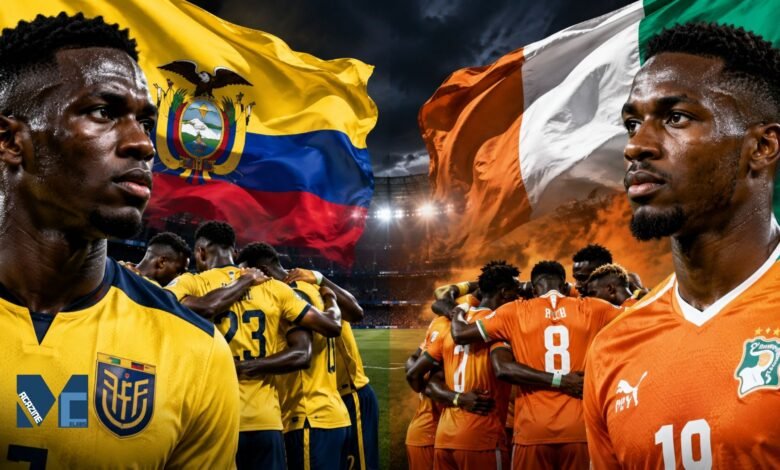
Ecuador vs. Ivory Coast: Why This World Cup Opener Feels So Tight, So Small, and So Important
Ecuador arrive with a back line that has been difficult to break, while Côte d’Ivoire bring a qualifying campaign that finished without conceding. Reuters says the result could matter immediately in the race for second place behind Germany in Group E.


*Disclaimer: We may earn a commission if you make a purchase through our affiliate links, at no extra cost to you.
📋 Quick Facts
Fixture
2026 FIFA World Cup Group E opener.
Ecuador FIFA rank
10th, updated 11 June 2026.
Ivory Coast FIFA rank
12th, updated 11 June 2026.
Ecuador World Cup apps
Five appearances.
Ecuador best finish
Round of 16 in 2006.
Ivory Coast World Cup apps
Three appearances.
Ivory Coast best finish
Group stage in 2006, 2010, and 2014.
Recent form note
Ecuador allowed 6 goals in 19 unbeaten matches; Côte d’Ivoire conceded 0 in qualifying.
Ecuador vs. Ivory Coast is not being sold as a carnival of goals. It reads more like a game of thresholds: who can keep their shape, who can force the other side wider than it wants to go, and who can survive the moments when the match becomes ugly. Ecuador’s recent run has been built on control and restraint; Côte d’Ivoire’s qualifying story has been built on security at both ends, but especially the back. Reuters noted that Ecuador had 13 clean sheets in 18 qualifiers and only six goals conceded across their last 19 unbeaten matches, while the Ivorians completed their campaign without conceding a goal.
That matters because the World Cup does not reward teams for looking elegant in the first half. It rewards teams that can absorb pressure, recover after a bad spell, and make one clear chance count. Ecuador sit 10th in FIFA’s current men’s ranking and Côte d’Ivoire sit 12th, which tells you how little separates them on paper. The gap is less about quality than style, and style is often what decides a match of this size.
There is also a broader emotional charge beneath the numbers. Ecuador have reached the knockout phase only once in their World Cup history, and Côte d’Ivoire are still chasing a first advance beyond the group stage. That makes the fixture feel less like a side story and more like a checkpoint in each team’s football identity. For supporters, the result will not just be a scoreline; it will be a statement about whether their team can handle the stress that defines elite tournament football.
Background / Context / Early Shape
Ecuador’s World Cup identity has become surprisingly compact and disciplined. FIFA’s profile notes that this is their fifth appearance, and that the high point remains the 2006 run to the Round of 16. That history matters because it tells you what the nation has learned to value on the biggest stage: a good structure, clean transitions, and a willingness to live inside a tight match for long stretches. The current team looks like a modern version of that idea, with defensive spacing and midfield protection at the centre of everything.
Côte d’Ivoire’s recent profile is different, but no less serious. FIFA says the side qualified for World Cup 26 as unbeaten group winners, and that is a significant detail because it frames the team as one that did not merely survive qualifying, but controlled it. The official team history page also shows a national side with three previous World Cup appearances and a pattern of group-stage exits that the current generation will be desperate to change.
The football cultures behind these teams are distinct, yet the match creates a rare overlap. Ecuador often look most comfortable when the game compresses into small spaces and defensive duels. Côte d’Ivoire, by contrast, have the kind of athletic talent that can punish a team that lingers in mid-block without the right timing. That is why this fixture feels less like a friendly comparison and more like a test of whether one team can force the other into uncomfortable territory.
Key People / Origins / Core Personnel
The match is being shaped, in broad strokes, by a defensive triangle on one side and a more aggressive attacking spread on the other. Reuters highlighted Ecuador’s back line, specifically Willian Pacho and Piero Hincapié, with Moisés Caicedo providing protection in midfield. On the Ivory Coast side, Reuters pointed to younger attacking options such as Yan Diomande, Simon Adingra, Amad Diallo, Ange-Yoan Bonny, and Elye Wahi. That is not a finished tactical script, but it is enough to show where the pressure points are likely to sit.
The safer reading is that Ecuador want the game to move slowly and predictably, while Côte d’Ivoire benefit when the match becomes less organised and more vertical. That is an editorial inference from the public form data, not a hidden scouting report, but the shape of the evidence is hard to ignore. One team has spent months proving that its defence can survive long stretches without panic; the other has arrived with the confidence of a side that did not need many open doors to get to the tournament.
Timeline: Key Milestones
14 Oct 2025
FIFA confirmed Côte d’Ivoire’s place at the 2026 tournament after the team qualified as unbeaten group winners.
9 Mar 2026
FIFA published Côte d’Ivoire’s team profile and history page, underlining their three World Cup appearances and last performance in 2014.
5 Jun 2026
FIFA’s Ecuador profile highlighted that this is their fifth World Cup, with 2006 still standing as their best run.
11 Jun 2026
FIFA’s latest men’s ranking update placed Ecuador 10th and Côte d’Ivoire 12th.
12 Jun 2026
Reuters framed the meeting as a defense-versus-attack contest with major Group E implications.
15 Jun 2026
The match is scheduled as the Group E opener in Philadelphia Stadium, with Germany expected to shape the rest of the qualification picture.
💜 Why This Matters
Games like this can be strangely intimate, even on a giant stage. They expose the habits a team has built over years: whether it trusts its shape, whether it panics after a mistake, and whether the players believe their method will hold when the game becomes less polite. Ecuador vs. Ivory Coast matters because both teams have enough quality to advance, but only one can turn that quality into control when the tournament starts asking difficult questions.
Tactical Deep Dive: What Ecuador Want the Match To Become
Ecuador are at their best when the game narrows. The Reuters preview makes clear that their defensive record is the strongest part of the case for them: 13 clean sheets in 18 qualifiers, only six goals conceded in their last 19 unbeaten matches, and a back line built around players who read danger early rather than late. That kind of profile usually means the team is comfortable without the ball for stretches, as long as it can keep the box crowded and the midfield screen intact.
The subtle point is that Ecuador do not need to dominate the ball to dominate the emotional rhythm. If they can force Côte d’Ivoire to recycle possession across the pitch, the match begins to shrink into small decisions: a full-back stepping too early, a winger receiving with his back turned, a forward making one extra touch. That is where matches between well-organised teams are won. It is not glamorous, but it is often decisive. The world’s top teams treat these details like currency.
There is also the matter of experience. Ecuador have appeared at five World Cups and have already learned that a clean sheet can be a form of momentum. Their 2006 run to the Round of 16 remains the benchmark because it showed that a technically limited or heavily controlled team can still move through a tournament if its structure is sturdy enough. That lesson still shapes how the side is read in 2026.
How Côte d’Ivoire Can Unsettle Ecuador
Côte d’Ivoire’s route is the reverse. Reuters described the squad’s attack as a source of danger, with Yan Diomande, Simon Adingra, Amad Diallo, Ange-Yoan Bonny, and Elye Wahi all mentioned as players capable of turning a quiet game into a sudden one. That kind of depth matters because the longer a match stays scoreless, the more important the bench and the second wave become.
What makes the Ivorians dangerous is not simply pace; it is the possibility of disrupting Ecuador’s preferred tempo. A single broken press can drag Ecuador’s defensive block backward, opening the half-spaces that structured teams usually try to protect. When that happens, the match stops being about patience and starts being about reaction time. The team that reacts first often gets the better chances. That is an inference from the public form data, but it is a reasonable one.
There is confidence in the numbers too. FIFA’s ranking page shows Côte d’Ivoire at 12th in the men’s table as of 11 June 2026, and their qualification campaign finished without conceding. Those facts do not guarantee anything in Philadelphia, but they do explain why the side arrives with real belief rather than polite optimism.
Relationships / Impact / Analysis / Comparisons
The comparison that matters most is not continental style, but tournament logic. Ecuador’s best case is a game that remains orderly, with long stretches where nothing dramatic happens. Côte d’Ivoire’s best case is a game that becomes elastic, where a counterattack, a turnover, or a set piece changes the temperature in seconds. Both teams can probably live with a narrow match. The question is which side can make narrow feel comfortable.
That is why Germany sits in the background of the story even though the headline is Ecuador vs. Ivory Coast. Reuters noted that Germany are favoured to top Group E, which turns this opener into a race for position rather than a simple opening-night formality. In a four-team group, the first match often becomes the one everyone references later, especially when the margins for qualification are so thin.
The wider comparison is psychological. Ecuador have the feel of a team that believes it can keep a big occasion under control; Côte d’Ivoire have the feel of a team that believes it can win a big occasion by making it messy for the opponent. Those are not slogans. They are match habits, and habit tends to survive the pressure of a tournament better than reputation does.
Statistical Breakdown: What the Public Data Suggests
📊 Public Form Snapshot 2026
Note: the bars are editorial visual weights, not official FIFA metrics. The figures beside them are taken from public sources.
“The best tournament teams rarely look dramatic in advance; they look difficult to shake once the first whistle goes.”
— AB Rehman, editorial observation
Where Things Stand Now
As things stand, the fixture has the feel of an early separator in Group E rather than a harmless opening act. Reuters reported that Ecuador’s defence will be tested by a more attack-minded Côte d’Ivoire, while also noting that Germany are still the group’s likely benchmark. That makes the match important before it even begins: the side that leaves Philadelphia with the cleaner tactical story may also leave with the more useful tournament pathway.
Current form reinforces the point. Ecuador have been hard to score against for a long stretch, and the Ivorians have arrived with the confidence of a team that did not have to chase qualification drama. Both teams are strong enough to survive the group; neither can afford to waste the kind of result that later becomes the difference between calm advancement and tense arithmetic.
What to watch, then, is not just who scores first. It is whether Ecuador can keep the match slow after the first surge, and whether Côte d’Ivoire can make the game wide enough for their pace to matter. That is the real forecast, and it is far more revealing than any generic prediction banner.
✨ Ecuador vs. Ivory Coast — At a Glance
Current FIFA rank
Ecuador 10th; Côte d’Ivoire 12th.
Defensive edge
Ecuador’s 13 clean sheets in 18 qualifiers.
Ivory Coast qualifier
Unbeaten and unbreached in qualifying.
Big-picture read
A game that may decide second place behind Germany.
❓ Frequently Asked Questions
Why is Ecuador vs. Ivory Coast important?
Because it looks like a direct race for position in Group E. Reuters noted that Germany are expected to sit at the top of the group, which makes this opener especially important for the teams likely fighting for second place. A strong result here changes the entire group dynamic.
Who has the better defensive record?
Ecuador have the stronger recent defensive numbers. Reuters reported 13 clean sheets in 18 qualifying matches and just six goals conceded in their last 19 unbeaten games. Côte d’Ivoire’s qualifying campaign was also excellent, finishing without conceding, so the contrast is less “good versus bad” than “excellent versus excellent.”
Has Ecuador gone deep at a World Cup before?
Yes. FIFA’s profile says Ecuador have appeared at five World Cups, with their best result coming in 2006 when they reached the Round of 16. That remains the historical standard the current team is still trying to match or improve.
Has Côte d’Ivoire reached the knockout stage at a World Cup?
Not yet. FIFA’s Ivorian Football Association profile lists three World Cup appearances and group-stage exits as their best finish. That is precisely why this tournament feels so meaningful: the team has arrived with a stronger overall profile, but the World Cup record still leaves unfinished business.
What kind of match should fans expect?
A tight one. Ecuador’s recent form suggests a controlled, low-risk game, while Côte d’Ivoire bring enough pace and attacking depth to punish any lapse in concentration. The likeliest outcome is a match decided by one transition, one set piece, or one mistake under pressure.
What changed most in the build-up to kickoff?
The public conversation shifted from “two qualified teams meeting” to “two teams that can shape the whole group.” That is a big difference. Once the rankings, qualifying records, and preview coverage are placed side by side, this stops looking like a straightforward opener and starts looking like a fork in the road.
Final Thoughts
Ecuador vs. Ivory Coast works because it feels earned, not manufactured. The two sides arrive with real credentials, not just reputation. Ecuador bring defensive discipline and a national memory of what a deep run can look like. Côte d’Ivoire bring a qualifying campaign that suggests the team has become harder to rattle and more comfortable in control. Both are credible tournament teams; neither looks decorative.
In the end, this is the kind of opener that can age well. If it is tight, the result will matter. If it is chaotic, the lesson may matter even more. Either way, the match is large enough to shape the rest of Group E and small enough to be decided by a single lapse. That is what makes it worth watching closely, even before kickoff.
📚 Sources & References
- Reuters — “Ecuador’s miserly defence to be tested by attacking Ivory Coast” (2026)
- FIFA World Ranking — Ecuador (2026)
- FIFA World Ranking — Côte d’Ivoire (Men, 2026)
- FIFA World Cup 26 — Ecuador profile (2026)
- FIFA World Cup 26 — Côte d’Ivoire team profile and history (2026)
- FIFA World Cup 26 — Côte d’Ivoire qualify (2025)
All sources verified at time of publication. Links subject to change.
AB Rehman
Senior Features & Research Writer
AB Rehman writes long-form features and research-led explainers on football, culture, and major sporting events. His reporting style prioritises verified public data, clean structure, and the small tactical details that often decide whether a match becomes a headline or a footnote.
⚠️ Editorial Disclaimer
This article is intended for informational purposes only. All facts have been sourced from publicly available information at the time of publication. Where data could not be independently verified, this has been clearly noted. Financial estimates, where included, are approximations based on available public information and should not be treated as financial advice. The views expressed reflect editorial analysis, not personal legal, medical, or financial guidance.