
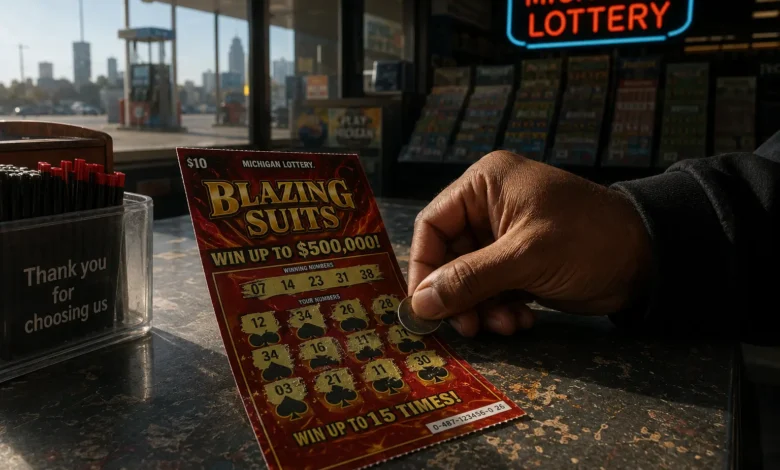
The $10 Decision: How a Michigan Man Won the $1M Lottery
From a discarded ticket in Detroit to a late-night gas station run in Cedar Springs — how ordinary Michigan men turned routine lottery purchases into life-changing $1 million wins, and what their decisions reveal about luck, timing, and the state's booming instant games market.


*Disclaimer: We may earn a commission if you make a purchase through our affiliate links, at no extra cost to you.
📋 Quick Facts
Wayne County Winner (Nov 2025)
33-year-old, Detroit — Blazing Suits Ticket
Lump Sum Payout (Wayne County)
~$693,000 after taxes
Kent County Winner (March 2026)
31-year-old, Cedar Springs — Electric 100s
Lapeer County Winner (Dec 2024)
Robert Benaglio — $1M Powerball Prize
MI Lottery FY25 Prize Payouts
$2.8 billion paid to players statewide
School Aid Fund Contribution (FY25)
$1.16 billion — 7th consecutive year over $1B
Blazing Suits Ticket Price
$10 per ticket
Total MI Lottery contributions since 1972
Over $30 billion to the School Aid Fund
When a 33-year-old Wayne County man walked into Fawaz Petroleum on Schoolcraft in Detroit on November 21, 2025, he noticed something seemingly insignificant — a $10 Blazing Suits instant game ticket sitting abandoned on the checkout counter. Another customer had decided against the purchase at the absolute last second. Acting on pure impulse, the man bought the rejected ticket, scratched off the metallic surface, and uncovered a reality-altering revelation: he had just secured the Michigan Lottery’s $1 million top prize. “I scratched the ticket off and couldn’t believe it when I saw it was a $1 million winner,” he later recounted to lottery officials, still grappling with the shock. “I never would have thought I’d win such a large lottery prize, so it’s truly a blessing.” That single, spontaneous $10 decision — intercepting another person’s discarded fate — irrevocably changed his financial trajectory overnight.
This Wayne County man’s experience is part of a broader, fascinating phenomenon. Across Michigan, a distinct pattern has been quietly playing out through the entirety of 2025 and into 2026. Ordinary residents — primarily anonymous, working-class men — are transforming routine stops at local gas stations, convenience stores, and petroleum outlets into seven-figure windfalls. The serendipity of these moments is striking. In March 2026, a 31-year-old Kent County resident stopped at a Wesco station in Cedar Springs late at night merely to cash in a minor $20 winning ticket. He pocketed half, reinvested the remaining $10 into an Electric 100s scratch-off, and walked away with a $1 million jackpot. Earlier, in January 2025, Robert Benaglio of Lapeer County discovered on New Year’s Eve that a Powerball ticket he had routinely purchased a week prior had made him a millionaire. While the specific games and locations vary, the underlying thread remains identical: the razor-thin margin between a mundane daily errand and a life-altering financial breakthrough was decided by a single piece of paper.
Behind these individual moments of luck lies a massive, highly structured economic engine. Michigan’s instant games market has experienced exponential growth over the past decade, evolving into a cornerstone of state revenue and consumer entertainment. According to official reporting from the Michigan Lottery, a staggering $2.8 billion was paid out in prizes during fiscal year 2025 alone. This figure not only highlights the sheer volume of participation but also underscores the lottery’s deep cultural entrenchment in the American Midwest. By examining these million-dollar wins — analyzing the mechanics of the games, the demographic profiles of the winners, and their overwhelmingly pragmatic post-win financial decisions — we gain a compelling window into a system where institutional probability continually intersects with unpredictable human fortune.
The Michigan Man $1M Lottery: Background and Scale
The Michigan Lottery has operated since 1972, making it one of the older state lotteries in the country. What began as a modest revenue-generating mechanism for the state has evolved into a multi-billion-dollar enterprise with a dual mandate: offer players a legitimate chance at transformative prizes while funnelling profits into Michigan’s public school system. Under state law, all lottery profits are directed to the School Aid Fund, which supports K–12 education programs across every school district in the state.
The scale of that contribution has grown considerably. In fiscal year 2025, the Michigan Lottery contributed $1.16 billion to the School Aid Fund — the seventh consecutive year in which contributions exceeded $1 billion, according to a press release issued by Governor Gretchen Whitmer’s office in January 2026. Acting Lottery Commissioner Joe Froehlich noted that since the lottery’s founding, total contributions to education have surpassed $30 billion. For context, the FY25 contribution represented approximately 25 cents of every dollar spent on lottery products that year.
Instant games — the scratch-off tickets that feature so prominently in Michigan’s $1 million win stories — accounted for the majority of that revenue. In 2024, Michigan Lottery players won nearly $1.8 billion playing instant games alone, per official lottery reporting. The state currently offers more than 100 active scratch-off titles at price points ranging from $1 to $40 per ticket, with the $10 tier — where both the Blazing Suits and Electric 100s jackpots were won — offering top prizes most commonly between $500,000 and $1 million.
The Games Behind the Wins: Blazing Suits and Electric 100s
The Blazing Suits game, which launched in June 2025 as a $10 ticket, offers prizes ranging from $10 to $1 million. By the time the Wayne County winner claimed his prize in late November 2025, players had collectively won more than $14 million through the game — with more than $32 million in prizes remaining, including two remaining $1 million top prizes and 15 $2,000 prizes, according to Michigan Lottery Connect. The Electric 100s game, which launched in June 2025 as well, had generated more than $30 million in total player winnings by the time of the Kent County man’s March 2026 win, per CBS Detroit reporting. Both games are part of a broader portfolio of $10 instant tickets that Michigan lottery analysts consistently identify as the tier offering the most meaningful top-prize potential relative to ticket cost.
The Saginaw County winner, who made headlines separately, played the Epic Wild Time game — a $10 ticket that launched in September 2025. He chose to receive his prize as a lump sum of approximately $693,000 rather than annuity payments spread over time, and has stated plans to buy a new car and share the windfall with family, per WZZM13 reporting. That payout figure — around 69% of the $1 million face value — reflects federal and state tax withholding applied to lottery lump-sum payments in Michigan, a detail that surprises many first-time winners.
Timeline: Key Michigan Man $1M Lottery Wins
DECEMBER 2024 / JANUARY 2025
Robert Benaglio of Dryden (Lapeer County) matches five white balls in the December 23, 2024 Powerball drawing — numbers 22-42-44-57-64 — but does not discover his $1 million prize until scanning the ticket on New Year’s Eve. He had purchased a single Powerball ticket every week for ten consecutive years at the Metamora BP on South Lapeer Road.
APRIL 2025
A 45-year-old Van Buren County man wins $1 million on the Major Cashword instant game after a cashier accidentally hands him the wrong ticket at a Speedway in Paw Paw. He had asked for a different game entirely. He takes the lump sum — approximately $634,000 — and plans to pay off his home and save for retirement.
NOVEMBER 21, 2025
A 33-year-old Wayne County man purchases a Blazing Suits ticket left unclaimed on the counter at Fawaz Petroleum, 19245 Schoolcraft, Detroit. He wins the $1 million top prize and later collects approximately $693,000 as a lump sum, with plans to save his winnings.
LATE 2025
A Saginaw County man wins $1 million on the Epic Wild Time instant game (launched September 2025, $10 per ticket). He elects the lump sum — roughly $693,000 — and tells lottery officials he intends to buy a new car and share the money with family, describing it as building a better future, per WZZM13.
MARCH 2026
A 31-year-old Kent County man stops at a Wesco gas station in Cedar Springs late at night to cash a $20 winning ticket. He puts $10 in his pocket and spends the other $10 on an Electric 100s scratch-off. It returns $1 million. He plans to purchase a new vehicle and save the remainder, per CBS Detroit.
MAY 2026
An Oakland County man (Roger Roy, of Ortonville) wins a $1 million Powerball prize through his online subscription account. He discovers the win via an unusually worded prize notification email and waits for his wife to return home before logging in to check the amount together, per Michigan Lottery Connect.
💜 Why This Matters
What makes these Michigan wins genuinely striking is not the amounts themselves — it is the accidental quality of so many of them. A ticket left on a counter. The wrong game handed over by a cashier. A late-night errand that detoured into a different life entirely. These are not stories about people who studied odds tables or pursued the lottery as a financial strategy; they are stories about human unpredictability intersecting with institutional probability. For the men involved — many of them anonymous, cautious about publicity, and reportedly planning to save or share rather than spend extravagantly — the money represents something harder to quantify: the sudden collapse of financial anxiety that millions of ordinary Americans carry quietly, every day.
What Michigan Winners Typically Do With the Money
Across the cases documented by the Michigan Lottery from 2024 through early 2026, a consistent pattern emerges in how $1 million winners describe their intentions: pay off debts, buy a car, save the bulk of it, share with family. The Van Buren County man explicitly mentioned paying off his home and saving for retirement. The Saginaw County winner spoke of building a better future. The Kent County winner said he would buy a vehicle and save the rest. None of the winners featured in this period announced plans for lavish purchases or immediate lifestyle changes — a pattern that aligns with research on lottery winners broadly, which suggests that modest, debt-reducing financial decisions are common in the immediate aftermath of a win, though longer-term outcomes vary considerably.
The lump-sum versus annuity choice also appears consistently. All winners documented here opted for the single, reduced payout rather than annual instalments over twenty or more years. The lump sum for a $1 million Michigan instant game prize has typically come out to approximately $693,000 after mandatory federal and state withholding — meaning roughly 30% of the headline prize is absorbed in taxes before the winner receives anything. This is not a detail the Michigan Lottery obscures; it publishes the lump-sum figure alongside announcements, and winners appear to make the election consciously. For someone managing immediate financial pressure — a mortgage, aging car, family needs — the certainty of a large sum now outweighs the higher total value of spread payments over decades.
Worth noting in the broader context: the unexpected financial windfalls that reshape lives do not follow a standard script. Some winners invest conservatively; others funnel money into long-held ambitions. The lottery simply creates the opening. What people do inside it reflects their pre-existing values and priorities more reliably than it does any sudden personality shift induced by wealth.
The Decade-Long Habit: Robert Benaglio and the Patience Argument
Among the Michigan $1 million winners in recent memory, Robert Benaglio of Dryden occupies a slightly different category. He did not stumble across a discarded ticket or receive the wrong game by accident. He bought one Powerball ticket per week for ten straight years — not out of obsession or financial desperation, but as a considered, modest, unchanged routine. Speaking to lottery officials after his win, Benaglio described the feeling of discovering on New Year’s Eve that the ticket he had scanned was worth $1 million as “shocking,” adding that it was “finally starting to hit me” and that he was “just now believing that this is real.”
His numbers — 22-42-44-57-64 — matched all five white balls in the December 23, 2024 drawing. He had purchased the winning ticket at the Metamora BP on South Lapeer Road, roughly 35 miles east of Flint. The win generated particular coverage partly because of the decade-long consistency it took to achieve — a detail that lands differently from the purely accidental wins and functions almost as a counter-narrative: not randomness seizing a moment, but patience eventually intersecting with probability.
In 2024, according to Lottery Commissioner Suzanna Shkreli, ten Michigan Lottery players became millionaires through Powerball alone — including a lottery club that won an $842.4 million jackpot, a separate and much larger event. Benaglio’s individual $1 million prize exists alongside that context: for every club win or record jackpot, dozens of quieter individual wins occur across the state, with modest announcements, anonymous profiles, and unremarkable plans for the money.
📊 Michigan Lottery Revenue Distribution (FY25)
Note: Figures reflect official Michigan Lottery FY25 reporting. Lump-sum prize payouts to individual winners are subject to federal and state tax withholding, typically resulting in a net receipt of approximately 69% of the stated prize. Financial results reported by the Lottery for FY25 are unaudited pending final review, per official state disclosures.
“Winning is a great feeling, but it’s also a lot of pressure because your mind starts thinking of all the different things you can do with this amount of money.”
— Wayne County winner (anonymous), as quoted by Michigan Lottery Connect, November 2025
Anonymity, Privacy, and the Culture of Michigan Lottery Wins
A consistent feature across nearly all of these Michigan $1 million wins is the decision by winners to remain anonymous. The Wayne County man, the Kent County man, the Van Buren County man, the Saginaw County winner — all declined to be publicly identified. Robert Benaglio is a notable exception; his name appeared in official Powerball press materials, which suggests either a different comfort level with publicity or the distinct nature of a named draw-game prize versus an anonymous scratch-off win.
Michigan does not have a law requiring lottery winners to disclose their identities publicly, though the Michigan Lottery typically issues press releases with winners’ counties, ages, and occasionally the retailer location. This approach balances the lottery’s interest in promoting wins as achievable — real people, real places — with winners’ legitimate desire for privacy. The consequences of identified lottery wins can include unwanted attention from strangers, requests for money from acquaintances, and in extreme cases, personal security risks. The pattern of anonymity seen in these cases reflects a sensible and widely shared instinct.
It is also worth noting that the retailers where winning tickets are sold receive a commission for hosting the sale. Fawaz Petroleum in Detroit, the Wesco in Cedar Springs, the Metamora BP — all would have received a percentage of the prize as a bonus commission from the Michigan Lottery, an incentive structure that the lottery uses to maintain retailer engagement with its products. In FY25, the Michigan Lottery paid out more than $300 million in commissions to approximately 10,000 retailers statewide, with more than 700 retailers each selling over $1 million worth of tickets during the year, per official Michigan Lottery data.
Where Things Stand Now
As of mid-2026, the Michigan Lottery continues to operate a robust portfolio of instant games, with the $10 tier remaining one of the most active for top-prize wins. The Electric 100s and Blazing Suits games that produced 2025–2026 winners have both continued to sell, with remaining top prizes still available in the latter as of the reporting period. The state’s most recent major winner in the Powerball space was Roger Roy of Ortonville (Oakland County), who won a $1 million prize in May 2026 through his online subscription account — representing the growing digital channel through which Michigan residents increasingly play, without ever visiting a physical retailer.
The broader picture remains stable: the Michigan Lottery contributed $1.16 billion to the School Aid Fund in FY25 — down slightly from $1.25 billion in FY24 but still marking seven consecutive years above the $1 billion threshold, according to the Governor’s office. Acting Commissioner Froehlich has highlighted the $8.7 billion in cumulative contributions over that seven-year span as a figure that translates into tangible classroom investment, from per-pupil funding to free school meals. For the wider public conversation about how state-sponsored gambling balances individual fortune against collective benefit, Michigan’s model continues to generate substantial data points on both sides.
Individual wins at the $1 million level are expected to continue at a similar cadence. Based on publicly reported data, Michigan produces multiple seven-figure instant game winners each year across its various counties and game titles. The conditions that produced the 2025–2026 cluster of wins — a strong portfolio of newly launched $10 instant games, wide retail distribution, and an active player base — have not changed materially. What changes, as with all lottery outcomes, is who happens to be in the right place, at the right time, holding the right ticket.
✨ Michigan $1 Million Lottery Wins — At a Glance
FY25 Total Prizes Paid Out
$2.8 billion
School Aid Fund (FY25)
$1.16 billion
Typical Net Lump Sum (after tax)
~$693,000
MI Lottery Contributions Since 1972
Over $30 billion
❓ Frequently Asked Questions
How much does a Michigan $1 million lottery winner actually take home?
Michigan $1 million lottery winners who choose the lump sum typically receive approximately $693,000 after mandatory federal and state tax withholding. This represents roughly 69% of the stated prize. Winners may opt for annuity payments instead, which deliver the full $1 million over a series of annual instalments, but most documented winners in 2025–2026 have elected the immediate lump sum.
What Michigan Lottery instant game did the Wayne County man win $1 million on?
The Wayne County man won $1 million on the Blazing Suits instant game — a $10 scratch-off ticket that launched in June 2025. He purchased the winning ticket on November 21, 2025 at Fawaz Petroleum LLC at 19245 Schoolcraft in Detroit. The ticket had been left unclaimed on the counter by another customer, and he bought it spontaneously.
Can Michigan lottery winners remain anonymous?
Michigan does not legally require lottery winners to publicly disclose their full identity. The Michigan Lottery typically issues press releases identifying winners by county, age, and the location of the winning ticket purchase, without revealing names — unless the winner consents to full disclosure. The majority of instant game winners featured in recent lottery announcements have chosen to remain anonymous.
How much does the Michigan Lottery contribute to schools?
In fiscal year 2025, the Michigan Lottery contributed $1.16 billion to the state’s School Aid Fund — the seventh consecutive year in which contributions exceeded $1 billion. Under Michigan state law, all lottery profits are directed to the School Aid Fund, which supports K–12 public education statewide. Total contributions since the lottery launched in 1972 have surpassed $30 billion.
Which Michigan Lottery instant games offer a $1 million top prize?
Multiple Michigan Lottery $10 instant game titles carry a $1 million top prize, including Blazing Suits, Electric 100s, Epic Wild Time, and Major Cashword, among others. The Michigan Lottery currently offers more than 100 active scratch-off games across price points from $1 to $40. Top-prize availability changes as tickets are sold; the official Michigan Lottery website publishes remaining prize counts for each active game.
What did Robert Benaglio do differently to win the Michigan Lottery?
Robert Benaglio of Dryden (Lapeer County) purchased exactly one Powerball ticket per week for ten consecutive years before matching all five white balls in the December 23, 2024 drawing to win $1 million. Unlike many instant game winners whose wins were partly accidental, Benaglio’s was the product of consistent, long-term participation. He bought his winning ticket at the Metamora BP on South Lapeer Road and did not discover he had won until scanning the ticket on New Year’s Eve 2024.
Final Thoughts
The Michigan men who have won $1 million through the state lottery in the past eighteen months share less than the headline figure might suggest. One bought a ticket somebody else left behind. One got handed the wrong game entirely. One spent a dollar-a-week habit across a decade. One cashed a small winning ticket on a late-night stop and reinvested the proceeds into a different game on impulse. What unites them is not strategy, wealth, or special circumstance — it is the ordinary architecture of daily life, punctuated by a single improbable outcome.
For those drawn to these stories as instructional — as evidence that certain behaviours improve lottery odds — the reality is more mundane. Michigan instant game winners emerge from across the state’s 83 counties, from gas stations in Cedar Springs to petroleum outlets in Detroit, from weekly Powerball subscriptions to cashier accidents in Paw Paw. The Michigan Lottery’s scale ensures that wins happen regularly, but the distribution is genuinely random in ways that no purchasing strategy reliably influences. What the lottery does offer, credibly, is the school funding that flows from every ticket sold — a benefit that accrues regardless of whether any individual player wins or loses.
The Wayne County man who picked up an abandoned Blazing Suits ticket described winning as “a great feeling, but also a lot of pressure.” That combination — elation shadowed immediately by the weight of decision-making — is perhaps the most honest account of what a sudden $1 million actually feels like. The money changes the arithmetic of possibility. What comes after depends entirely on the person holding it.
📚 Sources & References
- Michigan Lottery Connect — Wayne County Man Wins $1 Million on Blazing Suits, November 2025
- CBS Detroit — Michigan Man Turns Late-Night Gas Station Run into $1 Million Win, March 2026
- Powerball.com — Michigan Man Wins $1 Million After Buying Ticket Weekly for 10 Years, January 2025
- WZZM13 — Saginaw County Man Plans to Build a Better Future with $1 Million Win
- Michigan.gov — Governor Whitmer Press Release: Michigan Lottery Contributes More Than $1 Billion to Schools for Seventh Consecutive Year, January 2026
- Michigan Lottery Connect — Van Buren County Man Wins $1 Million on Major Cashword, April 2025
- ABC12 / WJRT — Michigan Lottery Contributes $1.16 Billion to School Aid Fund, January 2026
- Michigan Lottery Connect — Oakland County Man Wins $1 Million Powerball Prize, May 2026
All sources verified at time of publication. Links subject to change.
AB Rehman
Senior Features & Research Writer
AB Rehman is a features and research writer covering news, personal finance, and human interest stories with a focus on verified, primary-source reporting. His work draws on official public data, institutional announcements, and named sources to produce accurate long-form content for general and specialist audiences, prioritising clarity and factual precision over speculation.
⚠️ Editorial Disclaimer
This article is intended for informational purposes only. All facts have been sourced from publicly available information — including official Michigan Lottery press releases, state government announcements, and reporting from established news organisations — at the time of publication. Winner identities are reported only where officially disclosed; all anonymous winners are described using publicly available details provided by Michigan Lottery officials. Lump-sum prize figures referenced are approximations based on official lottery announcements and reflect pre-tax estimates; actual net receipts vary by individual tax circumstances. This article does not constitute financial, gambling, or legal advice. The views expressed are editorial in nature only.