What Is TTRS? The Complete Guide to Touch-Type Read and Spell for Dyslexia & Literacy
TTRS — Touch-Type Read and Spell — is a multi-sensory online typing course built specifically for learners with dyslexia, ADHD, and other literacy challenges. Here is everything you need to know about how it works, who it helps, and whether it is worth it.


*Disclaimer: We may earn a commission if you make a purchase through our affiliate links, at no extra cost to you.
📋 Quick Facts
Full Name
Touch-Type Read and Spell
Founded
1992
Suitable Age
Age 7+ to Adult
Teaching Method
Orton-Gillingham / Multi-Sensory
Total Words Covered
4,500+
Course Structure
24 Levels × 31 Modules Each
Endorsed By
British Dyslexia Association
Format
Online Subscription (Home & School)
TTRS stands for Touch-Type Read and Spell, an online multi-sensory program that teaches touch-typing while simultaneously building reading and spelling skills. Originally developed in 1992 and grounded in the Orton-Gillingham phonics method, TTRS is widely used in UK schools, homes, and specialist support settings for learners with dyslexia, ADHD, dyspraxia, and other specific learning differences. The course covers more than 4,500 English words across 24 structured levels, and its approach — hearing a word, seeing it, then typing it — converts language knowledge into muscle memory in a way that traditional reading exercises rarely achieve.
For many families navigating learning differences, finding a genuinely effective tool can feel like searching for something that does not exist. TTRS has earned a reputation as one of the few programs that does what it says. It is not a flashy app built around points and cartoon rewards. The design philosophy is quieter and more purposeful: short, manageable modules, audio reinforcement, and a success-first scoring system based on accuracy rather than speed. That restraint turns out to be precisely what many struggling learners need.
The program is used in hundreds of schools and homes across the UK and internationally, endorsed by the British Dyslexia Association, and has featured in outlets including The Guardian and Forbes. It also holds accreditation as a Skills Approved Activity Provider for The Duke of Edinburgh’s Award. What follows is a thorough look at how TTRS works, who it is for, what the research says, and how to decide whether it is the right fit.
Background: Where TTRS Came From
TTRS was formally established in 1992 with the assistance of a group of educators, dyslexia specialists, and organisations working at the front line of literacy support in the United Kingdom. Its intellectual roots run considerably deeper, though. The program draws directly from Alpha to Omega, the landmark book by Dr. Beve Hornsby, Frula Shear, and Julie Pool, which had already become an acknowledged reference text in special educational needs classrooms across the country. That book was itself built on the pioneering Orton-Gillingham method, first developed in the 1930s by American neuropsychiatrist Dr. Samuel Orton alongside educator Anne Gillingham — an approach now considered the oldest dyslexia-specific framework for remedial reading instruction.
The founding group included Jean Hutchins of the British Dyslexia Association Computer Committee, Dr. Beve Hornsby of the Hornsby International Dyslexia Centre, and members of the North Kent Dyslexia Association, among others. The goal was not to create a typing trainer. It was to harness the keyboard as a literacy tool — specifically, to give students who struggled with handwriting and decoding a physical, repeatable way to learn how words are built. Over the past three decades, TTRS has moved from a desktop software program to a fully web-based platform, accessible on any internet-connected device without installation.
The shift online has significantly broadened TTRS’s reach. What once required a specialist to install and configure is now usable by a parent at home in the evening, by a teacher setting homework in a mainstream classroom, or by an adult literacy programme running in a prison library. That accessibility — without sacrificing the programme’s clinical rigour — is one of the more underappreciated aspects of how TTRS has grown.
The Orton-Gillingham Foundation: Why It Matters
The Orton-Gillingham approach is a structured, sequential, and cumulative method that teaches reading, spelling, and writing through explicit phonics instruction. Unlike whole-language approaches, it starts with the smallest units of language — individual phonemes and graphemes — and builds systematically toward words, phrases, and sentences. Critically, it is multi-sensory: learners engage through sight, sound, and movement simultaneously, which research has consistently shown to support deeper retention, particularly in learners whose phonological processing is atypical.
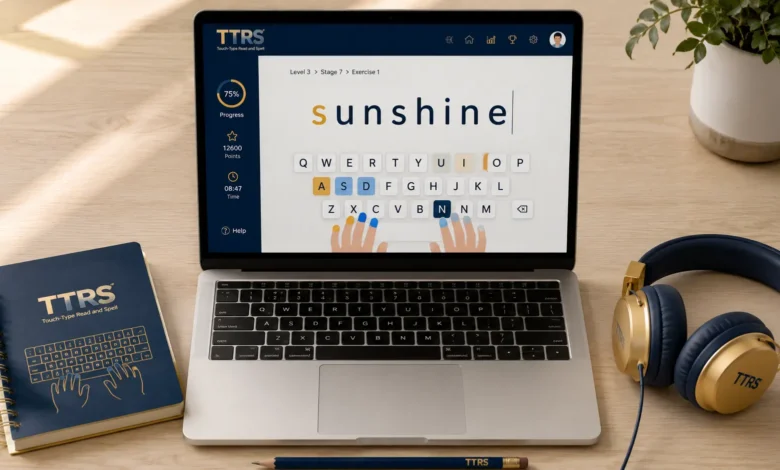
TTRS applies this logic to the keyboard. When a student types the word “cat,” they see it on screen, hear it spoken aloud through audio, observe which fingers should press which keys via an on-screen keyboard guide, and physically enact the spelling through keystroke sequence. That four-channel reinforcement — visual, auditory, kinesthetic, and proprioceptive — is exactly what the Orton-Gillingham framework prescribes. The result, across decades of use, is that word spellings become encoded not just as abstract knowledge but as physical patterns — what practitioners call muscle memory, or what students often describe in their own terms: “It’s like talking with my fingers. When I want to spell a word, I just think where my fingers would go.”
Timeline: Key Milestones in TTRS
1930s
Dr. Samuel Orton and educator Anne Gillingham develop the foundational multi-sensory approach to reading and spelling that TTRS would later be built upon — what becomes known as the Orton-Gillingham method.
1992
Touch-Type Read and Spell is formally established in the UK with input from the British Dyslexia Association, Dr. Beve Hornsby, and several specialist regional dyslexia associations. The program launches based on the Alpha to Omega word list framework.
2000
Multiple independent research studies are published. Topley (2000) documents measurable adult literacy gains, particularly in spelling, through TTRS use. Cavanagh and Park (2000) find the program also benefits visually impaired learners. The evidence base begins to build formally.
2018
Harridine (2018) investigates TTRS as a technology-based intervention for children with dyslexia in mainstream UK schools, concluding it supports a wide range of SEN learners with accessible, consistent, and engaging modules. Ofsted (the UK school inspection body) also references TTRS positively in a primary school review, noting it has an assessment structure and informs diagnosis of learning.
2020s
TTRS transitions to a fully web-based subscription model accessible on any device, making it practical for home learning without specialist installation. New features arrive including interactive literacy games (Word Drop, Fishing for Words, Typing Trail), a custom subject creator for teachers, and customisable display settings for colour, font, and audio — designed specifically for sensory and attention differences.
Present
TTRS operates as an accredited Skills Activity Provider for The Duke of Edinburgh’s Award and is endorsed by the British Dyslexia Association. The platform is used daily across hundreds of homes, schools, colleges, charities, and adult literacy programmes in multiple countries, with both UK and US voice versions available.
💜 Why This Matters
Dyslexia affects an estimated 10% of the UK population, and yet the experience of struggling to read or spell in a classroom rarely receives the same urgency as other learning challenges. For many children, repeated failure at the most basic academic tasks is not just a skills gap — it is an identity wound that hardens into a belief that they simply are not clever enough. TTRS addresses that dynamic directly, not by lowering the bar, but by changing the route: it lets a learner build literacy through their hands rather than forcing the same phonics-on-paper approach that never worked for them. The reported gains in self-confidence from TTRS users — children who begin wanting to become authors, adults who return to education after decades away — are not a side effect of the program. They are part of what makes it effective.
How the TTRS Course Actually Works
The TTRS course is structured across 24 levels, each containing 31 modules. Modules are short — typically completable in a few minutes — which suits the attention profiles of many learners with ADHD or dyspraxia who struggle to sustain focus through longer sessions. The program begins with the vowels (a, e, i, o, u), introducing them through simultaneous audio and on-screen visual cues alongside a graphic prompt showing which finger to use for each key. From there, learners build incrementally through consonant combinations, vowel blends, sight words, punctuation, and whole sentences — always following the phonics sequence established in Alpha to Omega.
Scoring within TTRS is notably designed around accuracy rather than speed, which sets it apart from conventional typing programs where words-per-minute can become a source of anxiety. A pass threshold of 80% accuracy is the default (and this can be adjusted by an admin), with the system offering positive feedback and trophy milestones as learners advance. Crucially, the module does not move forward until a key has been correctly typed — there is no rushing past mistakes, which reinforces the over-learning principle central to Orton-Gillingham theory.
Display customisation is available for font, colour overlay, and text size — accommodating learners who benefit from coloured backgrounds or specific visual formats often used by those with Meares-Irlen syndrome alongside dyslexia. Both a UK English voice and a US English voice are included, with male and female options, which is relevant for schools and home users in different countries. The recommended daily usage is 10–20 minutes, which is achievable even in busy household or classroom schedules. This low time commitment, combined with consistent structured repetition, is part of why the program’s results accumulate over time.
Who Is TTRS For? Users, Settings, and Learning Differences
TTRS was originally conceived for learners with dyslexia, but the pool of people it serves has expanded considerably since the 1990s. The program is now routinely recommended for students with ADHD, dyspraxia (developmental coordination disorder), Down syndrome, autism spectrum disorder, and physical impairments that make handwriting difficult or impossible. Aphasic adults recovering from strokes have also been noted as beneficiaries — the keyboard provides an alternative motor pathway for language production when written expression has been disrupted.
In schools, TTRS is used both as a whole-class typing resource and as a targeted intervention for students on the SEN register. Because the program requires minimal teacher supervision once set up — students work at their own pace with on-screen guidance — it allows educators to focus attention on learners who need direct support while others work independently. Schools can access separate admin and student accounts, set custom spelling lists, archive accounts when students leave, and monitor progress through the platform’s dashboard. This operational flexibility has made it popular with SENCOs (Special Educational Needs Coordinators) across the UK.
For home users, particularly homeschooling families, TTRS offers a subscription that can cover multiple users under one account. Parents report it as one of the few programs their children with learning differences will return to willingly — partly because the structure is clear and non-threatening, and partly because small, regular wins are built into every session. The program also has a genuine adult user base: adult literacy programmes in prisons and community libraries have deployed it as a tool for mature learners who need both computer skills and foundational literacy support, often for employment purposes. The modern workplace increasingly demands digital communication skills, and being unable to type confidently is a practical barrier that TTRS directly addresses.
English as a Second Language (ESL) learners represent another substantial audience. The phonics-based, audio-supported structure makes TTRS unusually effective for learners who are building English literacy from scratch — it reinforces the connection between sound and symbol in a way that reading lists alone rarely achieve. The program has both UK and US voice variants, which is relevant for ESL contexts in different regions.
📊 TTRS Learner & Programme Overview
Note: Programme depth and word count figures are drawn from official TTRS documentation. Individual learner progress will vary depending on frequency of use, age, and nature of learning difference.
“The Leicestershire Dyslexia Association has been using Touch-Type Read and Spell for many years. It supports many of our students both in our workshop and at home.”
— Leicestershire Dyslexia Association, as cited by the British Dyslexia Association
The Research Behind TTRS
TTRS sits on a notably substantive evidence base for an educational software product. Independent studies stretching back to the year 2000 have investigated its impact across a range of learner populations, and the findings have generally been positive. Topley (2000) studied adult literacy gains through TTRS and documented improvements across most tested measures, with spelling showing the most noticeable change. Cavanagh and Park (2000), working with visually impaired children, found the programme helped improve literacy skills even in that specialised context — demonstrating a flexibility the designers had perhaps not originally anticipated.
More recently, Harridine’s 2018 study looked at TTRS as a mainstream school technology intervention for children with dyslexia and concluded it supports learners across a wide spectrum of SEN needs, with accessible and engaging modules that require minimal additional scaffolding from teachers. Separately, an Ofsted review of a UK primary school specifically noted TTRS as “a strength,” observing that the programme is integrated into school practice, has an assessment structure, and helps inform diagnostic understanding of individual learners. These are not modest endorsements — Ofsted citations in school inspection reports carry real institutional weight.
A key finding across multiple studies points to what researchers describe as a “significant advantage for the TTRS group across all measures of skill development,” with self-report measures also indicating positive impact on self-confidence, self-esteem, and concentration. This dual outcome — measurable skills improvement alongside reported gains in learner identity and confidence — is harder to achieve than either result alone, and it is consistent with what educators and parents report in practice. For learners who have spent years associating literacy tasks with failure, a programme that produces early, tangible success through a non-traditional route changes not just what they can do, but how they see themselves as learners. Just as certain natural interventions work best through regular, consistent use, TTRS’s effectiveness depends on daily short sessions rather than occasional long ones — a point researchers consistently emphasise.
Where Things Stand Now
TTRS is currently offered as a fully web-based subscription available to both home users and schools, with no software installation required. The platform runs on any internet-connected PC, Mac, or tablet, which considerably lowers the practical barrier for families and institutions. Separate home and school subscription tiers are available, with family plans allowing multiple users under a single account — the most economical option for households with more than one child using the program.
Recent platform updates have introduced three interactive literacy games — Word Drop, Fishing for Words, and Typing Trail — which reinforce words and spelling patterns already covered in the main course lessons. These games are designed to be age-appropriate without being childish, which is a meaningful distinction for older students who would disengage from overtly juvenile gamification. A subject creator tool also allows teachers and admins to add custom spelling lists and build bespoke lessons specific to their class or individual learner needs.
The programme maintains its accreditation as a Duke of Edinburgh’s Award Skills Activity Provider, meaning students who complete the programme as part of a structured routine can log the hours toward their DofE Skills section — an unusual and useful dual benefit for secondary school students. Trustpilot reviews remain predominantly positive as of early 2026, with recurring themes around improved confidence, consistent engagement from reluctant learners, and tangible gains in typing and spelling proficiency. The programme also continues to be deployed in adult prison education settings and community literacy programmes, reflecting its reach beyond the core school-age market. Those seeking to understand the broader landscape of technology-assisted learning — including how digital platforms are increasingly serving niche learning communities — will find TTRS a well-established benchmark case.
✨ TTRS — At a Glance
Founded
1992 — UK
Course Modules
744 Total (24 × 31)
Primary Methodology
Orton-Gillingham
Key Endorsement
British Dyslexia Association
❓ Frequently Asked Questions
What does TTRS stand for?
TTRS stands for Touch-Type Read and Spell. It is a multi-sensory online typing and literacy programme developed in the UK in 1992. The course teaches touch-typing using the Orton-Gillingham phonics approach, simultaneously building reading and spelling skills. It is designed for learners of all ages from 7 upward, with particular effectiveness for those with dyslexia and other specific learning differences.
Is TTRS good for dyslexia?
Yes. TTRS was originally designed with dyslexic learners in mind and is endorsed by the British Dyslexia Association. It uses a structured Orton-Gillingham-based phonics programme that addresses the phonological processing challenges common in dyslexia. Multiple independent research studies have documented measurable improvements in spelling and reading, as well as self-reported gains in confidence and self-esteem among dyslexic users.
What age is TTRS suitable for?
TTRS is suitable for learners aged 7 and upward, including adults. The programme has no upper age limit and is actively used in adult literacy settings including libraries, colleges, and prison education programmes. The modular structure and audio support make it accessible to young children and mature learners alike, though a child must be able to sit at a keyboard and follow simple on-screen instructions to begin.
How long does it take to complete TTRS?
TTRS is a self-paced programme with 24 levels and 31 modules per level — 744 modules in total. At a recommended pace of 10–20 minutes per day, completion can take anywhere from several months to over a year depending on how regularly the learner uses the programme and which level they begin at. There is no fixed timeline; progress is determined by accuracy rather than speed or time invested.
Does TTRS work for ADHD?
TTRS is commonly used and recommended for learners with ADHD. Its short module format — typically a few minutes each — is well-suited to attention profiles that struggle with longer tasks. The multi-sensory engagement (seeing, hearing, and typing simultaneously) also helps maintain focus. Positive reinforcement built into the scoring system further supports motivation, and display settings can be adjusted to reduce visual clutter for learners with sensory sensitivities.
Can TTRS be used in schools?
Yes. TTRS offers a dedicated education subscription with separate admin and student accounts. Schools can monitor individual progress, assign spelling lists, and set custom lesson content. The programme integrates into whole-class keyboarding sessions or as a targeted SEN intervention. Ofsted has noted its use positively in a UK primary school review. Schools can access a two-week trial education licence before committing to a subscription.
Final Thoughts
TTRS has been around for more than three decades, and its persistence is not accidental. Educational software comes and goes — most is replaced within a few years by something shinier or cheaper. TTRS has survived because the problem it addresses is real, the method it applies is evidence-based, and the outcomes it produces are documented and reproducible. It does not promise transformation; it delivers consistent, incremental progress through repetition and structure, which is exactly what the learners it serves need most.
The programme’s greatest strength may be what it does not do: it does not rush learners toward speed goals that trigger anxiety; it does not layer on distracting gamification that obscures the learning; it does not pretend that one format works for all. The range of populations it genuinely serves — from a seven-year-old with dyslexia in a UK primary school to an adult learner in a prison literacy programme rebuilding skills before release — reflects the quality of the underlying pedagogy rather than marketing ambition. For SENCOs, parents, and adult literacy tutors, TTRS remains one of the most reliable tools in a difficult field, and the specialists who work daily with learning differences have consistently pointed to it as a programme worth sustained commitment.
The one honest caveat is subscription cost over time. TTRS is not free, and for families on tight budgets who may already be paying for diagnostic assessments, tutors, and specialist resources, adding another monthly outgoing requires real consideration. A 30-day refund guarantee reduces that risk, and the two-week school trial licence provides similar insurance for institutions. For most learners who engage with the programme consistently at the recommended daily pace, the evidence strongly suggests the investment produces measurable returns — in spelling accuracy, in keyboard fluency, and in something harder to quantify but unmistakably real: the confidence that comes from getting something right that once felt impossible. The way we talk about bodies and learning has evolved, and so too has our understanding that different learners need different doors to the same room. TTRS, for many, is that door.
📚 Sources & References
- Touch-Type Read and Spell — Official Website (readandspell.com)
- Wikipedia — Touch-type Read and Spell Overview
- British Dyslexia Association — TTRS Programme Page
- TTRS Research Page — readandspell.com (Topley 2000; Cavanagh & Park 2000; Harridine 2018)
- TTRS — Understanding the Orton-Gillingham Approach
- TTRS — What Is TTRS and How Does It Teach Typing?
All sources verified at time of publication. Links subject to change.
AB Rehman
Senior Features & Research Writer
AB Rehman is a features and research writer covering education, health, lifestyle, and specialist learning. His work focuses on separating verified fact from speculation, drawing on primary sources and academic research to produce accurate, readable long-form content for general and specialist audiences. He writes for MagazineCelebs.co.uk and related publications.
⚠️ Editorial Disclaimer
This article is intended for informational purposes only. All facts have been sourced from publicly available information at the time of publication. Where data could not be independently verified, this has been clearly noted. Programme pricing and subscription structures are subject to change and should be confirmed directly via the official TTRS website. The views expressed reflect editorial analysis only and do not constitute professional educational, medical, or financial guidance.