
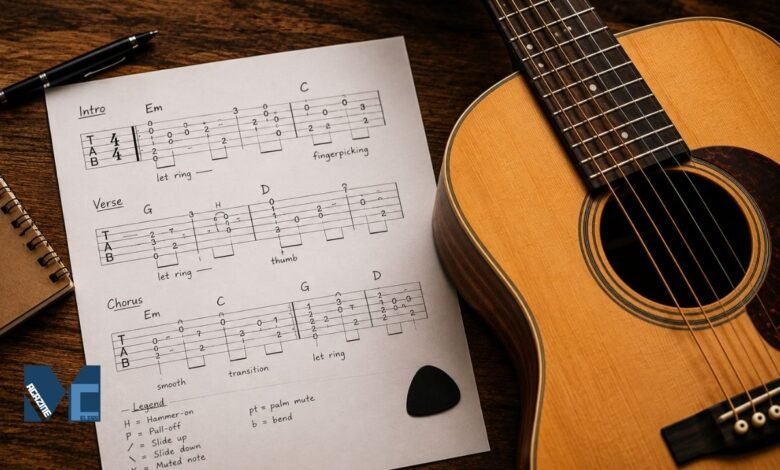
How to Read Guitar Tabs: The Complete Beginner’s Guide to Guitar Tablature
Guitar tablature is the fastest way to start playing real songs without reading sheet music. This guide breaks down every symbol, string, and number so you can decode any tab in minutes.


*Disclaimer: We may earn a commission if you make a purchase through our affiliate links, at no extra cost to you.
📋 Quick Facts
Format Name
Guitar Tablature (Tab)
Number of Lines
6 (Standard Guitar)
Top String (Thinnest)
High E (1st string)
Bottom String (Thickest)
Low E (6th string)
Numbers Indicate
Fret Position
0 Means
Open String (No Fret)
Bass Guitar Tab Lines
4 (Standard Bass)
Read Direction
Left to Right
Guitar tablature — universally shortened to guitar tab — is a text-based notation system that tells you exactly which string to press and which fret to hold, without requiring any knowledge of standard sheet music. Each line in a tab represents one of the six strings on your guitar, and every number tells you which fret to press. Read left to right, follow the numbers, and you’re playing the song. That’s the short version.
The reason tabs have become the default language of self-taught guitarists — from bedroom players working through YouTube tutorials to experienced musicians quickly learning a new cover — is that they cut through years of formal music theory. Classical sheet music requires you to recognise notes on a staff, understand key signatures, and parse rhythm values. Guitar tablature skips all of that. The focus is physical: where your fingers go, not what the note is called. This accessibility has made tab the dominant format on platforms like Ultimate Guitar, which hosts tens of millions of transcriptions across virtually every genre.
That said, tablature is not without its limits. Standard tabs don’t always tell you when to play a note — just where. The best players combine tab reading with an ear for the original recording. But for the purposes of getting your fingers moving on the right frets, knowing how to read guitar tabs is one of the most useful skills a guitarist can develop, and it takes about twenty minutes to get the basics locked in.
The Structure of a Guitar Tab: Strings, Lines, and Numbers
Open any guitar tab and you’ll see six horizontal lines stacked on top of one another. These lines represent your six guitar strings, but here’s where new players often get tripped up: the layout is the reverse of what you might expect. The top line in a tab corresponds to the thinnest, highest-pitched string — the high E (1st string). The bottom line represents the thickest, lowest-pitched string — the low E (6th string). Think of it as holding your guitar flat on a table and looking down at it from above.
The strings, from top line to bottom line in a standard tab, are: high E, B, G, D, A, and low E. You’ll often see these letters printed at the left edge of the tab for reference. Numbers placed on a line tell you which fret to press on that string. A 0 means you play that string open — no fingers on the fretboard at all. A 1 means the first fret, a 5 means the fifth fret, and so on. Numbers that appear directly above each other (stacked vertically) are played simultaneously — that’s a chord. Numbers that appear one after another left to right are played in sequence — that’s a melody, riff, or scale run.
Standard guitar tab notation looks like this for the opening riff of a classic rock song:
B|–1–3–3–3–1—–|
G|–0–2–0–2–0—–|
D|–2–0–0–0–2—–|
A|–3———–3—–|
E|——————–|
Each column of numbers is one moment in time. The tab reads left to right, exactly like written text. When you see numbers in the same vertical column, press all those frets at once. When they’re spread horizontally, pick them one after the other.
Where Guitar Tablature Came From
Tablature itself is not a modern invention. Lute tablatures from the Renaissance period — dating back to the early 1500s — used a similar concept: diagrams and letters indicating finger placement rather than pitch names. The system was practical for fretted instruments precisely because it described physical action rather than abstract musical information. When the guitar displaced the lute as the dominant popular string instrument, the notation logic carried forward.
The modern revival of tab as the primary format for popular music instruction is closely tied to the rise of the internet. Guitar enthusiasts began posting text-based tabs in Usenet newsgroups and early music forums during the 1990s, using plain ASCII characters to approximate the six-line format. Ultimate Guitar, founded in 1998 by Eugeny Naidenko in Russia, became the central archive for this community-sourced notation and has since grown into the world’s largest guitar tab repository. The format’s revival also owes something to self-taught musicians who became commercially successful — artists who proved that formal notation was never a prerequisite for musical skill.
Musicians like Thomas Bangalter of Daft Punk have spoken about the influence of learning music through accessible, informal methods rather than classical conservatory paths — a broader cultural shift that tab culture both reflects and accelerates.
Timeline: Key Milestones in Guitar Tablature
c. 1507
Some of the earliest surviving printed lute tablatures appear in Francesco Spinacino’s Intabulatura de lauto, published by Ottaviano Petrucci in Venice — establishing the foundational logic of fret-based notation.
1970s–1980s
Guitar method books and rock instructional magazines begin printing text-based tablature alongside chord diagrams as a standard teaching tool, bringing the format to mass audiences in the UK and US.
Early 1990s
Guitar enthusiasts on internet newsgroups (alt.guitar.tab) begin exchanging ASCII-format tabs freely online, creating the first large-scale, crowd-sourced archive of guitar notation in history.
1998
Ultimate Guitar launches, consolidating the scattered online tab community into a single searchable platform. It grows to become the world’s most visited guitar resource, with a catalogue estimated at over one million tab entries.
2000s–2010s
Guitar Pro software introduces interactive tab notation — combining tablature with standard notation, audio playback, tempo control, and instrument simulation — shifting tabs from static text to a dynamic learning format.
2020s
Platforms like Yousician, Fender Play, and TikTok guitar tutorials embed tab notation into interactive or video formats, making guitar tablature more accessible than at any point in the instrument’s history.
💜 Why This Matters
The guitar is one of the world’s most widely played instruments precisely because the barrier to entry is low — and tab lowers it further. For players who grew up without access to formal music education, or who simply wanted to learn songs rather than theory, tablature has been the equaliser. It means a teenager with a second-hand guitar and an internet connection can, within an afternoon, play the opening riff of a song they love. That’s not a small thing. For many players, that afternoon is where a lifelong relationship with music actually begins.
Guitar Tab Symbols Explained: Bends, Slides, Hammer-Ons, and More
Once you’ve grasped the basic grid of strings and frets, the next layer of guitar tablature is its library of symbols — shorthand markers that describe how to play a note, not just which fret to press. These guitar tab symbols encode the physical techniques that give guitar playing its character: the expressive bends of blues solos, the smooth pull-offs of fingerpicking patterns, the percussive slaps of funk bass lines.
Here are the most common guitar tab symbols you’ll encounter:
- h — Hammer-on: Play the first note, then “hammer” your finger onto the second fret without picking again. Written as
5h7. - p — Pull-off: The reverse of a hammer-on. Pluck the higher note and pull your finger off to sound the lower fret. Written as
7p5. - b — Bend: Push or pull the string sideways to raise the pitch.
7b9means bend at the 7th fret until it sounds like the 9th. - r — Release bend: After bending, let the string return to its original pitch. Written as
7b9r7. - / — Slide up: Slide your finger from a lower fret to a higher one while maintaining pressure.
5/9. - \ — Slide down: Slide from a higher fret to a lower one.
9\5. - ~ or v — Vibrato: Rapidly oscillate the string pitch by shaking or bending repeatedly. Adds expressiveness to held notes.
- x — Muted/Dead note: Rest your fretting hand lightly on the string and pick it. Produces a percussive thud with no pitch — widely used in funk and rhythm guitar.
- t — Tap: Use your picking-hand finger to tap a fret on the fretboard rather than using the fretting hand. A technique associated with Eddie Van Halen’s two-handed tapping style.
- PM or PM— — Palm mute: Rest the edge of your picking hand on the strings near the bridge. Creates a tighter, more muffled tone used constantly in rock and metal rhythm playing.
Mastering these techniques individually is more important than trying to combine them all at once. Most songs you encounter will use just two or three of these symbols. Learning to spot a hammer-on pattern and execute it cleanly will serve you far more than memorising the entire symbol list in one sitting.
How to Read Bass Guitar Tab: The Four-String Format
Reading a bass guitar tab follows exactly the same principles as standard guitar tablature — but with four lines instead of six. The four lines correspond to the four strings of a standard bass guitar, from top to bottom: G (thinnest), D, A, and E (thickest, lowest pitch). As with guitar tab, numbers indicate fret positions, 0 indicates an open string, and the notation reads left to right.
A simple bass tab might look like this:
D|———————|
A|–0–3–5–3–0——|
E|–3—————3–|
Bass tabs frequently use the same technique symbols as guitar tabs — slides, hammer-ons, pull-offs, and vibrato all appear in bass notation. There are also bass-specific techniques to watch for: slap (often marked with a capital S or T for thumb) and pop (marked with P or a plus sign) are characteristic of funk and slap bass styles. If you’re learning a genre like classic Motown, funk, or progressive rock, these markings will appear regularly. Understanding how structured learning systems work can help bass beginners build technical vocabulary more systematically alongside their tab reading.
The main practical difference when reading bass tabs is context: bass lines are generally more rhythmic and less melodically varied than lead guitar parts, so a bass tab may repeat the same two or three fret positions for an entire verse. The challenge isn’t usually decoding the notation — it’s locking the timing to the groove of the song, which you’ll always need to cross-reference with the original recording.
Guitar Tab vs. Guitar Sheet Music: Understanding the Difference
This is one of the most common questions from players who want to expand their skills beyond tab: how does guitar tablature compare to reading guitar sheet music? The short answer is that they are two entirely different systems serving different purposes, and professional musicians often use both depending on context.
Standard guitar sheet music — or guitar notation — uses the conventional five-line staff, note heads, clef symbols, key signatures, and time signatures that apply to any instrument. It tells you the precise pitch and exact rhythmic duration of every note. This is how classical compositions, jazz charts, and film scores are written. Reading it requires substantial theoretical training, but it communicates far more information than tab — including dynamics, articulations, and precise rhythmic values that tab often omits.
Guitar tablature sacrifices pitch names and rhythmic precision in exchange for immediate, physical clarity. You don’t need to know that the note is a dotted quarter note B-flat to play it — you just need to know it’s on the third fret of the G string. Many published guitar books and sheet music collections now include both formats printed simultaneously: standard notation on the upper staff and tablature directly beneath it. This combined format is widely considered the most complete teaching tool, as it gives experienced sight-readers the notation they prefer while letting beginners follow the tab and gradually connect it to the staff above.
For most contemporary guitarists playing rock, pop, or blues — genres where raw feeling and physical technique matter more than precise classical notation — tab remains the practical daily language. Sheet music literacy becomes more valuable if you plan to play with orchestras, record in professional studios with written charts, or work as a session musician.
📊 Guitar Learner Resource Overview: Key Statistics
Note: Guitar learner estimates are approximate figures drawn from publicly cited surveys and industry reports. Verified financial disclosures from guitar platform operators have not been made publicly available.
“Tablature is the people’s notation. It puts the music in the hands of anyone willing to sit down and try — and that has always been where great guitar playing comes from.”
— AB Rehman, Senior Features & Research Writer
Common Mistakes When Reading Tabs (And How to Avoid Them)
The most consistent error beginners make when reading tabs for guitar is ignoring rhythm entirely. Because standard tab doesn’t indicate note duration, it’s easy to play every note at the same speed — a flat, metronomic version of a song that bears little resemblance to the original. The fix is simple and non-negotiable: always listen to the recording while you’re learning from the tab. The tab tells you what to play; the recording tells you how to play it rhythmically. Treat the two together as a single resource.
A second common issue is string orientation confusion. New players sometimes read the top line of a tab as the lowest-pitched string — because when you look down at a guitar in playing position, the thickest string is physically closest to your face. In tab, the visual logic is inverted. The top line is the high E. Once this clicks, the grid becomes completely intuitive, but it’s worth taking a moment to confirm it every time you sit down with a new tab until the orientation is fully automatic.
Third, beginners often try to learn a song from tabs that aren’t rated or verified. User-submitted tabs on community platforms vary enormously in quality. Some are transcribed by ear with exceptional accuracy; others are rushed approximations with wrong chords and missing sections. When learning an important song, cross-reference two or three tabs against the recording and use the version that most closely matches what you hear. Platforms like Ultimate Guitar use a rating system that helps identify consistently accurate transcriptions — prioritise tabs marked as “official” or with high user ratings where possible.
Where Things Stand Now
Guitar tablature in 2026 exists across a wider range of formats and platforms than at any previous point. Static text tabs remain the most common format — free, instantly accessible, and compatible with any screen. But interactive formats have matured significantly. Guitar Pro 8, the latest iteration of the long-running notation software, allows players to load a tab, control playback speed, isolate individual instruments, and loop difficult sections — features that were only available in expensive private tutoring a generation ago.
Streaming platforms and apps have further blurred the line between tab and video instruction. Fender Play and Yousician embed tab notation directly into video lessons, so the notation is always contextualised by a performance. TikTok and YouTube have produced a generation of player-educators who annotate their fretboard in real time, effectively creating a visual tab that moves at the speed of the music. For learners who struggle to synchronise static notation with a recording, these formats can be genuinely transformative.
The copyright position of online tabs remains legally complicated. Music publishers have historically contested the right of community platforms to host free transcriptions of copyrighted songs, arguing that tab constitutes a reproduction of musical composition. Ultimate Guitar’s licensing agreements have evolved in response to this, with the platform now offering licensed content alongside community uploads. For players, the practical impact is minimal — tabs remain freely available in abundance. But it’s worth understanding that the ecosystem supporting free tab culture depends on ongoing negotiations between platforms and rights holders.
✨ Guitar Tablature — At a Glance
Lines in Standard Tab
6 (Guitar) / 4 (Bass)
Reading Direction
Left to Right
Open String Symbol
0 (zero)
Largest Tab Archive
Ultimate Guitar (est. 1998)
❓ Frequently Asked Questions
What do the numbers mean in guitar tabs?
Numbers in guitar tabs indicate which fret to press on a given string. The line the number sits on tells you which string to use. A 0 means play that string open without pressing any fret. A 5 means press the fifth fret on that string. Numbers stacked vertically are played simultaneously as a chord; numbers read left to right are played in sequence as a melody or riff.
Is the top line of a guitar tab the highest or lowest string?
The top line of a guitar tab represents the highest-pitched string — the high E (1st string, thinnest). The bottom line represents the lowest-pitched string — the low E (6th string, thickest). This is the reverse of how the strings appear visually when you look down at a guitar in playing position, which confuses many beginners at first.
How do you read tabs for guitar if you’re a complete beginner?
Start by identifying the six horizontal lines — each one is a string, from high E at the top to low E at the bottom. Numbers on each line tell you which fret to press. Read left to right, just like text. Find a simple song with a well-rated tab, put the recording on, and follow the numbers slowly. Begin with single-note riffs before attempting chords. Most players can decode a basic tab within one practice session.
What does “h” and “p” mean in guitar tab?
“h” stands for hammer-on: you pick the first note and then tap your finger onto the next fret without picking again, allowing the note to ring. “p” stands for pull-off: you play the higher note and then pull your finger away to sound the lower fret beneath it. Both techniques connect notes smoothly and are written between two fret numbers, for example 5h7 or 7p5.
How do you read a bass guitar tab?
Bass guitar tabs use four lines instead of six, corresponding to the four strings of a standard bass: G, D, A, and E from top to bottom. The same numbering logic applies — numbers indicate fret positions, 0 means open string, and you read left to right. Bass tabs may include additional symbols like S (slap) or P (pop) for funk bass techniques. The principles are identical to standard guitar tab.
Is guitar tab the same as sheet music?
Guitar tab and standard sheet music are different notation systems. Tab shows you where to place your fingers using fret numbers on a string grid — it’s visual and physical. Sheet music uses a five-line staff with notes that indicate pitch and rhythm precisely. Tab is faster to learn for beginners and dominant in popular music genres. Sheet music is essential for classical playing, professional session work, and full rhythmic accuracy. Many publications combine both formats.
Final Thoughts
Learning how to read guitar tabs is, in the most practical sense, learning a new visual language — one that maps directly onto the physical geography of the guitar itself. Six lines, a handful of numbers, a few recurring symbols. That’s almost the entire vocabulary. The real work isn’t decoding the notation; it’s building the muscle memory to make your fingers obey it, and developing the ear to fill in the rhythmic detail that tab alone can’t provide.
What makes tablature worth mastering is not just its simplicity, but its reach. The same notation system that a fifteen-year-old uses to learn their first power chord riff is the same one used by experienced players to quickly sketch out new song ideas, share parts with bandmates, or learn a cover in a rehearsal break. It scales without becoming more complicated. And in an era when almost every song ever recorded has a tab version floating somewhere online, fluency in this format is essentially a passport to the entire history of recorded guitar music.
Whether you’re working through your first open-position chords, trying to decode a theatrically complex guitar part from a musician you admire, or figuring out how to read a bass guitar tab for the first time, the fundamentals remain identical. Master the grid, listen to the recording, and trust the process. The notation is only ever a starting point — what you do with it is entirely your own.
📚 Sources & References
- Ultimate Guitar — About & Platform Overview
- Fender — How to Read Guitar Tabs (Official Fender Guide)
- MusicTheory.net — Music Theory Lessons (Open Resource)
- Guitar World — How to Read Guitar Tab
- Guitar Pro Software — Features & Tab Playback
All sources verified at time of publication. Links subject to change.
AB Rehman
Senior Features & Research Writer
AB Rehman is a features and research writer covering music education, instrument technique, and popular culture. His work focuses on making specialist knowledge accessible to general audiences, drawing on primary sources and established teaching references to produce accurate, readable long-form content for both beginner and experienced musicians.
⚠️ Editorial Disclaimer
This article is intended for informational and educational purposes only. All facts have been sourced from publicly available information at the time of publication. Guitar tablature conventions may vary between publishers and platforms; where community-sourced tabs are referenced, accuracy is not guaranteed by the author. Statistical estimates cited in this article are drawn from publicly reported industry figures and should be treated as approximations rather than authoritative data. The views expressed reflect editorial analysis and general music education guidance only.