
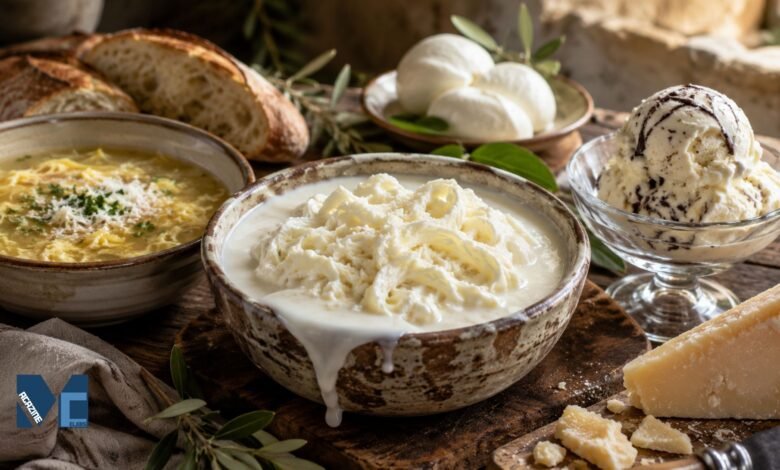
What Is Stracciatella? Cheese, Soup, Gelato & Meaning Explained
From a creamy Puglian cheese to a comforting Roman soup, stracciatella means something different depending on where you're sitting at the table — here's how to tell them apart, where to find them, and how to make them at home.


*Disclaimer: We may earn a commission if you make a purchase through our affiliate links, at no extra cost to you.
📋 Quick Facts
Meaning
“Little rags” or “little shreds”
Three Forms
Soup, cheese, and gelato
Cheese Origin
Puglia, early 1900s
Soup Origin
19th-century Rome
Cheese Made From
Mozzarella curd shreds + fresh cream
Closely Linked To
Burrata (its creamy filling)
Soup Core Ingredients
Broth, egg, Parmigiano Reggiano
Cheese PGI Status
“Stracciatella di Andria” protected name
Stracciatella is one of those Italian words that does triple duty at the table, and that’s exactly why so many people end up confused the first time they encounter it. Order “stracciatella” in a trattoria in Rome and a waiter will likely bring you a light broth with delicate threads of egg floating through it. Ask for stracciatella at a cheese counter in Puglia, and you’ll be handed a tub of something closer to liquid mozzarella — soft curd shreds folded through fresh cream. And if you’re standing in front of a gelato case in Milan, stracciatella means a milk-based ice cream streaked with shards of dark chocolate. All three trace back to the same root: the Italian verb stracciare, meaning “to tear” or “to shred,” and the diminutive straccia, or “little rag.”
None of these three foods is a fake or a marketing spin-off of the others — they developed independently, in different regions and centuries, and simply share a description that happened to fit each one. The soup came first, born in 19th-century Roman kitchens as a way to stretch leftover festive broth. The cheese followed in the early 1900s, when Puglian dairy workers found a use for mozzarella scraps that would otherwise have gone to waste. The gelato is the most recent of the three, a 1960s invention from Lombardy that borrowed the name because the chocolate shards resembled the egg ribbons in the soup.
What ties them together beyond etymology is a certain thriftiness — each version began as a way of using something that might have been discarded, and turning it into something people now seek out deliberately. That’s worth keeping in mind whether you’re searching for stracciatella cheese near you, hunting down an authentic soup recipe, or simply trying to work out which version a recipe or restaurant menu is actually referring to.
Where the Word Comes From — and Why It Splits Three Ways
The shared root of all three foods is the idea of shredding or tearing. According to multiple Italian food historians, stracciatella is composed of small shreds, and the name is a diminutive of straccia, meaning “rag” or “shred,” translating to “a little shred.” That description applies almost literally to the cheese, where strands of curd are physically torn by hand. For the soup, the “shreds” are the wispy curds of egg that form the moment beaten egg meets hot broth — the term comes from straccetti, meaning “little rags,” an apt description of the beaten egg’s appearance when whisked into simmering broth, where it breaks up into tiny shredded clouds.
The gelato borrowed the same imagery for an entirely different reason. The chocolate shards running through the milk-based ice cream are reminiscent of the shredded egg found in the original stracciatella soup, which is why a 20th-century Milanese gelato maker reached for a name that already existed in Italian kitchens rather than coining something new. So while the three foods share nothing in terms of ingredients or preparation, the visual logic — small torn fragments suspended in something smoother — runs through all of them.
Three Regions, Three Stories
Each version of stracciatella is rooted in a specific Italian region, and that geography matters if you’re trying to find an authentic version. The soup, stracciatella alla romana, belongs to Lazio and specifically Rome, where it grew out of the practice of buying large quantities of meat for Christmas broth and needing a way to use the surplus stock afterward. The cheese belongs to Puglia, in the southeastern heel of Italy, with the town of Andria at its centre — the same town that gave the world burrata. Burrata itself is a dairy product associated with the Murgia plateau in Puglia, produced from cow’s milk, rennet, and cream, with origins that may date back to around 1900, though more recent research points to a Bianchino family farm in Andria developing the modern product in 1956. The gelato, meanwhile, has its roots further north in Lombardy, generally dated to the 1960s.
Timeline: How Stracciatella Evolved
19th Century
Stracciatella soup emerges in Rome as a practical way to use leftover festive chicken broth, with beaten egg and Parmigiano Reggiano whisked in to create the signature “egg ribbons.”
Early 1900s
In Puglia, dairy producers begin mixing leftover mozzarella curd shreds with fresh cream during a period of economic hardship, giving rise to stracciatella cheese.
Circa 1956
Burrata — the mozzarella “pouch” filled with stracciatella — is developed in its now-familiar form on a farm near Andria, giving the loose cheese a new, portable presentation.
1960s
Stracciatella gelato is created in Lombardy, where thin chocolate shards drizzled into milk-based ice cream evoke the egg ribbons of the Roman soup, lending the new flavour its name.
2016
“Stracciatella di Andria” is granted Protected Geographical Indication status in Italy, formally recognising the link between the cheese and its Puglian birthplace.
2020s
Stracciatella cheese becomes widely available across UK, US, French, Italian, and Australian supermarkets and delis, often sold alongside burrata rather than as a standalone product.
💜 Why This Matters
There’s something quietly reassuring about a food whose entire identity is built on not wasting anything. Stracciatella cheese exists because Puglian cheesemakers refused to throw away mozzarella scraps, and the soup exists because Roman cooks didn’t want good broth going stale after Christmas. In an era where food waste is a genuine environmental concern, these dishes are a reminder that resourcefulness and indulgence aren’t opposites — sometimes the most luxurious thing on the table started life as a leftover.
Stracciatella Cheese: What It Is and How to Use It
Stracciatella cheese is a fresh, unaged product made by hand-shredding mozzarella curd and folding the resulting strands through fresh cream. It comes from Puglia, the southern Italian region known for its dairy traditions, with its name derived from “stracciare,” meaning “to tear” or “to shred,” producing a spoonable mixture of partially shredded curd and cream. The texture sits somewhere between a very soft mozzarella and a rich, savoury cream — pourable, slightly stretchy, and mild rather than tangy.
Most of the stracciatella sold internationally today is made from cow’s milk, though the most prized version is made from buffalo milk. Stracciatella di bufala is produced specifically in the province of Foggia in Apulia using Italian Mediterranean buffalo milk, made year-round but considered at its best in spring and summer. If you’re searching for “stracciatella near me” and want the most authentic experience, look for Italian delis or specialty cheese shops that stock it separately from burrata — many supermarkets only sell it as the filling inside a burrata ball, which is a perfectly good introduction but not quite the same as a tub of the cheese on its own.
In the kitchen, stracciatella rewards simplicity. Spooned over warm pasta with fresh tomato sauce, it melts slightly into the sauce while the strands stay intact; it also pairs naturally with roasted vegetables like beets, tomatoes, or radishes, and works well on toasted bread with olive oil and flaky salt. Because it’s unaged and meant to be eaten fresh, it doesn’t keep for long — most producers recommend using it within a day or two of opening.
Stracciatella Soup: The Roman Original
If you’ve ever had Chinese-style egg drop soup, stracciatella alla romana will feel immediately familiar, though the flavour profile is quite different. The soup consists of a rich chicken broth into which a mixture of beaten egg and finely grated Parmigiano Reggiano is whisked, with the classic ratio being roughly one egg for every two cups of broth. Some versions add a pinch of nutmeg, lemon zest, or a spoonful of semolina flour, which helps the egg form fluffier ribbons as it cooks.
The technique is the part that matters most. The broth needs to be at a steady simmer — too hot and the egg seizes into rubbery clumps rather than delicate strands; too cool and it won’t cook through properly. A steady hand and a gentle stirring motion while drizzling in the egg mixture make the difference between fine, silky shreds and a clumpy result. Spinach, shallots, or a touch of lemon are common additions in home versions, though purists tend to keep the ingredient list close to the original four: broth, egg, cheese, and pepper.
It’s worth noting that this is the version most likely to appear on Italian-American restaurant menus and in home-cooking blogs under “stracciatella soup recipes” — and it’s distinct from both the cheese and the gelato, despite sharing the name. If a recipe calls for chicken stock and eggs, you’re looking at the soup; if it calls for mozzarella curd and cream, that’s the cheese.
📊 Stracciatella: Where Each Version Sits
Note: These comparisons reflect general culinary categorisation and consumer familiarity rather than precise market data. No verified sales or popularity statistics for stracciatella products have been published by an authoritative source.
“Just make sure you clarify which one you’re talking about — gelato, soup, or cheese — because in Italy, stracciatella never means just one thing.”
— Adapted from Giadzy’s culinary explainer on the three stracciatellas
Where Things Stand Now
Stracciatella cheese has had something of a moment outside Italy over the past several years, riding on burrata’s popularity in restaurants across the US, UK, France, and Australia. Where burrata once felt like the indulgent option, increasing numbers of delis and supermarkets now stock loose stracciatella as a separate product — useful for anyone who wants the creamy filling without the mozzarella shell, or who wants to use it more liberally across multiple dishes. Andria’s status as the epicentre of stracciatella production has been reinforced by its Protected Geographical Indication designation, which guarantees that only stracciatella produced in Andria following traditional methods can be labelled “Stracciatella di Andria” — a useful detail for shoppers trying to distinguish artisanal product from mass-produced imitations.
The soup, meanwhile, remains a steady fixture of Roman and Italian-American home cooking rather than a restaurant trend — it’s the kind of dish people make when they’re unwell or want something light, and recipe interest tends to spike during colder months. The gelato flavour has stayed remarkably consistent in form since its invention, and remains one of the most ordered flavours at gelaterie across Italy and increasingly abroad.
Stracciatella vs Burrata: Untangling the Confusion
Because stracciatella cheese is the substance inside burrata, the two are frequently mixed up — and retailers don’t always help. Burrata is essentially a pouch of fresh mozzarella filled with stracciatella and clotted cream, giving it its distinctive soft texture, and is a speciality of the Puglia region of southern Italy. If you cut open a ball of burrata, what spills out is, by definition, stracciatella.
The practical difference comes down to presentation and portion control. Burrata gives you a defined shell, making it easier to plate as a single serving — slice it open at the table and the stracciatella filling becomes the visual centrepiece. Loose stracciatella, sold in a tub, is more of a spreadable, pourable ingredient meant to be dolloped across multiple servings of pasta, salad, or bread. Neither is “better” — they’re really the same filling in two different formats, and which one makes sense depends on whether you want a single showpiece or a versatile topping you can use across a meal.
Making Stracciatella Soup at Home: Tips That Actually Matter
For anyone searching out stracciatella soup recipes, the good news is that the dish is genuinely forgiving once you understand the one technique it depends on. The small curds of egg formed during the egg-dropping process are the “little rags” that give the dish its name, and the quality of your broth — whether homemade chicken stock, beef stock, or a good low-sodium boxed version — has an outsized effect on the final result.
A few details separate a forgettable bowl from a memorable one. Use Parmigiano Reggiano or Pecorino Romano rather than a generic “parmesan” blend — the flavour difference is noticeable in such a simple dish. Whisk the egg mixture thoroughly before it goes anywhere near the pot, including the cheese and any flour or semolina, so it disperses evenly rather than clumping. And resist the urge to add the egg mixture all at once; a slow, steady drizzle while stirring gently is what produces those fine ribbons rather than a single solid mass. Fresh parsley, a light grating of nutmeg, or a twist of lemon zest at the end can lift the dish without changing its character.
✨ Stracciatella — At a Glance
Word Origin
From “stracciare” — to tear or shred
Cheese Texture
Soft curd strands in fresh cream
Soup Core
Broth + beaten egg + cheese
Best Known Relative
Burrata
❓ Frequently Asked Questions
What does stracciatella mean?
Stracciatella means “little rags” or “little shreds” in Italian, from the verb stracciare, “to tear.” The word describes three different foods: a Roman egg-drop soup with shredded ribbons of egg, a fresh Puglian cheese made from torn mozzarella curd, and a chocolate-chip-style gelato whose chocolate shards resemble the soup’s egg ribbons.
What is stracciatella cheese made of?
Stracciatella cheese is made by hand-shredding fresh mozzarella curd into thin strands and mixing them with fresh cream. It originated in Puglia, southern Italy, where it’s traditionally made from cow’s or buffalo milk and eaten fresh rather than aged. It’s also the filling found inside burrata.
How do I find stracciatella near me?
Look for Italian delicatessens, specialty cheese shops, or supermarkets with a dedicated Italian or fresh-cheese section, where it’s often sold in small tubs alongside burrata and fresh mozzarella. If a standalone tub isn’t available, buying burrata and using the creamy filling is a workable substitute.
What is the difference between stracciatella and burrata?
Stracciatella is the loose, creamy mixture of shredded mozzarella curd and cream. Burrata is a pouch of mozzarella shell filled with that same stracciatella mixture. In short, stracciatella is the filling, and burrata is the packaging — they share the same core ingredients.
How do you make stracciatella soup?
Bring chicken broth to a gentle simmer, then whisk together beaten eggs with grated Parmigiano Reggiano (and optionally a pinch of nutmeg, semolina, or lemon zest). Slowly drizzle this mixture into the simmering broth while stirring gently, cook for one to two minutes until the egg forms thin ribbons, then season and serve.
Is stracciatella gelato the same as stracciatella cheese?
No. Stracciatella gelato is a sweet, milk-based ice cream with chocolate shards, created in Lombardy in the 1960s. Stracciatella cheese is a savoury fresh dairy product from Puglia made of mozzarella curd and cream. They share only a name and the visual idea of “shreds” running through a smooth base.
Final Thoughts
What makes stracciatella worth understanding properly isn’t just culinary trivia — it’s that the confusion around the word is, in its own small way, a window into how regional Italian cuisine actually works. Three separate communities, in three separate centuries, independently arrived at the same descriptive word because it fit what they were looking at: torn curd, shredded egg, chopped chocolate. None of them borrowed from the others on purpose.
If you take one thing away from this, let it be the simple rule of thumb: cheese counter means Puglia and cream, a menu listing “stracciatella” as a starter likely means Roman egg soup, and a gelato case means chocolate shards in milk. Context — where you are, and what’s in front of you — does most of the work of telling them apart.
For readers exploring more of Italy’s regional specialities and the stories behind them, dishes like truffles follow a similar pattern of strong regional identity shaping how a single ingredient is used and perceived across the country.
📚 Sources & References
- Stracciatella (cheese) — Wikipedia
- Burrata — Wikipedia
- Stracciatella: One Name, Three Italian Delicacies — La Cucina Italiana
- Homemade Stracciatella alla Romana — La Cucina Italiana
- Gelato, Soup, Cheese… What Is Stracciatella, Anyway? — Giadzy
All sources verified at time of publication. Links subject to change.
AB Rehman
Food & Lifestyle Features Writer
AB Rehman is a features and research writer covering food culture, regional cuisines, and lifestyle topics. His work focuses on separating verified fact from speculation, drawing on primary sources to produce accurate, readable long-form content for general and specialist audiences.
⚠️ Editorial Disclaimer
This article is intended for informational purposes only. All facts have been sourced from publicly available information at the time of publication. Where data could not be independently verified, this has been clearly noted. The views expressed reflect editorial analysis, not personal legal, medical, or financial guidance.