
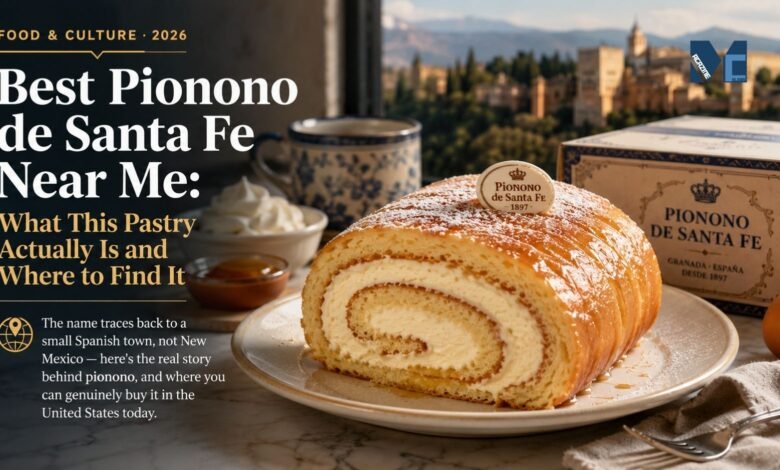
Best Pionono de Santa Fe Near Me: What This Pastry Actually Is and Where to Find It
The name traces back to a small Spanish town, not New Mexico — here's the real story behind pionono, and where you can genuinely buy it in the United States today.


*Disclaimer: We may earn a commission if you make a purchase through our affiliate links, at no extra cost to you.
📋 Quick Facts
True Origin
Santa Fe, Granada, Spain
Year Created
1897
Creator
Ceferino Isla González
Name Source
Pope Pius IX (“Pío Nono”)
New Mexico Link
None confirmed — name overlap only
Core Ingredients
Eggs, sugar, flour, syrup, cream
Latin American Variant
Dulce de leche roll (Argentina, Peru)
US Availability
Latin & Filipino bakeries, select cities
If you’ve typed “best pionono de Santa Fe near me” into a search bar, you’re probably picturing a pastry with some connection to Santa Fe, New Mexico. It doesn’t have one. Pionono is a rolled sponge cake pastry that takes its name from Santa Fe, a small town next to Granada, in southern Spain, where it was created in 1897. There is no documented New Mexico bakery tradition behind the name — the overlap is a coincidence of two places sharing the word “Santa Fe.”
That doesn’t mean the search is a dead end. Pionono — and its close cousins under other names — genuinely exists in the United States, just not where the query implies. You’ll find it at Latin American bakeries (often filled with dulce de leche rather than the original Spanish custard cream), and under the name “pianono” at Filipino bakeries on the West Coast. This piece sorts the real history from the search-engine noise, and points you toward where the pastry actually shows up stateside.
We’ll cover where the name came from, how the Spanish original differs from the versions sold in Florida, California, and online, and what to actually search for if you want to try one near you.
Where the Name Actually Comes From
Pionono is, by most documented accounts, a Spanish invention. According to Wikipedia’s entry on the pastry, it was created by pastry chef Ceferino Isla, who opened a bakery called Casa Ysla in the town of Santa Fe, near Granada, in 1897. He named the cake after Pope Pius IX, whose name in Italian — Pio Nono — gave the pastry its label. Some accounts add a religious layer to the story: Isla was reportedly devoted to the Virgin Mary and wanted to honor the Pope’s 1854 declaration of the dogma of the Immaculate Conception.
A separate, more folkloric version of the story credits three sisters at a bakery called “La Blanquita” with shaping an earlier version of the cake into a papal-tiara shape decades before Isla, and says the dessert was only later renamed pionono in his honor. Spanish-language food sites note this point directly: the bakeries that use “Santa Fe” in their pionono branding are doing so for traceability, not because every version sold under that name follows one single secret recipe — Casa Ysla’s actual formula has reportedly never been published.
Why “Santa Fe, New Mexico” Doesn’t Fit
There is no equivalent founding story, bakery, or documented tradition connecting pionono to Santa Fe, New Mexico. New Mexico’s capital has its own well-documented and genuinely diverse pastry culture — bakers there make everything from French mille-feuille to Hungarian poppy-seed pastries to Middle Eastern basbousa — but pionono specifically isn’t part of that local lineup based on available reporting. If a page tells you otherwise without naming a real bakery or address, treat it as unverified.
Timeline: How Pionono Spread
1897
Ceferino Isla opens Casa Ysla in Santa Fe, Granada, and creates the pastry that becomes known as pionono, named for Pope Pius IX.
1916
Pedro Galatino reportedly gives King Alfonso XIII a taste of the pastry; Casa Ysla is said to receive a royal title as a result, adding a crown to its logo.
20th century
The recipe travels with Spanish migration to Latin America and the Philippines, adapting along the way — Argentina and Peru develop versions filled with dulce de leche; the Philippines develops “pianono,” often flavored with ube or pineapple.
~2006
Peruvian baker Maria Luisa Benavides starts selling desserts from her home kitchen in South Florida; her pionono eventually becomes the namesake product of her bakery in Key Biscayne.
Today
US shoppers can find pionono-style rolls at Latin bakeries (often Peruvian or Argentine-run), Filipino grocery chains under the “pianono” name, and through niche online Spanish-food retailers.
💜 Why This Matters
Search results built around “near me” food queries often skip the part where the food actually has a place. A pastry named for one Spanish town gets pasted onto an unrelated American city because the words match, and a search engine doesn’t know the difference. The people who lose out are the home cooks and small bakers — a Peruvian grandmother’s recipe, a Filipino family bakery’s pianono — whose real, documented work gets buried under generic content built to catch the same keyword.
What Pionono Actually Tastes Like
The Spanish original is built from a very thin sponge sheet, moistened with syrup, filled with cinnamon-spiced pastry cream, and rolled into a cylinder. The top is finished with another layer of cream and lightly torched, giving it a toasted, almost crème brûlée-style crust. Traditional etiquette in Granada holds that you eat it in a single bite, though most people don’t manage it.
The version more commonly found in the US — particularly at Peruvian and Argentine bakeries — swaps the custard cream for dulce de leche, the caramelized milk spread that’s a staple across South America. Azucar Bakery describes its version simply as a sponge cake rolled with dulce de leche, sold by the slice. It’s sweeter and less custardy than the Granada original, but it’s the version most Americans will actually encounter if they go looking.
The Filipino “pianono” is a third branch entirely: a soft cake roll, frequently filled with ube (purple yam) or pineapple cream rather than dulce de leche or pastry custard, sold at Filipino bakeries on the West Coast and through specialty grocers.
Where to Actually Find It in the US
If you’re searching from New Mexico specifically, the honest answer is that you’re unlikely to find a bakery selling pionono under that name nearby. What Santa Fe, NM does have is a working international pastry scene worth exploring on its own terms — French-trained bakers, Slovakian and Hungarian strudel makers, and Middle Eastern semolina desserts all show up in local bakery features, even without a pionono connection.
For an actual pionono or pianono, the most reliable US options are concentrated in cities with large Latin American or Filipino communities. In South Florida, Piononos Bakery in Key Biscayne has built two decades of reputation specifically around the dessert, alongside other Peruvian and international sweets. On the West Coast, Filipino bakeries and grocers — including chains carrying Valerio’s and Kagat Bakery products — stock pianono in flavors like ube and plain butter cream. Specialty online Latin grocers also ship dulce de leche rolls to areas with no local bakery option, which is realistically the most dependable route for most of the country, including New Mexico.
📊 Where Pionono-Style Pastries Are Actually Sold in the US
Note: These are relative availability patterns based on publicly findable bakeries and retailers, not a measured market survey. No authoritative US sales data for pionono specifically has been published.
“Food doesn’t really have borders, so what we make in one country ends up shaping what gets baked somewhere else entirely.”
— Brezna O’Brien, Slovakian baker quoted in Edible New Mexico’s coverage of Santa Fe’s international bakery scene
Where Things Stand Now
As of 2026, pionono remains a niche item in the US — present but not widespread, kept alive mainly by bakeries with direct ties to Spain, Peru, Argentina, or the Philippines rather than by any New Mexico tradition. The clearest sign of staying power is that established operators like Key Biscayne’s Piononos Bakery have built two decades of business around the dessert rather than treating it as a passing novelty.
Meanwhile, search interest in phrases pairing food names with “near me” and specific city names has become a recognizable content pattern, often produced at volume by sites with little connection to the food itself. If you’re researching this topic, cross-checking any “near me” claim against a real, named, addressable business — the way you would for a restaurant review — is the simplest way to avoid being misled.
✨ Pionono — At a Glance
Real Hometown
Santa Fe, Granada, Spain
US Hot Spot
Key Biscayne, Florida
Closest Cousin
Filipino pianono
NM Connection
Unconfirmed
❓ Frequently Asked Questions
Is pionono actually from Santa Fe, New Mexico?
No. Pionono originated in Santa Fe, a small town near Granada in southern Spain, where pastry chef Ceferino Isla created it in 1897. No documented bakery or tradition links the pastry to Santa Fe, New Mexico — the shared name is coincidental.
What is pionono made of?
The traditional Spanish version uses a thin egg-and-flour sponge cake, soaked in syrup, filled with cinnamon pastry cream, and topped with a toasted cream layer. Latin American versions typically swap the cream filling for dulce de leche.
Where can I buy pionono in the US?
The most established option is Piononos Bakery in Key Biscayne, Florida. Filipino bakeries and grocers also sell a related version called pianono, often flavored with ube or pineapple. Online Latin grocery retailers ship dulce de leche rolls to areas without a local bakery.
Is pionono the same as a Swiss roll or jelly roll?
It’s a close relative — both are rolled sponge cakes — but pionono is distinguished by its syrup-soaked sponge, custard or dulce de leche filling, and a torched cream topping that gives it a distinct caramelized finish.
Why is it called “pionono”?
It’s named after Pope Pius IX, whose name in Italian was rendered “Pio Nono.” The pastry’s rounded, somewhat squat shape was reportedly designed to echo the Pope’s silhouette.
Can I make pionono at home?
Yes. It requires a thin sponge cake baked briefly at high heat, a cooked syrup, a custard or dulce de leche filling, and a kitchen torch or broiler to caramelize the top layer. Most home versions take under an hour from start to finish.
Final Thoughts
The honest version of this story is less tidy than “best pionono near you in Santa Fe” implies, but it’s more interesting. A pastry chef in a small Spanish town named a dessert after a Pope in 1897, and over the next century it traveled across an ocean, picked up dulce de leche in one country and ube in another, and ended up sold under three different names on three different continents — none of which happen to be New Mexico.
If you’re in Santa Fe, NM and want something close to the spirit of the original — a layered, regionally rooted pastry with a real story behind it — the city’s actual bakeries, with their French, Slovakian, and Middle Eastern specialties, are arguably a better match for that search than chasing a pionono that isn’t there. And if you specifically want pionono itself, Florida, the West Coast, or a Latin grocer’s shipping page will get you closer than anywhere in New Mexico currently can.
Either way, you’ll know what you’re actually eating, and where it actually came from. That’s worth more than a list built around a coincidence in spelling.
📚 Sources & References
- Pionono — Wikipedia
- Piononos from Santa Fé — Bake-Street.com
- Pastry Perfection in Santa Fe — The Bite, Edible New Mexico
- About Us — Piononos Bakery, Key Biscayne
- Dulce de Leche Roll (Pionono) — Azucar Bakery
All sources verified at time of publication. Links subject to change.
Hassan Ali
Senior Features & Research Writer
Hassan Ali is a features and research writer covering food history, consumer culture, and the gap between what people search for and what’s actually true. His work focuses on separating verified fact from speculation, drawing on primary sources to produce accurate, readable long-form content for general and specialist audiences.
⚠️ Editorial Disclaimer
This article is intended for informational purposes only. All facts have been sourced from publicly available information at the time of publication. Some elements of pionono’s early history — including the “La Blanquita” sisters’ account — are reported as popular tradition rather than confirmed historical record, and this has been noted accordingly. Business details such as hours, pricing, and availability are subject to change; readers should confirm directly with any bakery before visiting.