


*Disclaimer: We may earn a commission if you make a purchase through our affiliate links, at no extra cost to you.
Industrial sites often include tall structures and hard-to-reach areas. These places still need inspections, cleaning, repairs, and maintenance. So the big question is how to reach them safely and without wasting time or money.
More and more, the answer is industrial rope access. Compared with older options, rope access can be faster to set up, cheaper to run, and it has a strong safety record. But how does it compare with scaffolding, lifts, and other common methods in both safety and speed?
This guide explains the key differences and what to think about before choosing a method.
What Are Industrial Rope Access Methods?
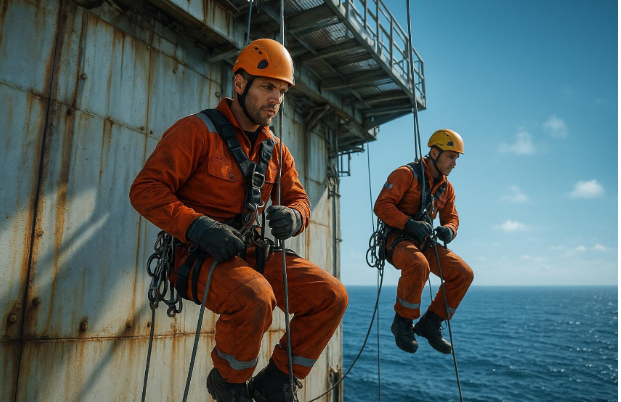
Industrial rope access (IRA) is a work method that uses ropes and climbing-style equipment to help trained technicians reach high or awkward areas. It is similar to techniques used in climbing and caving, but it is built around workplace rules, tested gear, and clear procedures. Rope access is used across many industries, such as wind energy, oil and gas, construction, and heavy industry.
The main goal is to reach areas without building large access structures like scaffolding or bringing in big machines. That often means less disruption around the site. Technicians use ropes to go up, down, or sideways across a structure while staying attached. Rope access work can include:
- Inspections (visual checks and testing support)
- Cleaning
- Repairs and maintenance
- Small installation tasks
Rope access became widely used in industry during the 1980s. Since then, groups like IRATA International and SPRAT have set training and work rules so the method is consistent and reliable.
Key Techniques Used in Rope Access
Industrial rope access uses a planned rope system with backup built in. Technicians normally work on two separate ropes:
- Main working rope (supports the technician during work)
- Safety backup rope (a second line in case the main line fails)
Common gear includes:
- Ascenders and descenders to move up or down at a controlled speed
- Full-body harness with safe attachment points
- Lanyards and energy absorbers to reduce force if a fall happens
- Anchor points fixed to the structure, usually with backups
- PPE such as helmets and gloves
The work is also controlled by clear steps, such as planning and checking the site, setting anchors, getting into position, doing the task, then packing down and reviewing what happened.
How Do Rope Access Methods Compare to Traditional Approaches?
For working at height, many sites still use scaffolding, ladders, cradles, cranes, and mobile elevating work platforms (MEWPs) like cherry pickers. These tools can be useful, but they are not always the best choice. Rope access often wins on speed and access, especially on complex structures. The best option depends on cost, safety needs, site layout, and how long the job will take.
Rope Access vs. Scaffolding
Rope access and scaffolding often differ most in cost, speed, and how much space they need.
| Factor | Rope Access | Scaffolding |
| Setup time | Often hours | Often days (or longer on large jobs) |
| Cost | Usually lower for short/medium tasks | Often higher due to materials and labour |
| Site space needed | Very small footprint | Large footprint and more site impact |
| Best use | Inspections, targeted repairs, awkward access | Long projects, many workers, heavy tools/materials |
Rope access is often cheaper because it needs less equipment and fewer people to set up. Scaffolding can still be the right choice where workers need a large platform for a long period, or where heavy tools and materials must be used for extended work.
Rope Access vs. Aerial Lifts and Platforms
MEWPs and platforms give workers a stable place to stand. They can be a good match for tasks at a fixed height, especially when the job needs heavy equipment or repeated lifting.
Rope access is usually better where access is tight or the structure shape is complex. Lifts often struggle in narrow spaces, uneven ground, or areas blocked by equipment. Rope access technicians can also move between work points faster without constantly repositioning a machine, which helps on inspection work or small repairs spread across a structure.
What Safety Standards and Procedures Govern Industrial Rope Access?
Safety is the base of industrial rope access. Because working at height has clear risks, rope access is controlled by strict rules, training, and equipment checks. IRATA International and SPRAT are two major groups that set standards and training levels. They help keep work methods consistent and keep safety performance high.
Training and Certification Requirements
Technicians usually follow a level system. For example, IRATA uses three levels under its Training, Assessment and Certification Scheme (TACS):
- Level 1: Works under the direct supervision of a Level 3. Learns basic rope access, equipment checks, basic rigging help, and basic rescue skills. Must be at least 18 and fit for the work.
- Level 2: Builds on Level 1 with more advanced rigging and rescue skills, plus hauling systems. Still works under a Level 3 and must meet experience requirements.
- Level 3: The most experienced level. Can supervise rope access safety on site and take full responsibility for planning and safe working. Needs Level 2 status, at least one year of experience, 1000 logged hours as Level 2, and a first-aid certificate.
This step-by-step training and independent assessment helps confirm that technicians can work safely and support the team, including in rescue situations.
Equipment Standards for Rope Access Work
Rope access gear must meet strict safety standards. The rope system uses two ropes (main and backup) so there is a fail-safe option. Harnesses are full-body types with safe connection points, and lanyards and energy absorbers reduce force during a fall.
Movement devices like ascenders and descenders allow controlled travel and often include braking features. Anchors are also set up with backups, usually a main anchor supported by extra anchors to reduce the chance of total failure.
PPE is also required, commonly including:
- Helmet (impact and falling object protection)
- Gloves (grip and hand protection)
Regular inspection is part of normal work, with checks for wear, damage, and correct function before and during use.
Typical Safety Protocols and Risk Management
Rope access work follows planned safety steps. Before starting, the team completes a full risk assessment. This means checking the site and spotting hazards such as:
- Falling objects
- Bad weather
- Confined spaces
- Sharp edges and abrasion risks on ropes
- Site traffic and moving equipment
Many providers also supply method statements that explain the job steps and the safety controls in place. During the work, teams follow set procedures like using two ropes, keeping clear communication, and checking equipment through the day. Rescue plans are also prepared before the job starts and are part of normal training, so teams can act quickly if something goes wrong. IRATA also updates its work rules over time and checks member compliance to support safe working.
What Are the Main Risks of Rope Access and How Are They Managed?
Any work at height has risks. Rope access is no exception, but the industry uses strong controls to reduce danger. The biggest risk is falling, along with injuries related to suspension or dropped objects.
Fall Hazards and Injury Prevention
Falls are still a major cause of workplace deaths. The UK Health and Safety Executive (HSE) reported that between March 2021 and March 2023, 29% (40 out of 135) of workplace deaths were due to falls from height, with over 60% involving ladders, scaffolds, platforms, roof edges, and fragile roofs.
Rope access reduces risk through a mix of controls, including:
- Two independent ropes (main and backup)
- Multiple anchor points
- Fall protection parts like energy absorbers
- Full-body harnesses designed for safe suspension
- PPE such as helmets and gloves
- Training that focuses heavily on checks, planning, and correct procedures
IRATA’s Work & Safety Analysis from 2022 reported three fatalities involving rope access in 21.2 million working hours during 2021, showing a much lower rate compared with many older access options.
Emergency Preparedness and Rescue Procedures
Even with strong prevention, teams must be ready for emergencies. Rescue skills are a core part of rope access training, especially for Level 3 technicians, and first-aid certification is commonly required at that level.
Many rope access teams use a buddy system, where technicians work in pairs and can help each other quickly. Technicians train for different rescue situations and are assessed on these skills. Before the job starts, the team agrees on rescue steps, communication rules, and the equipment that will be used if an incident happens.
Does Rope Access Improve Efficiency?
Yes. Rope access is widely used because it often finishes work faster and with less disruption than traditional methods. That can lower costs and reduce downtime, especially on sites that need to keep running while work is done.
Setup and Teardown Time Compared to Alternatives
One of the biggest time savings comes from setup and pack-down. Scaffolding may take days or weeks to build and remove, depending on size. Rope systems can often be set up in minutes or within a few hours. This helps with urgent inspections and repairs — contractors like Rope Access in London build their offer around fast mobilisation for exactly this reason — and reduces the total time people need to be on site.
Flexibility in Reaching Challenging Locations
Rope access works well on sites where normal equipment struggles, such as:
- Wind turbine blades and towers
- Offshore structures
- Mine shafts
- Chemical towers and confined plant areas
- Bridges, stacks, tanks, and tall buildings
Technicians can get close to the surface for hands-on work. They can also move between points without moving heavy machines, which improves productivity and reduces delays caused by repositioning.
Impact on Project Timelines and Costs
Rope access often costs less because it needs fewer materials and less time for setup. It can also reduce indirect costs by cutting downtime. Traditional access methods may bring higher costs from installation, equipment hire, larger teams, longer schedules, and site restrictions.
Rope access equipment is built for long service life and regular inspection, which can also reduce replacement and repair costs over time compared with some heavier access equipment that takes more wear.
Environmental and Operational Benefits of Rope Access
Rope access also has benefits beyond safety and speed, especially around site impact and keeping operations running.
Reduced Environmental Footprint
Rope access uses relatively small amounts of equipment and does not rely on large machines for many tasks. That often means:
- Less transport of heavy equipment
- Less material use compared with scaffold structures
- Less waste produced
- Less need to change the ground or clear space on site
This can be helpful on sensitive sites or where reducing environmental impact is a project goal.
Minimal Interruption to Operations
Because rope access has a small footprint and quick setup, it can often be done while the site keeps operating. Refineries, power plants, factories, and telecom sites often benefit from this, since large shutdowns are expensive. Rope access teams can work in tight areas and reduce interference with other workers and systems, helping keep downtime low.
Key Points on Safety and Efficiency in Rope Access
Industrial rope access has clearly changed how many industries handle work at height. It combines strong safety controls with fast setup and flexible access, and it often performs better than traditional methods. Ryan Spence, Head of IRATA Services at RSSI, explains it well: “Efficiency isn’t just about cost-effectiveness; it’s about pioneering the most effective, safe and sustainable access solutions.” This reflects a wider move toward smarter methods that reduce disruption and lower risk while still delivering good value over time.
Access methods are also developing further. For some inspection work, Remote Visual Inspection (RVI) tools like drones and robotic crawlers can be even safer and quicker because they keep people away from hazards. They can also gather detailed data using HD cameras, thermal imaging, and LiDAR. Drones can cover large areas fast, and crawlers can move through confined spaces like tanks and pipelines.
These tools usually support rope access rather than replace it. RVI works well for gathering information and early checks, while rope access is still needed for hands-on repairs and complex maintenance where a person must physically do the job. Many sites will get the best results by combining both: RVI for fast, low-risk inspection, and rope access for skilled manual work. Choosing the right approach depends on the job scope, budget, safety needs, and environmental impact.