


*Disclaimer: We may earn a commission if you make a purchase through our affiliate links, at no extra cost to you.
The useful Lahore-to-UK technology story is not a generic outsourcing pitch. It is a commercial operating question: can a business keep customer accountability close to a UK buyer while drawing on a Lahore-linked engineering and delivery capability?
That question matters most in narrow markets. A trades firm considering an AI receptionist has a different buying process, risk profile and definition of value from a fintech firm commissioning a workflow tool. In either case, a supplier needs more than technical capability. It needs a credible diagnosis of the problem, a clear route from sale to delivery, and an accountable person when something goes wrong.
The companies below should not be assumed to be bootstrapped. Public material reviewed for this article does not establish that they are self-funded or financed solely through operating revenue. UK government guidance distinguishes reinvested profits, loans, outside investment and government-backed support as different ways a business can obtain growth finance. An independently operated business, a privately funded business and a bootstrapped business are not necessarily the same thing.
An evidence-led view of the examples
The comparison uses a limited evidence standard. Legal-entity details are treated as verifiable where they appear in Companies House records. Locations, services, team structures and market positioning are treated as company-reported unless independently corroborated. Unknown commercial details remain unknown: public pages do not establish revenue, profitability, customer concentration, retention quality or funding status.
| Business | Publicly Described Lahore / Pakistan Link | UK-Facing Relevance | Business Type & Stated Offer | Evidence Status |
|---|---|---|---|---|
| Conovo Technologies | Says its core delivery team is based in Lahore, Pakistan. | Says it is headquartered in Slough, UK; Conovo Ltd is an active UK company incorporated in 2020. | AI automation, integrations and custom software. Also identifies DeskCaller as an AI receptionist aimed at UK trades businesses. | Location and service offering are company-reported; UK legal entity is independently checkable. |
| Orbiqon | Says it operates a Lahore engineering hub. | Says it has a London base and UK registration. | AI engineering studio offering MVP development, automation and embedded engineering teams. | Company-reported. |
| Techanzy | Lists Lahore among its business locations. | Lists London and has a current UK entity incorporated in 2023. | AI-native technology partner offering digital products, custom systems and startup development. | Locations and services are company-reported; UK legal entity is independently checkable. |
| Pikessoft | Says it began as a Lahore-based team and maintains a Lahore office. | Says it serves UK clients and has a London office. | Digital product development and AI services across healthcare, fintech and retail. | Company-reported. |
| Green Softech | Says it was founded in Lahore and is headquartered there. | Says it maintains a UK presence. | Broad technology services covering web development, software, mobile applications, AI, cloud and infrastructure. | Company-reported; specific UK-client claims have not been independently verified. |
The table is useful for understanding stated operating models, not for ranking these firms. For example, Conovo Ltd’s Companies House record can confirm its legal identity and stated activity, but cannot validate commercial performance or customer outcomes.
A two-market operating model, rather than an offshore hand-off
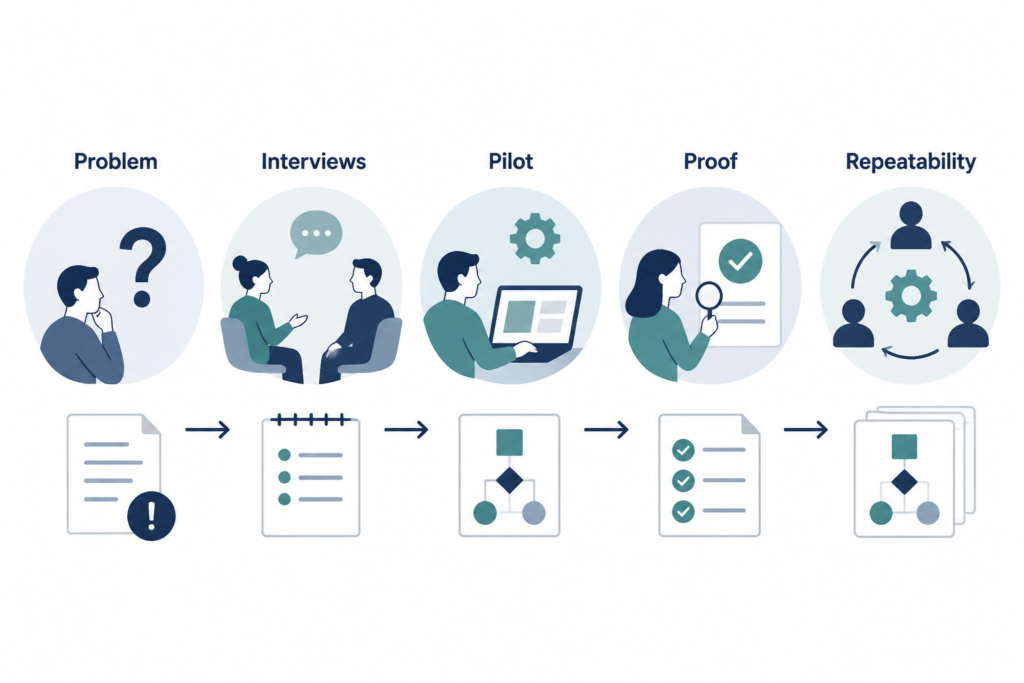
A distributed model works best when commercial and delivery teams share clear ownership of outcomes.
The most workable version of a distributed model gives both sides clear ownership. UK-facing functions can own discovery, commercial scoping, contracts, partnerships, account management and escalations. Lahore-linked teams can lead engineering, design, quality assurance, technical discovery and ongoing iteration.
This is not a claim that every featured business works this way. Conovo, for instance, publicly describes a Slough headquarters and Lahore delivery team; other companies disclose less about their actual allocation of commercial and delivery responsibilities. The principle is nonetheless practical: the people selling a specialised solution should have a direct line to the people building it, and both should share responsibility for what was promised.
A registered office, incorporation or one UK client is not proof of UK market leadership. Nor does a London location automatically mean local commercial accountability. Founders should be precise about these distinctions, particularly when buyers are assessing supplier risk.
Narrow niches make cross-border delivery easier to trust
Broad claims such as “AI development for businesses” force customers to compare a supplier with a large, undifferentiated field. A narrow offer starts with a visible workflow and a recognisable buyer: missed inbound calls for trades firms, manual document review for a regulated team, or repeated scheduling failures in a logistics operation.
A specialist position can improve four things:
- Buyer clarity. The business knows who owns the pain, who controls the budget and what event makes action urgent.
- Demonstrability. A focused prototype can show a familiar workflow rather than a catalogue of capabilities.
- Repeatability. Similar engagements reveal common requirements, implementation steps and support needs.
- Pricing discipline. The discussion can centre on a costly operational problem rather than generic day rates.
The operating model should change with the sector, not simply with the technology.
- AI and automation: Begin with a controlled workflow, explicit acceptance criteria and a human fallback for exceptions. A broad “agent” proposition is rarely enough; the buyer needs to understand where it is used, who checks outputs and how issues are escalated.
- Fintech and tax technology: Keep discovery, risk ownership and customer sign-off close to the buyer. Engineering can be distributed, but an early engagement should focus on a bounded process rather than an untested replacement for core financial systems.
- Construction technology: Sales may require patient relationship-building with contractors, consultants or project teams. Product value often depends on fitting site workflows, so field discovery and implementation ownership need to be particularly strong.
- Logistics: Start with a defined operational bottleneck, such as exception handling, dispatch visibility or proof-of-delivery administration. Integration requirements and operational support can matter as much as the initial build.
- Healthcare: Avoid treating the sector as a quick software vertical. Buyers may require detailed assurance around governance, data handling, clinical safety and procurement. Founders should scope early work cautiously and obtain appropriate specialist advice.
- Enterprise software: Procurement, integration, security review and account management can be material parts of the sale. A low-friction pilot with one team may be a better route than trying to sell a company-wide transformation.
Agencies, product studios, marketplaces and SaaS firms also need different expectations. An agency sells expertise and capacity. A product studio can use client work to create reusable components. A marketplace must build participation on more than one side. SaaS requires recurring customer value, onboarding and support that can survive without continuous bespoke work. Treating them as one growth model obscures their very different cash demands.
Winning the first UK customers
For a small operator, founder-led sales is often the best research method. It reveals whether the buyer recognises the problem, who must approve a purchase, what evidence is missing and whether the requested solution is repeatable.
Use referrals, specialist communities, trade partnerships, credible demonstrations and narrowly scoped paid discovery alongside direct outreach. A growth platform can be one additional channel for testing distribution, but it should sit beside conversations and partnerships rather than substitute for them.
Social activity only deserves attention when it supports a defined acquisition experiment. For example, a construction-software founder might publish practical implementation lessons for a named audience, track enquiries and consultation requests, then use this guide to Instagram follower milestones only as a simple indicator of whether that relevant audience is growing. Follower counts alone are not proof of demand.
The stronger signals are commercial: repeated discovery calls with the right buyer, agreement on paid pilot terms, a timely deposit, expansion from an initial workflow, renewal of support, or introductions to comparable firms.
Cash conversion is part of the product strategy
Bootstrapping is not a badge; it is a set of constraints. A revenue-conscious team must know when cash enters the business, what it must fund, and how much unpriced support it is carrying.
Practical discipline includes:
- charge for discovery where the work produces material technical or commercial value;
- use staged payments tied to clear deliverables, rather than funding an entire build before invoicing;
- define what is included in implementation, training, warranty fixes, change requests and ongoing support;
- price support separately where the customer expects responsiveness after launch;
- monitor aged receivables and avoid allowing a single delayed customer payment to dictate hiring;
- agree the invoicing currency, payment timing and who bears conversion costs before signing; and
- avoid adding permanent capacity until signed work or a tested recurring demand pattern supports it.
Currency exposure is not just a finance-team concern. If UK revenue is received in sterling but substantial costs are incurred elsewhere, pricing and cash reserves need to account for exchange-rate movement. Founders should establish their commercial approach with appropriate financial advice rather than quietly absorbing a material swing on every project.
When client work is ready to become a product
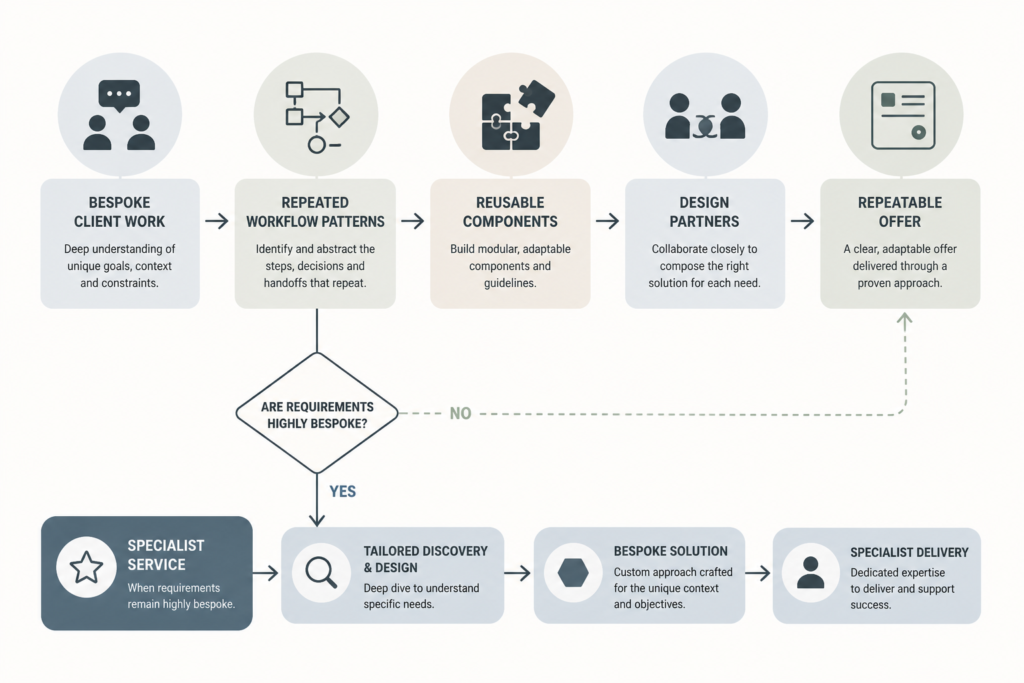
Repeated workflows may support productisation, while genuinely bespoke work can remain a healthy specialist service.
Services work becomes productisable when the repeated element is stronger than the bespoke element. Useful signals include the same buyer type returning with the same workflow problem, a similar data model across engagements, a common implementation sequence, requests for ongoing access rather than a one-off deliverable, and a support requirement that can be standardised.
That does not mean immediately building a full platform. First separate reusable intellectual property from customer-specific work; obtain clear contractual rights; test a repeatable package with a small number of design partners; and establish whether buyers will pay on a recurring basis for the outcome, not merely for another custom project.
The warning sign is equally important: if every prospect needs a different workflow, integration, approval path and support arrangement, the business may still be a healthy specialist service company. Forcing it into SaaS too early can create expensive product debt.
Trust must be designed into delivery
A compelling niche proposition can still stall if the supplier cannot answer basic questions about scope, ownership, quality assurance, support and data handling. Map the data involved, who can access it, where suppliers process it, and what must be agreed contractually. International personal-data transfers and sector-specific requirements can be fact-specific, so teams should obtain current legal and data-protection advice before making commitments or representations to customers.
Other predictable risks include founder dependency, unclear intellectual-property terms, uncontrolled scope, weak documentation, client concentration and inconsistent handovers between commercial and technical teams. These are manageable risks, but only if they are made visible early.
A practical UK-niche checklist
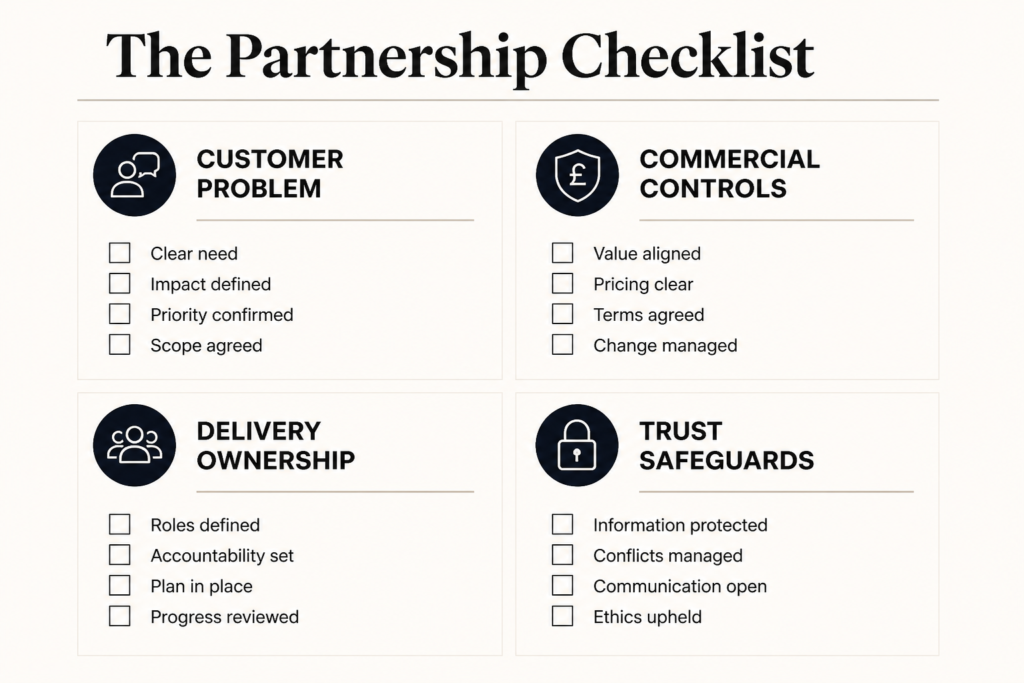
A focused readiness check can expose commercial and delivery gaps before a full product build.
Before committing to a full product build, ask:
- Can we name the buyer, the urgent trigger and the painful workflow?
- Have we obtained paid discovery, a pilot commitment or another credible proof of demand?
- Who owns UK-facing commercial decisions, onboarding and escalations?
- Which delivery tasks are repeatable, and which remain bespoke?
- Are payment stages, support boundaries and change-control rules written into the proposal?
- Have we considered currency, late payment and client-concentration exposure?
- Can we explain data flows, quality checks, access controls and IP ownership?
- Is there evidence for every public customer, outcome and company claim?
Lahore-linked businesses do not need to claim an abstract geographic advantage to win UK work. They need a specific customer problem, honest evidence, reliable cross-border execution and the financial discipline to turn early learning into a repeatable offer.
A repeatable UK entry process starts with a narrow problem and ends by testing whether delivery can be standardised.
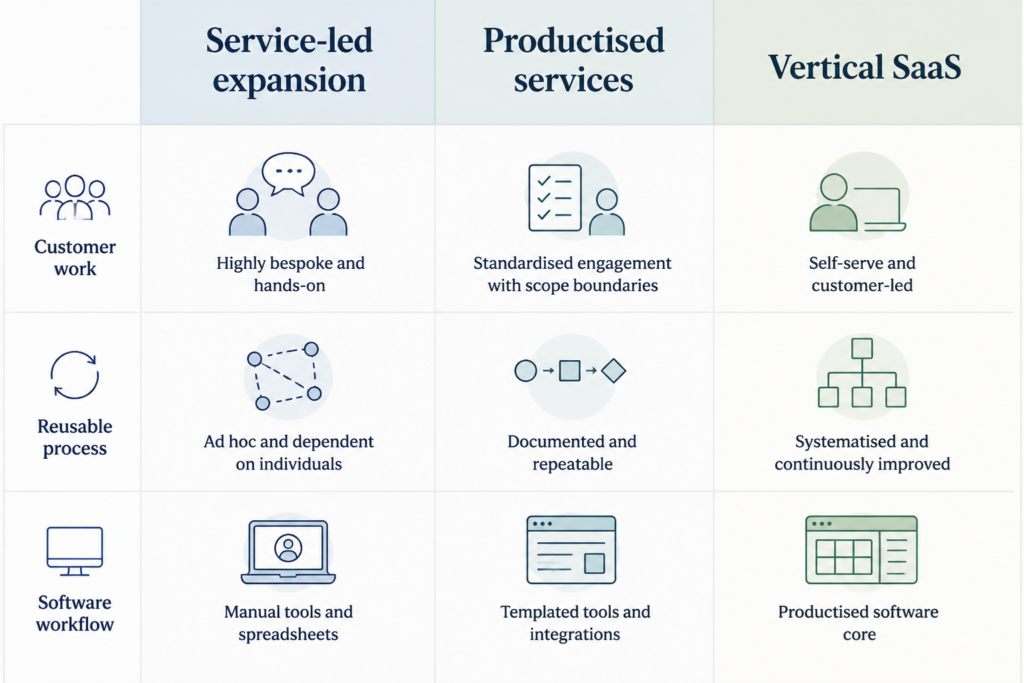
The appropriate route depends on buyer clarity, implementation demands, proof and cash fit—not on a universal growth sequence.
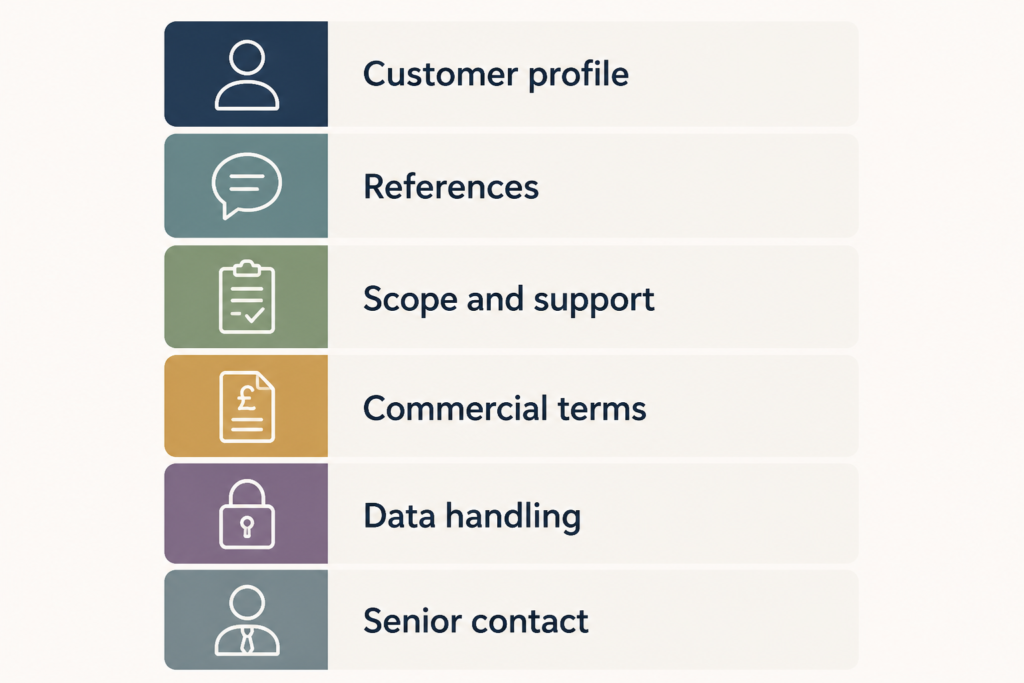
Trust is built from operational evidence that reduces buyer uncertainty, not from labels alone.