
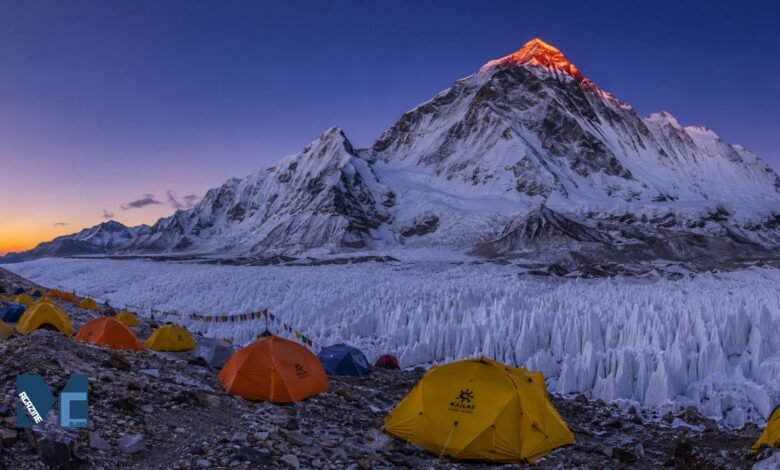
Advanced Base Camp: The World’s Highest Trekking Destination on Everest’s North Face
At 6,400 metres above sea level in Tibet, Everest's Advanced Base Camp is the highest point on Earth reachable without a climbing permit — and the staging post for every summit attempt from the north. Here is everything you need to know.


*Disclaimer: We may earn a commission if you make a purchase through our affiliate links, at no extra cost to you.
📋 Quick Facts
Elevation
6,400 m (20,997 ft)
Location
Tibet Autonomous Region, China
Glacier Route
East Rongbuk Glacier
Trek Distance (CBC to ABC)
~22 km one way
North Col Altitude
7,020 m — next stage above ABC
Best Trekking Season
April–May & September–October
Nearest Monastery
Rongbuk Monastery (4,980 m)
Oxygen at Altitude
~47% of sea-level concentration
Advanced Base Camp on the north side of Mount Everest sits at an elevation of approximately 6,400 metres (20,997 feet) in Tibet, making it the highest point in the world that non-climbers can legally reach without a mountaineering permit. Unlike Everest Base Camp on the Nepal side — which tops out at 5,364 metres and receives tens of thousands of trekkers each year — the Tibetan ABC is reached by a small fraction of that number, and the experience at the top is correspondingly raw, uncrowded, and uncompromising. The camp lies at the base of the North Col, where the East Rongbuk Glacier presses against the towering walls of the north face, giving a direct, close-range view of the mountain that no other publicly accessible point on Earth can match.
The route to advanced base camp begins not with a flight to Lukla or a week of hiking through mountain villages, but with a road journey across the Tibetan plateau. Trekkers typically enter via Lhasa, drive south and west through the stark, high-altitude interior of Tibet, pass through Shigatse and the frontier town of Tingri, and eventually arrive at the Chinese Base Camp at 5,200 metres — from which the actual trek to ABC unfolds over three to four days. That combination of driving to elevation before walking, while unusual, means the altitude gain is front-loaded and the physiological pressure starts earlier than many first-timers expect. Acclimatisation stops in Lhasa (3,650 m) and Nyalam (3,700 m) are not optional extras; they are functional necessities.
What makes advanced base camp distinctive — beyond its sheer altitude — is its history. Every north-side attempt on Everest, from George Mallory’s 1924 expedition to the present season, has passed through or staged from this location. The camp has been a witness to the sport’s greatest achievements and its most enduring mysteries. It exists simultaneously as a logistical hub for elite mountaineering expeditions and as a destination for determined trekkers who want to stand in the footsteps of the people who first tried, a century ago, to reach the top of the world. (However, if you are looking for a much more relaxing and accessible adventure closer to home, you can explore these weekend getaways in upstate New York).
The North Side of Everest: Geography and Context
Mount Everest straddles the border between Nepal and the Tibet Autonomous Region of China, and its two flanks are fundamentally different experiences. The south side — the Nepal approach — is defined by the Khumbu Icefall, a notoriously dangerous cascade of shifting seracs that climbers must cross multiple times during a standard expedition. The north side, by contrast, follows a long ridge route from the North Col at 7,020 metres up the Northeast Ridge toward the summit at 8,848.86 metres. On this Tibetan approach, the camp system works upward from the Chinese Base Camp (5,200 m) through an Intermediate Camp at around 5,760 metres, then to Advanced Base Camp at 6,400 metres, and eventually to a series of high camps culminating in Camp VI at approximately 8,230 metres before the final summit push.
The East Rongbuk Glacier is the arterial route connecting Chinese Base Camp to ABC. Described by PBS NOVA as the “12-mile highway to the north side of Everest,” the East Rongbuk was actually missed by Mallory during the 1921 British reconnaissance expedition; he initially failed to locate the turn-off from the main Rongbuk Glacier and expended considerable effort that season trying to find an alternative approach to the North Col. It was only in 1922 that the East Rongbuk route was properly mapped and climbed, and from that point it became the established path for every subsequent north-side expedition. The glacier is characterised by towering penitentes — spike-shaped ice formations created by differential solar radiation at high altitude — and the surrounding moraine terrain, bare of vegetation and frequently swept by fierce winds off the plateau, provides some of the starkest mountain scenery on Earth.
The terrain between Rongbuk Monastery and ABC also sits within what China designates the Chomolungma National Nature Reserve — “Chomolungma” being the Tibetan name for Everest, meaning roughly “Goddess Mother of the World.” This reserve status imposes restrictions on visitor numbers and regulates activities along the approach route, contributing to the relative solitude that characterises the ABC trek compared with its Nepali counterpart.
Rongbuk Monastery: The World’s Highest Place of Worship
No account of the ABC trek makes sense without Rongbuk Monastery, which sits at approximately 4,980 metres at the head of the Rongbuk Valley — making it, by most measures, the highest permanently occupied monastery on Earth. Founded in 1902 by the Tibetan Buddhist master Ngagwang Tenzin Norbu, Rongbuk is a Nyingma Buddhist institution and remains a functioning religious community. For most trekkers heading toward advanced base camp, it is the last significant cultural landmark before the terrain becomes entirely glacial and geological. The monastery’s painted prayer wheels, its views directly north face down the main Rongbuk Valley, and the quality of silence at that altitude are by many accounts more memorable than the altitude statistics would suggest. It also serves as a practical reference point: groups arriving at Rongbuk after the long drive from Shigatse often spend time here to let their bodies register the elevation before the serious trekking begins. Many early Everest expeditions — including Mallory’s — held their final planning sessions within its walls.
Timeline: Key Milestones in Advanced Base Camp History
1921
The first British reconnaissance expedition reaches the North Col at 7,020 m, led by George Mallory, Edward Oliver Wheeler and Guy Bullock — the first Westerners to set foot on Everest itself. The East Rongbuk Glacier route to what would become ABC is not fully mapped this year.
1922
The East Rongbuk Glacier is properly climbed for the first time during the 1922 British expedition, establishing the route via what is now Advanced Base Camp as the definitive path to Everest’s north side. This 22-kilometre approach becomes the standard for all subsequent north-side expeditions.
1924
George Mallory and Andrew “Sandy” Irvine depart from Advanced Base Camp on 4 June, beginning their final summit bid. According to historical accounts, Mallory departed ABC confident they would summit and return by nightfall. They were last seen near the Northeast Ridge by teammate Noel Odell at 12:50 PM on 8 June, then vanished. Mallory’s body was found in 1999 at 8,156 metres; Irvine’s partial remains were located on the Rongbuk Glacier by a National Geographic team in 2024.
1960
A Chinese mountaineering team — Wang Fuzhou, Gonpo, and Qu Yinhua — becomes the first group to successfully summit Everest from the north side, using the Northeast Ridge route via ABC and the North Col. The ascent happens on 25 May, establishing the Tibetan route as a viable summit path.
1980
Reinhold Messner completes the first solo ascent of Everest — without supplemental oxygen — using the north face via the Great (Norton) Couloir. His departure point was Advanced Base Camp. This feat, accomplished in three days from ABC, remains one of the most celebrated achievements in the sport’s history.
1999
A BBC-backed “Mallory and Irvine Research Expedition” stages from Advanced Base Camp and succeeds in locating George Mallory’s body at 8,156 metres on the north face. Conrad Anker is among those who make the find. The discovery deepens rather than resolves the central question: whether Mallory and Irvine reached the summit in 1924 before perishing.
2024
A National Geographic team recovers partial remains of Andrew “Sandy” Irvine on the Rongbuk Glacier, 100 years after his disappearance. The find, announced during Everest’s centenary year of serious British attempts, reignites academic debate about the 1924 summit bid and draws renewed international attention to the north face and Advanced Base Camp as sites of mountaineering history.
💜 Why This Matters
Standing at 6,400 metres on the Tibetan plateau, looking directly up at the north face of Everest, carries a different weight than any photograph or number can convey. The air at Advanced Base Camp contains roughly 47% of the oxygen available at sea level, and the body’s response to that deficit — the slower thinking, the shortened breath, the strange quality of sleep — makes the altitude viscerally real in a way that changes how people relate to what human endurance actually means. For the thousands of mountaineers who have departed this camp toward the summit, and for the handful of trekkers who reach it each season without climbing ambitions, the experience has a way of recalibrating ordinary assumptions about effort, risk, and what it costs to go somewhere genuinely difficult.
What Advanced Base Camp Actually Does: Logistics and Function
The term “base camp” in mountaineering describes the primary operational hub from which an expedition is managed, and “advanced base camp” refers to a higher-altitude staging point closer to the technical climbing objective. On the south side of Everest in Nepal, the terminology is slightly different — what is known as Camp II (6,400 metres, at the base of the Lhotse Face in the Western Cwm) is sometimes referred to as “Advanced Base Camp” in that context. On the north side, the term is used more formally and consistently: Chinese Base Camp (5,200 m) handles the bulk of long-term logistics, equipment storage, and communications infrastructure, while Advanced Base Camp at 6,400 m functions as the forward staging point for all technical operations above the North Col.
Supply lines to ABC rely primarily on yaks. The animals are physically capable of carrying loads to approximately 6,400 metres — roughly the altitude ceiling for yak use in this region — which is one of the reasons ABC was established where it was rather than higher. Above that point, human porters or Sherpa teams take over. This creates a natural supply bottleneck at ABC that makes the camp’s organisational role particularly important: gear is staged here, oxygen cylinders are checked and repacked, rope teams are assembled, and weather windows are assessed before groups move to higher camps. During peak season, the camp itself is dotted with the brightly coloured tents of international expeditions, each with its own communication setup, medical support, and logistics chain. The China-Tibet Mountaineering Association (CTMA) supervises access to the area and requires all climbers to have proper permits, which are considerably more expensive than the Nepal-side equivalent.
For trekkers who are not attempting the summit, the experience at ABC is more stripped-back. There are no tea houses at 6,400 metres — accommodation is tented, food must be carried or prepared by a guiding team, and the environmental conditions (wind, cold, and low oxygen) demand a level of preparation that distinguishes the ABC trek sharply from even the more demanding commercial treks in Nepal. The discipline required to manage physical output against available oxygen is one of the most consistent themes reported by those who have made the journey.
Advanced Base Camp vs. Everest Base Camp Nepal: A Practical Comparison
The distinction matters to anyone planning a high-altitude Himalayan trip. Nepal’s Everest Base Camp sits at 5,364 metres, is reached by a 12 to 14-day trek beginning with a flight to Lukla, and passes through culturally rich Sherpa communities including Namche Bazaar and Tengboche. The trail is well-serviced, with tea houses providing accommodation and meals throughout, and the route sees an estimated tens of thousands of trekkers annually. The Himalayan Rescue Association runs an aid post at Pheriche (4,243 m) along the route, and altitude sickness — which affects an estimated 30–40% of EBC trekkers in some form — is managed within a well-established emergency framework that includes helicopter evacuation services.
Advanced Base Camp in Tibet is a different proposition in almost every measurable respect. The altitude is 1,036 metres higher. The approach combines a multi-day road journey across the Tibetan plateau with a three-to-four-day trek from the Chinese Base Camp, and the last stretch requires camping rather than tea house accommodation. Tibet entry requires a specific permit — the Tibet Travel Permit — along with a Tibet Mountaineering Association permit for those going beyond Chinese Base Camp to ABC, and both must be arranged through a registered Tibetan tour operator. The total journey from Kathmandu to ABC takes approximately 9 days under typical itinerary structures, with acclimatisation stops built in at Lhasa, Nyalam or Zhangmu, and Tingri. Visitor numbers are substantially lower than on the Nepal side, which means the ABC experience is quieter but also means the safety infrastructure — evacuation options, medical posts, other trekkers who might assist in an emergency — is considerably thinner.
The other major difference is the visual one. At ABC on the Tibetan side, the north face of Everest dominates the southern horizon without any obstruction. The mountain’s pyramid shape is more dramatic from this angle than from the Nepal side, where the south face is partially concealed by the surrounding ridgeline and the scale only reveals itself at certain viewpoints. Many experienced mountaineers and photographers regard the view from ABC in Tibet — the full sweep of the north face, the North Col clearly visible above, the summit pyramid catching morning light — as among the most arresting in the entire Himalayan range. Whether that view justifies the additional difficulty and cost compared with other high-altitude destinations is a question every trekker must answer for themselves, but the consensus among those who have done both is clear: ABC is harder, more expensive, less forgiving, and substantially more impressive.
📊 Estimated ABC Trek Cost Breakdown (2026 Guided Package)
Note: Figures are indicative estimates based on publicly available operator pricing as of 2026. Exact costs vary significantly by operator, group size, entry point (Kathmandu vs. Lhasa), and season. Emergency jeep evacuation from the Tibet side is reported to cost approximately USD 1,700 separately. No authoritative verified figure for the total market-average cost has been independently confirmed.
“Since setting off from Advanced Base Camp at 21,000 feet three days earlier, I had been able to choke down only a few bites of freeze-dried curry, a handful of cashews, and a single bite of something I could no longer identify.”
— National Geographic, from a 2025 account of the expedition searching for Mallory and Irvine on Everest’s north face
Acclimatisation, Altitude Sickness, and Safety at 6,400 Metres
The physiological challenge of reaching advanced base camp is categorically different from standard high-altitude trekking. At 6,400 metres, the available oxygen is approximately 47% of what the body receives at sea level, a reduction that affects cognitive function, motor control, appetite, and sleep quality in ways that are difficult to anticipate from lower elevations. Acute Mountain Sickness (AMS) is a real risk at any point above 3,500 metres; above 5,000 metres, the more serious conditions — High Altitude Pulmonary Edema (HAPE) and High Altitude Cerebral Edema (HACE) — can develop rapidly and become life-threatening within hours if the affected person is not descended quickly.
The guiding principle for all high-altitude movement — “climb high, sleep low” — is particularly critical on the ABC route. The Himalayan Rescue Association recommends never ascending more than 300–500 metres per day above 3,000 metres, and the itineraries for reputable ABC operators build in deliberate acclimatisation days at Lhasa, Nyalam, Tingri, and Chinese Base Camp before the trekking stage begins. Hydration is essential: the combination of dry Tibetan plateau air and physical exertion at altitude produces dehydration faster than most people expect, and three to four litres of water daily is a recommended baseline rather than an aspiration. Diamox (acetazolamide) is commonly used as a prophylactic against AMS and can be prescribed by a travel medicine physician before departure, though it is not a substitute for proper acclimatisation.
The relative isolation of the ABC route in Tibet compared with the Nepal-side EBC trek makes thorough pre-departure health assessment more important, not less. Evacuation from ABC in the event of a serious altitude-related emergency is slower and more logistically complex than from the Nepal side. Emergency jeep transport to lower altitude from the Chinese Base Camp area is the primary evacuation method; helicopter rescue in Tibet is available but expensive and subject to permit restrictions, and the availability of aircraft at short notice cannot be guaranteed. Travel insurance that specifically covers high-altitude trekking and helicopter evacuation to at least 6,500 metres is regarded by operators as non-negotiable for clients attempting this route.
Where Things Stand Now
The north side of Everest continues to attract serious mountaineering expeditions each spring season, with the China-Tibet Mountaineering Association managing permits and expedition logistics from the Chinese Base Camp. The 2024 centenary of the 1924 Mallory-Irvine expedition brought renewed media attention to the north side; the discovery of Sandy Irvine’s partial remains by a National Geographic team on the Rongbuk Glacier has intensified academic debate about what happened on the mountain that June, without resolving the central question of whether the pair reached the summit. That unresolved mystery continues to draw expedition teams to Advanced Base Camp with historical as well as climbing motivations.
For civilian trekkers, access to the ABC route via Tibet remains subject to Chinese permit regulations that can change with limited notice. As of 2026, independent trekking to Advanced Base Camp without an authorised Tibetan tour operator is not permitted, and all visitors require a Tibet Travel Permit in addition to a standard Chinese visa — a combination that must be arranged before entering Tibet. Operators who specialise in this route report that group sizes are kept deliberately small, partly because the terrain and altitude demands it and partly because the Chomolungma National Nature Reserve imposes visitor management requirements. Those who have completed the trek describe the logistical complexity as a reasonable price for the quality of what they find at the top: a direct view of the north face, virtually no crowds, and a silence on the glacier that the Nepal side — for all its considerable attractions — simply cannot replicate.
Interest in the north-side approach among adventure trekkers from the UK, Australia, and North America has been growing incrementally in recent years, partly driven by accounts shared online and partly by the growing saturation of the Nepal-side EBC route during peak seasons. The trade-off — higher cost, more complex logistics, greater physical demand, and the need for more rigorous pre-trip preparation — is increasingly accepted by a cohort of experienced trekkers for whom the difference between a crowded and an uncrowded mountain justifies the additional effort. In that respect, Advanced Base Camp occupies a particular position in the world of high-altitude travel: demanding enough to limit its audience, accessible enough that it doesn’t require a full mountaineering skill set, and historically significant in a way that few other places on Earth can match.
✨ Advanced Base Camp — At a Glance
Elevation
6,400 m / 20,997 ft
Trek Duration (CBC to ABC)
3–4 days
Kathmandu to ABC
~9 days total
Permit Required
Tibet Travel Permit + CTMA Permit
❓ Frequently Asked Questions
What is Everest Advanced Base Camp and where is it located?
Everest Advanced Base Camp (ABC) is a high-altitude staging camp on the north side of Mount Everest in Tibet, China, situated at approximately 6,400 metres (20,997 feet) above sea level. It lies along the East Rongbuk Glacier at the base of the North Col, and serves as the primary forward logistics hub for all north-face summit attempts. It is the highest point on Earth reachable by trekkers without a mountaineering permit.
How is Everest Advanced Base Camp different from Everest Base Camp in Nepal?
Nepal’s Everest Base Camp sits at 5,364 metres and is reached via a 12 to 14-day tea-house trek from Lukla. Tibet’s Advanced Base Camp is 1,036 metres higher, reached by a combination of road journey and glacier trek from the Chinese Base Camp, and requires camping rather than tea house accommodation. ABC receives far fewer visitors, offers a direct frontal view of Everest’s north face, and demands a higher degree of pre-trip preparation and physical fitness.
Do you need a permit to trek to Everest Advanced Base Camp in Tibet?
Yes. Trekkers require a standard Chinese visa, a Tibet Travel Permit (arranged through a registered Tibetan tour operator), and — for those proceeding beyond the Chinese Base Camp to Advanced Base Camp — an additional permit from the China-Tibet Mountaineering Association (CTMA). Independent travel to ABC is not permitted; all visitors must be part of an organised tour with an authorised Tibetan agency.
What is the best time of year to trek to Advanced Base Camp?
The two main windows are April to May (spring, coinciding with the main Everest climbing season) and September to October (post-monsoon autumn). Spring offers the most stable weather and the best chance of clear views of the north face, but it also means sharing the route and ABC with active summit expeditions. Autumn is quieter and often provides excellent visibility. Winter and the monsoon months (June to August) are not suitable for trekkers.
How do mountaineers use Advanced Base Camp during Everest expeditions?
Advanced Base Camp functions as the forward staging hub for north-side expeditions. Supplies transported by yak caravans from the Chinese Base Camp terminate here — 6,400 metres is approximately the upper limit for yak load-carrying. Teams reassemble gear, check oxygen supplies, plan rotation schedules, and assess weather windows from ABC before moving to the North Col (7,020 m) and the higher camps. All technical climbing operations on the north face are co-ordinated from ABC.
How much does an Everest Advanced Base Camp trek cost in 2026?
Guided ABC trek packages vary widely but typically range from approximately $3,000 to $5,500 or more per person, depending on operator, group size, level of service, and whether the route starts from Kathmandu or Lhasa. This figure generally covers permits, internal transport, camping equipment and meals during the trek, and guide fees. Flights, international travel insurance, and personal equipment are additional costs. Independent trekking is not permitted, so no lower-cost self-guided option exists. Emergency evacuation by jeep or helicopter is a separate expense and must be covered by specialised travel insurance.
Final Thoughts
Advanced Base Camp is one of the few places in the world where the physical difficulty of getting there and the historical density of what happened there are genuinely proportional. The walk along the East Rongbuk Glacier — 22 kilometres of moraine, ice penitentes, and wind — earns the view at the end, and the view at the end is of a face that has tested the outer edge of human performance for over a century. The fact that Mallory and Irvine set out from this altitude in 1924 wearing wool and leather, carrying rudimentary oxygen equipment that their colleague had barely finished redesigning, and that a century later their story still generates academic papers and funded expeditions — that is not nostalgia. It is testimony to the scale of what was attempted there.
For trekkers considering the route, the practical reality is that this is an undertaking requiring genuine preparation rather than optimistic fitness. The altitude at ABC is unambiguous in its effects, and the isolation from the safety infrastructure that Nepal’s EBC route provides makes it unforgiving of poor decisions or inadequate acclimatisation. The permit bureaucracy is real, the cost is higher than Nepal alternatives, and the logistics are more complex. Those who go anyway — and come back from it — rarely describe it as something they would skip if given the choice again. Some things are simply worth the effort of getting to them properly.
What the advanced base camp offers, ultimately, is not just altitude but perspective. Standing at 6,400 metres on the Tibetan plateau, with the north face of the world’s highest mountain filling the horizon and the sound of the glacier settling in the cold, it becomes possible to understand in a physical rather than abstract sense what the mountain actually is — and what it costs to go higher. For those who have made that journey, the number 6,400 metres carries a very specific weight for the rest of their lives. For those planning to make it, the preparation starts now.
📚 Sources & References
- PBS NOVA Online — East Rongbuk Glacier, Everest Climb Guide
- Wikipedia — North Col (Everest), History and Expeditions
- Wikipedia — 1924 British Mount Everest Expedition
- National Geographic — Everest North Face Expedition, Mallory & Irvine, 2025
- Ask Me Nepal — Advanced Base Camp Trek: Northern Route 2026 Guide
- Eco Nepal Trekkers — Advanced Base Camp: Role in Himalayan Expeditions (2026)
- Tibet Travel Expert — Everest Advance Base Camp 6400m Trekking Details
All sources verified at time of publication. Links subject to change.
AB Rehman
Senior Features & Research Writer
AB Rehman is a features and research writer covering adventure travel, mountaineering history, and high-altitude destinations. His work focuses on separating verified fact from speculation, drawing on primary sources to produce accurate, readable long-form content for general and specialist audiences.
⚠️ Editorial Disclaimer
This article is intended for informational purposes only. All facts have been sourced from publicly available information at the time of publication. Where data could not be independently verified, this has been clearly noted. Cost estimates are approximations based on publicly available operator pricing and should not be treated as confirmed figures — trekkers should obtain current quotes directly from licensed operators. Permit requirements and access regulations in Tibet are subject to change; always consult an authorised Tibetan tour operator and the relevant embassy before planning travel. This article does not constitute travel, medical, or safety advice. High-altitude trekking carries significant physical risks; readers should seek professional medical guidance before undertaking any high-altitude expedition.