
How to Check Transmission Fluid: A Complete Step-by-Step Guide
Checking your transmission fluid correctly — whether your car has a dipstick or a sealed unit — can prevent costly gearbox damage. Here is everything you need to know, done properly.

*Disclaimer: We may earn a commission if you make a purchase through our affiliate links, at no extra cost to you.
📋 Quick Facts
Fluid Type
Automatic or Manual ATF
Check Frequency
Every 30,000–60,000 miles
Healthy Fluid Colour
Bright red or pink, clear
Warning Colour
Dark brown or black
Engine State for Check
Running (most automatics)
Dipstick Location
Near back of engine bay
Sealed Transmission
Requires mechanic check
Replacement Cost (Est.)
£80–£250 (service-dependent)
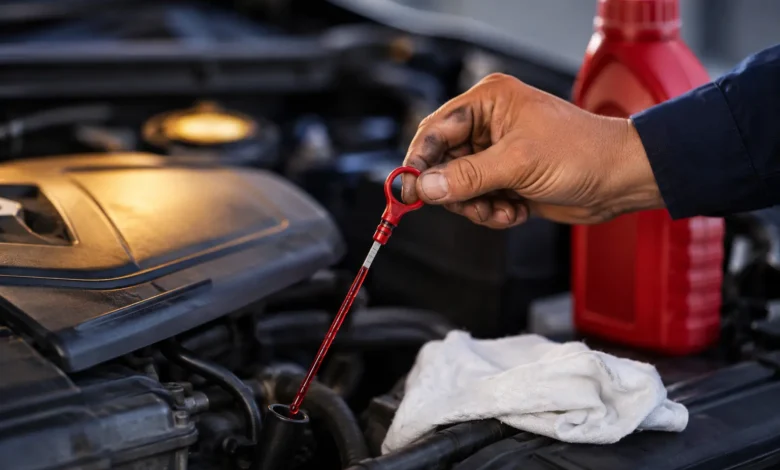
To check transmission fluid, locate the transmission dipstick — typically found toward the rear of the engine bay, often labelled and coloured differently from the oil dipstick — with the engine running and the gearbox in Park. Pull the dipstick out, wipe it clean, reinsert it fully, then withdraw it again and read the level against the marked MIN and MAX lines. Healthy fluid is bright red or pink and faintly sweet-smelling. If it reads below MIN, appears dark brown, or smells burnt, you need to act promptly. That covers the basics in under 60 words — but doing it correctly for your specific vehicle requires a little more care.
Transmission fluid is one of the most overlooked fluids in routine car maintenance. Unlike engine oil, which most drivers check habitually, the gearbox fluid is often ignored until something goes wrong — and by that point, the damage can already be done. A transmission rebuild can cost anywhere from £1,500 to over £4,000, depending on the vehicle and severity of wear. Checking the fluid takes under five minutes and costs nothing.
The complication is that not all vehicles have the same setup. Some modern cars — particularly those built since the mid-2010s — use sealed transmission units with no accessible dipstick at all. Others require the engine to be running and the gearbox cycled through its gear positions before a reading is meaningful. This guide covers the full range of scenarios so you know exactly what you are dealing with, whatever you drive.
Understanding What Transmission Fluid Does
Automatic transmission fluid — commonly referred to as ATF — is a hydraulic fluid that serves several functions simultaneously. It lubricates the dozens of moving components inside the gearbox, acts as a coolant for the transmission itself, transmits hydraulic pressure that enables gear changes, and conditions the rubber seals to keep them supple. In short, without adequate fluid at the right quality level, an automatic transmission simply cannot work as designed.
Manual transmissions use a different fluid — typically gear oil rather than ATF — but the principle of checking it remains broadly similar: the fluid must be at the correct level and in good condition. The consequences of running low are the same in both cases: accelerated wear on gear teeth, synchroniser rings, and bearings, eventually leading to rough shifting or total gearbox failure.
Because the fluid does so much work, it degrades over time. Oxidation, heat cycling, and contamination from metal particles all take a toll. Manufacturers specify service intervals for good reason. According to data from vehicle maintenance guides published by organisations such as the AA and RAC, many drivers significantly underestimate how often transmission fluid should be inspected, particularly on older vehicles where seals may be more prone to minor leaks.
Does Your Car Have a Transmission Dipstick?
This is the first question worth answering before you reach for anything. Many vehicles produced since around 2010 — particularly those from manufacturers like BMW, Mercedes-Benz, Ford, Volkswagen, and several others — use what is often called a “lifetime fill” or sealed transmission. These units have no dipstick at all. The manufacturer’s position is that the fluid does not need checking or replacing under normal service conditions, though independent mechanics frequently challenge this view, pointing out that no fluid genuinely lasts a vehicle’s lifetime under real-world conditions.
If your car has a sealed transmission, checking the fluid yourself is not possible without specialist equipment. A qualified mechanic can check the level via a fill plug underneath the vehicle, typically with the engine running and at a specific temperature. If you are unsure whether your vehicle has a dipstick or a sealed unit, the owner’s manual will tell you definitively. Failing that, a quick search of your vehicle’s make, model, and year — or a call to the manufacturer’s helpline — will resolve the question in minutes. For those with accessible dipsticks, the process is straightforward.
Timeline: How Transmission Service Recommendations Have Evolved
1950s–1970s
Early automatic transmissions enter mass-market vehicles. Manufacturers recommend checking ATF with every oil change; fluid quality is basic and degradation rapid. Transmission dipsticks are standard fitment on virtually all automatics.
1980s–1990s
Synthetic ATF formulations improve significantly. Service intervals begin to extend. Most service manuals of the era recommend a fluid change every 30,000 miles under normal driving conditions, with checks every 15,000 miles.
Early 2000s
Several European manufacturers begin introducing sealed transmission units, citing improved fluid longevity and reduced maintenance costs. The “lifetime fill” concept gains traction despite ongoing debate among independent mechanics about its real-world validity.
2010s
Dual-clutch transmissions (DCTs) and continuously variable transmissions (CVTs) become widespread, each requiring specific fluid types. Consumer confusion increases as there is no single universal check procedure. Many fleet operators begin insisting on fluid changes regardless of “lifetime fill” designations.
2020s–Present
Growing owner awareness drives demand for clearer guidance. Independent workshops and motoring organisations increasingly advise against relying on lifetime fill claims, particularly for vehicles that regularly tow, drive in stop-start urban traffic, or have exceeded 80,000 miles.
💜 Why This Matters
For the vast majority of people, a car is one of the most significant financial assets they own. A transmission failure is rarely dramatic — it creeps in with slightly sluggish gear changes, a faint shudder on acceleration, or a barely-there burning smell — and by the time the warning is unmistakeable, serious internal damage may already be underway. Spending five minutes every few months checking your transmission fluid is not about mechanical enthusiasm; it is about protecting a machine many families genuinely cannot afford to lose. That connection between routine observation and real financial security is what makes this one of the most quietly important tasks in car ownership.
Step-by-Step: How to Check Automatic Transmission Fluid
The following procedure applies to vehicles with a conventional accessible dipstick — still the majority of cars on UK and US roads today. Before beginning, check your owner’s manual to confirm whether your specific vehicle requires the engine to be running or switched off for an accurate reading. Most automatic transmissions require a warm, running engine; a notable exception is some Honda and Acura models, which specify a cold engine check. Getting this wrong produces a false reading.
Step 1 — Warm the transmission. Drive the car for at least 10–15 minutes so the gearbox reaches normal operating temperature. Park on a level surface. If you check fluid after only a cold start, thermal expansion means the reading will be artificially low. With the engine still running, apply the handbrake firmly.
Step 2 — Locate the dipstick. Open the bonnet and look toward the rear of the engine bay, typically on the passenger side on front-wheel-drive vehicles, or at the back of the engine on rear-wheel-drive cars. The transmission dipstick is usually brightly coloured — often red or pink — to distinguish it from the oil dipstick, which is typically yellow. It sits in a tube that runs down into the transmission casing.
Step 3 — Pull and wipe. Wearing a glove if the engine is hot, pull the dipstick fully out. Wipe it clean with a lint-free cloth or paper towel — you need a clear surface to read against.
Step 4 — Reinsert and withdraw again. Push the dipstick all the way back into its tube, ensuring it seats fully, then pull it out once more. This two-step process gives a stable reading. A single pull after the dipstick has been sitting inside for hours can give an inaccurate high reading from fluid that has run back up the tube.
Step 5 — Read the level and inspect the fluid. The dipstick has two marks — MIN (or COLD) and MAX (or HOT). With a warm engine, your fluid should sit at or just below the MAX mark. Anything below MIN means you need to add fluid. While reading the level, pay close attention to the fluid’s condition: it should appear translucent red or pink. Brown fluid is degraded. Black fluid with a burnt smell means the transmission has been running under stress and a full service is urgent. Milky or foamy fluid suggests water contamination — a serious problem requiring immediate professional attention.
Step 6 — Top up if needed. If the level is low, add the correct specification of ATF through the dipstick tube using a thin-necked funnel. Your owner’s manual will state the exact fluid specification — this is not a place for guesswork. Different transmissions use chemically incompatible fluids (Dexron, Mercon, SP-IV, CVT-specific fluids, and so on), and using the wrong type causes more damage than running low. Add a small amount at a time, rechecking the level after each addition.
Why Transmission Fluid Is Checked With the Engine Running
This is one of the most commonly searched questions on the topic, and the answer comes down to how an automatic gearbox actually works. Unlike engine oil, which pools in the sump when the engine is off, automatic transmission fluid circulates throughout the valve body, torque converter, and cooling circuit whenever the engine is running. When the engine is switched off, a significant volume of fluid drains back from these circuits into the sump pan. If you check the level at this point, you are reading only what has drained back — not the total system volume — which gives a falsely high reading.
With the engine running and the selector cycled through each gear position (P, R, N, D, and the numbered ranges) before settling in Park, the fluid has been pushed through every passage in the system and an accurate equilibrium level is established. This is why virtually every automatic transmission manufacturer’s procedure requires the engine to be running and the vehicle to be at operating temperature. The only exceptions are vehicles specifically engineered around a cold-check procedure — always verify your vehicle’s requirement in the manual rather than assuming.
This also explains why topping up a sealed transmission is technically complex: the mechanic must raise the car, locate the underbody fill plug, bring the fluid to a precise temperature range using a scan tool to monitor transmission temperature, and add fluid until it begins to overflow from the check hole — a controlled process that cannot be replicated with a garage dipstick. Passionate motoring enthusiasts like Mike Wolfe, whose restoration passion project highlights just how much care classic car owners devote to mechanical maintenance, understand this principle intuitively. For everyday drivers, the key takeaway is simpler: if your car has no dipstick and the check light comes on, go directly to a dealer or specialist.
📊 Transmission Service Cost Comparison (UK Estimates, 2026)
Note: Figures are approximate and based on publicly available workshop pricing data at time of writing. Actual costs vary significantly by vehicle make, model, and region. These estimates should not be treated as quoted prices.
Where to Put Transmission Fluid — and What to Never Get Wrong
Transmission fluid is added through the dipstick tube — the same tube from which you just pulled the dipstick. Use a clean, narrow funnel that fits securely so you do not spill fluid onto hot engine components. Add cautiously: pouring too much fluid in at once is a genuine risk. Overfilling the transmission can be just as damaging as running it low, because excess fluid gets aerated by the rotating parts, turns foamy, and loses its ability to lubricate and transmit hydraulic pressure effectively. Add in small increments — roughly 100–200ml at a time — and recheck the dipstick level between each addition.
The single most critical rule is fluid specification. Check your owner’s manual and use only the exact grade listed. On the fluid bottle itself, look for the manufacturer’s approval code — for example, “Dexron VI licensed” or “Ford Mercon V approved.” Many independent mechanics recommend sticking to OEM-specified fluid rather than universal ATF blends, particularly on newer vehicles where transmission tolerances are tighter and fluid chemistry is more exacting. If in any doubt, buy from a franchised dealership’s parts counter, where staff are trained to match fluid to vehicle.
One practical tip worth knowing: never add engine oil, power steering fluid, brake fluid, or any other automotive fluid to the transmission dipstick tube. These tubes all look similar under a bonnet, and cross-contamination from a single error can require a full transmission flush — an expensive lesson that costs far more than taking an extra moment to verify the label. Colour-coded dipstick handles help, but always read the label on the tube cap before adding anything. The Automotive Research and Consumer Education (ARCE) guidance published in many mainstream motoring publications consistently flags this as one of the most common and most preventable owner maintenance errors.
“The transmission is the hardest-working component in your drivetrain and the most expensive to replace. Fluid is not a consumable most drivers think about — until the bill arrives. Five minutes twice a year is all the attention most transmissions ever need to run reliably for 200,000 miles.”
— AB Rehman, Senior Features & Research Writer, editorial perspective based on published industry guidance
Warning Signs: When a Level Check Is Not Enough
Checking the transmission fluid level is a starting point, not the entire picture. Fluid condition matters as much as quantity. Fresh ATF has a translucent red or pinkish hue with no smell or a faintly sweet odour. As it ages and becomes heat-stressed, it darkens progressively through orange-brown toward black and may develop a distinct burnt smell — similar to overheated cooking oil. According to guidance from organisations including the Institute of the Motor Industry (IMI) and published consumer motoring data, burnt-smelling dark fluid is a reliable indicator that the transmission has been running at temperatures beyond its thermal limits, often due to sustained towing, repeated short journeys with insufficient warm-up time, or an underlying mechanical issue causing excessive friction.
Milky or frothy fluid is particularly serious. This appearance typically indicates that engine coolant or water has entered the transmission — either through a faulty transmission cooler that is integrated with the radiator, or in rare cases from a vehicle that has been driven through deep standing water. Contaminated fluid loses its lubricating properties almost entirely. If you notice milky fluid, do not drive the vehicle further until the system has been professionally assessed and flushed.
Beyond visual inspection, pay attention to how the car drives. Hesitation when pulling away from a standstill, gear changes that feel delayed or clunky, an unexplained shudder or vibration during acceleration, or a slipping sensation where the engine revs but the car does not accelerate proportionally — these are all gearbox distress signals. Any of them alongside degraded fluid warrants an immediate workshop visit. Motorsport history reminds us that even well-maintained machines at the professional level require constant fluid monitoring; the disciplined mechanical approach associated with racing professionals like Ned Jarrett — where every fluid was checked before every competitive run — reflects a standard that ordinary car owners can meaningfully adapt at home.
Where Things Stand Now
The landscape of transmission maintenance has become more complex as vehicle technology has advanced. Sealed transmissions are now fitted to a broad range of mainstream models from Ford, BMW, Mercedes-Benz, Volkswagen, Audi, and others. The prevailing advice from independent mechanics, supported by organisations including the AA and RAC, is that no transmission fluid is truly “lifetime” under real driving conditions — particularly in the UK, where stop-start urban traffic, variable weather, and frequent motorway cruising all place varied thermal demands on the gearbox.
For the majority of drivers who do have dipstick-equipped transmissions, the check remains one of the simplest self-maintenance tasks available. Modern ATF formulations are genuinely long-lived compared to fluids from earlier decades, but they are not indestructible. A check every 30,000 miles as a minimum — or whenever you notice any driving irregularity — is a reasonable standard that most service manuals support.
On the consumer technology side, some newer vehicles now include transmission fluid temperature and condition sensors that feed data to the onboard diagnostics system, with alerts displayed via the instrument cluster or connected smartphone app. This is not yet universal, but the direction of travel is clear: over the next decade, manual fluid checks will likely become less common as monitoring systems improve. For now, though, the dipstick remains the most reliable diagnostic tool most drivers have access to — and using it costs absolutely nothing.
If you are also interested in related vehicle safety systems, understanding how ABS testing and automotive diagnostics work gives broader context to the kinds of routine checks that keep modern vehicles safe and operational.
✨ Transmission Fluid Check — At a Glance
Time Required
5–10 minutes
Tools Needed
Cloth, funnel, correct ATF
Check Interval
Every 30,000 miles
Cost of Neglect
£1,500–£4,500+
❓ Frequently Asked Questions
How do you check transmission fluid level?
With the engine running and warm, locate the transmission dipstick toward the rear of the engine bay. Pull it out, wipe clean, reinsert fully, then withdraw again. Read the fluid against the MIN and MAX markings. On a warm engine, the level should sit at or near MAX. Anything below MIN means fluid needs to be added using the correct ATF specification for your vehicle.
How do you check your automatic transmission fluid?
Drive for 10–15 minutes to warm the transmission, then park on level ground with the engine still running. Locate the ATF dipstick — usually red-handled — near the rear of the engine bay. Pull, wipe, reinsert, and withdraw once more. Check the level and inspect the fluid colour: bright red or pink is healthy; dark brown or black with a burnt smell indicates the fluid needs replacing urgently.
Why check transmission fluid when the engine is running?
When the engine is off, a significant volume of transmission fluid drains back from the torque converter, valve body, and cooler lines into the sump, producing a falsely high reading. With the engine running and the gearbox at operating temperature, fluid is circulating through all passages and an accurate equilibrium level can be read. Most automatic transmissions require this procedure; always verify in your specific owner’s manual.
Where is the transmission fluid dipstick located?
On front-wheel-drive vehicles, the transmission dipstick is typically on the passenger side of the engine bay toward the rear, near where the transaxle meets the engine block. On rear-wheel-drive cars, it usually sits at the back of the engine near the firewall. It is generally identified by a brightly coloured handle — often red or orange — and labelled “Transmission” or “ATF.” If your vehicle has no dipstick, it uses a sealed transmission requiring specialist servicing.
Where do you put transmission fluid?
Transmission fluid is added through the dipstick tube, using a narrow clean funnel to avoid spilling onto hot engine components. Add the exact ATF grade specified in your owner’s manual — using the wrong fluid type is damaging. Add in small increments and recheck the dipstick level after each addition to avoid overfilling, which causes aeration and can harm the transmission just as much as running low.
How often should you check your transmission fluid?
Most manufacturers recommend inspecting transmission fluid every 30,000 to 60,000 miles under normal driving conditions, with a full fluid change at 60,000 miles or per your service schedule. However, if you regularly tow heavy loads, drive in heavy urban traffic, live in an extreme climate, or notice any change in gear-shift quality — delayed engagement, shuddering, or slipping — check the fluid immediately regardless of mileage.
Final Thoughts
Checking your transmission fluid is one of those maintenance tasks that sits at the intersection of simplicity and consequence. The procedure itself — locate the dipstick, wipe, reinsert, read — takes roughly the same time as making a cup of tea. Yet the failure to do it, repeated over thousands of miles, can quietly set up one of the most expensive mechanical failures in automotive ownership. There is something almost disproportionate about that gap between effort and risk.
The key variables to keep straight are straightforward: confirm whether your vehicle has a dipstick or a sealed unit; always check with the engine running and the gearbox warm for accurate automatic readings; use only the exact ATF specification your manufacturer requires; and treat dark, burnt, or milky fluid as an immediate warning rather than something to monitor for another few thousand miles. These are not complex principles — they just require the habit of looking.
Modern vehicles are increasingly capable of monitoring their own systems, and fluid condition sensors are gradually removing some of the guesswork. But for the majority of cars currently on the road, a dipstick and a clean cloth remain the most reliable tools available to a car owner. Use them. The transmission that keeps shifting smoothly at 150,000 miles is almost always the one that was checked.
📚 Sources & References
- The AA — How to Check Your Car’s Fluids
- RAC — Essential Car Fluid Checks
- Which? — Car Servicing: What You Need to Know
- Car and Driver — Transmission Fluid: How Often to Change
- Popular Mechanics — How to Check Transmission Fluid
All sources verified at time of publication. Links subject to change.
AB Rehman
Senior Features & Research Writer
AB Rehman is a features and research writer covering automotive maintenance, consumer how-to guides, and practical lifestyle topics. His work focuses on separating verified fact from speculation, drawing on primary sources to produce accurate, readable long-form content for general and specialist audiences.
⚠️ Editorial Disclaimer
This article is intended for informational purposes only. All facts have been sourced from publicly available information at the time of publication. Maintenance procedures described are general in nature and may vary depending on vehicle make, model, and year — always consult your owner’s manual or a qualified mechanic for vehicle-specific guidance. Cost estimates are approximations based on publicly available workshop pricing data and should not be treated as quoted figures. The views expressed reflect editorial analysis, not professional mechanical or financial advice.