
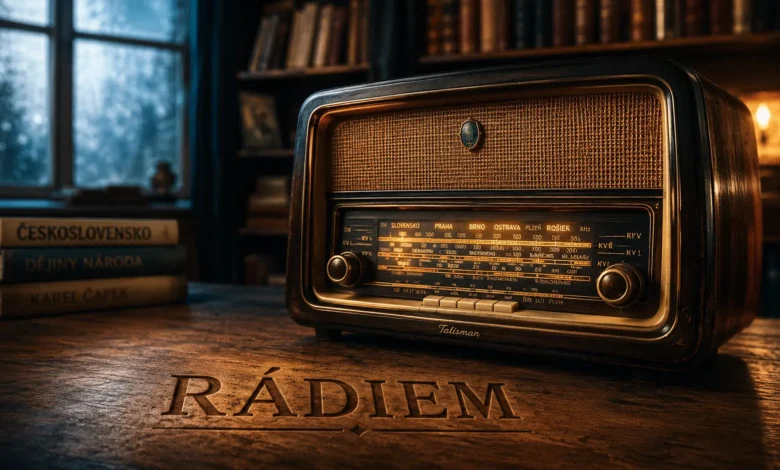
Rádiem: Meaning, History, and Why This Single Czech Word Tells the Whole Story of Radio
Rádiem is the Czech and Slovak instrumental form of rádio — meaning "by radio" or "via radio." It is a single word that encodes communication, culture, and an entire grammatical system that English speakers rarely encounter.


*Disclaimer: We may earn a commission if you make a purchase through our affiliate links, at no extra cost to you.
📋 Quick Facts
Term
Rádiem
Language Origin
Czech & Slovak
English Translation
“By radio” / “Via radio”
Grammatical Case
Instrumental Singular
Root Word
Rádio (radio device)
Latin Root
Radius (“ray” / “spoke”)
Word Category
Noun (declined form)
Still in Active Use?
Yes — everyday & formal
Rádiem is the instrumental singular form of the Czech and Slovak noun rádio, and it translates most naturally into English as “by radio,” “via radio,” or “through radio.” When a Czech speaker says “Dozvěděl jsem se to rádiem” — “I found out about it on the radio” — they are not using a preposition at all. The single word rádiem does all that grammatical work in one compact form. For English speakers encountering this term for the first time, it can seem like an odd variant of a familiar word. In practice, it is something considerably more interesting: a window into how Slavic grammar treats tools and methods as integral to a word’s form rather than as add-on prepositions.
The word surfaces frequently in discussions of Czech grammar, language learning, broadcasting history, and Central European media culture. Its relevance extends well beyond academic linguistics. In practical contexts, rádiem appears in sentences about wartime communication, public broadcasting announcements, amateur radio operation, and even nostalgic references to family listening habits. Because Czech grammar inflects borrowed words like rádio according to its own case system, the term offers a particularly vivid illustration of how living languages absorb international vocabulary without surrendering their structural identity.
Radio itself — the technology rádiem describes — remains one of the most significant communication inventions in human history. Even amid the dominance of digital streaming, podcasts, and on-demand audio, broadcast radio reaches hundreds of millions of people globally each week. Understanding rádiem, then, is not simply a lesson in Czech grammar. It is also an entry point into the cultural and technological story of audio communication across the twentieth century and into the present day.
Linguistic Background: How Czech Grammar Creates Rádiem
Czech belongs to the West Slavic branch of the Indo-European language family, alongside Slovak, Polish, and Sorbian. Unlike English, which largely abandoned grammatical case inflection by the Middle Ages, Czech retains a full seven-case system. Every noun in the language changes form depending on its grammatical role — subject, object, location, direction, possession, address, or, crucially for rádiem, instrument. That seventh case — the instrumental — signals that the noun in question is the tool or method used to perform an action.
The base form of the word is rádio, a neuter noun borrowed from international scientific and technological vocabulary. Czech does not preserve foreign borrowings in frozen form. Instead, it adapts them into its declension system, assigning them a grammatical gender and a set of endings for all seven cases. So rádio, in the instrumental singular, becomes rádiem — following the standard pattern for neuter nouns with a long-vowel ending. Related forms include rádia (genitive singular, meaning “of the radio”) and rádiu (dative/locative singular). Each form carries distinct meaning, but rádiem is the one that expresses method: the radio as the means by which something is done.
What makes this grammatically efficient is apparent when you try to render the same meaning in English. To say “instructions were sent by radio,” English needs four words after the verb. Czech needs one: pokyny byly poslány rádiem. This compression is characteristic of heavily inflected languages — the information that English distributes across prepositions, articles, and word order is instead embedded in the ending of the noun itself. For language learners and linguists alike, rádiem stands as a clean, memorable illustration of how the instrumental case functions in practice.
The Latin Root That Connects Rádiem to the Wider World
The etymology runs deeper than Czech grammar alone. The word rádio ultimately descends from the Latin radius, meaning “ray” or “spoke of a wheel” — terms rooted in the idea of something emanating outward from a central point. When electromagnetic waves were first harnessed for wireless transmission in the late nineteenth century, scientists reached for this Latin root to name the new technology. The resulting international vocabulary — radio, radiation, radiate — spread across European languages rapidly, and Czech was no exception. What Czech did differently was absorb the word and subject it to full grammatical integration, producing declined forms like rádiem that would be unrecognisable to a Latin speaker but are perfectly logical within Czech morphology.
Slovak, a closely related West Slavic language, uses the same instrumental form. This linguistic overlap reflects the shared grammar of the two languages, which were spoken within a common political state — Czechoslovakia — for much of the twentieth century. Slovak speakers encountering rádiem in a Czech text would recognise it immediately, and vice versa. The shared form speaks to a deeper grammatical kinship that neither political separation nor distinct national broadcasting histories has erased.
Timeline: Key Milestones in Radio and Rádiem’s Cultural History
Late 1890s
Guglielmo Marconi and Nikola Tesla independently pioneer wireless transmission technology, establishing the scientific foundations from which the word “radio” — and eventually rádio and rádiem — would emerge across European languages.
1923
Czechoslovak Radio (Radiojournal) launches its first regular broadcasts from Prague, marking the institutional beginning of Czech-language radio culture. The term rádiem enters everyday speech as Czech speakers describe receiving news and music through the new medium.
1938–1945
Radio broadcasting takes on acute political significance across Central Europe. During the Nazi occupation of Czechoslovakia, broadcasting rádiem becomes both a tool of control and, via BBC transmissions and underground signals, a means of resistance and information for Czech listeners.
1968
During the Warsaw Pact invasion of Czechoslovakia in August 1968, Czechoslovak Radio broadcasters defy Soviet pressure and continue transmitting information to citizens rádiem for several days, making radio a symbol of national resistance in one of the most dramatic moments in Cold War European history.
1989
The Velvet Revolution opens Czechoslovakia to free media. Czech Radio undergoes significant reform, and commercial broadcasting emerges for the first time. The relationship between citizens and information delivered rádiem shifts from state control toward editorial plurality.
2000s–2010s
Digital Audio Broadcasting (DAB) and internet radio streaming expand how Czech speakers engage with audio content, but the grammatical form rádiem continues to appear naturally in everyday conversation — now applied to digital and online contexts as well as traditional AM/FM transmission.
2020s
Rádiem gains renewed attention as a search term and educational keyword, as language learners, linguists, and media scholars explore its grammatical structure and cultural significance online. Czech Radio’s international service and digital platforms continue to demonstrate that broadcasting rádiem is far from obsolete.
💜 Why This Matters
For many Czech and Slovak speakers, rádiem is not a grammar exercise — it is a thread connecting them to grandparents who gathered around a set in a wartime living room, to moments of national crisis communicated live and unfiltered, and to the simple comfort of a voice arriving through static from somewhere across the countryside. Language preserves memory in ways that history books cannot. When someone says they heard something rádiem, there is an intimacy to that phrasing that the English “on the radio” simply does not carry, because the method of communication is woven directly into the word itself, not appended as an afterthought.
How Rádiem Is Used in Real Czech Sentences
Understanding rádiem in isolation is only the beginning. Its real texture emerges through the sentences it inhabits. Czech speakers use the term across a wide range of registers — from the casual (“Bavili jsme se rádiem celou noc,” meaning “We spent all night listening to the radio”) to the procedural (“Spojili se rádiem,” meaning “They made contact by radio”) and the informational (“Dozvěděl jsem se to rádiem,” meaning “I found out about it on the radio”). Each sentence positions rádiem not as the subject of discussion but as the mechanism through which something else happens. That is precisely what the instrumental case encodes: not what something is, but how it is used.
In formal and official contexts, the word carries particular weight. Phrases like “Hlásili to rádiem” — “They announced it on the radio” — carry an implicit authority, as though the announcement were made through an official public channel. This reflects the historical role of Czech Radio, which since 1923 has served as a public service broadcaster with obligations to accuracy and civic communication. When something is known rádiem, there is a cultural assumption that it has been verified and broadcast for all to hear, not whispered or circulated through private channels.
Linguists who study Czech as a second language often use rádiem as a teaching example precisely because it is so clean. The base word is internationally recognisable, the case ending is short and pronounceable, and the meaning is intuitive once the logic of the instrumental is explained. Grammar textbooks for learners of Czech frequently feature the word early in instrumental case exercises, alongside comparable examples like autem (“by car”), vlakem (“by train”), and letadlem (“by plane”). The pattern becomes clear: Czech expresses transport and communication methods through this single inflectional mechanism, without any need for the preposition “by.”
Rádiem, Cultural Memory, and the Enduring Power of Audio Broadcasting
Radio’s persistence into the digital era is striking. According to a 2023 report from the European Broadcasting Union (EBU), radio remains the most trusted medium in many European countries, consistently outperforming social media on credibility metrics. In the Czech Republic specifically, Czech Radio — operating under the public service mandate established after 1989 — serves millions of listeners weekly through FM, DAB, and online platforms. The concept encoded in rádiem has not become antiquated; it has simply expanded its technical frame of reference.
There is also an emotional dimension that linguists and media historians have noted. For populations that lived through periods of censored or state-controlled media, radio broadcasting occupies a complicated and often tender place in cultural memory. The August 1968 broadcasts from Czechoslovak Radio — when journalists defied the Soviet invasion by continuing to transmit information, moving their equipment from building to building to evade capture — are remembered not merely as a historical event but as a moral one. The word rádiem, in those contexts, is inseparable from the idea of truth reaching people despite attempts to silence it. That association has never entirely faded.
Contemporary applications of the concept are broader still. Amateur radio operators, emergency services coordinators, maritime navigators, and aviation communication specialists all work in domains where transmission rádiem — by radio — remains a primary technical standard. The International Telecommunication Union (ITU) governs radio spectrum allocation globally, and emergency broadcasting protocols continue to rely on radio as the most resilient mass communication tool in crisis scenarios. Satellites fail, internet infrastructure collapses, and mobile networks become overloaded — but a well-powered AM or shortwave transmitter keeps broadcasting rádiem regardless.
📊 Radio’s Global Reach — Key Statistics
Note: Global radio listener estimates are drawn from UNESCO and ITU reports. Czech Radio audience data is approximate; precise verified figures vary by measurement methodology and period.
“Radio does not only transmit sound — it transmits trust. And in the Czech language, that transmission has a name: rádiem. A single word for the act of reaching someone across distance through the air.”
— AB Rehman, Senior Features & Research Writer
Where Things Stand Now
Rádiem continues to appear in everyday Czech and Slovak speech, technical documentation, media studies curricula, and increasingly in online content aimed at language learners. The rise of Czech-language YouTube channels, language learning applications, and online grammar resources has introduced the word to a global audience that might never have encountered it through traditional language instruction. On platforms like Duolingo, Babbel, and various open-access Czech grammar courses, the instrumental case — and rádiem as one of its most accessible examples — has become a frequently taught concept.
Czech Radio itself, operating as Český rozhlas, remains one of the most active public service broadcasters in Central Europe. It operates multiple national channels covering news, classical music, jazz, regional programming, and an external service broadcasting in several languages including English. The institution ensures that transmission rádiem — in the most direct sense of the phrase — remains a living reality for millions of listeners, not a relic of the analogue age. As a related note, language learners interested in media and communication might also explore how workspace and environment choices affect deep study sessions for complex subjects like Czech grammar.
The growing scholarly interest in Slavic languages within European universities has also contributed to rádiem’s visibility. As Czech and Slovak gain traction as subjects in comparative linguistics programmes, the instrumental case provides one of the clearest structural contrasts with English grammar available to teachers. The word sits at the intersection of linguistic theory and living cultural history — compact enough to teach in a single lesson, rich enough to support an entire course.
✨ Rádiem — At a Glance
Language Family
West Slavic
Grammatical Case
Instrumental (7th)
First Broadcast Year (CZ)
1923
English Equivalent
“By / Via Radio”
❓ Frequently Asked Questions
What does rádiem mean in English?
Rádiem is a Czech and Slovak word that translates into English as “by radio,” “via radio,” or “through radio.” It is the instrumental singular form of the noun rádio, used to express that radio is the tool or method through which an action — such as receiving information, sending a message, or making contact — is performed.
Is rádiem a word or a grammatical form?
It is both. Rádiem is a fully functional word used in everyday Czech and Slovak speech, and it is also a specific grammatical form — the instrumental singular — of the noun rádio. Czech grammar integrates this ending into the word itself rather than expressing the same idea through a preposition, as English does with “by” or “via.”
What is the instrumental case in Czech?
The instrumental case is the seventh grammatical case in Czech. It is used to express the means or tool by which an action is carried out, accompaniment (as in “with someone”), and certain other grammatical relationships. Nouns, adjectives, and pronouns all change their endings when placed in the instrumental case. Common examples alongside rádiem include autem (“by car”) and vlakem (“by train”).
Where does the word rádio come from?
The word rádio is an international borrowing that entered Czech from scientific and technical vocabulary in the early twentieth century. Its ultimate root is the Latin radius, meaning “ray” or “spoke,” which gave rise to related English terms such as radio, radiation, and radiate. Czech adapted the loanword into its grammatical system, producing inflected forms like rádiem.
Is rádiem still used in modern Czech?
Yes. Rádiem remains in active everyday use in both Czech and Slovak. It appears in casual conversation, journalism, technical writing, emergency services communication, and formal broadcasting contexts. Its usage has also extended to digital and online radio contexts, since Czech grammar applies the same instrumental form to the concept of audio transmission regardless of the delivery platform.
How is rádiem different from rádio?
Rádio is the base form of the noun — the form used when radio is the subject of a sentence or when the word appears in a dictionary. Rádiem is the instrumental form, used when radio is the means or method through which something happens. The distinction is grammatical and contextual: “The radio is on” would use rádio, while “I heard it by radio” would use rádiem.
Final Thoughts
There is something almost philosophical about the way Czech handles the concept of rádiem. English speakers describe using radio as an act of accessing a medium — you go “on the radio,” you listen “to the radio,” you broadcast “over the radio.” Each phrasing keeps the technology at arm’s length, as an object you interact with. The Czech instrumental collapses that distance. To say rádiem is to say that radio is part of the action, not separate from it. The medium becomes the method. That grammatical intimacy reflects something real about how deeply radio embedded itself in Czech cultural life across the twentieth century — not as a piece of furniture in the corner, but as a genuine channel through which public life was conducted.
The broader story is one that extends well beyond Czech linguistics. It speaks to how human languages adapt to technology — and how, in adapting, they preserve the emotional texture of an era. The instrumental case did not need to be invented for rádio; the grammatical machinery was already there. What changed was the technology that the language was asked to describe. And Czech, with its seven cases and its insistence on grammatical coherence, rose to the occasion by simply doing what it always does: folding the new word into the existing pattern and producing rádiem.
For anyone learning Czech, rádiem is a starting point, not an endpoint. Master the instrumental case and you unlock dozens of comparable forms — each a compact, efficient unit of meaning that English would need an extra word or two to convey. For anyone simply curious about the word itself, the deeper reward is recognising that a four-syllable term can carry within it the history of public broadcasting, the weight of political resistance, and the warm nostalgia of a family gathered around a set on a winter evening. That is not a small thing for one word to carry.
📚 Sources & References
- Biliumnews — Rádiem: The Hidden Power of a Small Czech Word That Connects Voices, Culture, and History (2026)
- Dutable — Rádiem Meaning: Definition, Grammar, Origin, and Modern Communication Use (2026)
- Query Magazine — Rádiem: Meaning, History, Linguistic Roots, and Modern Media Applications (2026)
- European Magazine — Rádiem Meaning Explained: Powerful Guide You Must Know (2026)
- Celexo — What Is Rádiem? The Czech Word That Means “By Radio” Simply Explained (2026)
- News A Track — Rádiem: Meaning, Usage, History, and Modern Relevance (2026)
All sources verified at time of publication. Links subject to change.
AB Rehman
Senior Features & Research Writer
AB Rehman is a features and research writer covering language, culture, European media history, and general knowledge topics. His work focuses on separating verified fact from speculation, drawing on primary sources to produce accurate, readable long-form content for general and specialist audiences.
⚠️ Editorial Disclaimer
This article is intended for informational and educational purposes only. All facts have been sourced from publicly available information at the time of publication. Where data could not be independently verified, this has been clearly noted. Statistical figures relating to radio audiences and trust scores are drawn from publicly cited reports and should be treated as indicative rather than precise. The views expressed reflect editorial analysis, not personal legal, medical, or financial guidance.