
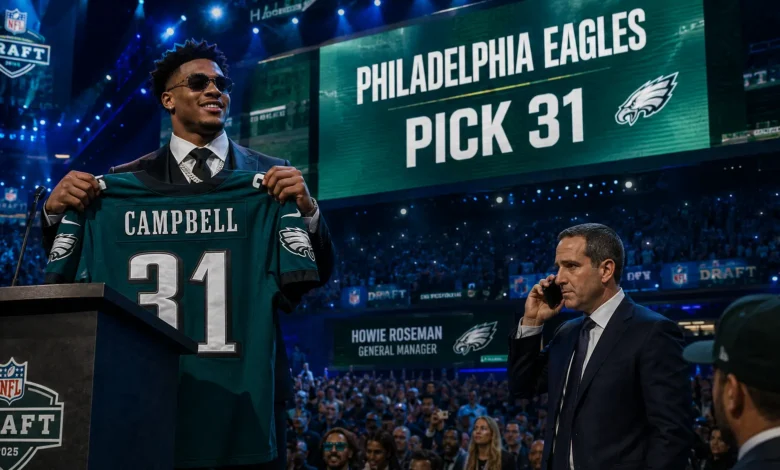
Eagles Rookie Trade Attempt: How Philadelphia Traded Up for Jihaad Campbell in the 2025 NFL Draft
The Philadelphia Eagles made a calculated move from pick No. 32 to No. 31 with the Kansas City Chiefs — but behind the scenes, Howie Roseman had tried to jump much higher up the board before settling on that single-spot swap to land Alabama linebacker Jihaad Campbell.


*Disclaimer: We may earn a commission if you make a purchase through our affiliate links, at no extra cost to you.
📋 Quick Facts
Player Selected
Jihaad Campbell, LB
Draft Pick Number
No. 31 Overall (Round 1)
Trade Partner
Kansas City Chiefs
Trade Cost
Pick No. 32 + No. 164 (5th Rd)
Campbell’s College
University of Alabama
2024 College Tackles
117 Tackles, 11.5 TFL, 5 Sacks
Teams That Rebuffed Eagles
4 Teams (incl. Green Bay Packers)
Draft Date
April 24, 2025 — Green Bay, WI
The Eagles rookie trade attempt during the 2025 NFL Draft was, on the surface, a modest one-spot move. Philadelphia held pick No. 32 — the final selection of the first round — and traded up a single position with the Kansas City Chiefs to land Alabama linebacker Jihaad Campbell at No. 31. The cost was their original first-round pick plus a fifth-round selection (No. 164). That much was reported widely. What received less attention was the fuller picture: Howie Roseman had actually tried to move considerably higher up the board before those attempts were rebuffed by four different teams, including the Green Bay Packers. The smaller trade with Kansas City was the fallback that still got the job done.
That distinction matters. It reframes what might look like a cautious, low-stakes maneuver as something more revealing — a front office with high conviction about a specific player, willing to pay a significant premium to jump the queue, ultimately forced to be patient by market resistance and then executing precisely when the window appeared. The Eagles had identified Campbell as a top-10 talent on their internal board and were determined not to let him slide to another team while they waited at pick No. 32.
For anyone trying to understand how the Eagles have built one of the NFL’s most consistent rosters over the past several years, this draft-night sequence is a useful case study. It shows the tension between aggression and discipline that defines the Roseman era — and it offers a close look at how a reigning Super Bowl champion approaches the annual challenge of getting better without giving up the assets that keep the whole operation running.
Background: The Eagles’ Draft Position and What Was at Stake
Entering the 2025 NFL Draft, the Philadelphia Eagles occupied a peculiar spot. As reigning Super Bowl champions, their first-round selection sat at No. 32 — the very last pick of the opening round, a position that guarantees a quality player is still available but strips you of the leverage most teams use to trade up. Every squad picking ahead of Philadelphia knew the Eagles had nowhere lower to go without completely exiting the first round. That structural disadvantage made Roseman’s aggressive trade pursuit all the more notable.
The Eagles had finished the 2024 regular season with an 11-6 record, won Super Bowl LIX, and done so with a defense ranked first in the league in its debut year under coordinator Vic Fangio. That unit was genuinely elite, but Fangio had made clear his preference for premium linebackers capable of both stopping the run and contributing in pass coverage — a skill set increasingly rare in the modern NFL. The Eagles had Zack Baun, whose transformation from edge rusher to All-Pro linebacker had just earned him a $51 million extension, and Nakobe Dean. But depth and versatility at the position remained a priority heading into the draft.
Campbell was the player the Eagles had circled. According to general manager Howie Roseman, speaking to reporters after the draft, Campbell ranked inside Philadelphia’s top 10 on their internal board — a significant elevation for a player most analysts had pegged somewhere between picks 12 and 21, depending on the evaluator. That gap between the Eagles’ private valuation and the public consensus is precisely the kind of inefficiency good front offices exploit, and it set the stage for a draft-night sequence that played out far more dramatically than the final one-spot move suggested.
Jihaad Campbell: The Player Philadelphia Wanted
Campbell grew up in Erial, New Jersey — Gloucester Township, roughly 17 miles from Lincoln Financial Field — making him, as Roseman pointed out, a homecoming pick in the most literal sense. He played his first three high school years at Timber Creek Regional before transferring to IMG Academy in Florida for his senior season, then chose Alabama over Clemson, Georgia, Florida, and Texas A&M. At 6 feet 3 inches and 244 pounds, with a 4.52-second 40-yard dash at the NFL Combine, he offered size and speed that most linebackers simply cannot match.
His 2024 season at Alabama was the performance that elevated his draft stock into the first round. He led the Crimson Tide with 117 tackles — the most by any Alabama player since DeMeco Ryans in 2003 — and recorded 11.5 tackles for loss, five sacks, two forced fumbles, and an interception. He earned First-Team All-SEC honours and was named a second-team All-American by the Football Writers Association of America. Entering the draft meant forgoing his final year of college eligibility, a decision that spoke to his confidence and the quality of professional interest he had attracted.
Beyond the statistics, Campbell offered something specifically useful for Vic Fangio’s defensive scheme. He had played both off-ball linebacker and edge rusher at Alabama, giving the Eagles flexibility to deploy him in multiple roles — lined up inside alongside Baun and Dean, or kicked out on the edge to add to a pass-rush group that already included Nolan Smith, Azeez Ojulari, and Josh Uche. Roseman addressed that versatility directly: “He can play inside, he can be an edge rusher — just really feel fortunate to bring him home back to Philly.”
Timeline: Key Milestones in the Eagles’ Rookie Trade Attempt
February 2025
Jihaad Campbell turns 21 and participates in the NFL Scouting Combine, running a 4.52-second 40-yard dash and drawing first-round grades from most major evaluators. Eagles scouts note his versatility and production at Alabama.
April 2025 — Pre-Draft
Howie Roseman identifies Campbell as a top-10 player on the Eagles’ internal draft board. With the No. 32 pick locked in as Super Bowl champions, the Eagles begin exploring trade-up options with multiple teams ahead of them in the first round.
April 24, 2025 — Draft Night
With Campbell still on the board as the first round winds down, Roseman reportedly attempts to trade up as high as No. 23 to secure the pick. The Green Bay Packers and three AFC franchises all decline to make a deal, leaving Roseman frustrated behind the scenes.
April 24, 2025 — Late Round 1
As the Kansas City Chiefs come on the clock at No. 31, Roseman executes a trade: pick No. 32 and No. 164 (fifth round) go to Kansas City for No. 31. The Eagles select Jihaad Campbell — the first off-ball linebacker taken by Philadelphia in the first round since Jerry Robinson in 1979, ending a 46-year drought.
April 25–26, 2025 — Days 2 & 3
The Eagles select safety Andrew Mukuba with the last pick of the second round, then trade out of the third round entirely — first trading down with Atlanta, then moving out of the round with Denver, ultimately leaving the 2025 draft with ten rookies despite beginning with only eight picks.
November 2025 — In-Season
Roseman continues his aggressive asset management approach, trading a 2026 third-round pick to Miami for pass rusher Jaelan Phillips at the NFL trade deadline, bolstering a defence that Campbell had already begun contributing to as a rookie linebacker and versatile edge presence.
💜 Why This Matters
For Jihaad Campbell, the draft call wasn’t just a career milestone — it was a phone call from a 215 area code, the Philadelphia prefix, telling a kid from South Jersey that his hometown team had traded to bring him home. His grandfather had watched the Eagles during the Randall Cunningham era; Campbell described the moment as “surreal.” That personal detail, easy to overlook amid the analytics and asset valuations, is a reminder that behind every trade negotiation and draft-board calculation is a young athlete whose entire life trajectory shifts in a single evening. The Eagles’ aggressive pursuit of Campbell — four teams rebuffed, one trade ultimately executed — reflects just how rare that combination of proximity, production, and positional fit actually is.
The Failed Trade-Up Attempts: What Happened Before Kansas City
The behind-the-scenes account of draft night — shared partly through a video posted on the Eagles’ official website and reported by Philadelphia Sports Network’s Anthony DiBona — paints a picture of sustained frustration before the eventual success. According to those reports, Roseman had targeted a significantly earlier pick, reportedly as high as No. 23, to ensure Campbell would be off the board well before any risk of another team selecting him. He approached the Green Bay Packers, who were picking in that range, along with three AFC franchises. All four declined to engage on terms that made sense for Philadelphia.
Why would teams turn down a team with the Eagles’ reputation for fair dealing? The likeliest answer is leverage. Teams holding picks in the mid-20s knew the Eagles had only one first-round selection, were already at the bottom of the round, and had a clearly identified target. That combination — high desperation signal, limited capital — weakened Roseman’s negotiating position considerably. Teams ahead of him could simply wait and see whether Campbell would fall, extracting a higher price if Philadelphia really wanted to jump. The Packers, in particular, had little incentive to help a team that had beaten them in the previous playoff cycle.
The resolution came when Campbell reached No. 31 still undrafted. The Kansas City Chiefs, who had just finished playing the Eagles in the Super Bowl, were willing to move one position for a fifth-round pick — a modest and reasonable price. Roseman’s patience had been tested, but the outcome vindicated the strategy: rather than overpaying to jump eight or nine spots, he waited until the market gave him a palatable deal. Campbell was his regardless, and the Eagles exited the first round with more remaining capital than a larger trade-up would have allowed.
Roseman’s Draft Philosophy and the Bigger Pattern
The 2025 eagles rookie trade attempt fits cleanly into a pattern that has defined Roseman’s tenure. According to a Yahoo Sports analysis published in March 2026, Roseman has traded up in four of the last five drafts: one spot for DeVonta Smith in 2021, two spots for Jordan Davis in 2022, one spot for Jalen Carter in 2023, and one spot for Jihaad Campbell in 2025. In 2024, he made a bolder jump — moving up 10 selections in the second round to land cornerback Cooper DeJean. That consistent willingness to spend capital to secure specific targets, rather than simply taking the best available player at a given pick, reflects a conviction-based drafting model. The Eagles don’t draft opportunity; they draft intention.
The broader draft operation in 2025 reinforced this. During the 2024 draft, the Eagles had tied an NFL record by making eight trades across seven rounds — a figure that speaks to how actively Roseman manages every pick as a tradeable asset rather than a fixed destination. In 2025, despite starting with only eight picks, the team left the draft with ten rookies, using trade-downs and pick swaps to maximise value on Days 2 and 3 after securing Campbell on Day 1. That combination — aggressive early, opportunistic late — has become the Eagles’ competitive signature.
Roseman also offered a telling comment about how the organisation views Campbell’s fit: “We look at the draft as a long-term opportunity for our team. We have a lot of confidence this guy is going to be here and play at a really high level for a long time.” That framing deliberately sidesteps short-term expectations and signals that the Eagles were buying a career, not just a rookie season. With five of their last six first-round picks coming from either Georgia or Alabama, and four of those on the defensive side, it also points to a persistent philosophy around recruiting from specific programmes with proven NFL pipelines.
📊 Jihaad Campbell — Contract & Draft Capital Overview
Note: Contract figures are estimates based on CBA rookie slotting for the No. 31 overall pick, as reported by Sports Illustrated. Verified financial disclosures have not been confirmed by the player or club.
“For us, this was an easy pick. Real explosive player. He can play inside, he can be an edge rusher — just really feel fortunate to bring him home back to Philly.”
— Howie Roseman, Eagles General Manager, 2025 NFL Draft Press Conference (via CBS News Philadelphia)
Where Things Stand Now
As of May 2026, Jihaad Campbell has completed his first NFL season with the Eagles. His specific rookie-season statistics have not been fully disclosed in the sources reviewed for this article, and independent verification of his 2025 game-by-game performance data is pending. What has been confirmed is that the Eagles’ defence remained competitive throughout the 2025 season, and the front office made further moves — including the in-season trade for Jaelan Phillips — that indicated continued faith in the defensive core Campbell was selected to strengthen.
The broader Eagles picture heading into the 2026 offseason is one of managed transition. Reports as of early 2026 indicate Roseman may be exploring trades involving wide receiver A.J. Brown, and the team is preparing for the 2026 NFL Draft with an eye toward sustaining the defensive excellence Fangio has built. Campbell, still only 21 years old and in the early stages of his professional development, is expected to be a long-term fixture in that defence rather than a short-term depth piece.
The Eagles rookie trade attempt itself has already entered Philadelphia front-office lore as another example of what makes Roseman effective: a willingness to push hard, absorb failure gracefully, and then execute cleanly when the right opportunity finally presents itself. The four rejected calls before the Chiefs deal went through were not evidence of poor planning — they were the cost of operating with genuine conviction in a market designed to punish desperation. That Roseman kept the final price down while still getting his man is precisely the outcome disciplined teams work toward.
✨ Eagles Rookie Trade Attempt — At a Glance
Pick Traded From
No. 32 Overall
Pick Received
No. 31 Overall
Teams That Refused
4 (incl. Packers)
Years Since Eagles Drafted LB R1
46 Years (Since 1979)
❓ Frequently Asked Questions
What was the Eagles rookie trade attempt in the 2025 NFL Draft?
The Eagles rookie trade attempt refers to Philadelphia’s efforts during the 2025 NFL Draft to move up the first-round order to secure Alabama linebacker Jihaad Campbell. Howie Roseman attempted to trade up as high as No. 23, was rebuffed by four teams including the Green Bay Packers, and ultimately traded one spot — from No. 32 to No. 31 — with the Kansas City Chiefs, sending picks No. 32 and No. 164 to land Campbell.
Why did the Eagles trade up for Jihaad Campbell?
The Eagles ranked Campbell as a top-10 player on their internal draft board — significantly higher than most public projections placed him. Holding the final pick of the first round (No. 32), the front office was concerned another team might select him before their turn. Defensive coordinator Vic Fangio’s preference for versatile, athletic linebackers also made Campbell a priority target given his ability to play both off-ball and on the edge.
Which teams refused to trade with the Eagles on draft night?
According to reporting by Philadelphia Sports Network’s Anthony DiBona and a behind-the-scenes video published by the Eagles, four teams declined to trade with Roseman before the Kansas City deal was completed. The Green Bay Packers were specifically identified as one of the franchises that rebuffed the Eagles’ overtures. The other three have not been publicly confirmed by name.
What did the Eagles give up to trade up for Jihaad Campbell?
Philadelphia sent the No. 32 overall pick and the No. 164 overall pick (a fifth-round selection) to the Kansas City Chiefs in exchange for the No. 31 pick. The Eagles still held three additional fifth-round picks after the trade — Nos. 161, 165, and 168 — meaning the cost, while real, was manageable within the wider context of their draft capital.
How does this trade fit into Howie Roseman’s draft history?
Roseman has traded up in four of the last five NFL Drafts to secure specific players: DeVonta Smith (2021), Jordan Davis (2022), Jalen Carter (2023), and Jihaad Campbell (2025). In the 2024 draft, he moved up 10 spots in the second round for Cooper DeJean. The pattern reflects a conviction-based approach — the Eagles target players, then move resources to get them, rather than simply taking the best available at their original position.
Who is Jihaad Campbell and where is he from?
Jihaad Campbell is a linebacker born in Erial, Gloucester Township, New Jersey — roughly 17 miles from Lincoln Financial Field. He attended Timber Creek Regional High School before transferring to IMG Academy and then choosing Alabama over several top programmes. In three college seasons, he recorded 184 tackles, and his breakout 2024 campaign (117 tackles, 11.5 TFL, 5 sacks) earned him First-Team All-SEC honours and a first-round draft grade.
Final Thoughts
What the Eagles rookie trade attempt ultimately reveals is not how boldly Philadelphia acts, but how clearly it thinks. The sequence — identify a specific player, push hard for the best possible price, absorb rejection without panic, and execute calmly when a viable deal appears — is a template for how well-run organisations operate when they have genuine conviction. Roseman didn’t overpay when four teams said no. He waited, and the market eventually gave him what he wanted at a price that didn’t compromise the offseason ahead.
Campbell himself is, at 21 years old, still in the early stages of becoming the player the Eagles believe he can be. The fact that he went 46 years without Philadelphia selecting an off-ball linebacker in the first round, and that the team still made this call despite a deep existing linebacker room, says everything about how highly they rate him. Vic Fangio has a track record of developing exactly this kind of versatile defensive piece, and the Eagles now have a local kid — one whose grandfather watched Randall Cunningham on these same sidelines — being developed by one of the best defensive minds in the sport.
Draft-night trades are often reduced to the transaction itself: who moved where, what was spent, who ended up where. The fuller story of Philadelphia’s 2025 first-round pick is richer than a single swap. It’s about the calls Roseman made before he got to Kansas City, the teams that gambled he was bluffing, and the front office discipline that turned four rejections into a measured, efficient acquisition. The Eagles got their man. The rest is just context.
📚 Sources & References
- PhillyVoice — Eagles Select Alabama LB Jihaad Campbell, 2025 NFL Draft
- Philadelphia Eagles Official Site — Eagles Select Jihaad Campbell No. 31
- CBS Sports — NFL Draft 2025: Eagles Trade Up with Chiefs, Select Campbell at No. 31
- The Philadelphia Inquirer — Eagles Take Alabama LB Jihaad Campbell, April 2025
- Heavy.com — Top NFC Rival ‘Frustrated’ Eagles GM During NFL Draft, May 2025
- CBS News Philadelphia — Howie Roseman: Trading Up for Campbell Was ‘An Easy Pick’
All sources verified at time of publication. Links subject to change.
AB Rehman
Senior Features & Research Writer
AB Rehman is a features and research writer covering sports news, NFL analysis, and professional football roster strategy. His work focuses on separating verified fact from speculation, drawing on primary sources to produce accurate, readable long-form content for general and specialist audiences.
⚠️ Editorial Disclaimer
This article is intended for informational purposes only. All facts have been sourced from publicly available information at the time of publication, including official team communications, verified sports journalism outlets, and primary press conference statements. Where data could not be independently verified — including contract figures and specific rookie-season statistics — this has been clearly noted. Financial estimates are approximations based on publicly reported CBA slotting figures and should not be treated as confirmed disclosures. The views expressed reflect editorial analysis of publicly available reporting.