
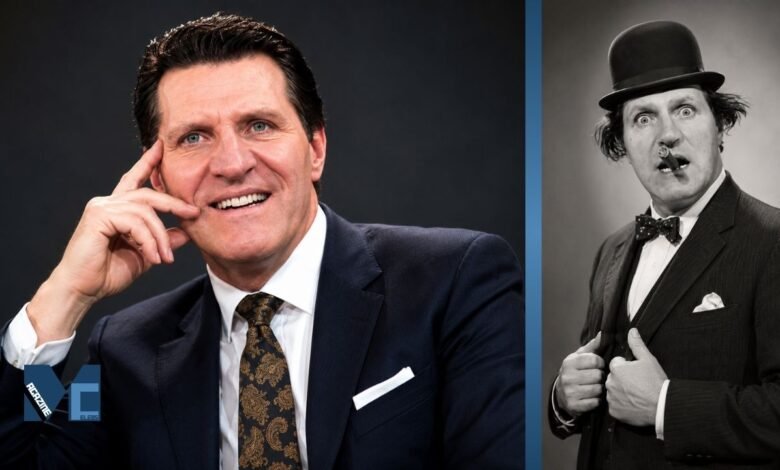
Tommy Cooper: The Man Behind the Fez Who Died Making the Nation Laugh
From a Welsh mining town to the pinnacle of British television — the extraordinary, heartbreaking, and deeply human story of Tommy Cooper, the comedian who made failure look like genius and left the stage for the very last time on live TV in 1984.


*Disclaimer: We may earn a commission if you make a purchase through our affiliate links, at no extra cost to you.
⚡ Quick Facts: Tommy Cooper
Full Name
Thomas Frederick Cooper
Date of Birth
19 March 1921
Birthplace
Caerphilly, Glamorgan, Wales
Date of Death
15 April 1984 (aged 63)
Profession
Comedian, Magician, Actor
Height
6 ft 4 in (1.93 m)
Spouse
Gwen Henty (m. 1947)
Probate Estate (1984)
£327,272 (verified)
Thomas Frederick Cooper — known to the entire nation simply as Tommy — was one of the most genuinely original performers Britain ever produced. A Welsh-born comedian and magician who stood six feet four in his socks, he made a career out of spectacular, choreographed incompetence, turning apparently failed magic tricks into a comedy style so precise it was almost mathematical. For nearly four decades, audiences simply could not look away. The laughs were instantaneous, partly because nobody could quite work out how he was doing it — or whether he was doing it at all.
Tommy Cooper died on 15 April 1984, aged 63, collapsing with a heart attack during a live performance of Live from Her Majesty’s on ITV. The audience kept laughing for a moment before the reality set in. He was pronounced dead at Westminster Hospital. The red fez, the booming laugh, the catastrophically unreliable magic — all of it stopped, mid-show, in front of millions of people watching at home. It remains one of the most shocking moments in the history of British television.
But Tommy Cooper’s story begins not on a stage in London’s West End, but in a terraced house in a Welsh mining town where a woman who wasn’t even his mother helped bring him into the world two months before he was expected.
Early Life & Biography
Tommy Cooper was born on 19 March 1921 at 19 Llwyn-On Street in Caerphilly, Glamorgan, Wales. He arrived two months prematurely — a detail that would later feature in his own self-deprecating accounts — delivered by the landlady of the house where his family were lodging. Doctors feared he might not survive infancy. He did, growing into a presence that was hard to miss: by adulthood, he measured six feet four and carried a physical authority that worked as much in his favour as his comedic instincts.
When Cooper was three years old, his father moved the family to Exeter in Devon. The Caerphilly air was heavy with coal pollution at the time, and the relocation was partly driven by health concerns. It was in Exeter that Tommy Cooper acquired the West Country burr that became a defining element of his stage persona — an accent that belonged neither wholly to Wales nor England, and which added an odd, dislocated quality to his delivery that audiences found oddly compelling.
The Exeter years were not without difficulty. His father enjoyed gambling, and the family finances were precarious enough that they eventually lost their home and relocated again, this time to Langley, a village near Southampton. Despite these disruptions, Cooper’s childhood was later remembered — at least publicly — with warmth. What is clear is that from an early age, he was observant, quietly ambitious, and drawn to performance in ways that even he may not have fully understood.
Parents, Siblings & Family Background
His father, Thomas H. Cooper, had served as a recruiting sergeant in the British Army before transitioning to work as a coal miner. His mother, Catherine Gertrude Cooper (née Wright), was English — born in Crediton, Devon — and was, by accounts from those who knew the family, the more financially pragmatic of the two parents. She took in sewing and managed the household’s limited resources with considerable skill, and it was largely her determination that allowed the family to send young Tommy to a private preparatory school in Exeter, Comrie House Prep School on Willeys Avenue. He later attended Mount Radford School for boys.
Tommy had a younger brother, David, born in 1930. The Cooper family’s interest in magic was not limited to Tommy: in the 1960s, David opened a magic shop on Slough High Street — D. & Z. Cooper’s Magic Shop — which became a modest institution for enthusiasts in the area. The Cooper family’s connection to conjuring, then, ran deeper than one famous fez.
The catalyst for everything came when Tommy was eight. His aunt Lucy gave him a magic set. He spent hours with it, not in the distracted way children often treat gifts, but with genuine absorption. Tricks were practised, refined, and repeated until they were second nature. What he did not yet know was that the tricks going wrong would eventually matter more than the tricks going right. That discovery came later, on a boat.
Full Bio & Career Timeline
After leaving school, Cooper became an apprentice shipwright in Hythe, near Southampton. At sixteen, working on a boat, he performed magic for the first time in front of a live audience. Every trick failed. Stage fright overwhelmed him and he ran off. But something interesting lodged itself in his memory: the audience had laughed. Years later, he recalled thinking to himself — well, it all went wrong, but I got a laugh. That distinction, between performing magic and performing the failure of magic, became the foundation of everything that followed.
1939–1947
Cooper enlists in the British Army’s Horse Guards regiment at the outbreak of the Second World War, serving for seven years. Much of his service is spent in the Middle East. He joins concert parties to entertain troops — and it is in Cairo that he first wears a fez, grabbing it from a passing waiter after mislaying his own hat. The audience laughed. He never went back to a conventional hat on stage.
1947
After demobilisation, Cooper marries Gwen Henty in Nicosia, Cyprus on 24 February. He signs with agent Miff Ferrie, who would remain his sole representative for the next 37 years until Cooper’s death. Cooper embarks on his professional career in show business, touring variety halls with his act built around magic tricks that appear to go spectacularly wrong.
1948
Cooper makes his television debut on the BBC talent show New to You. The BBC, in an early audition report, described him as an “unattractive young man with an extremely unfortunate appearance.” The British viewing public would eventually disagree quite emphatically. A season at the famous Windmill Theatre follows, solidifying his stage credentials.
1952–1967
Cooper’s television career gathers pace. He stars in his own BBC series It’s Magic (1952) and then makes 28 shows for ITV over several years. During this period he suffers his first heart attack, which forces him to give up cigars — a habit he had indulged heavily since his army days. Despite this health setback, his popularity grows. He becomes a member of The Magic Circle and earns the respect of serious conjurors alongside his comedy audiences.
1968–1980
The peak years. Cooper works with London Weekend Television from 1968 to 1972 — producing Cooper King-Size and related series — then moves to Thames Television from 1973 to 1980, where The Tommy Cooper Show and Cooper (1975) make him one of the most recognisable faces on British screens. At the height of his fame, he is reportedly earning over £1,000 per week. He is widely considered the most impersonated comedian in the country.
1980–1984
His health deteriorates visibly. Heavy drinking — replacing the cigars he had given up — and the physical toll of decades of live performance begin to restrict the kind of work available to him. He continues to perform, appearing as a guest on other entertainers’ shows. He also collaborates with comedian Eric Sykes during this period. His final performance comes on 15 April 1984 on the ITV variety show Live from Her Majesty’s, hosted by Jimmy Tarbuck. Mid-act, he suffers a massive heart attack and collapses on stage. He dies shortly afterwards.
💜 A Human Perspective
Tommy Cooper spent decades perfecting the art of making chaos look effortless, but the chaos inside his private life was considerably less polished. His biographer John Fisher noted that friends and colleagues agreed he carried a deep, almost compulsive anxiety about money — despite being, by the 1970s, one of the country’s highest-earning entertainers. The drinking that eventually ended his career was not simply a personal failing; it was the slow accumulation of pressure from 37 years of live performance, the maintenance of a double life, and the particular loneliness of a man who was most fully himself only when standing in front of an audience. In that sense, the stage was not just his workplace. It was, quite literally, where he lived.
Relationships, Marriage & Children
Tommy Cooper married Gwen Henty — whom he affectionately nicknamed “Dove” — in Nicosia, Cyprus on 24 February 1947. The marriage lasted until his death in 1984; they never divorced. Gwen died in 2002. The couple had two children. Their son, Thomas Henty (born 19 January 1956 as Thomas John Cooper), became a television actor and stage manager who worked under the professional surname Henty. Tragically, he died on 13 August 1988 at the age of just 32. Their daughter, Vicky Cooper, has been considerably more public in later years, particularly following the 2018 Channel 5 documentary Tommy Cooper: In His Own Words, which featured her first television interview. Vicky has spoken warmly of her father, describing him helping her go through his joke lists at the dining table, marking each one red, amber, or green.
There was, however, another significant relationship. For approximately 17 years, Cooper maintained an affair with his stage assistant, known publicly as Mary Kay (born Mary Fieldhouse). The relationship — conducted alongside his marriage to Gwen — has been widely reported. In the 2014 ITV biopic Tommy Cooper: Not Like That, Like This, starring David Threlfall, the affair formed a central narrative thread. Cooper’s daughter Vicky acknowledged the relationship in subsequent interviews but pushed back firmly against the drama’s portrayal of her father as violent, saying she had no memory of anything resembling domestic abuse and that the portrayal left her feeling, in her own words, assaulted. The tension between the man his family knew and the version dramatised for television remains unresolved — a reminder that public figures rarely simplify into the versions their biographies require.
Cooper’s relationship with money was, by multiple accounts, notably complicated. His biographer described him plainly as the tightest man in show business. One frequently cited anecdote involves him pressing something into a taxi driver’s pocket as he left a cab — only for the driver to discover it was a tea bag. His daughter, however, offered a more nuanced account, describing a father who was generous with his time and attention at home even if not always with his wallet.
“Tommy Cooper’s child-like vulnerability and deceptively simple brand of humour made him the most loved and impersonated of comedians. That it was real, and that he possessed something which elevated his comedy to the heights of genuine art, should just be accepted and cherished.”
— From the Tommy Cooper Society, Caerphilly
Public Image, Comedy Style & the Fez
Tommy Cooper’s on-stage persona was deceptively simple: a large, shambling man in a red fez who could not, apparently, execute a single magic trick without something going catastrophically wrong. The genius of it — and it was genuine genius — was that the failures were immaculately constructed. Cooper was a fully inducted member of The Magic Circle, respected by serious practitioners of the craft. He understood the mechanics of conjuring at a high level. The tricks he appeared to bungle were deliberately engineered to fail in precisely the right way, at precisely the right moment. The chaos was controlled.
His comedy also relied heavily on rapid-fire one-liners — what came to be known affectionately as “Cooperisms.” Brief, absurdist, delivered with that booming laugh and bewildered expression: I went to the doctor. He said, “You’ve got a very serious illness.” I said, “I want a second opinion.” He said, “All right, you’re ugly as well.” They were not sophisticated jokes. That was entirely the point. The simplicity was the craft.
The fez itself had an origin story that Cooper told in various forms over the years. The most consistent version places it in wartime Cairo, where he was due to perform but had misplaced his hat. Spotting a passing waiter wearing a tarboosh — the Middle Eastern equivalent of a fez — he grabbed it, wore it on stage, and the crowd erupted. He kept wearing it for the rest of his career. For those who saw him only on television, the red fez was as inseparable from his identity as his height or his laugh. It became the most recognisable prop in British comedy.
His influences were eclectic and perhaps surprising. He cited Laurel and Hardy as significant touchstones, along with the sharp timing of Max Miller and, across the Atlantic, Bob Hope. These were performers who understood that comedy was structural — that the pause before the punchline mattered as much as the punchline itself. Cooper absorbed those lessons and built something that felt entirely his own. For more on British entertainers who shaped mid-twentieth-century comedy, see our profile of veteran British entertainer Anthony Head.
Financial Overview & Estate
Tommy Cooper was, at the peak of his career in the mid-1970s, one of British television’s highest-earning performers. Contemporary accounts suggest he was earning over £1,000 per week at the height of his Thames Television period — a substantial income by the standards of the time. Despite this, his relationship with money was fraught, and his biographer characterised him publicly as pathologically reluctant to spend it.
The one verified financial data point from the public record is his probate estate. Cooper’s will was proved on 29 August 1984, with his estate valued at £327,272 — a figure that reflects both his earnings across nearly four decades in show business and, possibly, the financial effects of a long period in which television offers had dried up. No verified breakdown of assets or income streams beyond this probate figure has been publicly disclosed, and any specific net worth estimates from secondary sources should be treated with caution.
📊 Verified Financial Context (1984)
Note: Income source percentages are illustrative based on career profile. Only the probate estate figure (£327,272) is publicly verified. All other financial claims lack verified public documentation.
✨ Tommy Cooper Legacy Snapshot
Years Active
1947–1984 (37 years)
Signature Prop
Red Fez (from Cairo, 1943)
Caerphilly Statue
Unveiled 2008 (Anthony Hopkins)
Magic Circle Member
Yes — fully inducted
How Did Tommy Cooper Die? The Night He Collapsed on Stage
On the evening of Sunday 15 April 1984, Tommy Cooper walked onto the stage of Her Majesty’s Theatre in Westminster for a live recording of ITV’s Live from Her Majesty’s, hosted by Jimmy Tarbuck. He was wearing a red silk brocade robe over his usual stage clothes and his trademark fez. The act involved increasingly large objects being passed through an opening in the back of the robe by the show’s production team, appearing to materialise from thin air beneath the garment — a variation on the kind of prop-based comedy that had defined his career for decades.
Part-way through the routine, Cooper collapsed. The audience, accustomed to his stagecraft, initially interpreted it as part of the act. People kept laughing. The curtain was brought down. The broadcast cut to a commercial break. Ten minutes later, Tommy Cooper was pronounced dead at Westminster Hospital. He had suffered a massive heart attack. He was 63 years old.
The moment was witnessed by millions watching at home, though its gravity did not immediately register either for the studio audience or, for a brief disorienting time, for many viewers. The reaction, when it came, was one of profound national shock. Cooper had been not merely popular but genuinely beloved — one of those performers who had become so much part of British cultural life that his absence created a particular kind of silence. His body was cremated, and his ashes were scattered at Mortlake Crematorium in London.
His magic robe from that final performance later passed into the collection of fellow magician Paul Daniels, who purchased it at a Comic Heritage auction. In 2025, the robe came under the hammer at Tennants Auctioneers in North Yorkshire with an estimate of £4,000–£6,000, a measure of how enduring the material traces of his legend remain.
For those interested in the broader context of sudden deaths in the British entertainment world, and the conversations they continue to prompt about performer wellbeing, our profile of British television presenter Matthew Wright touches on related themes of health, public life, and the pressures faced by long-running British TV personalities.
Legacy, Honours & Cultural Memory
In the years since his death, Tommy Cooper’s reputation has not merely endured — it has grown. The mechanics of his comedy, which looked effortless and chaotic in equal measure, have attracted serious critical attention. Comedians from across the generations have named him as a foundational influence. Sir Anthony Hopkins, who was born in Port Talbot and shares Cooper’s Welsh roots, helped unveil a bronze statue of Cooper in Caerphilly in 2008 — a gesture that underscored the particular pride Wales takes in its most famous exported comedian.
A blue plaque was placed on his former home in Barrowgate Road, Chiswick, in May 2016. The British Heart Foundation used his image in a 2012 campaign raising awareness about cardiac conditions. In 2014, the ITV biopic Tommy Cooper: Not Like That, Like This — written by Simon Nye and directed by Benjamin Caron — brought the story of his affair with Mary Kay and the complexities of his private life to a new generation, though not without controversy from his surviving family. His daughter Vicky gave her first television interview in the Channel 5 documentary Tommy Cooper: In His Own Words, broadcast on Christmas Day 2018.
His brother David’s magic shop in Slough has long since closed, but the family’s connection to the conjuring world it represented is part of a wider story about how British variety entertainment was built — often through families, small businesses, and the kind of professional networks that have almost entirely disappeared. For another perspective on British entertainment dynasties and the families behind public careers, see our feature on actress Daisy Head, daughter of Anthony Head, and the ways in which creative talent moves across generations.
Tribute productions have toured regularly. In 2014, Just Like That! The Tommy Cooper Show moved into the Museum of Comedy in Bloomsbury and has continued to tour extensively across the UK. In 2010, actor Clive Mantle spent months training with magician Geoffrey Durham to portray Cooper at the Edinburgh Festival — reportedly mastering many of the original tricks as part of his preparation.
The phrase “just like that” — Cooper’s verbal punctuation, delivered with a snap of the fingers after each bit of business — passed into common British usage in a way that very few comedic catchphrases manage. It became shorthand for a kind of wry, affectionate understatement. Even people who never saw him perform in his lifetime know what it means.
Where Is the Tommy Cooper Legacy Now?
Tommy Cooper died in 1984. His estate — managed through the Tommy Cooper Estate with the involvement of his daughter Vicky — continues to oversee licensed productions, archive material, and commercial uses of his image and work. The estate was active in supporting the 2014 tribute production and in managing how his story is presented publicly, as demonstrated by Vicky’s detailed response to the ITV biopic’s more contested portrayals.
His widow Gwen — the “Dove” of his letters and private life — died in 2002. Their son Thomas died in 1988. Their daughter Vicky, who is now in her mid-sixties, has spoken of her father with consistent warmth and a firm desire to protect what she describes as the reality of the man she knew rather than the caricature that public life and posthumous drama can sometimes produce. She recalled his dedication to his craft — the careful testing and timing of jokes at the dining table, her mother’s precision with timing that the two of them developed together — as evidence of a professionalism that the chaos of his stage act was always designed to conceal.
Cooper’s home borough of Chiswick in west London still bears the blue plaque on Barrowgate Road. Caerphilly, the Welsh town he left at age three and returned to only occasionally, has claimed him with considerable civic pride. The statue unveiled in 2008 stands in the town centre as a permanent reminder that the fez, the laugh, and the spectacularly failing magic trick all began — at least in terms of geography — in a terraced house on Llwyn-On Street. For more on the lives and legacies of British entertainers who shaped the second half of the twentieth century, see our profile of British actor Anson Boon, who represents a newer generation of British performance talent.
❓ Frequently Asked Questions About Tommy Cooper
When did Tommy Cooper die?
Tommy Cooper died on 15 April 1984, aged 63. He collapsed with a heart attack on stage during a live broadcast of Live from Her Majesty’s on ITV and was pronounced dead at Westminster Hospital shortly afterwards.
How did Tommy Cooper die?
Tommy Cooper died of a heart attack. He suffered a cardiac arrest while performing live on stage at Her Majesty’s Theatre in Westminster. His collapse was witnessed by the studio audience and millions of television viewers at home. He had previously suffered at least one heart attack earlier in his career. Heavy smoking (until a first cardiac episode forced him to stop) and later heavy drinking had significantly affected his health by the early 1980s.
Did Tommy Cooper die on stage?
Yes. Tommy Cooper collapsed on stage during a live television variety performance on 15 April 1984. The audience initially believed his collapse was part of the act. He died later that evening at Westminster Hospital. It is one of the most widely known and documented cases of a performer dying during a live broadcast.
Why did Tommy Cooper wear a fez?
According to Cooper’s own account, the fez originated in Cairo during the Second World War. Before a performance for troops, he discovered he had lost his hat and grabbed a tarboosh from a passing waiter. The audience found it funny, and he retained it as his signature prop for the rest of his career. The hat was red, conical, and became one of the most instantly recognisable props in British comedy history.
What are Cooperisms?
Cooperisms are the short, absurdist one-liner jokes associated with Tommy Cooper’s style — typically rapid, deadpan, and structured around unexpected logic or wordplay. They are often delivered in quick succession. Examples include: “I said to the doctor, I think my wife’s dead. He said, what makes you think that? I said, the sex is the same but the ironing’s piling up.” They have become a distinctive subgenre of British joke-telling.
Where was Tommy Cooper born?
Tommy Cooper was born on 19 March 1921 at 19 Llwyn-On Street in Caerphilly, Glamorgan, Wales. He was two months premature and delivered by the landlady of the house where his family were lodging. His family moved to Exeter, Devon when he was three years old.
Was Tommy Cooper a real magician?
Yes. Despite the intentionally bungled appearance of his magic on stage, Tommy Cooper was a fully inducted member of The Magic Circle and was genuinely respected by professional conjurors. His tricks were not actually failing — they were engineered to appear to fail. The technical skill required to make well-executed magic look consistently, hilariously wrong is considerable, and Cooper spent decades perfecting it.
Final Thoughts
Tommy Cooper remains, more than four decades after his death, one of the most discussed figures in British comedy. Not because he was controversial in the way some of his contemporaries became — though the questions raised by the 2014 biopic about his private life have not been entirely settled — but because his comedy was genuinely unusual. It occupied a space that no one else has convincingly claimed. The failed magic trick as high art. The deliberately bad as the precisely good. The man who looked hopelessly lost on stage while actually being in complete control of everything happening around him.
He died as he had lived professionally: in front of an audience, mid-performance, wearing the fez. There is something both poignant and faintly appropriate about that, though one is reluctant to lean too heavily on the symbolism. He was 63 years old, he had been performing for close to four decades, and his body had been warning him for years. The particular cruelty was the timing — live television, millions watching, and an audience so conditioned to his chaos that they laughed as he fell.
The statue stands in Caerphilly. The blue plaque is fixed to the Chiswick house. The jokes circulate on the internet, many of them stripped of attribution, passed along by people who have no idea who first told them. That, perhaps more than any formal honour, is the measure of Tommy Cooper’s reach. For related profiles on Welsh personalities and British public figures who have left a comparable cultural imprint, see our feature on British public figure Isabel Oakeshott and the complex legacies that public life can generate, as well as our profile of British actress Emily Head and what it means to grow up in the shadow of British entertainment.
📚 Sources & References
- Wikipedia: Tommy Cooper — Full biography entry with verified citations
- IMDb: Tommy Cooper — Official filmography and biography
- Exeter Memories: Tommy Cooper — Early life in Exeter, local sources
- Caerphilly Council: Tommy Cooper — Official municipal tribute page
- BFI Screenonline: Tommy Cooper (1921–1984) — Biography
- BBC Radio Wales: Memories of Tommy Cooper, 30 years after his death
- Daily Express: Tommy Cooper’s daughter Vicky speaks out (2018)
AB Rehman
Celebrity Features & Biography Research Writer
AB Rehman specialises in long-form celebrity biography and public figure profiles, with a particular focus on British entertainment history. His work draws on verified public sources, official records, and reputable editorial archives. He writes for MagazineCelebs.co.uk with a commitment to factual accuracy and editorial integrity.
⚠️ Editorial Disclaimer
This biography has been researched and written using publicly available and reputable sources including Wikipedia (with cited academic and institutional references), IMDb, BBC, BFI Screenonline, local council records, and verified press reports. Financial information is limited to the verified probate estate figure (£327,272, proved 29 August 1984). All other financial characterisations are contextual and historical, not precise valuations. Where information could not be independently verified, this has been stated. This article does not constitute legal, financial, or professional advice of any kind. The views and editorial judgements expressed are those of the author and do not represent official positions of any person or institution mentioned. MagazineCelebs.co.uk is committed to factual accuracy and will update content where verified corrections are identified.