UK Supermarket Fridge Cyber Attack: Tens of Thousands of Fridges Secured in Secret Operation

Britain’s biggest supermarkets spent weeks quietly disconnecting thousands of refrigeration controllers from the internet after researchers found a flaw that could have let hackers change fridge temperatures and spoil food. The UK supermarket fridge cyber attack risk was reported by the BBC on Friday, 20 November 2026, and a fix for the flaw in commercial fridge and freezer systems has now been developed and rolled out.
No mass spoilage in British supermarkets has been reported. The danger was that the same method used in attacks across Europe in October and November 2026 could have been turned on British stores, warehouses and restaurants before the flaw was closed.
UK Supermarket Fridge Cyber Attack — Quick Reference Summary
| Detail | What is known |
|---|---|
| Story | Secret UK operation to secure commercial fridges and freezers against hacking |
| Reported | Friday, 20 November 2026 (BBC reporting, carried by Reuters and trade press) |
| Flaw found | Late October 2026, in refrigeration controllers made by Resource Data Management (RDM) |
| Found by | Ethical hackers at Omega Solutions; verified by Pen Test Partners |
| Scale in the UK | Thousands of controller devices controlling tens of thousands of fridges and freezers taken off the open internet |
| Agencies involved | National Cyber Security Centre (NCSC), Department for Environment, Food and Rural Affairs (Defra), Food Standards Agency (FSA), British Retail Consortium |
| European attacks | France in October 2026 (more than 700 sites targeted); further attacks in November across at least seven European countries |
| Fix | RDM released initial security updates and new firmware; supermarkets removed controllers from the open internet first |
| Still exposed | Smaller cold-chain operators may still be at risk if their controllers remain online |
| Exploit details | Not publicly verified — researchers and authorities are withholding the method so it cannot be reused |
The European Fridge Hacks That Put Britain on Alert
The UK operation followed a run of attacks on supermarket refrigeration in Europe. In France, controls at more than 700 supermarket sites were targeted on the night of Sunday 11 to Monday 12 October 2026, and the French foreign ministry said the attacks caused fires and spoiled food worth tens of millions of euros.
A second wave followed in November. Supermarkets across at least seven European countries were targeted, including stores operated by Carrefour, SuperValu, ICA and Delhaize, and some refrigeration units reached 50C, leaving chilled and frozen products unsellable. Reuters reported the fix on 20 November, noting that stores in the earlier hacks were forced to throw away millions of euros’ worth of food.
France attributed the October attacks to an offensive cyber unit it linked to Iran’s Islamic Revolutionary Guard Corps. Iran’s Foreign Ministry described the accusations as baseless and biased, so the attribution remains disputed rather than settled.
The Flaw Found in Britain’s RDM Controllers
British firms at first thought they had escaped because the UK food industry mostly uses different equipment from the Danish Danfoss controllers hit in mainland Europe. That assumption held only until late October, when ethical hackers at Omega Solutions found a major flaw in the widely used controllers made by British company Resource Data Management.
Pen Test Partners then verified the vulnerability and helped raise the alarm. The flaw sat in the operating systems of commercial fridges and freezers used by supermarkets, warehouses and restaurants, and it could have provided an opening for hackers to interfere with temperatures in the same way as the European attacks.
The exact method has not been published. Researchers and authorities are refusing to release the exploit while controllers may still be exposed, so how the flaw would be triggered in practice is not publicly verified.
How Thousands of Fridges Were Taken Offline
Once the risk was confirmed, the NCSC, Defra and the Food Standards Agency joined researchers and supermarket IT teams in a behind-the-scenes drive that began in late October. Dozens of companies were warned, and teams worked evenings and weekends to find exposed controllers and secure them.
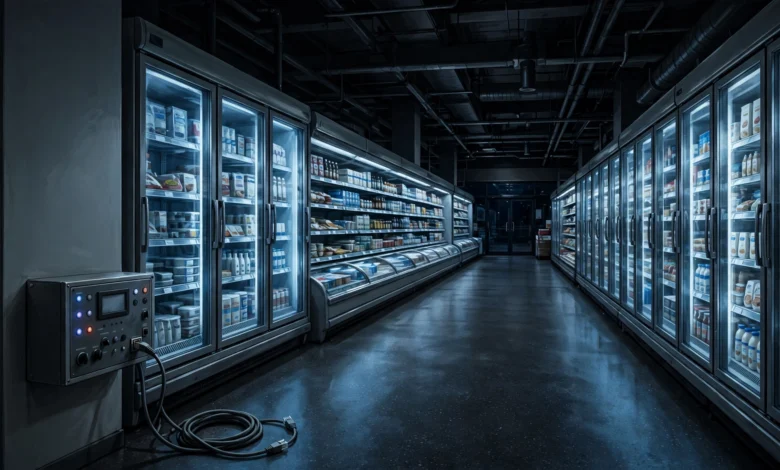
Thousands of devices controlling tens of thousands of refrigeration units were taken off the open internet, either remotely or in some cases physically. Staff were ordered to remove internet cables and monitor temperatures manually while the fix was prepared. Grocery Gazette’s report on the operation describes the same manual fallback, with employees physically unplugging cables and checking temperatures by hand.
A worker at one large chain described the effort as a race against time, with hundreds of devices taken offline every day over the course of a week. The worker warned that warehouses holding millions of pounds’ worth of food could have faced severe business interruption and supply chain problems if hackers had found the method first. The NCSC declined to comment on the report.
Why RDM Disputes How Serious the Flaw Was
RDM has disputed the severity of the vulnerability. Its chief executive, Ged Evans, said the company moved quickly to address the concerns, releasing initial security updates and contacting customers with advice on protecting their equipment, and the company says there is no evidence that hackers exploited the vulnerability in its controllers.
The manufacturer argues that the researchers’ findings involved testing that went beyond normal procedures, including dismantling its hardware, and that exploiting the flaw would have required physical access to a piece of hardware. Pen Test Partners, by contrast, treated the risk as urgent enough to justify disconnecting controllers at scale before the firmware fix arrived.
Both positions can be read from the same facts: a flaw was found, controllers were taken offline, and new firmware was issued. Whether any British RDM controller was actually exploited before the fix is not publicly verified, and RDM’s statement that it has seen no evidence of exploitation is the only position on record.
What Shoppers and Smaller Food Firms Still Need to Watch
Pen Test Partners says the immediate threat has largely been addressed, but smaller businesses operating refrigeration equipment could still be exposed. Food manufacturers, cold storage warehouses and other firms further down the supply chain may not yet have received the necessary alerts, which is why the operation’s secrecy is now giving way to public warnings.
Some British suppliers were hit even while the big supermarkets escaped. London-based wholesaler Langridge Organic reported that six of its 10 refrigeration units had been compromised, and the Association of Independent Meat Suppliers confirmed incidents affecting several members. The pattern matches the cold-chain failures behind the Kayem Foods meat recall in the United States, where a warehouse cooling failure alone was enough to force a Class I recall.
The warning has also crossed the Atlantic. In the United States, a joint advisory published on Thursday, 5 November 2026 by agencies including the Cybersecurity and Infrastructure Security Agency and the FBI warned that attackers were targeting commercial refrigeration controllers in retail grocery and cold storage facilities, and recommended keeping controller panels off the public internet. British shoppers faced a run of official safety notices this month, from the Toyota recall over airbag inflators to this fridge operation, and the practical lesson is the same: the official notice, not the rumour, decides what to do.
Questions Readers Are Asking About the Fridge Operation
Was there a UK supermarket fridge cyber attack?
There was a UK supermarket fridge cyber attack risk serious enough to trigger a secret national operation, but no mass attack on British supermarket fridges has been reported. Attacks did hit France in October and at least seven European countries in November 2026, and some British food suppliers reported compromised units.
Which fridges were at risk?
Commercial fridges and freezers controlled by internet-connected Resource Data Management controllers in supermarkets, warehouses, restaurants, petrol stations and stadiums. Thousands of controller devices, covering tens of thousands of refrigeration units, were taken off the open internet.
Has the flaw been fixed?
A fix has been developed and rolled out, and RDM has released initial security updates and new firmware. Pen Test Partners says the issue has been largely mitigated, though smaller cold-chain operators may still be exposed if their controllers remain online.
Was any food in British supermarkets spoiled by hackers?
No spoilage in major British supermarkets has been reported from this flaw. In Europe, hackers remotely changed temperatures and triggered defrost cycles, forcing businesses to throw away large quantities of food, with some units reaching 50C.
Who was behind the European fridge hacks?
France attributed the October attacks in France to a cyber unit it linked to Iran’s Revolutionary Guards, and Iran rejected the accusation. No attribution for the November wave has been settled in public reporting, so the actor behind those attacks is not publicly verified.
Claims Worth Checking Before Sharing
Claim: “Hackers emptied British supermarket fridges.” No such mass incident has been reported. The UK story is a preventive operation: controllers were disconnected and patched after a flaw was found, following real attacks in Europe.
Claim: “The UK was safe because it uses different fridges.” That was the early assumption, and it was wrong. The UK largely escaped the first attacks because it uses RDM rather than Danfoss controllers, but researchers then found a separate flaw in the RDM systems.
Claim: “RDM fridges were definitely hacked in Britain.” Not publicly verified. RDM says there is no evidence its controllers were exploited, and no independent confirmation of a successful UK exploitation has been published.