EasyJet Flight U24429 Emergency: What Really Happened Over Lyon
A routine Lyon-to-Porto journey turned into a mid-air security crisis after a passenger in an acute psychotic state attempted to storm the cockpit — here is the full account of what unfolded, and why it matters.


*Disclaimer: We may earn a commission if you make a purchase through our affiliate links, at no extra cost to you.
📋 Quick Facts
Flight Number
EasyJet U24429 (EJU4429)
Date of Incident
22 August 2025
Route
Lyon (LYS) → Porto (OPO)
Aircraft
Airbus A320 (Reg. OE-IJL)
Emergency Code
Squawk 7700 (General Emergency)
Cause
Passenger — Airsickness & Acute Psychosis
Altitude at Diversion
20,000 feet
Outcome
Safe Landing — No Injuries Reported
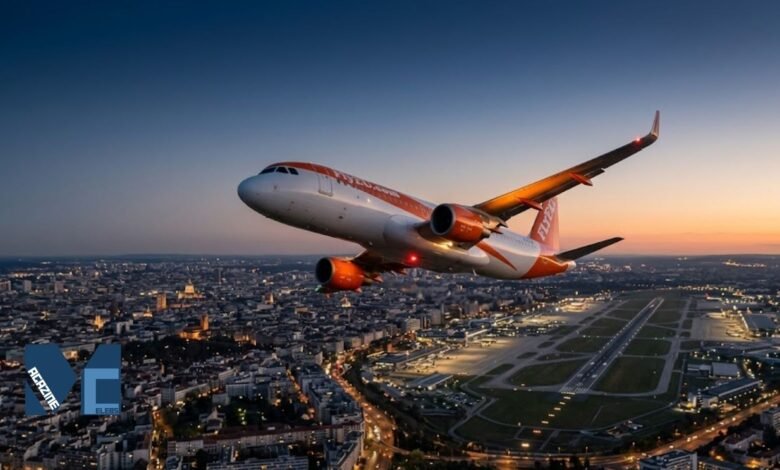
EasyJet flight U24429 declared an in-flight emergency on 22 August 2025, shortly after departing Lyon Saint-Exupéry Airport bound for Porto, Portugal. The Airbus A320 registered OE-IJL stopped its climb at 20,000 feet after a passenger in an acute psychotic state attempted to force entry into the cockpit. The crew transmitted squawk 7700 — the universal distress signal — and turned the aircraft back toward Lyon, where it landed safely on runway 35R approximately 45 minutes after departure. French police and medical teams met the aircraft at a remote stand. No injuries were reported among passengers or crew.
The incident drew swift attention from aviation tracking communities and safety commentators, not because the outcome was catastrophic — it was not — but because of how quickly a standard European short-haul service became a high-stakes security event. What made U24429 notable was the combination of a medical episode and a cockpit access attempt, two of the most serious categories of in-flight disruption that cabin crews are trained to intercept.
EasyJet confirmed the diversion in an official statement, noting that once the passenger was removed by police on arrival, the flight continued to Porto that same evening. The episode has since become a frequently cited case study in discussions around in-flight mental health emergencies, passenger restraint protocols, and the broader rise in disruptive behaviour on commercial aircraft since 2020.
The Route and Aircraft: Lyon to Porto
The Lyon–Porto route is a routine short-haul service covering roughly 1,350 kilometres, typically flown in under two hours. EasyJet operates this corridor as part of its wider Western European network, with Lyon Saint-Exupéry Airport serving as one of the airline’s key French bases. Flight U24429 on 22 August 2025 was already running approximately one hour behind schedule when it pushed back from the gate, departing at 18:34 local time on runway 35L. It was a Friday evening in late summer — one of the busiest periods in European air travel — and the aircraft was in normal operational condition.
The Airbus A320 involved, registered OE-IJL, is a narrow-body twin-engine jet that forms the backbone of easyJet’s European fleet. With a typical seating capacity of around 180 passengers in an all-economy configuration, the A320 is one of the most widely operated commercial aircraft in the world. There was nothing in the aircraft’s condition or the weather environment that contributed to the emergency — this was an incident driven entirely by events inside the cabin.
The Passenger at the Centre of the Incident
French police confirmed following the landing that the disruption was caused by a 26-year-old Portuguese national travelling on the flight. Medical examinations conducted after his removal from the aircraft revealed he was suffering from a combination of airsickness and an acute psychotic disorder, which had placed him in a state of delirium. According to reports from Travel Tomorrow and AIRLIVE, shortly after takeoff he began exhibiting erratic behaviour and then attempted to force his way into the cockpit. Cabin crew, supported by other passengers, physically restrained the individual. No injuries were recorded among those who intervened. The man was taken to hospital for further evaluation after police took him into custody at Lyon.
Timeline: Key Milestones of the U24429 Emergency
18:34 CEST — 22 Aug 2025
EasyJet U24429 departs Lyon Saint-Exupéry Airport on runway 35L, already running one hour behind schedule. Aircraft is an Airbus A320 registered OE-IJL. Destination: Porto, Portugal.
Shortly After Departure
A 26-year-old Portuguese passenger begins exhibiting severely disruptive behaviour consistent with acute psychosis and airsickness. He moves toward the cockpit area and attempts to gain entry. Cabin crew and fellow passengers intervene and physically restrain him.
At 20,000 Feet
Pilots halt the climb and broadcast squawk 7700 — the international general emergency code — alerting air traffic control to the developing situation onboard. ATC clears airspace and grants priority return routing to Lyon.
19:19 CEST — Aircraft Lands
U24429 lands on runway 35R at Lyon Saint-Exupéry, 45 minutes after departure. Emergency crews are on standby. The aircraft is directed to a remote stand to allow police and medical teams to board without disruption to the main terminal.
Post-Landing
French police take the disruptive passenger into custody. Medical examination confirms airsickness combined with acute psychotic disorder. The man is transported to hospital for evaluation.
Later That Evening
EasyJet confirms in an official statement that once the passenger was removed by police, flight U24429 continued to Porto. Remaining passengers reached their destination the same night. No injuries to crew or passengers were reported.
💜 Why This Matters
For the passengers on board that Friday evening, a two-hour trip to Porto turned into something considerably more unsettling — a reminder that commercial aviation, for all its routine reliability, rests on the split-second decisions of a handful of trained professionals. The U24429 incident did not end in tragedy precisely because those professionals responded without hesitation. But it also surfaces a question the industry has been wrestling with for years: as mental health crises and post-pandemic behavioural incidents rise on commercial flights, are current protocols enough to protect both passengers and crew? The answer matters not just to aviation insiders, but to anyone who boards a plane.
How the Crew Responded: Aviation Protocols in Action
The cabin crew’s handling of the U24429 emergency reflects precisely the kind of high-pressure training that airlines invest in but passengers rarely see exercised. When a passenger moves aggressively toward the flight deck, the crew’s first obligation is to prevent access — not to diagnose the cause. In this case, flight attendants acted without waiting for the situation to escalate further, enlisting the help of other passengers to physically restrain the individual. That kind of coordinated response inside a pressurised cabin moving at several hundred kilometres per hour requires training, nerve, and clear communication.
Simultaneously, the pilots in the cockpit — who remain behind a reinforced, locked door during flight under post-9/11 security regulations — were receiving real-time updates from the cabin crew and making their own assessment. Their decision to declare a general emergency and initiate an immediate return to Lyon rather than diverting to a closer airport or attempting to continue to Porto reflects the standard operating logic: when cockpit security is at risk, land as soon as safely possible. Squawk 7700 ensured they had full priority from air traffic control the moment the code was transmitted.
Passenger accounts cited in subsequent reporting described the cabin crew as composed and communicative throughout, keeping the rest of the aircraft calm while the situation was being managed. According to accounts from witnesses in similar high-pressure public incidents, the presence of authoritative, controlled communication dramatically reduces panic — a point aviation psychologists emphasise when analysing disruptive passenger events. The 45-minute gap between departure and landing left little room for anything other than decisive action, and the crew delivered it.
The Broader Picture: Unruly Passengers and Aviation Safety Trends
The U24429 incident did not occur in isolation. It lands in the middle of a well-documented surge in disruptive passenger reports across European and global aviation. The International Air Transport Association (IATA) has tracked a marked increase in unruly passenger incidents since 2020, with reported data indicating that disruptive events in 2022 occurred at a rate of approximately one per 568 flights — compared to one per 835 flights before the pandemic. That shift represents a substantial change in the operating environment for cabin crews on any given day.
Cases involving cockpit access attempts, however, remain genuinely rare. Most disruptions involve verbal altercations, alcohol-related behaviour, or non-compliance with safety instructions. Attempts to reach the flight deck push into a different category entirely — one that triggers immediate emergency protocols regardless of the apparent reason behind the behaviour. The security architecture introduced after 2001, including reinforced cockpit doors and strict access protocols, was designed precisely to prevent incidents like this from escalating further.
Mental health-related in-flight incidents are a distinct and growing subcategory within the broader disruption data. The combination of altitude, confined space, sensory stress, and the inability to leave creates conditions that can accelerate deterioration in passengers who may already be vulnerable. For airlines, this creates a genuine operational challenge: the responsibility to manage safety onboard does not come with the authority to screen passengers for psychological vulnerability before boarding, and most episodes of this nature emerge without warning. The U24429 case is typical in that respect — nothing about the passenger’s outward presentation before boarding could have predicted the severity of what occurred in the air, according to available reports. More broadly, the relationship between physical illness and psychological episodes is more complex than it might appear, particularly under the physiological stress of flight.
📊 Unruly Passenger Incidents — Key Aviation Safety Metrics
Note: Pre-pandemic and 2022 incident rate figures are sourced from IATA reporting as cited by Travel Tomorrow. Cockpit attempt and mental health percentages are estimated based on available industry commentary and do not represent verified IATA statistical categories.
“Flight EJU4429 from Lyon to Porto returned to Lyon shortly after take-off due to the behaviour of a passenger onboard. The flight was met by police on arrival and once the passenger was removed by police, the flight continued onto Porto.”
— EasyJet, Official Statement, August 2025
What Squawk 7700 Actually Means — and Why It Was the Right Call
When the pilots of U24429 selected squawk 7700 on their aircraft’s transponder, they were doing something that carries genuine weight across the aviation system. Transponder code 7700 is the universally recognised general emergency signal — distinct from 7500 (hijack) and 7600 (radio failure) — and its transmission immediately alerts every air traffic control facility monitoring that section of airspace. The effect is almost instantaneous: surrounding traffic is rerouted, the affected aircraft is given absolute priority for descent and landing, and ground emergency services at the destination airport are placed on standby.
Declaring an emergency is not a decision pilots make lightly, precisely because of the operational cascade it triggers. In the case of U24429, the declaration was entirely appropriate: a passenger had attempted to breach the cockpit, crew members were physically restraining an individual in an acute psychotic state, and the flight could not safely continue with the situation unresolved. The formal emergency designation ensured that Lyon controllers had the full picture and could clear the aircraft straight back in without delay. That speed — 45 minutes from departure gate back to touchdown — reflects how efficiently the system works when communication is clean and decisions are made without hesitation.
It is worth noting that not every squawk 7700 declaration ends with a dramatic outcome. The code can be selected for a wide range of situations, including medical emergencies among passengers, severe turbulence injuries, fuel concerns, and pressurisation issues. The aviation community generally treats the willingness to declare an emergency as a sign of good crew resource management, not of failure. In the U24429 case, it was the mechanism that transformed an escalating threat into a controlled resolution. Passengers interested in understanding how aviation handles broader emergency classification systems and their real-world implications will find that the codes embedded in everyday operations carry far more procedural weight than most travellers ever appreciate.
Where Things Stand Now
EasyJet has not publicly released any further operational changes or statements specifically arising from the U24429 incident beyond confirming the diversion and its resolution. The airline’s existing protocols — including crew de-escalation training, passenger restraint procedures, and cockpit security measures — are aligned with European Union Aviation Safety Agency (EASA) requirements and reflect the broader regulatory framework that governs commercial operations across the continent.
The 26-year-old Portuguese passenger was transported to hospital for medical evaluation following his removal from the aircraft. No further public information on any legal proceedings has been confirmed at the time of this article’s publication. French law provides for prosecution of passengers who physically attempt to access an aircraft’s flight deck or assault crew members, but the extent to which his medical condition affects any such proceedings has not been publicly disclosed.
For the wider industry, the U24429 case continues to be referenced as a useful example in discussions about how airlines handle the intersection of mental health crises and aviation security. The IATA Working Group on Unruly Passengers has been actively engaged with member airlines on revising reporting frameworks and improving pre-boarding identification tools, though systematic screening for psychological vulnerability remains ethically and practically complex. What the U24429 incident demonstrated — and what remains its most significant legacy for aviation safety professionals — is that when crew training, passenger cooperation, and ATC coordination operate in concert, even a fast-deteriorating situation can be resolved without a single injury. That outcome is not automatic. It is practised.
✨ EasyJet Flight U24429 — At a Glance
Time to Emergency Landing
45 Minutes
Emergency Code Activated
Squawk 7700
Injuries Reported
Zero
Flight Completed?
Yes — Porto Same Evening
❓ Frequently Asked Questions
What happened on EasyJet flight U24429?
EasyJet flight U24429 declared an in-flight emergency on 22 August 2025, shortly after departing Lyon for Porto. A 26-year-old Portuguese passenger experiencing airsickness and an acute psychotic episode attempted to enter the cockpit. Cabin crew and passengers restrained him. The pilots broadcast squawk 7700 and returned to Lyon, landing safely 45 minutes after departure. No injuries were reported, and the flight continued to Porto that evening.
What does squawk 7700 mean on a flight?
Squawk 7700 is the internationally recognised transponder code for a general aircraft emergency. When a pilot selects this code, it alerts all air traffic control facilities in range that the aircraft requires immediate priority handling. It does not necessarily mean a crash is imminent — it signals that the crew needs priority routing, airspace clearance, or emergency ground services on standby. It is distinct from squawk 7500 (hijack) and 7600 (radio failure).
Why did EasyJet U24429 return to Lyon instead of continuing to Porto?
The pilots chose to return to the departure airport because the passenger had attempted to access the cockpit — one of the most serious in-flight security threats under current aviation regulations. Continuing a roughly two-hour flight with a physically restrained and medically unstable passenger in an acute psychotic state was not operationally viable. Returning to Lyon allowed police and medical teams to intervene quickly, and the remaining passengers ultimately reached Porto the same evening.
Was the EasyJet U24429 emergency caused by a technical fault?
No. The Airbus A320 registered OE-IJL was in normal operational condition throughout. The emergency was caused entirely by passenger behaviour — specifically, a disruptive individual suffering from airsickness and acute psychosis who attempted to enter the cockpit. There were no reported mechanical failures, weather issues, or structural concerns with the aircraft itself.
Are disruptive passenger incidents on flights becoming more common?
Yes, according to IATA data. The rate of disruptive passenger incidents rose from approximately one per 835 flights before the Covid-19 pandemic to one per 568 flights in 2022 — a significant increase. Airlines and regulators have responded with enhanced crew training, stricter enforcement policies, and cross-border information-sharing on banned passengers. Incidents involving cockpit access attempts remain rare within this broader trend, but are treated as the highest-priority category.
What happened to the passenger involved in the U24429 incident?
French police took the 26-year-old Portuguese national into custody upon landing at Lyon. Medical examinations confirmed he was suffering from airsickness and an acute psychotic disorder, and he was transported to hospital for further evaluation. No injuries were reported among crew or other passengers. The specific details of any subsequent legal proceedings have not been publicly confirmed at the time of publication.
Final Thoughts
The EasyJet U24429 emergency will not be remembered as an aviation disaster — because it was not one. What it will be remembered for, at least in professional circles, is a clean demonstration of how the system is supposed to work: a crew that made fast decisions without hesitation, pilots who chose caution over schedule, air traffic controllers who cleared the path, and ground teams who were ready the moment the wheels touched runway 35R. The 45-minute turnaround from departure to safe landing is, in a sense, the story — not the crisis itself, but the speed and competence with which it was resolved.
That said, the incident does point to something unresolved. Commercial aviation has developed extraordinarily sophisticated tools for managing mechanical failure and environmental hazard. The human element — specifically, what happens when a passenger boards in a psychological state that cannot be assessed from the outside — remains far more difficult to manage systematically. Mental health-related disruptions mid-flight are an operational reality that airlines are increasingly confronting without adequate pre-boarding tools to address them. The U24429 passenger was, by all accounts, physically ill and in acute psychological distress; nothing about the pre-boarding process would likely have flagged the severity of what was about to unfold.
For passengers, this story ends reassuringly — everyone reached Porto, no one was hurt, and the professionals did their jobs. For the industry, it is one more data point in a growing body of evidence that in-flight human factors deserve the same rigorous systematic attention that engine reliability and airspace management have received for decades. The sky, as U24429 demonstrated, is well managed. The cabins beneath it are getting harder.
📚 Sources & References
- AIRLIVE — EasyJet flight U24429 declares emergency after departure from Lyon, August 2025
- Travel Tomorrow — EasyJet flight does U-turn after passenger in psychotic state tries to enter cockpit, August 2025
- NewsAtrack — EasyJet Flight U24429 Emergency: How a Routine Lyon-to-Porto Journey Turned Into a Mid-Air Security Incident
- Flex Magazines — EasyJet Flight U24429 Emergency Incident Details and Timeline
- Quick Blogs — EasyJet Flight U24429 Emergency: What Happened Mid-Air and Why It Matters for Aviation Safety
All sources verified at time of publication. Links subject to change.
Hassan Ali
Senior Features & Research Writer
Hassan Ali is a features and research writer covering news analysis, aviation safety, and public interest investigations. His work focuses on separating verified fact from speculation, drawing on primary sources to produce accurate, readable long-form content for general and specialist audiences.
⚠️ Editorial Disclaimer
This article is intended for informational purposes only. All facts have been sourced from publicly available information at the time of publication, including reports from AIRLIVE, Travel Tomorrow, and EasyJet’s own official statement. Where data could not be independently verified — including statistical estimates relating to mental health incident subcategories — this has been clearly noted. The views expressed reflect editorial analysis and do not constitute legal, medical, or aviation safety advice.