
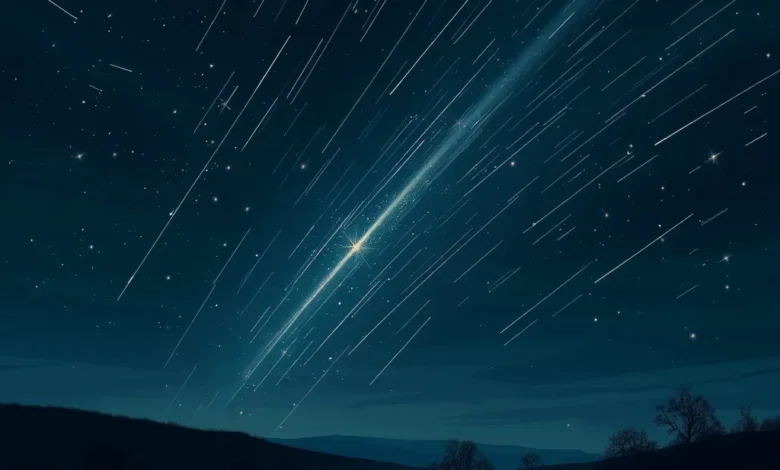
Leonid Meteor Shower Peaks Tonight: When and How to Watch the November 2026 Display

The Leonid meteor shower reaches its peak on the night of Tuesday 17 November into the early hours of Wednesday 18 November 2026, with NASA recommending the hours after midnight and before dawn, once the first-quarter Moon has set. Under ideal dark skies, observers could see around 15 meteors an hour, although most viewers will see fewer. The shower stays active from 6 to 30 November, and every Leonid is a speck of dust shed by Comet 55P/Tempel-Tuttle.
Leonid Meteor Shower 2026 — Quick Reference Summary
| Peak night | Night of 17–18 November 2026; IMO maximum 23:45 UTC on 17 November. |
| Best viewing window | After midnight until dawn on 17 and 18 November, after moonset. |
| Expected rate | Around 15 meteors per hour under ideal dark skies; fewer for most viewers. |
| Active dates | 6–30 November 2026. |
| Radiant | Constellation Leo, near the bright star Regulus. |
| Parent comet | 55P/Tempel-Tuttle, which orbits the Sun about every 33 years. |
| Meteor speed | About 71 kilometres per second (44 miles per second). |
| Moon phase | First quarter on 17 November; sets around midnight. |
| Storm expected? | No — a modest annual display, not a storm year. |
Why the Early Hours of 18 November Are the Ones to Catch
The exact peak moment is one of the few things the experts describe slightly differently. The International Meteor Organization places the regular maximum at 23:45 UTC on 17 November, EarthSky, citing the American Meteor Society, lists midnight UTC on 18 November, and NASA’s own Leonids page calls the night of 16–17 November the peak night. The practical advice is the same in every version: watch in the dark hours before dawn on both 17 and 18 November, after the Moon has set. The first-quarter Moon is about half lit on 17 November and drops below the horizon around midnight, leaving the sky dark for the prime window. That timing is what makes this year a good one for the Leonids, even though the shower itself is modest.
Where the Shooting Stars Come From
The Leonids are debris left behind by Comet 55P/Tempel-Tuttle, a comet with a solid core only about 3.6 kilometres (2.24 miles) across that returns to the Sun’s neighbourhood roughly every 33 years. Each November, Earth crosses the comet’s dust trail, and the particles strike the atmosphere at about 71 kilometres per second, among the fastest of any annual shower. That speed is why Leonids are known for bright, swift streaks that often leave glowing trains behind them. The same stream produced the famous storm of 1833, when witnesses put the rate at more than 100,000 meteors an hour and many people thought the sky was falling, and another great storm in 1966. The most recent Leonid storm came in 2002, and scientists do not expect a storm in 2026, so tonight’s show is a steady annual display rather than a once-in-a-generation event. The comet’s next close pass by the Sun is due in 2031.
How to Watch Without Any Equipment
No telescope or binoculars are needed, and the naked eye is the best instrument for a meteor shower. Get away from city lights if you can, give your eyes about 30 minutes to adjust to the dark, and dress for the cold, because the best hours are the coldest ones. The meteors appear to radiate from the constellation Leo, near the star Regulus, which rises around midnight and climbs until dawn. Look about 30 to 45 degrees away from Leo, toward Ursa Major, Gemini, or high overhead, because meteors further from the radiant tend to look longer and more dramatic. As a bonus this week, Mars and Jupiter sit close together in Leo near their closest approach on 16 November, so the patch of sky you are watching holds two bright planets as well.
What Else November’s Night Sky Holds
The Leonids are not the only show this month. The Southern Taurids, known for bright fireballs, peaked around 5 November, and the Northern Taurids peaked around 12 November, so a stray fireball is still possible on a clear night. Looking ahead, a full supermoon rises on the evening of 24 November, the first in a run of three consecutive supermoons spanning November, December and January. November’s sky, in other words, rewards anyone willing to step outside after dark, and tonight’s Leonids are the first of its three headline events.
Frequently Asked Questions
Q: What time is the Leonid meteor shower tonight? A: The best hours are after midnight until dawn on Wednesday 18 November, local time, once the Moon has set. The early hours of Tuesday 17 November were also worth watching.
Q: How many meteors will I see per hour? A: Under ideal dark skies, around 10 to 15 an hour. Most viewers will see fewer, and NASA cautions that the ideal figure is a best case rather than a promise, so expect a handful of bright streaks rather than a constant rain.
Q: Do I need a telescope to see the Leonids? A: No. The shower is best watched with the naked eye, taking in as much sky as possible. Binoculars and telescopes narrow the view and make meteors harder to catch.
Q: Will the Moon spoil the view this year? A: Not much. The Moon reaches its first-quarter phase on 17 November and sets around midnight, just as the best viewing begins, leaving the sky dark for the prime hours.
Q: Why are the Leonids so fast? A: Leonid particles hit the atmosphere at about 71 kilometres per second, or 44 miles per second, making them among the fastest meteors of the year. That speed produces the bright streaks and glowing trains the shower is known for.