
What Is a Truffle? The Complete Guide to the World’s Most Expensive Food
From the forest floor to fine dining tables — and from chocolate boxes to Michelin-starred kitchens — truffles carry a mystique that few foods can match. Here's everything you need to know.


*Disclaimer: We may earn a commission if you make a purchase through our affiliate links, at no extra cost to you.
📋 Quick Facts
Classification
Subterranean Fungus (Ascomycete)
Most Prized Variety
White Alba Truffle (Tuber magnatum)
Price Range (White)
£2,500–£5,000+ per kg
Harvest Season
Oct–Dec (White) / Nov–Mar (Black)
Primary Origins
Italy, France, Spain, Australia
Key Compound
Androstenol (pheromone-like aroma)
Chocolate Truffle Origin
France, 1895 — Louis Dufour
Related Kingdom
Fungi — not plant, not animal
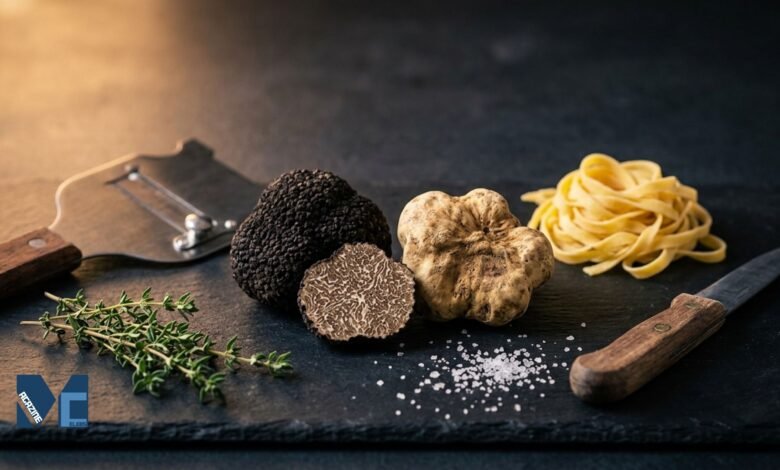
A truffle is a type of subterranean fungus belonging to the genus Tuber, prized across centuries of European gastronomy for its intensely aromatic flesh and near-impossible cultivation. It grows underground in close symbiosis with the roots of specific trees — oak and hazel being the most common hosts — and must be hunted, not farmed in any conventional sense. There are dozens of species, but two stand above all others in culinary importance: the white truffle of Alba in northern Italy, and the black Périgord truffle of southern France. Both are rare, seasonal, and expensive enough to change the bill at a restaurant by several orders of magnitude.
The word itself splits into two very different meanings depending on context. Ask a chef in Lyon, and a truffle is that knobbled, dark fungus shaved over pasta. Ask someone at a chocolatier’s counter in Brussels, and a truffle is a rolled ganache ball dusted in cocoa powder — soft, bittersweet, and named entirely for its resemblance to the real thing. These two meanings coexist in everyday language, occasionally creating genuine confusion, but the underlying logic is consistent: both carry connotations of luxury, indulgence, and a certain unmistakable richness.
Understanding what truffles actually are — biologically, culturally, and economically — matters more now than it did a decade ago. Global demand has surged, driven partly by social media, partly by the rise of accessible fine dining, and partly by a broader shift in food culture toward provenance and premium ingredients. As supply struggles to keep pace, the truffle market has become one of the more volatile and fascinating corners of the food economy. Because handling such exquisite and costly ingredients requires absolute precision in the kitchen, strict adherence to safety protocols and ServSafe Food Temperatures is critical for culinary professionals to preserve their delicate profile. This guide covers all of it.
The Biology Behind the Mystique
Truffles are not mushrooms in the common sense, though they belong to the same kingdom of fungi. The distinction matters: while most mushrooms fruit above ground, truffles develop entirely below the soil surface, producing what mycologists call a “hypogeous” fruiting body. They are classified within the phylum Ascomycota — the sac fungi — and reproduce via spores contained within a dense, wrinkled interior flesh called the gleba. That characteristic marbled interior, with its network of pale veins against darker flesh, is what separates a true truffle from other underground fungi.
The relationship between a truffle and its host tree is mycorrhizal — a mutually beneficial exchange in which the fungus attaches to tree roots and trades mineral nutrients for sugars produced by photosynthesis. This is why truffles cannot simply be grown in pots or isolated environments. They need the tree, the specific soil chemistry, the local climate, and a waiting period that stretches across years. Inoculated saplings planted with truffle spores may take seven to fifteen years before producing a first harvest, and yields remain unpredictable even then. France’s black truffle production has declined from roughly 2,000 tonnes annually in the early twentieth century to somewhere between 30 and 50 tonnes in recent decades, according to data cited by the French Ministry of Agriculture — a collapse driven by rural depopulation, changing land use, and climate disruption.
The aroma of a fresh truffle is one of the most studied and debated in food science. It involves a complex cocktail of volatile organic compounds, but one in particular — a steroid called androstenol — has attracted sustained research attention. Androstenol is structurally similar to certain mammalian sex pheromones, which helps explain why pigs were traditionally used to locate truffles underground: the animals were instinctively drawn to the scent. Today, trained dogs have largely replaced pigs in professional truffle hunting, largely because they are easier to handle and less likely to eat the product before it can be retrieved.
The Key Species: White, Black, and Everything Between
The white truffle (Tuber magnatum pico), harvested from October to December in the Langhe and Monferrato regions of Piedmont, Italy, is the variety commanding the highest prices. Its exterior is pale ochre or yellowish-brown, and its aroma is commonly described as garlicky, musky, and honeyed — with a penetrating intensity that cannot be replicated by truffle oil, which typically uses synthetic 2,4-dithiapentane rather than actual truffle extract. White truffles cannot be cooked; the heat destroys their aroma compounds entirely. They are shaved raw over finished dishes — pasta, risotto, eggs — at the last possible moment.
The black truffle (Tuber melanosporum), known as the Périgord truffle after the French region most associated with its production, has a rougher, pyramid-patterned black exterior and a more complex, earthier aroma. Unlike its white counterpart, it responds reasonably well to gentle heat, making it more versatile in cooking. It is this variety most commonly found in truffle butter, truffle sauces, and shaved over dishes at restaurants where white truffle would be beyond the budget. The black truffle season runs roughly from November to March. Spain — particularly Sarrión in the Teruel province — has in recent years become a significant black truffle producer, with some estimates placing Spanish output above that of France.
Other commercially relevant species include the summer truffle (Tuber aestivum), milder and far more affordable, and the Burgundy truffle (Tuber uncinatum), which is often considered the same species as the summer truffle despite regional naming conventions. Australia has developed a meaningful truffle industry since the 1990s, producing black Périgord truffles whose Southern Hemisphere season fills the gap when European supply runs dry — a fact that has made Australian truffles a significant commercial asset for export to Asian markets.
Timeline: Truffles Through History
Ancient World
Truffles are recorded in the culinary texts of ancient Mesopotamia and referenced by Greek writers including Theophrastus, who speculated they arose from thunder and rain. Roman writers Pliny the Elder and Apicius documented their use at feasts, with Pliny noting the mystery surrounding their origin in his first-century encyclopaedia Naturalis Historia.
1500s–1700s
Truffles become fixtures of French aristocratic cuisine. By the reign of Louis XIV, black Périgord truffles are regularly served at Versailles. The truffle gains a political dimension — serving it signals access, power, and Continental refinement.
1895
French chocolatier Louis Dufour of Chambéry is credited with inventing the chocolate truffle — a ganache centre of cream and chocolate, rolled in cocoa powder to mimic the appearance of a freshly dug fungus. The confection spreads rapidly through French and Belgian chocolate culture.
1970s–1990s
European black truffle production collapses by over 90% from its early-century peak. Meanwhile, Australian researchers begin experimenting with inoculated hazelnut and oak seedlings. By the mid-1990s, the Southern Hemisphere’s first commercial truffle harvests are confirmed, opening entirely new supply corridors.
2007
A 1.5 kilogram white Alba truffle sells at the annual auction in Alba, Italy, for approximately €330,000 — widely reported at the time as a record. The buyer, a Macau casino owner, demonstrated the expanding appetite for prestige ingredients across Asian luxury markets.
2010s–Present
Consumer interest in truffles accelerates globally, partly driven by food media, social platforms, and the mainstreaming of truffle-flavoured products from crisps to mayonnaise. Simultaneously, the market faces growing scrutiny over fraudulent labelling and the widespread use of artificial truffle flavouring in “truffle” products that contain no actual fungus.
💜 Why This Matters
The truffle represents something genuinely unusual in the modern food economy: an ingredient that cannot be industrialised. No amount of capital investment, no technology, no supply chain optimisation can reliably produce it at scale — which means the communities and ecosystems that have nurtured truffle grounds for generations hold something irreplaceable. As climate change shortens and shifts European truffle seasons, those communities face a real and documented economic pressure. The truffle is not just a luxury item; it is an ecological and cultural indicator, and what happens to it over the next fifty years will tell us something important about what we are willing to protect.
Why Are Truffles So Expensive?
The price of truffles is the product of several converging constraints, none of which are easily fixed. The fungus is seasonal, perishable, and almost entirely dependent on wild or semi-wild conditions. A white truffle begins degrading within days of harvest — its volatile aroma compounds dissipating rapidly — which means the window between ground and plate is measured in days, not weeks. This demands a supply chain that is fast, careful, and expensive to operate.
Labour costs are substantial. Truffle hunting requires trained dogs (or, more rarely, pigs), skilled handlers, and intimate knowledge of particular woodland terrain accumulated over lifetimes. Truffle grounds are closely guarded; disputes over hunting rights in truffle-producing areas of France and Italy have historically turned serious. The mycorrhizal relationship also means there is no meaningful off-season cultivation — you plant inoculated trees, manage the soil chemistry, and wait. The risk profile for a truffle producer is extraordinarily high relative to most agricultural enterprises.
Demand, meanwhile, has globalised while supply has not. The appetite for white and black truffles in Japan, China, South Korea, and the Gulf states has grown considerably since the 2000s. Luxury restaurants in these markets now compete directly with Michelin-starred establishments in Paris and London for a harvest that fluctuates year to year with rainfall and temperature. In years when the Italian summer is too dry or the French autumn too warm, prices spike sharply. According to market data reported by food trade publication Fine Dining Lovers and corroborated by Italian agronomic research bodies, white truffle prices have, in particularly poor harvest years, exceeded €5,000 per kilogram at wholesale.
What Is a Chocolate Truffle — And Why Is It Called That?
The chocolate truffle is an entirely separate category from the fungus, connected only by visual resemblance and the shared cultural weight of luxury. A classic chocolate truffle consists of a ganache centre — an emulsion of heavy cream and high-quality dark chocolate — which is rolled into a sphere and then coated in cocoa powder, melted chocolate, chopped nuts, or tempered chocolate shell. The cocoa-dusted exterior, dark and irregular, resembles the earthy, lumpy exterior of a real truffle closely enough that the naming has stuck for over a century.
Louis Dufour of Chambéry, France, is the confectioner most frequently cited as the originator of the chocolate truffle, reportedly creating the recipe around 1895 when supplies were low and improvisation was necessary. The format was adopted and refined by Belgian chocolatiers throughout the early twentieth century, where the praline tradition already placed emphasis on filled chocolate shells and ganache-based centres. Today, what constitutes a truffle candy varies significantly by country. In the United States and United Kingdom, the term often refers broadly to any filled chocolate confection of a rounded shape. In France and Belgium, more precise definitions apply, with ganache composition and coating method carefully specified.
The category has also expanded considerably. Champagne truffles, salted caramel truffles, matcha truffles, and Earl Grey truffles are now commonplace in premium gift boxes and artisan chocolate shops across the UK. Just as the culinary truffle anchors prestige dining, the chocolate truffle functions as shorthand for gifted indulgence — it is the format of choice for holiday boxes, Valentine’s collections, and any occasion where chocolate is meant to communicate thoughtfulness rather than convenience. Much like fine dining and the nutrients discussed in our guide to pistachio benefits, the chocolate truffle occupies a space where pleasure and perceived quality are inseparable.
📊 Truffle Price & Supply Breakdown (Approximate 2024–25 Market)
Note: Prices are approximate market estimates sourced from publicly reported trade data and specialist retailers. Verified annual figures are not consistently published by any central regulatory body. Prices fluctuate significantly with harvest conditions.
“The truffle is not grown. It is found — and that distinction is everything. Its value is not manufactured. It is earned by patience, by the right soil, by the right tree, by weather you cannot control.”
— AB Rehman, Senior Features & Research Writer, MagazineCelebs.co.uk
Truffles in Modern Cuisine and Culture
The truffle’s position in contemporary food culture is slightly paradoxical. On one hand, it remains the exclusive province of high-end restaurants and specialist retailers — a fresh white truffle shaved at tableside is still one of gastronomy’s most theatrical and expensive experiences. On the other, “truffle flavour” has become ubiquitous in supermarket products, from truffle oil and truffle crisps to truffle mayonnaise and truffle seasoned popcorn. The gap between these two realities is enormous and frequently misunderstood.
Most commercial “truffle oil” does not contain truffle. The dominant flavouring agent — 2,4-dithiapentane — is a synthetic compound that replicates one aromatic facet of real truffle while missing the dozens of others that compose its full sensory profile. Many food scientists and chefs, including Gordon Ramsay in several widely reported comments, have been vocal critics of truffle oil precisely because of this disconnect. Consumers who form their expectations of truffle flavour from oil-based products are often genuinely surprised by the actual thing, which is earthier, more complex, and far less pungent in the way that synthetic compounds tend to be.
Real truffle, used correctly, changes a dish in ways that are difficult to articulate without experiencing them. Shaved white truffle over a simple fried egg or buttered tagliolini creates an aromatic intensity that cooking cannot replicate or approximate — it sits across the top of the dish, warm from the plate beneath, releasing compounds in waves. It is an ingredient that rewards restraint and simplicity, and professional kitchens working with high-quality fresh truffle almost universally pair it with the most stripped-back possible preparations: eggs, butter, pasta, rice. Complexity in the base ingredient demands clarity on the plate.
For those interested in the broader world of naturally nutritious and premium whole foods, the truffle sits in an interesting position — it has historically been consumed for flavour rather than nutritional content, though research has identified genuine bioactive compounds in truffle flesh. The comparison is instructive when placed alongside other luxury food categories explored on this site, such as our deep-dive into pistachio nutrition and benefits.
Where Things Stand Now
The global truffle market is currently navigating several significant pressures simultaneously. Climate change has demonstrably disrupted production timelines in traditional European truffle regions. Italian researchers at the University of Pisa published findings in 2019 suggesting that reduced summer rainfall and higher temperatures in central Italy were contributing to smaller yields and shorter harvest windows for Tuber magnatum — a trend corroborated by growers in the field. French producers report similar patterns in the Périgord and Provence regions.
At the same time, cultivation science has advanced. Spain’s black truffle industry — centred primarily around the Sarrión area of Teruel — has grown into one of Europe’s most significant producers through systematic planting programmes initiated from the 1980s onward. The region now reportedly produces a substantial share of the world’s commercial black truffle supply, demonstrating that controlled cultivation, while still complex, is viable at scale for black but not white varieties. Research into white truffle cultivation continues, with Italian and international teams studying the mycorrhizal dynamics more precisely, but commercial-scale production of Tuber magnatum remains elusive as of 2025.
The regulatory environment around truffle labelling is also sharpening. The European Union has strengthened food origin labelling requirements, and specialist truffle retailers are increasingly required to document provenance. The Alba White Truffle Fair — held annually each October and November in Alba, Piedmont — remains the most important trade and cultural event in the truffle calendar, drawing buyers, chefs, and media from across the world and serving as the de facto price benchmark for the season.
✨ Truffles — At a Glance
Peak White Truffle Price
£5,000+/kg (bad harvest years)
French Production Decline
From ~2,000 to ~40 tonnes/yr
Cultivation Wait Time
7–15 years (inoculated trees)
Chocolate Truffle Origin
Chambéry, France — c. 1895
❓ Frequently Asked Questions
Are truffles mushrooms?
Truffles are fungi, but they are not mushrooms in the conventional sense. Mushrooms typically fruit above ground and belong to the phylum Basidiomycota. Truffles are Ascomycetes — sac fungi — and grow entirely below the soil surface. They share the same biological kingdom as mushrooms but are a biologically distinct type of fruiting body with a different structure, lifecycle, and reproductive mechanism.
Why are truffles so expensive?
Truffles are expensive because they cannot be farmed at industrial scale, grow only in specific ecological conditions, take years to produce, and degrade within days of harvest. Supply is inherently limited and weather-dependent. Meanwhile, demand from luxury restaurants and high-end food markets worldwide has grown consistently. The combination of fragile supply and expanding global demand produces the prices seen at auction and retail.
What is a black truffle?
A black truffle is most commonly Tuber melanosporum, the Périgord truffle, named after its traditional stronghold in the Dordogne region of southwest France. It has a rough, dark exterior covered in diamond-shaped warts, and an interior flesh that is dark grey-brown with white veins. Its aroma is earthy and complex, and it responds well to gentle heat, making it more versatile in cooking than the white truffle. Harvest runs from November to March.
What is a chocolate truffle made of?
A classic chocolate truffle is made from a ganache centre — an emulsion of dark chocolate and heavy cream, sometimes with added butter, alcohol (such as cognac or rum), or flavourings. This ganache is chilled until firm, then rolled by hand into spheres and coated in cocoa powder, melted chocolate, crushed nuts, or tempered chocolate. The name comes from the visual resemblance to the knobbly, cocoa-dusted exterior of a real culinary truffle.
What is inside a truffle (the fungus)?
Inside a culinary truffle is a dense, firm flesh called the gleba, characterised by a marbled appearance — pale veins running through darker tissue. This interior contains the spores responsible for reproduction, along with the volatile aromatic compounds that give each truffle species its distinctive scent. The pattern of veining and the colour of the flesh vary by species and are used by experts to assess quality and provenance.
What is a truffle candy?
A truffle candy is the American and broadly English-language term for a chocolate truffle — a confection consisting of a soft ganache centre coated in chocolate, cocoa, or nuts. The term is used particularly in the United States, where it distinguishes this type of filled chocolate from other candy formats. The word “truffle” in this context refers entirely to the visual resemblance to the fungal truffle, not any use of actual truffle as an ingredient.
Final Thoughts
The truffle, in both its forms, occupies an unusual position: it is simultaneously one of the most sought-after ingredients on Earth and one of the most frequently misrepresented. Whether you are looking at the ancient, difficult fungus hunted from beneath oak roots on a cold November morning in Piedmont, or at a ganache ball rolled in cocoa powder in a Christmas gift box, the word carries weight far beyond its physical form. Both versions communicate luxury, care, and a particular kind of pleasure that is harder to shortcut than most.
For the culinary truffle, the coming decades will be defined by ecological pressure. Climate models consistently suggest that the Mediterranean conditions under which black and white truffles thrive are shifting northward and becoming less stable. This has real consequences — for traditional producing communities, for the restaurants whose menus depend on fresh supply, and for the broader food culture that has built so much symbolic weight around an ingredient that cannot simply be replicated in a laboratory. The synthetic truffle oil aisle in the supermarket exists precisely because real truffle cannot scale. That gap between the authentic and the approximate is, in its way, a story about what we value and what we are willing to lose.
For the chocolate truffle, the trajectory is different but no less interesting. The format has become a canvas for artisan chocolatiers pushing boundaries of flavour pairing, provenance, and ethical sourcing — single-origin cacao ganaches, unexpected botanical infusions, and transparent ingredient stories have transformed what was once a fairly uniform confection into a genuinely varied category. Whether you are exploring the food science behind naturally powerful ingredients like pistachios or trying to understand what separates a genuine truffle experience from its many imitators, the underlying question is the same: does the real thing still matter, and can you still find it?
📚 Sources & References
- Fine Dining Lovers — What Is a Truffle? (S.Pellegrino Group)
- Encyclopædia Britannica — Truffle (Fungus)
- ScienceDirect — Volatile Compounds and Aroma Chemistry of Truffles, Food Chemistry (2019)
- The Guardian — Truffles: The Diamond of the Kitchen (2019)
- Fiera del Tartufo — Alba White Truffle Fair (Official Site)
- French Ministry of Agriculture — Agricultural Production Statistics (official)
All sources verified at time of publication. Links subject to change.
AB Rehman
Senior Features & Research Writer
AB Rehman is a features and research writer covering food culture, lifestyle, and explainer topics. His work focuses on separating verified fact from speculation, drawing on primary sources to produce accurate, readable long-form content for general and specialist audiences. He writes regularly for MagazineCelebs.co.uk on subjects ranging from celebrity biography to culinary deep-dives and health and lifestyle topics.
⚠️ Editorial Disclaimer
This article is intended for informational purposes only. All facts have been sourced from publicly available information at the time of publication. Where data could not be independently verified, this has been clearly noted. Price estimates are approximations based on reported trade data and specialist retailer listings and should not be used for commercial purchasing decisions. The views expressed reflect editorial analysis and general knowledge and do not constitute culinary, medical, or financial guidance.